

Brief

At a Glance
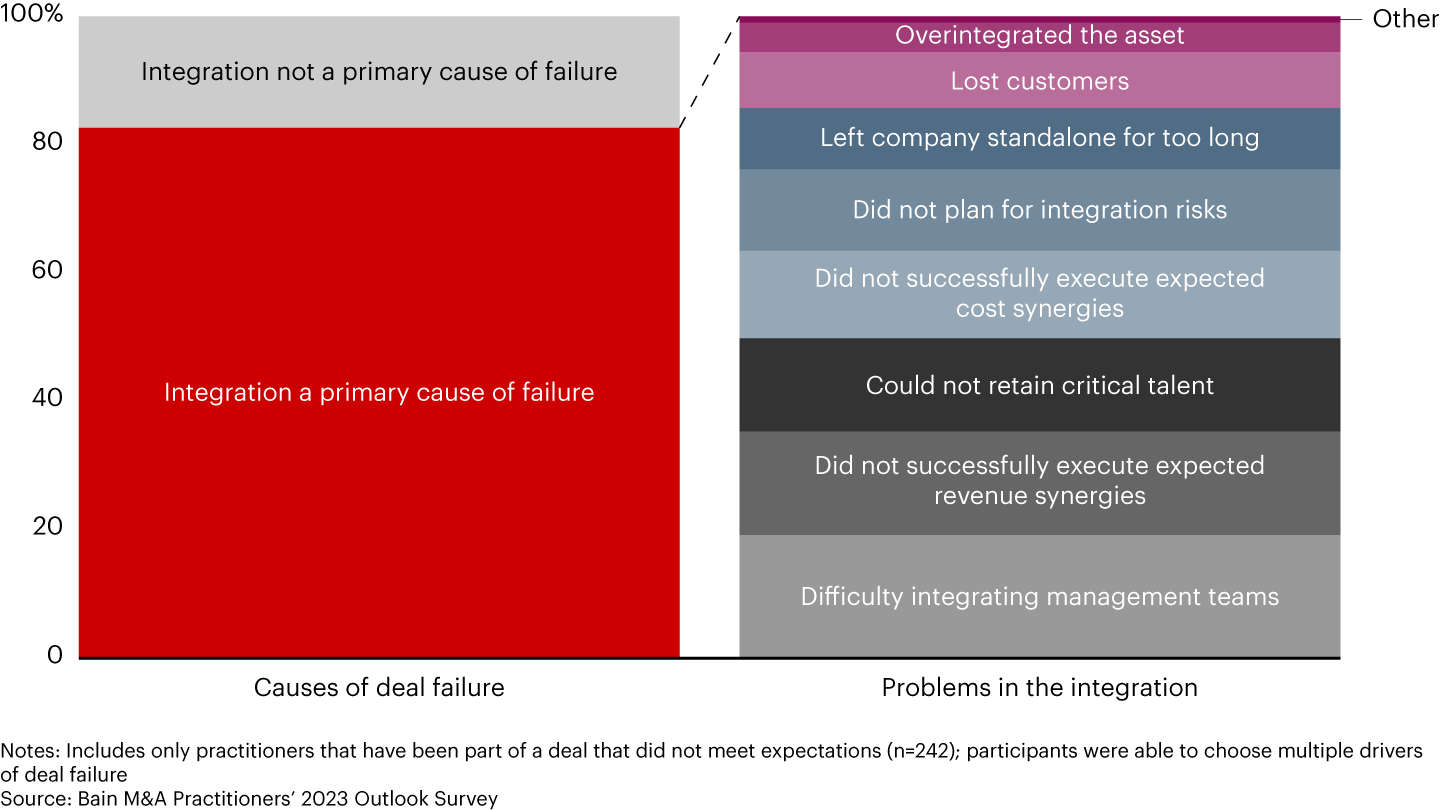
- Frequent acquirers are getting better, but when deals fail, integration is at the root 83% of the time.
- The best integrators recognize that each deal has unique needs, but they also bring repeatable skills that enhance value.
- They plan the integration during diligence and identify pivotal decisions.
- An increasingly important factor is the ability to use artificial intelligence and digital tools to gain an edge.
Companies that do more M&A deliver better shareholder returns, as the data has proven again and again. Plus, they’re getting better as time goes on. The advantage in shareholder returns achieved by frequent acquirers has more than doubled over the past 20 years, from 57% to 130% (see the Bain Brief “How Companies Got So Good at M&A”).
One of the big reasons is the edge that frequent acquirers have when it comes to integrating two companies. They treat integration more as a skill than a process, recognizing that each deal is unique and will require a different approach to achieve the strategic vision for creating value. And they do not shy away from investing in the integration. They’re aware that integration mistakes can turn great deals into costly regrets. In fact, the M&A executives we surveyed that have experienced failed acquisitions pointed to integration as a primary problem 83% of the time (see Figure 1).
Figure 1

But what do those that succeed at integration do differently? And how can companies with bold M&A ambitions but less of a track record keep up? The best integrators consistently follow 10 steps.
Step No. 1: Start planning integration during diligence
Many companies don’t start thinking seriously about integration until a deal is signed—and that’s always way too late. Acquirers need to use the diligence process to confirm their ability to integrate in a way that will maximize and accelerate value creation once the deal is closed (see “Tougher Times: Putting the Diligence Back in Due Diligence,” a chapter of Bain’s Global M&A Report 2023). The best companies make the most of a short diligence window by starting earlier, using outside-in data, and including areas that can help shape the focus of the integration, such as talent and culture. Then, they go deep on specific sources of value, with clean teams and rapid data analytics to identify potential cost and revenue synergies.
These deeper insights create conviction in the deal and allow an acquirer to start building a meaningful integration thesis early. What does good look like? By the time Emerson announced its acquisition of National Instruments, it already had critical information it needed to move quickly, such as a well-defined synergy target and a detailed understanding of the tech stack—that’s more than many acquirers know at deal close. The robust diligence gave Emerson confidence in the deal and a flying start on delivering value throughout the integration.
Step No. 2: Follow the money
Behind every solid deal is a deal thesis that clearly articulates the strategic intent and value creation potential for the proposed acquisition. But you can’t stop there. The best integrators use the deal thesis to craft an integration thesis that determines how the integration process will deliver that value. Too often, instead of using integration as a catalyst for transforming both the acquirer and target to meet their mutual full potential, companies sell themselves short by limiting integration efforts only to the low-end targets established during a pro forma diligence. Another misstep: Companies underdeliver by treating the integration like an undifferentiated, check-the-box assignment. They typically miss value creation opportunities or even destroy value by following checklists of “how we did it last time.” Every integration move should be dictated by and in service to the unique strategy and value potential that justified this deal.
Step No. 3: Turbocharge planning and delivery through software and artificial intelligence (AI)
For decades, integrations meant waves of project managers crowding out conference rooms and cafeteria tables as they managed weekly processes. Today, leading integrators are using digital tools and AI to change the game, reducing the need for a crowd of arms and legs to stay in sync. Beyond reducing costs, these tools create massive value by providing leaders with the insights that they need to move quickly when deploying resources toward the value-driven decisions.
Though new for some, AI and generative AI are already creating value for many. In our recent survey of more than 300 M&A practitioners, 22% reported using generative AI for integration planning, turbocharging formerly manual processes. This includes helping programs rapidly match and compare data across companies, analyze culture gaps, draft new job descriptions, develop communications in line with the deal vision, and flag risks for additional leadership attention. Even before integration begins, there are huge applications in diligence to identify and size synergies. And those that invest to climb this learning curve will build the data and experience to capitalize on next-generation applications, such as streamlining synergy tracking and suggesting additional sources of value (see “Generative AI in M&A: Where Hope Meets Hype,” a chapter of Bain’s Global M&A Report 2024).
In addition to AI, the best integrators also remember the tried-and-true basics—namely, digital tools specifically designed for integration. While it may be superficially easier to repurpose a transformation or project management tool for an integration, anything developed with only a single company in mind misses the foundational, two-company needs of integrations and will be clunky (at best). And remember that tools are only as good as the process that surrounds their use and the data that is provided. Invest up front to establish clear expectations, ways of working, and governance.
Step No. 4: Prepare for multiple closing scenarios
A new issue has steadily grown in recent years: Regulators around the world are taking a more active role in challenging deals, resulting in longer and less predictable deal closing times. Challenged deals presently take three months longer, on average, when compared with 2015. In fact, more than 40% of challenged deals now take a year or more to clear regulatory hurdles. This longer period of uncertainty distracts teams, leaders, and customers as Day 1 keeps changing and complex plans need to be scrapped. The answer is to plan for integration with stage gates that allow the vast majority of the company to focus on the base business. A small group of leaders sets the strategic priorities of the integration, using support from third-party clean teams that identify value and accelerate planning to capture that value until the company has the appropriate assurances and timing to deploy its own teams.
Step No. 5: Prioritize the pivotal decisions that will quickly deliver the most value
When Dell acquired EMC for $67 billion, it faced thousands of conflicting, interdependent decisions, but it zeroed in on one that would be critical to the deal’s success. Dell decided early to prioritize cross-selling both companies’ products with separate sales organizations, which is a departure from the typical approach of spending a year or more integrating teams and systems first. By mobilizing around that pivotal decision, Dell achieved multibillion-dollar revenue synergies within the first year, when most other acquirers would still be sorting out internal questions.
Dell’s approach shows the value of leading integrations with pivotal decisions rather than letting functional integration dictate the path. Again, the best integrators start from strategy. That means determining the handful of decisions that will boost value for their integration and structuring the integration around them. Pivotal decisions vary by deal and usually cross functions: What should our combined operating model be? How will we change our manufacturing and distribution footprint? How will we align our R&D roadmaps to deliver the vision of the combined products? These cross-functional decisions are so foundational to the value of the deal that they need to be part of the steering committee agenda and integration roadmap, not something that can be delegated to any one team to figure out.
Step No. 6: Move beyond the integration “traffic cop” mindset
Companies with less M&A experience might incorrectly think of integrations primarily as projects in need of project managers. This thinking assumes the strategy is set, so all that is needed is to stay on top of each team to ensure that they create and deliver on their work plans. We call these “traffic cop” integrations because the leaders spend their energy looking for anyone who isn’t staying in line and issuing “name and shame” citations, hoping to correct progress.
Successful acquirers take a more strategic approach when orchestrating the integration. They focus all of the teams on the value of the deal, deploying cross-functional teams to manage interdependencies, and ensuring crystal clear alignment across the entire company on the priorities and strategy for the integration.
Step No. 7: Resolve power and people issues quickly
The new organization should be designed around the deal thesis and the new vision for the combined company. You’ll want to select people from both organizations who are enthusiastic about this vision and who can contribute the most to it. Set yourself an ambitious deadline for filling the top levels, and stick to it; tough people decisions only get tougher with time. This is especially important as longer pre-close timelines extend uncertainty and hybrid or remote work makes it easier for top talent to find stability elsewhere.
Moreover, until you announce the appointments, your best customers and your best employees will be actively poached by your competitors when you are most vulnerable to attack. The sooner you select the new leaders, the quicker you can fight the flight of talent and customers and get on with the integration. Delay only leads to endless employee debate about who is going to stay or go and time spent responding to headhunter calls. You want all this energy focused on getting the greatest possible value out of the deal.
Step No. 8: Bridge the cultural “fault lines” that can halt progress
When can culture issues cost you a billion dollars? When cultural differences slam the brakes on an integration. Not all cultural differences need to be addressed, but certain destabilizing differences—we call them “fault lines”—can swiftly grow into silent killers of deal value. They may appear on the surface to be individual attitude or performance issues—for instance, a missed deadline or a decision that’s reversed via back channeling—but they are often symptoms of different ways of working or expectations across companies. If unaddressed, these issues can grow into outright hostility across businesses, the opposite of what is needed to create joint value. They can result in unwanted attrition of critical talent while acting as a tax that makes every integration activity less productive than it should be (see “How to Avoid the Fault Lines Sending Tremors through Cultural Integration in M&A,” a chapter of Bain’s Global M&A Report 2023).
What to do about it? Talk openly about the significant cultural issues that could cause the most harm. Go beyond superficial surveys, and use your integration management office as a culture lab that identifies where the frictions are forming and addresses them. That way, you can see what works in a safer environment before both companies are thrown into the deep end on Day 1. Hitachi’s acquisition of Silicon Valley–based GlobalLogic serves as an example of what to do right. The Japanese company wanted to strengthen its digital engineering capabilities with GlobalLogic, but it knew that cultural differences could be an obstacle. One major risk was that the target would lose its unique strengths under Hitachi—or under any large corporation, for that matter. Hitachi invested heavily in an effort to pinpoint and resolve cultural fault line issues. That included several workshops, in-person visits, and a unique cross-cultural team staffed across geographies to smooth over potential misunderstandings. The investment ended up preserving GlobalLogic’s culture by recognizing how that culture encouraged innovation and applying those learnings at Hitachi; it also ended up preserving and bringing the best of Hitachi culture to GlobalLogic.
Step No. 9: Get real on revenue synergies
Failing to realize expected revenue synergies is one of the most common causes of deal failure. And it’s no mystery why. Only half of surveyed executives tell us that they get enough granularity on potential revenue synergies to include them in the deal model (see “Bringing Science to the Art of Revenue Synergies,” a chapter of Bain’s Global M&A Report 2022). But revenue synergies can’t be treated like an afterthought. In practice, it takes a coordinated effort to identify and size opportunities down to the products and customers, incentivize and train the team, and enable sales operations across both companies. Doing this right usually requires clean teams and pre-close efforts to be ready for Day 1. This level of coordination and activation doesn’t happen automatically, and it is even more difficult in the upheaval of an integration. But for companies that bring science to the art of revenue synergies, the rewards are huge: The growth vision of the deal is realized in quick wins that build momentum for customers, the sales team, and a newly energized company.
This focus on cross-selling and go-to-market synergies helps validate the value created by the merger in the eyes of sales reps and customers. It also buys the company time to work on pursuing longer-term revenue synergies from integrated product offerings that further improve the combined value proposition.
Step No. 10: Invest to build a repeatable model
Companies that do M&A well enjoy a virtuous cycle, applying insights to future deals that make them easier, faster, and more productive. If your company doesn’t have this flywheel yet, you can use your next integration to set it up. You’ll need several elements working in harmony: a commitment to M&A as a growth driver; investment in your M&A capability, including the team and the operating model; aligned objectives with management and the board; a go-to network of advisers; and flexibility on how to achieve objectives across deal types. A big part of doing this well is attracting the appropriate talent to the integration team. The integration should feel like a launchpad for careers, where senior leaders invest in rising stars who graduate to advanced roles within the acquired company.
Even with the best intentions, it can be hard to execute integrations that deliver on the deal’s promise, much less outperform expectations. But following these 10 steps can help acquirers fly at the right altitude and apply the right amount of steering in the right places to overdeliver on value—all without getting lost in the weeds.
Published in June 2024