


Brief


|
|
It’s an all-too-familiar scenario at many companies: When the opportunity for a promotion arises, Jeff and Linda, both on the same team, reach out to their manager Bill to indicate their interest. Bill immediately proposes a lunch meeting with Jeff. Over sushi and a beer, Bill encourages Jeff, saying it will be a tough position but excellent for his career. Jeff feels energized and excited, knowing his boss believes he can succeed. A week later, Bill calls Linda into his office where, in a more formal setting, he lays out all the pros and cons of the new position. He explains how hard it will be and questions whether Linda would want to do it. Linda, who already feels as though she has had to fight to be successful in her last few roles, wonders whether she has the energy to prove herself again. The path to a senior leadership position is a strenuous climb. On paper, women appear prepared for the ascent—they now make up a majority of college graduates and 40% of the classes at top MBA programs. Well-educated, ambitious women are indeed moving up the corporate ranks, but disproportionately few reach the summit. According to Catalyst, an organization dedicated to workplace diversity, women make up just 25.1% of senior managers and executives at S&P 500 companies and only 4.4% of CEOs, despite efforts by many companies to close the gap. To understand why such a significant imbalance persists, Bain & Company and LinkedIn surveyed in 2016 more than 8,400 male and female LinkedIn members who work for companies in the US and who have at least a bachelor’s degree. The sample covered the full career spectrum, from entry-level employees to top leaders, and it spanned all major industries. This report details what we learned. Julie Coffman, who chairs Bain’s Global Women’s Leadership Council, shares four things companies should do to help the women in their organizations reach full potential at crucial midcareer moments. The harder route Any serious climber will tell you that getting to the top requires not only the right skills but also will and energy. Aspiration and confidence, in particular, are vital to staying the course. “Talent and skills only get you so far,” said a partner at a professional services company. “It’s a tough path, and the ones who make it are the ones who want it and believe, even during the down times, that they can get there.” Women and men today have the same climbing ability, even if they demonstrate different strengths at different times. The gender gap in the C-suite persists because external factors create a more difficult path to the top for women—one with more strenuous terrain requiring more energy and perseverance. That, in turn, affects women’s aspiration and confidence over time. Lower aspiration and confidence levels undermine important career-building behaviors, including the willingness to seize opportunities that will help propel a woman’s career. Our research shows that women are less likely than men to seek out an opportunity if they know their supervisor might not be fully supportive, to make decisions that could be perceived as risky or to voice an opinion with which others may not agree (see Figure 1). Women who have made it to the top recount how they had to persevere in the face of difficult terrain. “You have to be hungrier. You have to be more confident, show more commitment, more resilience and more momentum,” said a female general manager at a major American multinational technology company. 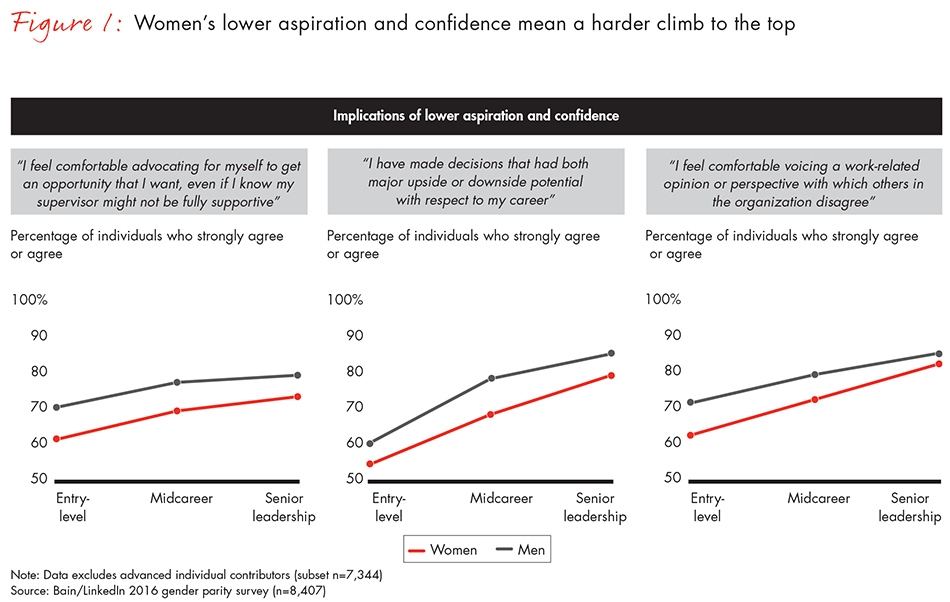 From the start, women confront different dynamics and experiences at work that make their climb tougher than that of their male colleagues. Cultural norms in the workplace, often rooted in conscious and unconscious bias, are well documented. Both can create significant obstacles to advancement. Bias can limit a woman’s opportunities to take on challenging projects, for example. It can also take more subtle forms, such as comments on a performance evaluation that question a woman’s career commitment or the assignment of extra administrative tasks to women in addition to their primary responsibilities (see Figure 2). 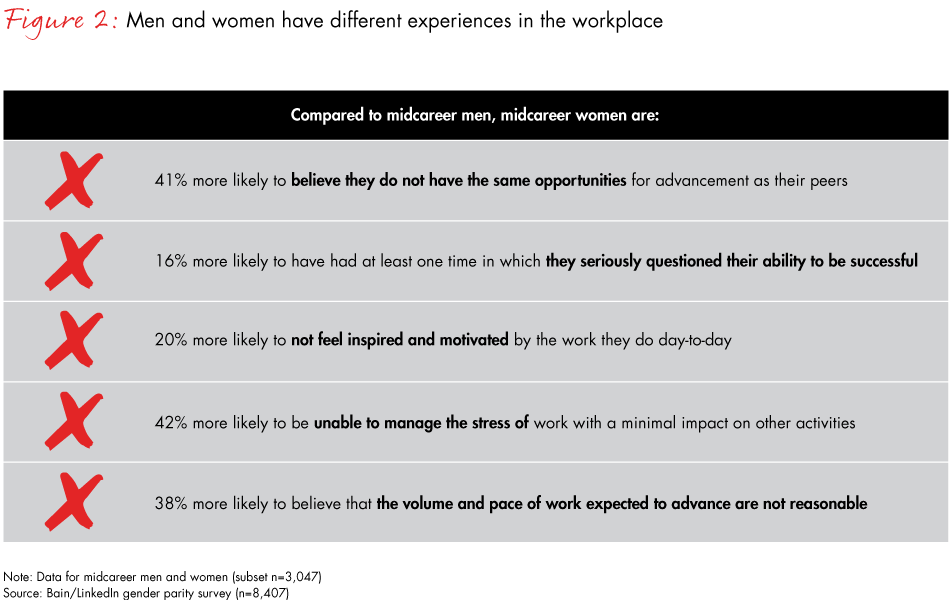 The global head of a major business unit at a financial services company said at certain points in her career, managers made assumptions about what she wanted based on what they knew about her personal life. “All around us, leaders assume they know the answer to career questions for women on their teams. How often do you hear senior male leaders weighing a woman’s personal life situation when considering her for something? They rarely talk about the personal life of a male candidate. Instead, men are often judged solely on objective professional criteria such as competence and experience.” Even today, gender bias can be overt, such as being excluded from all-male social gatherings. The female general manager from the multinational technology company who noted that women have to be “hungrier” and “more confident” described how a peer in a previous role would smooth the path for his direct male reports by socializing regularly with them, excluding the women on his team: “He would go out [and play golf] and make it all men, and that’s where they would make decisions.” Women also confront more challenging dynamics at home: 61% of midcareer women have a spouse or partner who is pursuing a more intense or equally intense career vs. 38% of midcareer men. In our sample, midcareer women with children were almost 6 times more likely to be the primary parent (see Figure 3). 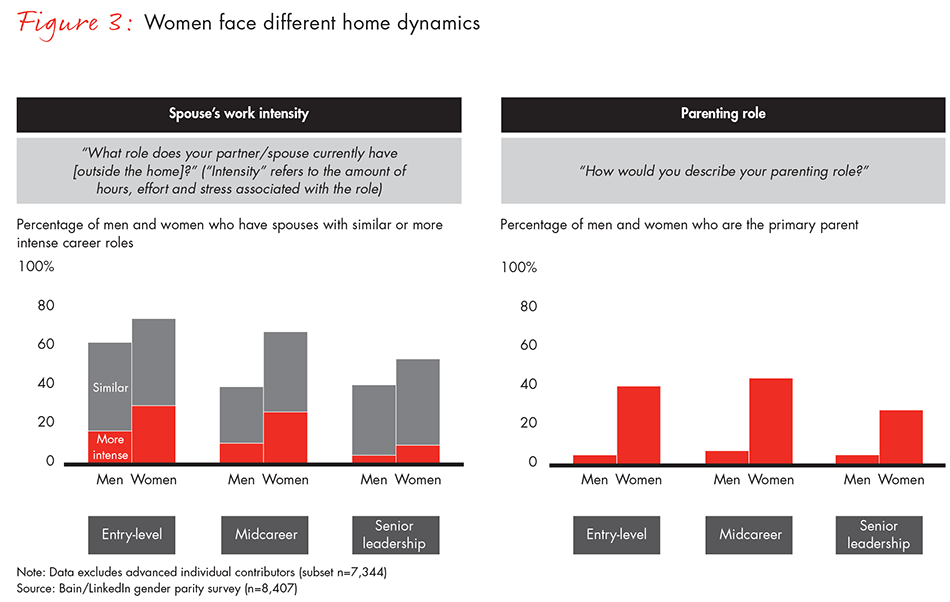 Men confront work-life integration issues too, but they do not face the same trade-offs. The global head of a major business unit at a financial services company said all 14 men who interviewed her for a top job shortly after her daughter’s birth asked whether she was committed to meeting the demands of the new position. “One of them said, ‘This is a 24/7 job. Can you do that?’ I remember thinking, I don’t see a bed in your office! Do you work 24/7?” The time and energy needed to manage these external factors erode women’s aspiration and confidence, prompting many to eventually reassess their career goals. Most significantly, women trail men at midcareer, the critical point when they need to decide whether to pursue the leadership track or opt out. While aspiration and confidence are lowest for both men and women at this point, reflecting the natural sorting process that occurs as people advance in their careers, a significant gender gap persists. At midcareer, just 56% of women demonstrate an aspiration to a senior leadership position, compared with 64% of men; and 57% of women show confidence that they can get there, compared with 66% of men (see Figure 4). Men’s terrain is often smoother, so they don’t need as much perseverance and they are more willing to take career risks. 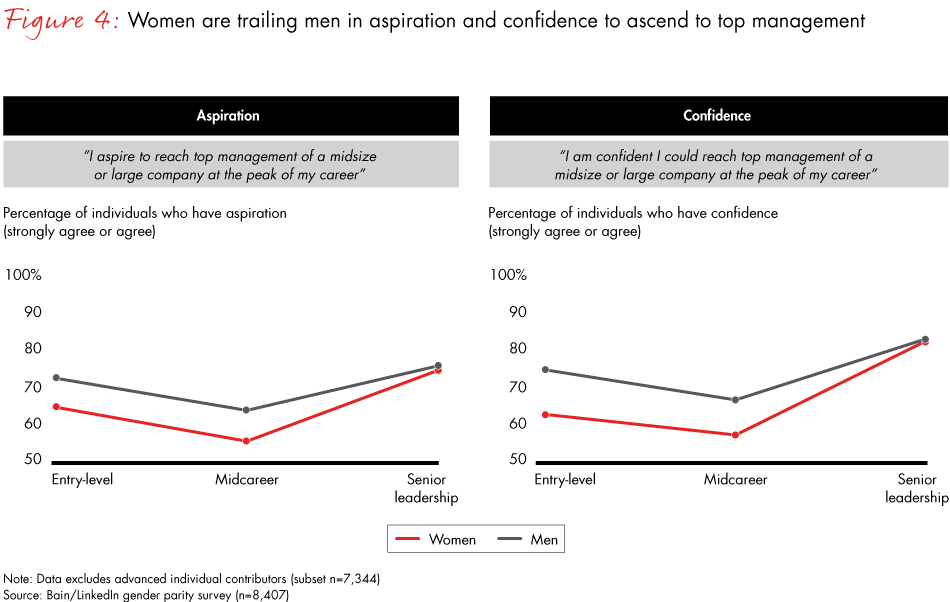 The pivotal role of frontline managers So, how do we get more women up the mountain? As every climber knows, having a seasoned guide—someone who knows the different routes and the terrain—can make all the difference. In the workplace, it’s the frontline managers who walk next to women every day and can exert significant influence on their development as leaders. Bain & Company’s 2014 survey on the gender divide, “Everyday Moments of Truth,” showed that top-down efforts to help women advance were necessary but not sufficient. Women (and men) make decisions about their careers based on the daily interactions with their managers and peers. The report showed women benefit significantly from support during the “conference room” years—the formative period when employees are building the mind¬sets to become senior leaders. During those years, frontline managers play a critical role. The responses to the latest survey bring the role of the frontline manager into even sharper focus. To help women get to the summit, frontline managers need to focus not only on building skills but also on bolstering aspiration and confidence. “I have always been very struck by how my managers told me not to get off the leadership track and told me to stick it out and try for the next rung,” said the chief operating officer of a major hospital network. Given that the workplace and home dynamics that make the journey to the top more difficult for most women are not improving, the role of frontline managers is made all the more important. Frontline managers often can help smooth the terrain, and in difficult passages, they can provide energy and encouragement. Helping women advance To understand what actions would increase women’s aspiration and confidence, we asked survey participants to answer 21 detailed questions about workplace dynamics. Five themes were particularly important in generating and maintaining aspiration and confidence (see Figure 5). The findings pointed to four ways that frontline managers can help women move up the mountain (see Figure 6). 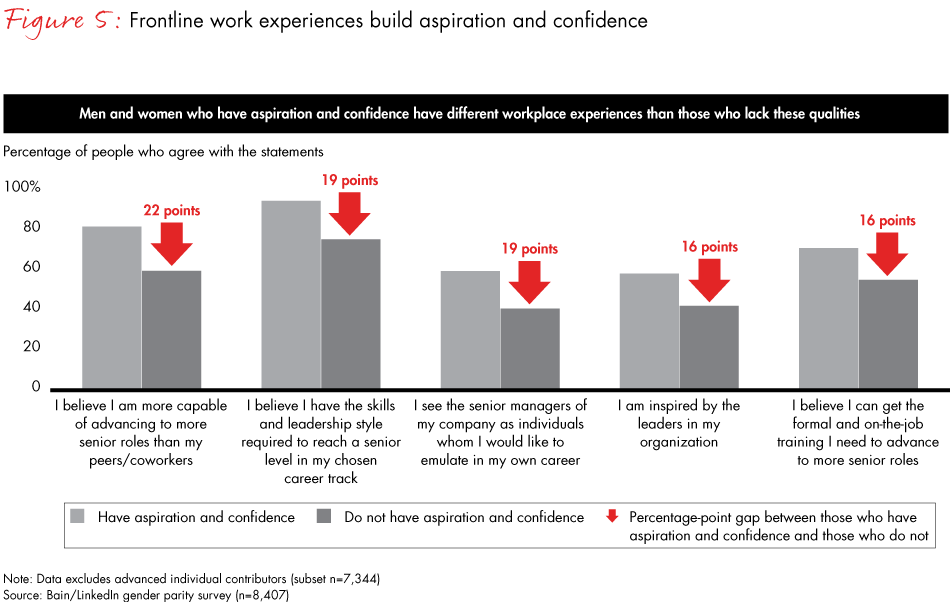 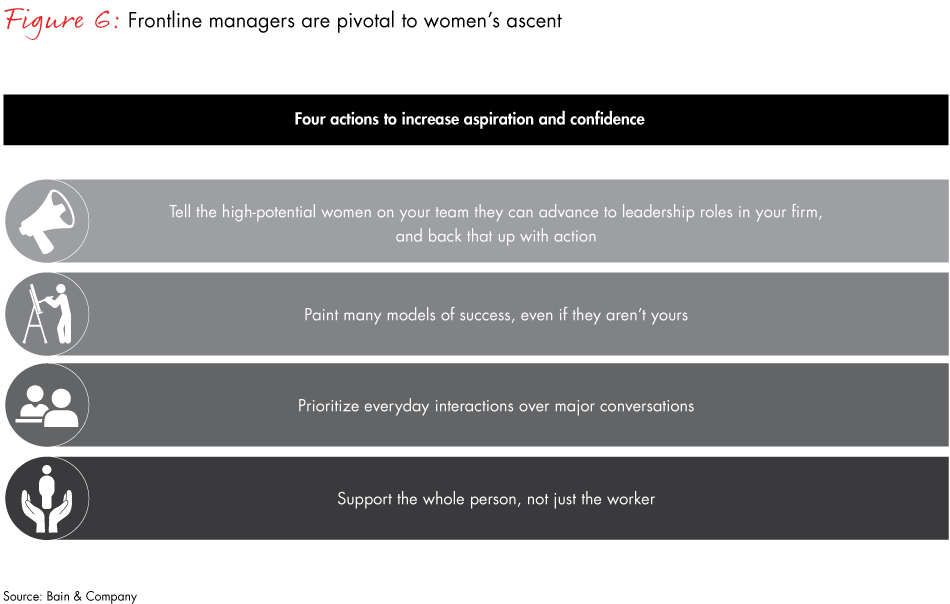 Tell the great women on your team that they can advance to leadership roles in your firm, and back that up with action. Believing is half the battle. Men and women who are aspirational and confident are 19 percentage points more likely than those who lack these qualities to believe that they have the skills and leadership qualities to advance, and they are 22 percentage points more likely to believe that they are more capable of advancing than their peers. However, few midcareer women envision themselves as successful: 41% are more likely to question whether they have the same opportunities for advancement as others of their level and experience, and 16% are more likely to have had at least one time in which they seriously questioned their ability to be successful. Survey respondents said managers who believed that they could be successful made a difference. The former vice president of human resources at a global oil and gas company said her manager set her aspirations soaring by encouraging her one day to think about a top management position, including CEO. “That was the first time I ever had someone really challenge me to think beyond the end of my current role…. He fueled my desire to be successful by telling me I would be successful.” Frontline manager actions:
Paint many models of success, even if they aren’t yours. Show women that there is more than one route to the top, and make it clear that there is no single stereotype of success. Point to male and female role models that women can learn from and emulate. Those who are aspirational and confident are 19 percentage points more likely to see senior leaders of their firm as those they would like to emulate and 16 percentage points more likely to be inspired by senior leaders of their firm. However, many women cite the lack of role models at the top who are facing similar work and home dynamics. To advance faster and further, midcareer women need to look ahead and not feel stymied by a stereotype of success that doesn’t fit them. “My second male manager was adamant that his team have a life at home,” said the global head of a major business unit at a financial services company. “He would come by my desk and insist I go home. He often told stories about how his close relationship with his father was pivotal to his success and he was determined to do the same for his family by making sure he had time for them. He emphasized the importance of balancing family with career but, at the same time, he never lowered his standards.” Frontline manager actions:
Make everyday interactions the priority over periodically scheduled reviews. Increase women’s day-to-day energy levels through open and regular feedback. Bain’s 2014 research concluded that everyday moments of truth are more critical to one’s long-term career path than career discussions or performance reviews. Daily interactions are particularly important for midcareer women, who are 20% more likely to feel uninspired by their work. Survey respondents said positive reinforcement—namely, a note of praise for doing things well—gave them a jolt of aspiration. One chief marketing officer of a national restaurant chain said her managers signaled they valued her work outside of the performance review process by sponsoring her visa and allowing flexible working hours when her husband lived in a different city. “The flexibility was a signal that I was doing well and they thought I would be successful.” Frontline manager actions:

Charting the Course: Getting Women to the TopHow frontline managers can reinforce the necessary mindsets to help women become senior leaders. Support the whole person—not just the worker. Women’s more challenging work and home dynamics make it tougher for them to juggle heavy work volumes and work-related stress. Our survey showed that midcareer women are 42% more likely than men to struggle with managing the stress of work without impact on other activities and 38% more likely to believe the volume and pace of work expected to advance is not reasonable. A female regional president at a global financial services firm turned down two promotions to run a business unit because the jobs required heavy travel and would have been tough on her family life. When a senior executive called to say he understood her decision and supported her 150%, she was shocked. “I don’t think he realizes the effect he had on me. He was true to his word.” A few years later the country manager two levels above her retired and she got the job. Managing work-life balance is part of a broader cultural conversation. However, frontline managers can play a positive role. Frontline manager actions:
Everyone’s aspiration and confidence ebbs and flows; that’s natural. However, the accumulated energy required for women to persevere increases the likelihood that frontline manager support can make a big difference in helping women emerge from a period of low aspiration and confidence and continue climbing. Of course, frontline managers alone can’t accelerate women’s ascent. They need visible and sustained support from the C-suite. Top leaders need to communicate clearly that gender parity is a priority—that it’s good for profits, good for shareholders and good for the future of the business. The organization also needs the right training programs to help women succeed. Leadership teams should track progress on key metrics for women’s career advancement and hold all management levels accountable for creating change. Ascending to the corporate heights is a long climb. It takes aspiration, confidence and committed mountain guides to persevere. Women are ready to make the trek. Companies that encourage managers to help women actively navigate the path to the top will be more successful at making the most of the talent across their entire workforce. Melissa Artabane is the director of Bain’s Global Women’s Leadership Council and is based in Boston. Julie Coffman is a partner with Bain & Company in the Chicago office and chair of Bain’s Global Women’s Leadership Council. Darci Darnell is a Bain partner in the Chicago office and a member of Bain’s Global Women’s Leadership Council. |