


Skip to Content
  • Offices

    Offices

    North & Latin America
    • Atlanta
    • Austin
    • Bogota
    • Boston
    • Buenos Aires
    • Chicago
    • Dallas
    • Denver
    • Houston
    • Los Angeles
    • Mexico City
    • Minneapolis
    • Monterrey
    • Montreal
    • New York
    • Rio de Janeiro
    • San Francisco
    • Santiago
    • São Paulo
    • Seattle
    • Silicon Valley
    • Toronto
    • Washington, DC
    Europe & Africa
    • Amsterdam
    • Athens
    • Berlin
    • Brussels
    • Copenhagen
    • Dusseldorf
    • Frankfurt
    • Helsinki
    • Istanbul
    • Johannesburg
    • Kyiv
    • Lisbon
    • London
    • Madrid
    • Milan
    • Munich
    • Oslo
    • Paris
    • Rome
    • Stockholm
    • Vienna
    • Warsaw
    • Zurich
    Middle East
    • Doha
    • Dubai
    • Riyadh
    Asia & Australia
    • Bangkok
    • Beijing
    • Bengaluru
    • Brisbane
    • Ho Chi Minh City
    • Hong Kong
    • Jakarta
    • Kuala Lumpur
    • Manila
    • Melbourne
    • Mumbai
    • New Delhi
    • Perth
    • Seoul
    • Shanghai
    • Singapore
    • Sydney
    • Tokyo
    See all offices
  • Alumni
  • Media Center
  • Subscribe
  • Contact
  • Global | English

    Select your region and language

    Global
    • Global (English)
    North & Latin America
    • Brazil (Português)
    • Argentina (Español)
    • Canada (Français)
    • Chile (Español)
    • Colombia (Español)
    Europe, Middle East, & Africa
    • France (Français)
    • DACH Region (Deutsch)
    • Italy (Italiano)
    • Spain (Español)
    • Greece (Elliniká)
    Asia & Australia
    • China (中文版)
    • Korea (한국어)
    • Japan (日本語)
  • Saved items (0)
    Saved items (0)

    You have no saved items.

    Bookmark content that interests you and it will be saved here for you to read or share later.

    Explore Bain Insights
  • Industries
    Main menu

    Industries

    • Aerospace & Defense
    • Agribusiness
    • Chemicals
    • Construction & Infrastructure
    • Consumer Products
    • Financial Services
    • Healthcare & Life Sciences
    • Industrial Machinery & Equipment
    • Media & Entertainment
      Industries
      Media & Entertainment
      • Media Lab
    • Metals
    • Mining
    • Oil & Gas
    • Paper & Packaging
    • Private Equity
      Industries
      Private Equity
      • Due Diligence
      • Exit Planning
      • Firm Strategy & Operations
      • Portfolio Value Creation
    • Social Impact
    • Retail
    • Technology
    • Telecommunications
      Industries
      Telecommunications
      • Capital Expenditure
      • Telco Digital Transformation
    • Transportation
    • Travel & Leisure
    • Utilities & Renewables
  • Consulting Services
    Main menu

    Consulting Services

    • Customer Experience
    • Sustainability
    • Innovation
    • M&A
    • Operations
    • People & Organization
    • Private Equity
    • Sales & Marketing
    • Strategy
    • AI, Insights, and Solutions
    • Technology
    • Transformation
  • Digital
  • Insights
    Main menu

    Insights

    • Industry Insights
    • Services Insights
    • Bain Books
    • Webinars
    • Bain Futures
    View all Insights
    Featured topics
    • Tariff Response
    • Artificial Intelligence
    • Thriving in Uncertainty
    • Executive Conversations
    • Macro Trends
    • M&A Report
    • Healthcare Private Equity Report
    • Paper & Packaging Report
    • Technology Report
    • CEO's Guide to Sustainability
    • CEO Insights
    • CFO Insights
    • COO Insights
    • CIO Insights
    • CMO Insights
    View all featured topics
  • About
    Main menu

    About

    • What We Do
    • What We Believe
    • Our People & Leadership
    • Client Results
    • Awards & Recognition
    • Global Affiliations
    Further: Our global responsibility
    • Sustainability
    • Social Impact
    • World Economic Forum
    Learn more about Further
  • Careers
    Main menu

    Careers

    • Work with Us
      Careers
      Work with Us
      • Find Your Place
      • Our Work Areas
      • Integrated Teams
      • Students
      • Internships & Programs
      • Recruiting Events
    • Life at Bain
      Careers
      Life at Bain
      • Blog: Inside Bain
      • Career Stories
      • Our People
      • Where We Work
      • Supporting Your Growth
      • Affinity Groups
      • Benefits
    • Impact Stories
    • Hiring Process
      Careers
      Hiring Process
      • What to Expect
      • Interviewing
    FIND JOBS
  • Offices
    Main menu

    Offices

    • North & Latin America
      Offices
      North & Latin America
      • Atlanta
      • Austin
      • Bogota
      • Boston
      • Buenos Aires
      • Chicago
      • Dallas
      • Denver
      • Houston
      • Los Angeles
      • Mexico City
      • Minneapolis
      • Monterrey
      • Montreal
      • New York
      • Rio de Janeiro
      • San Francisco
      • Santiago
      • São Paulo
      • Seattle
      • Silicon Valley
      • Toronto
      • Washington, DC
    • Europe & Africa
      Offices
      Europe & Africa
      • Amsterdam
      • Athens
      • Berlin
      • Brussels
      • Copenhagen
      • Dusseldorf
      • Frankfurt
      • Helsinki
      • Istanbul
      • Johannesburg
      • Kyiv
      • Lisbon
      • London
      • Madrid
      • Milan
      • Munich
      • Oslo
      • Paris
      • Rome
      • Stockholm
      • Vienna
      • Warsaw
      • Zurich
    • Middle East
      Offices
      Middle East
      • Doha
      • Dubai
      • Riyadh
    • Asia & Australia
      Offices
      Asia & Australia
      • Bangkok
      • Beijing
      • Bengaluru
      • Brisbane
      • Ho Chi Minh City
      • Hong Kong
      • Jakarta
      • Kuala Lumpur
      • Manila
      • Melbourne
      • Mumbai
      • New Delhi
      • Perth
      • Seoul
      • Shanghai
      • Singapore
      • Sydney
      • Tokyo
    See all offices
  • Alumni
  • Media Center
  • Subscribe
  • Contact
  • Global | English
    Main menu

    Select your region and language

    • Global
      Select your region and language
      Global
      • Global (English)
    • North & Latin America
      Select your region and language
      North & Latin America
      • Brazil (Português)
      • Argentina (Español)
      • Canada (Français)
      • Chile (Español)
      • Colombia (Español)
    • Europe, Middle East, & Africa
      Select your region and language
      Europe, Middle East, & Africa
      • France (Français)
      • DACH Region (Deutsch)
      • Italy (Italiano)
      • Spain (Español)
      • Greece (Elliniká)
    • Asia & Australia
      Select your region and language
      Asia & Australia
      • China (中文版)
      • Korea (한국어)
      • Japan (日本語)
  • Saved items  (0)
    Main menu
    Saved items (0)

    You have no saved items.

    Bookmark content that interests you and it will be saved here for you to read or share later.

    Explore Bain Insights
  • Industries
    • Industries

      • Aerospace & Defense
      • Agribusiness
      • Chemicals
      • Construction & Infrastructure
      • Consumer Products
      • Financial Services
      • Healthcare & Life Sciences
      • Industrial Machinery & Equipment
      • Media & Entertainment
      • Metals
      • Mining
      • Oil & Gas
      • Paper & Packaging
      • Private Equity
      • Social Impact
      • Retail
      • Technology
      • Telecommunications
      • Transportation
      • Travel & Leisure
      • Utilities & Renewables
  • Consulting Services
    • Consulting Services

      • Customer Experience
      • Sustainability
      • Innovation
      • M&A
      • Operations
      • People & Organization
      • Private Equity
      • Sales & Marketing
      • Strategy
      • AI, Insights, and Solutions
      • Technology
      • Transformation
  • Digital
  • Insights
    • Insights

      • Industry Insights
      • Services Insights
      • Bain Books
      • Webinars
      • Bain Futures
      View all Insights
      Featured topics
      • Tariff Response
      • Artificial Intelligence
      • Thriving in Uncertainty
      • Executive Conversations
      • Macro Trends
      • M&A Report
      • Healthcare Private Equity Report
      • Paper & Packaging Report
      • Technology Report
      • CEO's Guide to Sustainability
      • CEO Insights
      • CFO Insights
      • COO Insights
      • CIO Insights
      • CMO Insights
      View all featured topics
  • About
    • About

      • What We Do
      • What We Believe
      • Our People & Leadership
      • Client Results
      • Awards & Recognition
      • Global Affiliations
      Further: Our global responsibility
      • Sustainability
      • Social Impact
      • World Economic Forum
      Learn more about Further
  • Careers
    Popular Searches
    • Agile
    • Digital
    • Strategy
    Your Previous Searches
      Recently Visited Pages

      Content added to saved items

      Saved items (0)

      Removed from saved items

      Saved items (0)

      Brief

      Creating Value through Advanced Analytics

      Creating Value through Advanced Analytics

      Why advanced analytics is about decision-making, not just technology.

      By Michael C. Mankins and Lori Sherer

      • min read

      Brief

      Creating Value through Advanced Analytics
      en

      It’s easy for tech-savvy executives to get excited about Big Data and advanced analytics these days. Newly available tools allow companies to do things they couldn’t do before, like recommending specific products to online buyers or mining workers’ compensation claims data to recommend better treatment options for injured employees. But whiz-bang capabilities don’t create real value unless an organization incorporates these new techniques into its day-to-day operations.

      What does that mean in practice? The best way to understand any company’s operations is to view them as a series of decisions. People in organizations make thousands of decisions every day. The decisions range from big, one-off strategic choices (such as where to locate the next multibillion-dollar plant) to everyday frontline decisions that add up to a lot of value over time (such as whether to suggest another purchase to a customer). In between those extremes are all the decisions that marketers, finance people, operations specialists and so on must make as they carry out their jobs week in and week out.

      We know from extensive research that decisions matter—a lot. Companies that make better decisions, make them faster and execute them more effectively than rivals nearly always turn in better financial performance. Not surprisingly, companies that employ advanced analytics to improve decision making and execution have the results to show for it (see Figure 1). Decisions are where advanced analytics can add real value, quickly.
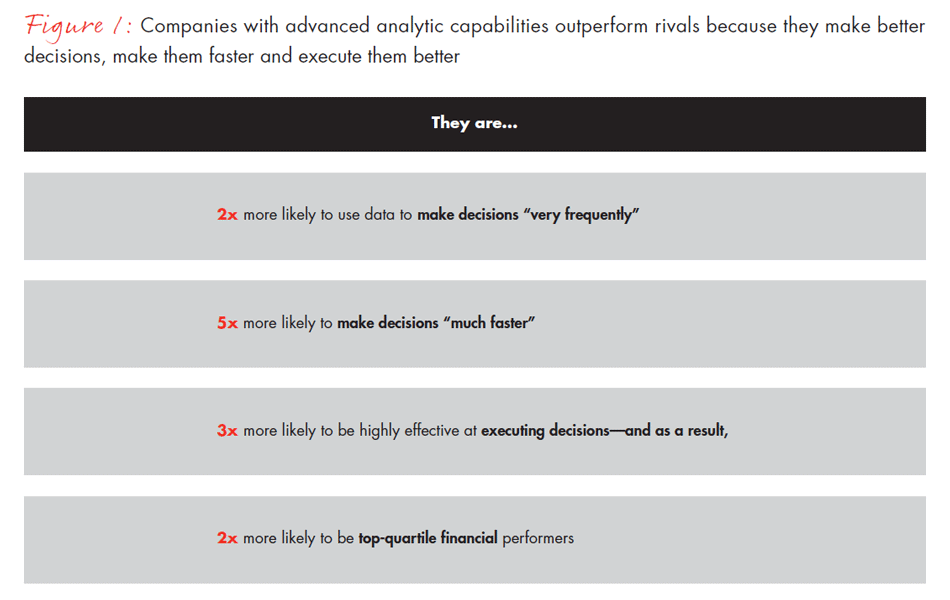

      creating-value-with-advanced-analytics-fig01_embed

      So let’s examine how these organizations use the tools of analytics to improve their decisions and thus their performance.

      Identifying the decisions that benefit most from advanced analytics

      Look first at one extreme of the decision spectrum: the small, everyday decisions that add up to a lot of value over time. Amazon, Capital One and others have already figured out how to automate many of these decisions, like whether to recommend product B to a customer who buys product A or what spending limit is appropriate for customers with certain characteristics. At the other extreme—big, infrequent strategic decisions—companies certainly assemble all the data and technology they can find, including analytic tools such as Monte Carlo simulations. But the choice ultimately depends on senior executives’ judgment.

      In the middle of the spectrum, however, lies a vast and largely unexplored territory. These decisions—both relatively frequent and individually important, requiring judgment and experience to make correctly—represent a potential gold mine for the companies that get there first with advanced analytics.

      Imagine, for example, a property and casualty company that specializes in insuring multinational corporations. For every customer, it might have to make risk-assessment decisions about hundreds of facilities around the world. Armies of underwriters make these decisions. Each one has a particular level of experience, and each is likely to weigh and sequence the dozens of variables differently.

      Now imagine that you employ advanced analytics to codify the approach of the best, most experienced underwriters. You build an analytic model that captures their decision logic. Other underwriters then use that model in making their decisions. This is using analytics not so much to crunch data as to simulate a human process.

      What is the outcome? The need for human knowledge and judgment hasn’t disappeared—you still require skilled, experienced employees. But you have changed the game, using machines to replicate best human practice. The decision process now leads to results that are:

      • Generally better: The incorporation of expert knowledge makes for more accurate, higher-quality decisions;
      • More consistent: You have reduced the variability of decision outcomes; and
      • More scalable: You can add underwriters as your business grows and bring them up to speed more quickly.

      In addition, you have suddenly increased your organization’s test-and-learn capability. Every outcome for every insured facility feeds back into the modeling process, so the model gets better and better. So do the decisions that rely on it.

      Using analytics in this way is no small matter. You’ll find that you need to alter your decision processes. You’ll need to build the technological capabilities, and you’ll have to ensure that your people adopt and use the new tools. Let’s go on to examine these challenges.

      Modifying decision processes to incorporate advanced analytics

      Think for a moment about how an organization makes a significant decision. First come the facts, the data that will inform the decision. Using these facts, someone formulates alternative courses of action and evaluates them according to agreed-on criteria. The decision maker then chooses the best alternative, and the organization commits itself to action.

      Advanced analytics can automate parts of this sequence; it offers the prospect of faster, better-informed decisions and substantially lower costs. But unless you’re prepared to transform how people work together throughout the decision-making process, you’re likely to be disappointed.

      Take a simple example: a company’s collections function. In years past, dozens of collection agents would receive hundreds of randomly allocated delinquent accounts every day, each one with a few facts about the customer. The agents then reviewed a standard list of alternatives and decided how they would try to collect what was owed.

      Today, an algorithm can assemble many more facts about the accounts than any human being could easily process: lengthy payment histories, extensive demographic data and so on. Using these facts, it can separate the accounts into simple categories, say red-yellow-green.

      Now the alternative courses of action are simpler. Red ones—low value, unlikely to pay—go straight to a collection agency. Green ones—high value, likely to pay—go to specially trained callers for white-glove service. The yellow ones require a careful review of alternatives and much more human intervention before a decision is reached. Within the yellow and green categories, moreover, sophisticated test-and-learn experiments can inform the decisions that remain. Agents can discover from these experiments which channels and messages generate the greatest financial return while minimizing costs and customer dissatisfaction. They can thus optimize their choices about how to pursue delinquent accounts.

      The new way of doing things is better and more efficient. But look at how it changes the process itself—and what’s expected of the people involved:

      • Software now assists with the collection and analysis of critical information, eliminating tasks once done by human beings. But people have to determine which facts to collect and how to weight them.
      • Red-yellow-green or other simple categorization schemes can speed up the formulation of alternatives. Advanced analytic models can incorporate the experience of an organization’s best decision makers, helping to eliminate alternatives that are less viable than others and focusing the evaluation on the most promising courses of action. People will require training in how to use the insights from the new decision-support tools.
      • Within the yellow and green groups, test-and-learn results can dramatically improve the quality of decisions an organization makes. People will still need to figure out what experiments to run and then interpret the results.

      The new decision procedures are likely to require investments in technology—for example, software that embeds rules and new decision logic into the workflow systems. They’ll also require redesigning people’s roles to fit with the new process. The possible need for new skills could mean extensive retraining and may require hiring new talent altogether.

      The use of analytics can hugely improve the quality of your decisions and can increase decision process efficiency by as much as 25%. When executed well, it leads to higher customer and employee satisfaction. But analytics alone won’t achieve these results; the decision process needs to change, with people learning new skills and taking on new roles. The transformation is organizational as well as technological, and is more extensive than many companies imagine.

      Making advanced analytics stick—helping employees put new tools to work

      Bringing advanced analytic tools into your organization can help you clone your best decision makers so that you get better, faster decisions in every situation that requires human judgment. But you will certainly have to confront that pesky human factor: people’s natural reluctance to adopt new ways of doing things.

      Companies that are most successful at getting employees to use the new tools seem to rely on a three-faceted approach. It includes:

      Cocreating analytics-based solutions. People often fear analytic tools because they don’t understand what’s inside the “black box” or why it’s important. So some companies have learned to involve employees who will be affected by the new tools in designing and refining the tools’ applications.

      A property and casualty insurance company, for instance, knew that business customers who invested in risk management were longer tenured and more profitable than others. So it naturally wanted to know which prospects in its database would be most likely to implement safety recommendations. It began creating a predictive analytic model—but what were the right variables to use?

      The company ran a series of workshops involving salespeople, claims adjusters, site-inspection engineers—anyone who might have a point of view on the issue. Participants came up with idea after idea that the analytics designers might never have thought of: whether the prospect had favorable employee ratings, what percentage of its management team held technical degrees, whether the company had a senior risk-management executive, whether it invested to protect its brand’s reputation, and others.

      The analytics folks tested many of the group’s hypotheses and eventually rank-ordered the variables; they also kept asking workshop participants whether the results and rankings made sense in light of experience. Eventually, participants became convinced that the model outputs matched their experience and intuition. Involved from the outset, they became advocates of the new tool throughout the organization.

      Involving marketing in the rollout. The tech-savvy experts who create and introduce analytic tools aren’t necessarily the best people to tell everyone why the tools are important. Social and communications skills, after all, don’t always go hand in hand with an advanced engineering degree. Marketers, however, are professional communicators—which is precisely why many companies rely on their marketing departments to develop a rollout plan for analytic tools.

      At one company, many employees were concerned about the privacy implications of tools relating to collections. Wouldn’t customers feel annoyed that the company had so much data about them and was using it to customize the collections process? In introducing the tools, marketers emphasized that the tools made life better for everybody, agents and customers alike. If high-value, high-likelihood-to-pay customers got special white-glove treatment, for instance, they would be happier than if faced with a one-size-fits-all collections protocol.

      Picking their spots with care. One company wanted to introduce a new predictive tool to help its sales representatives identify promising prospects. But it was afraid the reps would never use it. So executives identified a unit that was far behind plan, where the reps were unlikely to earn their bonuses.

      It gave this unit the tool first, saying, in effect, “Try this. It might help.” The reps, desperate for anything that might boost their results, eagerly tried the new tool. When they discovered its power—and saw their unit’s results improving—they began talking it up to their colleagues in other units. Before long, every sales agent in the company was clamoring for it.

      Every tool and every introduction is, of course, different. Early in the process, you will want to assess the specific risks you are likely to encounter and develop a plan to mitigate them. But these three approaches have helped many once-skeptical people overcome their reluctance and incorporate today’s analytic tools in their decisions. That’s where the real value of the new technology lies: in generating the better, faster decisions that almost always produce better financial results.

      Big Data—more appropriately, advanced analytics—is less about data than it is about decisions. To get the most out of their company’s investment in analytics, leaders have to focus on the decisions that matter most. They have to use analytic techniques to “clone” the organization’s best decision makers, incorporate these new approaches into the company’s decision processes and (most important) overcome human resistance to the new approach. It’s a lot to do—but that’s what it will take to realize the enormous promise of these dazzling new tools.

      Michael C. Mankins is a partner in Bain’s San Francisco office. Head of the firm’s Organization practice in the Americas, he is coauthor of Decide & Deliver: 5 Steps to Breakthrough Performance in Your Organization (Harvard Business Review Press, 2010). Lori Sherer is a partner in the San Francisco office and leads Bain’s Advanced Analytics practice.


      creating-value-with-advanced-analytics-fig01_full
      Authors
      • Headshot of Michael Mankins
        Michael Mankins
        Partner, Austin
      • Headshot of Lori Sherer
        Lori Sherer
        Advisory Partner, San Francisco
      Contact us
      Related Consulting Services
      • AI, Insights, and Solutions
      Sales and Marketing
      Using Predictive Analytics to Clone Your Best Decision Makers

      Companies can build analytic models that incorporate the experience and judgment of their most talented people.

      Read More
      Enterprise Technology
      Big Data: The Organizational Challenge

      If you don't know who (and where) your chief analytics officer is, you may already be behind the curve.

      Read More
      AI, Insights, and Solutions
      How AI Is Starting to Transform Circular Packaging

      There are 15 AI use cases companies across the value chain can use today to accelerate circularity.

      Read More
      AI, Insights, and Solutions
      How Life Sciences Leaders Are Widening the AI Capability Gap

      Most pharma and medtech companies agree that a strong data foundation is table stakes. Few invest equally in the behaviors needed to move from pilots to adoption.

      Read More
      AI, Insights, and Solutions
      Exploring AI for Packaging Circularity

      AI is already creating value across the packaging lifecycle, from optimising design and reducing material use to improving sorting and traceability.

      Read More
      Published in February 2015
      Tags
      • AI, Insights, and Solutions

      How We've Helped Clients

      AI, Insights, and Solutions Advanced Analytics Breakthrough Lets Metals Company Optimize Yield Cost

      Read case study

      AI, Insights, and Solutions Advanced Analytics powers up UtilityCo’s reliability, and customers notice

      Read case study

      Sales and Marketing Direct marketing excellence through experimental design

      Read case study

      Ready to talk?

      We work with ambitious leaders who want to define the future, not hide from it. Together, we achieve extraordinary outcomes.

      Stay ahead in a rapidly changing world. Subscribe to Bain Insights, our monthly look at the critical issues facing global businesses.

      *I have read and understand Bain’s Privacy Notice.

      Please read and agree to the Privacy Policy.
      Bain & Company
      Contact us Sustainability Accessibility Terms of use Privacy Modern Slavery Act Statement Cookie Policy Sitemap Log In

      © 1996-2026 Bain & Company, Inc.

      Contact Bain

      How can we help you?

      • Business inquiry
      • Career information
      • Press relations
      • Partnership request
      • Speaker request
      See all offices