


Skip to Content
  • Offices

    Offices

    North & Latin America
    • Atlanta
    • Austin
    • Bogota
    • Boston
    • Buenos Aires
    • Chicago
    • Dallas
    • Denver
    • Houston
    • Los Angeles
    • Mexico City
    • Minneapolis
    • Monterrey
    • Montreal
    • New York
    • Rio de Janeiro
    • San Francisco
    • Santiago
    • São Paulo
    • Seattle
    • Silicon Valley
    • Toronto
    • Washington, DC
    Europe & Africa
    • Amsterdam
    • Athens
    • Berlin
    • Brussels
    • Copenhagen
    • Dusseldorf
    • Frankfurt
    • Helsinki
    • Istanbul
    • Johannesburg
    • Kyiv
    • Lisbon
    • London
    • Madrid
    • Milan
    • Munich
    • Oslo
    • Paris
    • Rome
    • Stockholm
    • Vienna
    • Warsaw
    • Zurich
    Middle East
    • Doha
    • Dubai
    • Riyadh
    Asia & Australia
    • Bangkok
    • Beijing
    • Bengaluru
    • Brisbane
    • Ho Chi Minh City
    • Hong Kong
    • Jakarta
    • Kuala Lumpur
    • Manila
    • Melbourne
    • Mumbai
    • New Delhi
    • Perth
    • Seoul
    • Shanghai
    • Singapore
    • Sydney
    • Tokyo
    See all offices
  • Alumni
  • Media Center
  • Subscribe
  • Contact
  • Global | English

    Select your region and language

    Global
    • Global (English)
    North & Latin America
    • Brazil (Português)
    • Argentina (Español)
    • Canada (Français)
    • Chile (Español)
    • Colombia (Español)
    Europe, Middle East, & Africa
    • France (Français)
    • DACH Region (Deutsch)
    • Italy (Italiano)
    • Spain (Español)
    • Greece (Elliniká)
    Asia & Australia
    • China (中文版)
    • Korea (한국어)
    • Japan (日本語)
  • Saved items (0)
    Saved items (0)

    You have no saved items.

    Bookmark content that interests you and it will be saved here for you to read or share later.

    Explore Bain Insights
  • Industries
    Main menu

    Industries

    • Aerospace & Defense
    • Agribusiness
    • Chemicals
    • Construction & Infrastructure
    • Consumer Products
    • Financial Services
    • Healthcare & Life Sciences
    • Industrial Machinery & Equipment
    • Media & Entertainment
      Industries
      Media & Entertainment
      • Media Lab
    • Metals
    • Mining
    • Oil & Gas
    • Paper & Packaging
    • Private Equity
      Industries
      Private Equity
      • Due Diligence
      • Exit Planning
      • Firm Strategy & Operations
      • Portfolio Value Creation
    • Social Impact
    • Retail
    • Technology
    • Telecommunications
      Industries
      Telecommunications
      • Capital Expenditure
      • Telco Digital Transformation
    • Transportation
    • Travel & Leisure
    • Utilities & Renewables
  • Consulting Services
    Main menu

    Consulting Services

    • Customer Experience
    • Sustainability
    • Innovation
    • M&A
    • Operations
    • People & Organization
    • Private Equity
    • Sales & Marketing
    • Strategy
    • AI, Insights, and Solutions
    • Technology
    • Transformation
  • Digital
  • Insights
    Main menu

    Insights

    • Industry Insights
    • Services Insights
    • Bain Books
    • Webinars
    • Bain Futures
    View all Insights
    Featured topics
    • Tariff Response
    • Artificial Intelligence
    • Thriving in Uncertainty
    • Executive Conversations
    • Macro Trends
    • M&A Report
    • Healthcare Private Equity Report
    • Paper & Packaging Report
    • Technology Report
    • CEO's Guide to Sustainability
    • CEO Insights
    • CFO Insights
    • COO Insights
    • CIO Insights
    • CMO Insights
    View all featured topics
  • About
    Main menu

    About

    • What We Do
    • What We Believe
    • Our People & Leadership
    • Client Results
    • Awards & Recognition
    • Global Affiliations
    Further: Our global responsibility
    • Sustainability
    • Social Impact
    • World Economic Forum
    Learn more about Further
  • Careers
    Main menu

    Careers

    • Work with Us
      Careers
      Work with Us
      • Find Your Place
      • Our Work Areas
      • Integrated Teams
      • Students
      • Internships & Programs
      • Recruiting Events
    • Life at Bain
      Careers
      Life at Bain
      • Blog: Inside Bain
      • Career Stories
      • Our People
      • Where We Work
      • Supporting Your Growth
      • Affinity Groups
      • Benefits
    • Impact Stories
    • Hiring Process
      Careers
      Hiring Process
      • What to Expect
      • Interviewing
    FIND JOBS
  • Offices
    Main menu

    Offices

    • North & Latin America
      Offices
      North & Latin America
      • Atlanta
      • Austin
      • Bogota
      • Boston
      • Buenos Aires
      • Chicago
      • Dallas
      • Denver
      • Houston
      • Los Angeles
      • Mexico City
      • Minneapolis
      • Monterrey
      • Montreal
      • New York
      • Rio de Janeiro
      • San Francisco
      • Santiago
      • São Paulo
      • Seattle
      • Silicon Valley
      • Toronto
      • Washington, DC
    • Europe & Africa
      Offices
      Europe & Africa
      • Amsterdam
      • Athens
      • Berlin
      • Brussels
      • Copenhagen
      • Dusseldorf
      • Frankfurt
      • Helsinki
      • Istanbul
      • Johannesburg
      • Kyiv
      • Lisbon
      • London
      • Madrid
      • Milan
      • Munich
      • Oslo
      • Paris
      • Rome
      • Stockholm
      • Vienna
      • Warsaw
      • Zurich
    • Middle East
      Offices
      Middle East
      • Doha
      • Dubai
      • Riyadh
    • Asia & Australia
      Offices
      Asia & Australia
      • Bangkok
      • Beijing
      • Bengaluru
      • Brisbane
      • Ho Chi Minh City
      • Hong Kong
      • Jakarta
      • Kuala Lumpur
      • Manila
      • Melbourne
      • Mumbai
      • New Delhi
      • Perth
      • Seoul
      • Shanghai
      • Singapore
      • Sydney
      • Tokyo
    See all offices
  • Alumni
  • Media Center
  • Subscribe
  • Contact
  • Global | English
    Main menu

    Select your region and language

    • Global
      Select your region and language
      Global
      • Global (English)
    • North & Latin America
      Select your region and language
      North & Latin America
      • Brazil (Português)
      • Argentina (Español)
      • Canada (Français)
      • Chile (Español)
      • Colombia (Español)
    • Europe, Middle East, & Africa
      Select your region and language
      Europe, Middle East, & Africa
      • France (Français)
      • DACH Region (Deutsch)
      • Italy (Italiano)
      • Spain (Español)
      • Greece (Elliniká)
    • Asia & Australia
      Select your region and language
      Asia & Australia
      • China (中文版)
      • Korea (한국어)
      • Japan (日本語)
  • Saved items  (0)
    Main menu
    Saved items (0)

    You have no saved items.

    Bookmark content that interests you and it will be saved here for you to read or share later.

    Explore Bain Insights
  • Industries
    • Industries

      • Aerospace & Defense
      • Agribusiness
      • Chemicals
      • Construction & Infrastructure
      • Consumer Products
      • Financial Services
      • Healthcare & Life Sciences
      • Industrial Machinery & Equipment
      • Media & Entertainment
      • Metals
      • Mining
      • Oil & Gas
      • Paper & Packaging
      • Private Equity
      • Social Impact
      • Retail
      • Technology
      • Telecommunications
      • Transportation
      • Travel & Leisure
      • Utilities & Renewables
  • Consulting Services
    • Consulting Services

      • Customer Experience
      • Sustainability
      • Innovation
      • M&A
      • Operations
      • People & Organization
      • Private Equity
      • Sales & Marketing
      • Strategy
      • AI, Insights, and Solutions
      • Technology
      • Transformation
  • Digital
  • Insights
    • Insights

      • Industry Insights
      • Services Insights
      • Bain Books
      • Webinars
      • Bain Futures
      View all Insights
      Featured topics
      • Tariff Response
      • Artificial Intelligence
      • Thriving in Uncertainty
      • Executive Conversations
      • Macro Trends
      • M&A Report
      • Healthcare Private Equity Report
      • Paper & Packaging Report
      • Technology Report
      • CEO's Guide to Sustainability
      • CEO Insights
      • CFO Insights
      • COO Insights
      • CIO Insights
      • CMO Insights
      View all featured topics
  • About
    • About

      • What We Do
      • What We Believe
      • Our People & Leadership
      • Client Results
      • Awards & Recognition
      • Global Affiliations
      Further: Our global responsibility
      • Sustainability
      • Social Impact
      • World Economic Forum
      Learn more about Further
  • Careers
    Popular Searches
    • Agile
    • Digital
    • Strategy
    Your Previous Searches
      Recently Visited Pages

      Content added to saved items

      Saved items (0)

      Removed from saved items

      Saved items (0)

      Brief

      Energetic, Enthusiastic and Creative

      Energetic, Enthusiastic and Creative

      Employee advocacy as the key to customer centricity.

      By Rob Markey

      • min read

      Brief

      Energetic, Enthusiastic and Creative
      en

      A few years ago the CEO of a large, well-run industrial company decided that the organization was focusing too much on processes and not enough on customers. Starting now, he declared, it would listen closely to its customers. It would learn to provide them with a great experience, one that no competitor could match.

      Soon “customer centricity” was the company’s watchword, repeated at every opportunity. Top executives did the calculations showing the link between customer advocacy and financial performance. They agreed on objectives. They developed metrics and incentives. They assigned accountabilities for improving the customer experience, and they sponsored extensive training programs. Then they launched initiative after initiative, just as they had done with Six Sigma years earlier.

      The results? Disappointing. Only a few people took the message seriously and made improvements. Others figured out how to game the new metrics to make themselves look good. Overall, not much changed. Despite all the initiatives, remarkably few employees across the organization were doing anything differently.

      What went wrong?


      Companies have learned a sobering truth during the past decade or so: Building a truly customer-centric culture and organization is never primarily a top-down affair, to be implemented solely with the levers of conventional management. It is always a bottom-up process, with people throughout the organization actively developing and supporting the company’s culture. Employees need to see the fundamental connection between the work they do every day and its impact on customers. They must experience firsthand the deep satisfaction of earning their customers’ heartfelt gratitude and loyalty. If they don’t, then their jobs are just jobs—they may do as they’re told, but they won’t bring much energy, enthusiasm or creativity to the workplace. And as the industrial company learned, it’s precisely that energy, enthusiasm and creativity that true customer centricity requires.

      But the need for bottom-up change raises several questions:

      • How can companies make it easy for employees to relate to customers directly—to see, hear and feel what customers experience?
      • How can they make it easy for employees to change things, not only their own behaviors but the policies or products that get in the way of delivering an exceptional customer experience?
      • How can they provide the coaching, training and guidance employees need to learn and grow in their jobs?
      • How can they link customer centricity to their core strategies so every employee feels a direct connection to the company’s mission, and so senior leaders naturally roll up their sleeves and get involved in efforts to improve?

      The four mechanisms of the employee Net Promoter System

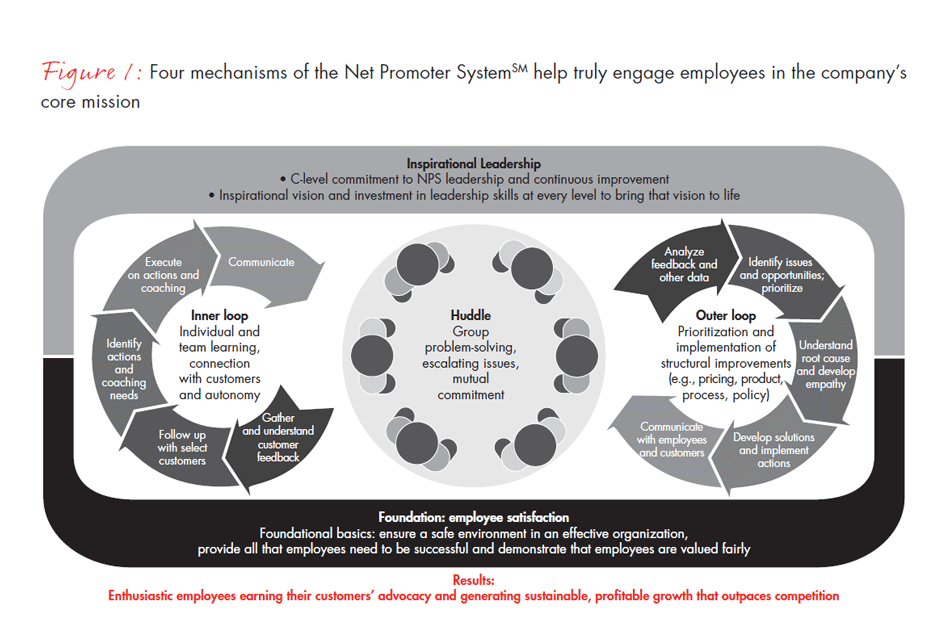
      The employee Net Promoter SystemSM—eNPS for short—uses four simple mechanisms to answer these questions (see Figure 1). Let’s look at each one in detail.

      energetic-enthusiastic-and-creative-fig01_embed

      The “inner loop”: high-velocity closed-loop feedback, learning and action. One cornerstone of any Net Promoter System is a disciplined method of gathering feedback from customers immediately after a transaction or interaction. The company asks customers, on a scale of zero to 10: How likely would you be to recommend this company or product to a friend or colleague? It also asks customers why they gave the rating they did, inviting them to describe what they liked or disliked about the interaction. This feedback flows directly and rapidly to the individuals and teams responsible for the customer’s experience, both frontline employees and people inside the organization (such as product designers) whose decisions affect customers. The employees see trends in the scores and hear the voice of the customer immediately—sometimes literally, if they’re listening to recordings of phone calls offering feedback.

      Employees then close the loop, following up with customers to learn more about what went right and what went wrong. When possible, they fix problems the customer encountered or flag the issue for team attention, alerting the customer to the outcome. Closing the loop is a critical step, and not just because it makes customers feel heard. Many employees, after all, don’t normally interact with customers, and those who do are often limited to prescribed transactions. Closing the loop gives people throughout the organization an opportunity to connect with customers on a human level. Positive interactions inspire and reward employees, letting them know they made a difference in their customers’ lives. Critical comments motivate people to learn how to address customers’ needs better, because the responsibility for improvement lies with them and their immediate managers rather than with some faraway boss. Over time, customers go from nameless, faceless individuals to flesh-and-blood people with whom the employees can empathize.

      The continuous, repetitive nature of this process is essential. As Malcolm Gladwell reminds us in his book Outliers, people learn through deliberate practice, and they develop expertise through constant repetition: action, observation of the outcome, hypotheses about variation, experimentation, observation of the outcome and so on, over and over again.

      The huddle: regular team meetings and working sessions. Short get-togethers—often called “huddles” after the brief team gatherings in American football when the quarterback calls the next play—take place daily or weekly. The supervisor leads the discussion, and every team member participates.

      The huddle focuses the entire group on the company’s core mission of improving customers’ lives. Employees ask each other: How can we serve our customers better, whether internal or external? What are we doing as a group to improve, and how can we help each other? What help do we need from other people in the company? They describe issues they have encountered, brainstorm ways to solve them and identify problems that need attention at a higher level of the organization. The huddle becomes a place where team members can bond over their shared mission; it’s a safe and rewarding venue to raise concerns and develop solutions.

      It’s also a place where the supervisor can coach and support the team in its efforts to fulfill its mission. At Telstra, the Australian telecommunications company, a manager called in to supervise technicians installing broadband in residences reported that team morale was low and Net Promoter ScoresSM in single digits when he started the job. Every week he spoke to the field techs to highlight examples of great performance, discuss what the team could do to improve, and relate all this to the feedback each individual had received. The team’s Net Promoter Scores improved 45 points in three months (see below, “Telstra’s employees: top-to-bottom customer centricity”).

      Rob Markey, a global leader in the Customer Strategy & Marketing practice, discusses how companies can create an environment where employees bring their best to work every day on behalf of the company.

      The “outer loop”: identifying and tackling systemic issues. In a high-functioning Net Promoter® company, frontline teams deal with many issues themselves, creating new service protocols, for example, or helping each other learn to be more responsive to customers. They escalate issues that require involvement from higher-level managers or across functions. The company establishes a rigorous process, often through a customer advocacy office, to identify, prioritize and pursue these issues.

      This outer loop system tracks trends in customer feedback, investigates root causes of issues, develops and launches initiatives and communicates the results to employees and customers. Careful management of the process ensures that employees’ voices are heard, and that they have the support of the organization in achieving their mission. It also lets senior leaders see the organization’s progress in achieving customer centricity. Any company that adopts the Net Promoter System considers customer centricity a strategic priority. These companies gauge their performance relative to that of their peers using competitive benchmark scores, which many companies treat as seriously and rigorously as financial results.

      Inspirational leadership

      While customer centricity is not primarily a top-down affair, it requires support from the top as much as it needs the involvement of the rank and file. Senior leaders at NPS companies usually get personally involved in the process. They allocate the necessary resources to the system. Many even participate in day-to-day activities, such as making follow-up calls to understand what it’s like to be a customer and what it’s like to be at the front lines serving those customers. These leaders demonstrate their personal commitment to customer centricity in how they spend their time, the questions they ask and how they address daily issues. They often play an active role in training, and they oversee the outer-loop processes that help coordinate functions and eliminate roadblocks.

      Build a solid foundation

      Of course, these four mechanisms must rest on a solid foundation of employee satisfaction. People can bring energy, enthusiasm and creativity to the workplace only if they feel that the fundamentals of their job are on track. Employees need the tools and training necessary to do their jobs well. They must believe that their compensation and benefits are fair, and they must trust their supervisors and managers. In eNPS companies, employees must also feel that managers listen and support them, that their huddles are effective and that they are rewarded for doing the right things for customers. 

      So eNPS companies ask employees: How likely would you be to recommend this company to a qualified friend as a place to work? They also ask employees the reason for their rating. Responses are anonymous to ensure candor, and they flow directly to team leaders. These “pulse checks” complement the huddles. They give supervisors insights into, and a chance to address, concerns that employees might hesitate to express in public. Just as it does with customer feedback, the company monitors the issues teams raise, tracks the response and communicates any results back to the people who raised them. It also creates regular reviews to share best practices throughout the organization.

      When the foundation is in place and the four mechanisms are working, the cumulative effect is to engage employees in ways that extend well beyond the usual definition of engagement. Employees at veteran Net Promoter companies understand the importance of delivering a great customer experience and take the lead in figuring out how to do so. When they need help, they ask for and receive it. They know the company listens to their concerns because they can see the evidence week in and week out. It’s little wonder that they create a lot of promoters among customers. After all, many of those employees are promoters themselves.


      Telstra’s employees: top-to-bottom customer centricity

      Telstra, the big Australian telecommunications company, has developed effective methods of involving employees throughout the organization in the company’s NPS. Here’s how the company puts the eNPS mechanisms to work:

      • Closed-loop feedback. Telstra continuously collects Net Promoter feedback after key episodes (such as buying and activating a phone) or interactions (such as contacting a call center or walking into a retail store). Employees who can use this data to improve the customer experience have access to it in real time through an on-demand portal.
      • Regular team meetings. Every team at Telstra holds a “T-time” meeting either once a week or once a month. Frontline teams in the field, in contact centers and in retail stores meet at least weekly and often daily. The meetings review scores, highlight positive performance and identify actions the team can take to improve the customer experience. Every team also goes through an exercise to determine its line of sight to the customer, discuss its role in improving the customer experience and identify what members can do differently. Support teams such as legal, communications and finance have been among the most enthusiastic adopters of this routine.
      • Outer loop. When teams at Telstra can’t solve an issue themselves, they escalate to higher levels of the organization through a system called T-Solve. A central office triages and prioritizes ideas and passes them along to the appropriate owner. The company also reviews all strategic and operational NPS data to spot the issues that customers perceive as most important. A team then identifies potential “must win” initiatives—actions that address the root cause of specific issues and promise to move the needle on Net Promoter Scores. It assesses issues on the basis of coverage (how many customers will be affected), impact (what the effect on NPS will be) and timing (when customers will notice a difference).
      • Senior leader involvement. Telstra’s top leaders walk the talk in terms of commitment to customers. They involve themselves in follow-up calls. They participate in a regular decision forum known as the Advocacy Board and discuss progress with the CEO in quarterly advocacy review meetings. Every leader receives a text message every day with his or her unit’s NPS results. The CEO calls managers with very high scores to offer congratulations, and managers with very low scores to explore the reasons.

      Rob Markey is a partner and director in Bain & Company’s New York office and leads the firm’s Global Customer Strategy and Marketing practice. He is coauthor of the best seller The Ultimate Question 2.0: How Net Promoter Companies Thrive in a Customer-Driven World.


      energetic-enthusiastic-and-creative-fig01_full
      Authors
      • Headshot of Rob Markey
        Rob Markey
        Advisory Partner, Boston
      Contact us
      Related Consulting Services
      • Net Promoter System®
      • Sales and Marketing
      How We Can Help
      • Net Promoter®
      Loyalty
      Net Promoter for People: Give Employees a Voice, Get Their Best

      Net Promoter® for People is about empowering employees to bring energy, enthusiasm and creativity to delight customers.

      Read More
      Loyalty
      After Years of Customer Loyalty Programs in Insurance, What Works, and What’s Next?

      Based on Bain’s 10 years of research, five themes describe the progress and challenges of earning customers’ advocacy in an increasingly digital experience.

      Read More
      Net Promoter System®
      How Banks Can Tease Out the Loyalty Metrics That Matter

      Measuring performance on the key episodes for a bank’s customers allows the bank to focus on investments that will improve loyalty—and its economics.

      Read More
      Loyalty
      Customer Behavior and Loyalty in Banking: Global Edition 2023

      Banks’ big challenge is the great unbundling by consumers.

      Read More
      Loyalty
      Speaking the Five Languages of (Customer) Love

      For Valentine’s Day, try wooing customers as you might a love interest.

      Read More
      Published in November 2014
      Tags
      • Loyalty
      • Net Promoter System®
      • Net Promoter®
      • Sales and Marketing

      How We've Helped Clients

      Support Functions Resetting Shared Services to Save $75 Million

      Read case study

      Transformation Transformation sparks financial leader's turnaround

      Read case study

      Transformation Turning around a pioneering service for working parents with sick children

      Read case study

      Ready to talk?

      We work with ambitious leaders who want to define the future, not hide from it. Together, we achieve extraordinary outcomes.

      Stay ahead in a rapidly changing world. Subscribe to Bain Insights, our monthly look at the critical issues facing global businesses.

      *I have read and understand Bain’s Privacy Notice.

      Please read and agree to the Privacy Policy.
      Bain & Company
      Contact us Sustainability Accessibility Terms of use Privacy Modern Slavery Act Statement Cookie Policy Sitemap Log In

      © 1996-2026 Bain & Company, Inc.

      Contact Bain

      How can we help you?

      • Business inquiry
      • Career information
      • Press relations
      • Partnership request
      • Speaker request
      See all offices