


Brief

|
|
Feedback. They call this feedback? The latest customer-satisfaction data had just come in from the vendor, and Sonja gazed at the screen in frustration. The needle hadn’t moved much this quarter—94% of the company’s customers still pronounced themselves “satisfied” or “very satisfied.” So why had those two big accounts suddenly put their business out to bid in the last eight weeks? How could they be satisfied if they were deciding to solicit other suppliers? And why on earth hadn’t we known about it in advance? Quickly she scrolled through the charts and tables. Response rate, 22%. Not much different from before. But who was responding? This was a B2B company, and its customers were big organizations. Probably 20 or 30 individuals at each one influenced buying decisions, with varying levels of clout. Yet the data offered no way to find out who the respondents really were—just vague job categories aggregated among all customers. And anyway, what did it mean that we got no feedback at all from more than three-quarters of the people who use our products? Sonja frowned. She would have to present this report next week, and she could already hear the snide remarks: “We’re wasting too much money on this stuff. Nobody reads it.” “Put yourself in our customers’ shoes—would you want to be filling out another dumb survey every few months? Besides, our sales reps already know all they need to know about our customers.” Right, she thought. The reps know so much that they had no clue those two accounts were going out to bid. She wondered if she could find some tactful way to make that point. As for the other objections, well, they seemed more or less on target. But what was the alternative—no feedback at all? She didn’t know. Better just get to work on the presentation. Sighing, she pulled up PowerPoint. Nearly every large B2B company solicits feedback from its customers, often in the form of quarterly or semiannual satisfaction surveys. But many of the executives my colleagues and I talk to report the same frustrations as our fictional Sonja. Some vendors’ surveys include so many questions that response rates plummet. Many ask for a long series of multiple-choice responses that provide lots of statistics but none of the detail that brings feedback to life. The data arrives in the form of big statistical reports, usually a couple of months after the survey closes. The numbers offer precious few insights into crucial questions such as whether and why a customer might be thinking of leaving. The Net Promoter SystemSM in a B2B setting also solicits feedback from customers. But that’s where the similarity to conventional methodologies ends. This system’s twin goals are to foster customer engagement and build strong client relationships. It isn’t so much a survey method as a means of facilitating relationship-enhancing conversations. It helps sales reps and account managers get involved in solving customers’ problems. It shows marketers and product designers and service engineers ways to make the customer’s experience better. The feedback it provides is continuous: It offers granular insights into what is troubling or delighting any given customer at any given time. Rob Markey, a global leader in the Customer Strategy & Marketing practice, discusses how the Net Promoter System® can facilitate relationship-enhancing conversations. Let’s look at the steps Net Promoter® companies must follow to implement this methodology. 1. Gather useful feedback The Net Promoter System begins with asking customers for feedback. How useful the feedback will be depends on two decisions. The first decision is which accounts and which people you’ll solicit feedback from. Most B2B companies have a “top 10” or “top 30” list of strategic accounts— typically the customers who buy the most and get the most attention from sales reps and management. Often, the account teams for these customers feel very close to them and claim to know everything about them. But the larger the customer, the more likely that there are some hidden problems within its organization. You won’t know until you ask. Further down the customer list will be a large number of accounts that generate relatively little revenue per customer. These bear scrutiny as well. Is the data on them up to date? Do they promise growth, profitability or both? To what extent should their feedback be solicited alongside that of the larger, more important customers? Moreover, B2B suppliers often sell multiple product lines to a single customer organization and have relationships with several of the customer’s business units. Companies need to prioritize these sub-accounts as carefully as the overall customer list. Of course, this process is complicated by the fact that organizations don’t respond to feedback requests—individuals do. And many different people in a customer’s organization are likely to be involved in buying decisions. To ensure that you’re hearing from the right people, you’ll need to make certain your account managers have accurate and thorough maps of their accounts. Who in the customer’s organization is responsible for approving vendors? Who makes buying decisions for each kind of equipment? Who influences those decisions? The decision-rights tool RAPID® is useful in this context: Account managers can identify Recommenders, Agreers (those who must OK a recommendation), those who have Input into the decision and those who Decide. The company can then check the map against the customer’s org chart. If you are selling radiology equipment to hospitals, the director of radiology needs to be on the map; the director of oncology or orthopedics may need to be on it as well. If you are selling scientific supplies to a biotech company, you need to make sure you are hearing both from procurement officers and from the scientists who use the supplies. It isn’t uncommon to wind up with up to 30 names from each customer organization. The important principles here are to solicit feedback broadly within an organization and to maintain clarity about the role of the people responding. Procurement people may assess your offerings primarily on price, delivery, terms and so on. End users are likely to judge you more on features, ease of use and service. If some respondents are detractors—people who don’t like doing business with you—you need to determine their roles before you consider changing your policy or products to accommodate their objections. The second decision concerns what to ask and how to ask it. Net Promoter feedback is focused and brief. A B2B questionnaire might simply inquire how likely a customer would be to recommend the company (on a zero-to-10 scale) and why they gave the rating they did. Some companies solicit feedback by phone, others prefer email and still others offer clients a choice. The timing of the request for feedback may be triggered by a particular interaction, such as the purchase of a piece of equipment, or it may be based on the calendar (every six months, say). Before the questionnaire goes out, the account manager places calls to prospective respondents requesting their participation. If they decline, they are not included. Outside vendors usually conduct phone surveys. Emails can come directly from account managers, with a link to the questionnaire itself. In either case, the request for feedback includes an invitation to receive a follow-up call. 2. The inner loop and huddle: Use the feedback to engage in direct dialogues with customers Every Net Promoter request for feedback generates a score along the zero-to-10 scale. But what matters most in a B2B context isn’t the aggregate score for a customer organization, which depends heavily on who is responding to the request for feedback. Rather, it’s the individual scores provided by people who play key roles in buying decisions. Even then, respondents’ verbatim comments are far more important than the score they give. Unlike the score, the comments open the door to a meaningful conversation about what can be done to improve the customer’s experience (see Figure 1). 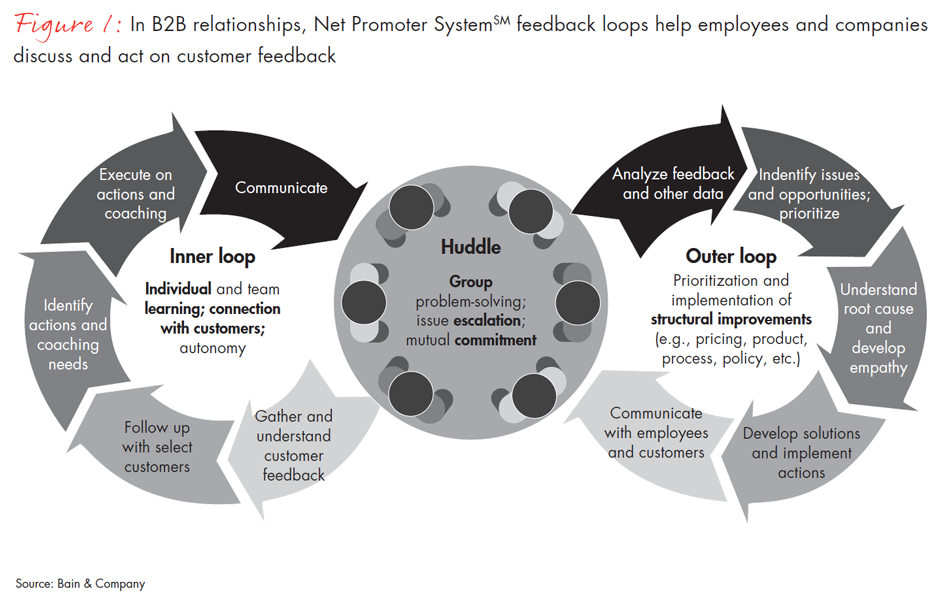 As the scores and verbatims come in, they are delivered immediately to every relevant member of the account team, along with anyone else who should see them. The feedback doesn’t need to be analyzed at this point— you can just pass along the raw responses. Account managers or their designees then place follow-up calls to learn more about individual responses, understand the customer’s concerns in more detail and (if necessary) follow up on any unresolved issues. Calls should go out to detractors (people who gave a rating of zero to six); to everyone who asked for a follow-up conversation; and to every respondent who indicated that he or she had something significant to say about the company’s products, services or the relationship between company and customer. These calls are not sales conversations. Nor are they meant to be a defense of the company or its employees. The caller’s job is to close the loop: to probe for specific experiences and complaints, to understand them in detail, to demonstrate real empathy for the customer’s experience and to explain how he or she proposes to address each unresolved issue. While these follow-up calls take some skill to execute well, they can generate deep insight. Typically, they prove highly rewarding for both the customers who are called and the employees who call. At this point the account team comes together in a huddle. Members look at all the feedback they have received. What are we seeing? What are the implications of what our clients have said? The team determines which concerns it can address on its own, by modifying behaviors or procedures. It also determines which concerns need to be addressed at higher levels or in other functional groups of the organization, and it passes that information along to the appropriate people, including the central Net Promoter team or customer advocacy office (CAO). Often, it will happen that the account team has been well aware of an issue but has been unable to get the other groups to focus on it. Now, armed with comments from customers, the team is far more likely to spark action. The account manager then goes back to his or her contacts in the client organization and engages in a conversation with the key people there. This is the feedback we heard. Here are our observations about what we can do to deliver more value. Here are some of the specific measures we’re planning. The manager may also offer observations about how the client organization could do things differently to derive more value from the relationship. The conversation should be candid, give-and-take, held in person when possible and on the phone when not. It should include commitments on both sides to take action and to follow up with every relevant individual. 3. The outer loop: Analyze the feedback across the organization; identify and prioritize initiatives The feedback and follow-ups from every account team in the organization flow to the central Net Promoter team or CAO, which can then identify broader issues and patterns. The feedback might let the central team see whether there are some roles in client organizations that the company consistently overserves or underserves. It might help the team identify types of customers whom the company serves particularly well or particularly poorly. Typically, analysts code the verbatim responses—including both positive and negative mentions—to help identify such patterns. The “buckets” for coding might include price, the sales process, setup, the product itself and service, with several sub-buckets in each category. Summarizing the feedback enables the central team to provide full dashboard reports to operating managers, including scores, granular response rates, verbatim summaries and follow-up status. Group leaders can see additional reports comparing NPS ratings and penetration for each account; they may also notice specific issues, such as a sales team that is out of its depth and needs more help. The team is also accountable for identifying and prioritizing issues and opportunities that cross functional or businessunit lines, and for launching initiatives to address them. Cummins Engine, for instance, learned from its customers that it wasn’t responding quickly enough to product issues that arose in the field. So it created an initiative called Project Speed, which gave the service engineering team authority to implement temporary fixes in the field until Cummins could get a permanent solution into production. All these steps need to be evaluated. Net Promoter companies track not just account penetration and participation rates but also follow-through and issue resolution. The company’s central team or CAO maintains a database and monitors progress across the organization. • • • Customer feedback is essential in any B2B organization, but there’s no reason for executives like Sonja to feel as frustrated as they do. The Net Promoter System offers feedback that gives them the information they need when they need it, along with processes and mechanisms to ensure that the information is acted on and incorporated into future decisions. The conversations it inspires bring company and customer into an ever-closer relationship. Net Promoter® and NPS® are registered trademarks of Bain & Company, Inc., Fred Reichheld and Satmetrix Systems, Inc. Net Promoter SystemSM is a trademark of Bain & Company, Inc., Fred Reichheld and Satmetrix Systems, Inc. RAPID® and Results Delivery® are registered trademarks of Bain & Company, Inc. Rob Markey is a partner and director in Bain & Company’s New York office and leads the firm’s Global Customer Strategy and Marketing practice. He is coauthor of the best seller The Ultimate Question 2.0: How Net Promoter Companies Thrive in a Customer-Driven World. |