


Brief


|
|
It is difficult to find an article or commentary about the future of the electric grid and distributed energy resources (DERs) that does not exude a sense of breathless enthusiasm and boundless potential. Electrification, decentralization and digitalization are converging to create a smarter and more connected electric system that promises to increase reliability, security, environmental sustainability and asset utilization, while opening new opportunities for services and business, especially downstream. Of course, utility executives bring a seasoned perspective to these projections, as they recognize the real-world challenges that stand between the current system and a more efficient, sustainable and distributed future. This transformation and the grid-edge technologies enabling it will require changes in customer behavior, blur the traditional boundaries between producers, distributors and consumers, and make the management of the system more complex. One of the key considerations will be cost, and utility executives will be among the market participants trying to determine how to manage this transition cost effectively. For example, research by the National Renewable Energy Laboratory finds that while distributed solar generation can provide locational value in some cases, it can cost more as a widespread solution than centralized solar generation. Distributed generation misses out on some of the economies of scale found in larger, centralized models, and companies incur marketing and sales costs that are not necessary for utility-scale arrays (see Figure 1). 
Harnessing New Technologies at the Edge of the Electric GridElectrification, decentralization and digitalization are creating a smarter and more connected electricity sector. Another significant challenge will be engaging consumers to achieve widespread adoption of grid-edge technologies. Some consumers are becoming more interested in their energy use because they share concerns about reliability, security or the environment. However, as with any new technology, grid-edge innovations follow a familiar adoption curve, with early adopters leading the charge, followed by those looking for cost savings and finally joined by the late adopters (see Figure 2). Experience shows that it can be difficult to get consumers to adopt new technologies unless there are clear benefits of cost or convenience. An important issue for policymakers and other participants in the electric ecosystem will be how to accelerate adoption of new grid-edge technologies in a cost-effective way. It would not be feasible to subsidize mass adoption by consumers, so policymakers will have to use a combination of “push” from regulatory and policy action and “pull” from private innovation, marketing and product development. 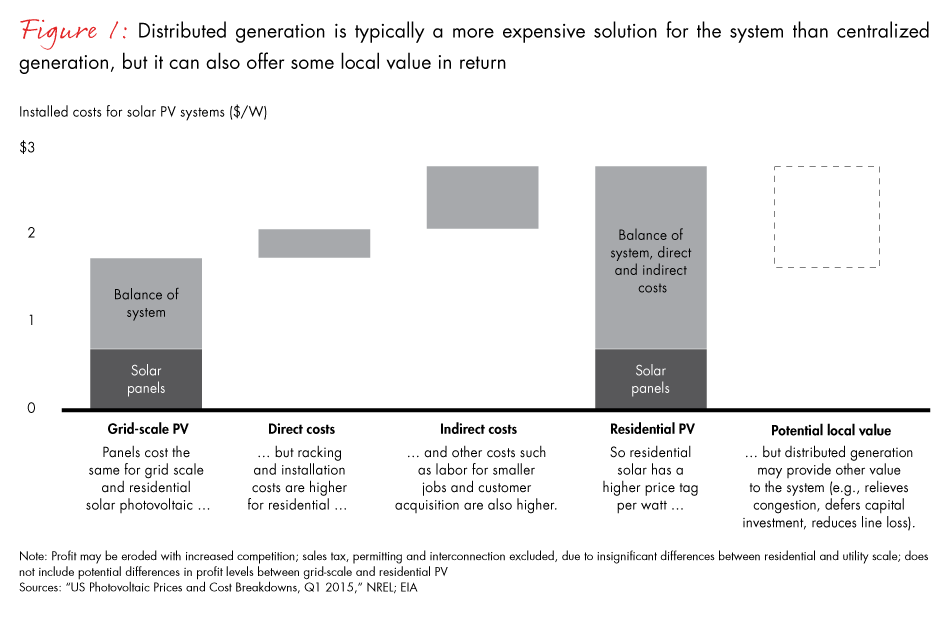 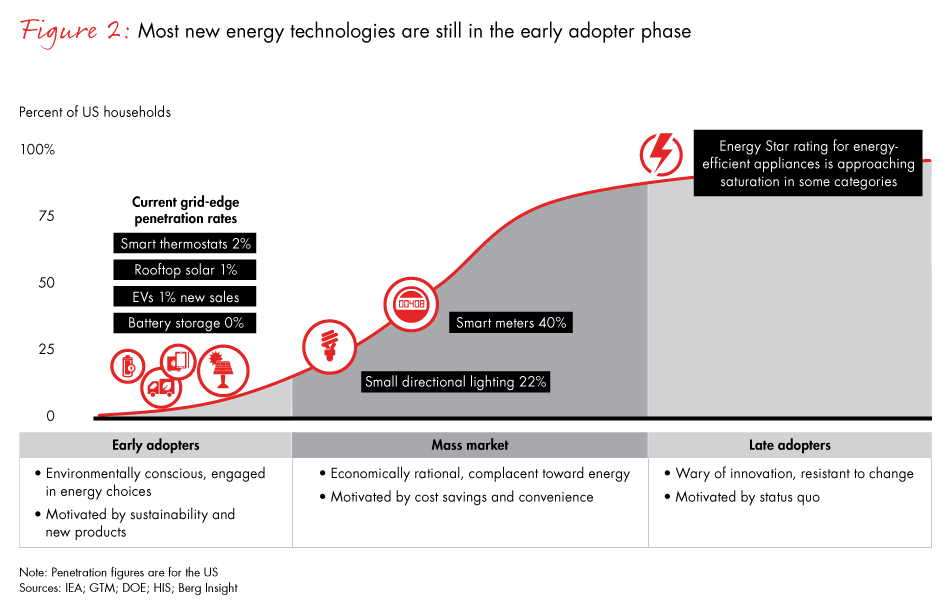
Given the tremendous value at stake, utility executives are already working to resolve these challenges and to position their organizations to benefit from three transformative trends:
Utility executives will have to acknowledge the future potential and current realities of these trends to understand where they should apply their efforts to ensure their organizations are prepared for the transformation and to be able to meet the needs of their customers and investors. Our work with the World Economic Forum, the most recent installment of a multiyear effort aimed at understanding the Future of Electricity, identified four areas in particular in which industry executives can play a leading role in managing the transformation (see Figure 3). The four areas, outlined in more detail in WEF’s March 2017 report, The Future of Electricity: New Technologies Transforming the Grid Edge, are:
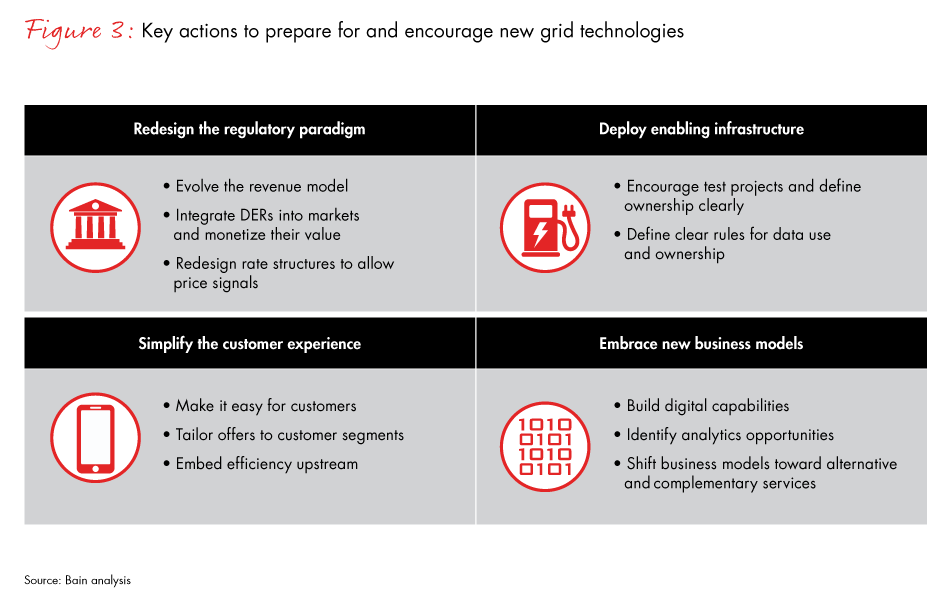 Redesign the regulatory paradigmUtilities will need to work with regulators to update the rules governing the industry if they are to foster innovation, open new roles for distribution network operators and facilitate the integration of distributed energy resources. Evolve the revenue model. The revenue model should evolve around two main principles: regulations based on outcomes and a utility earnings model based on total expenditures, rather than just on utilities’ investments in infrastructure. The first approach implies that policies reward players for reaching policy goals (such as energy efficiency, peak shaving or data sharing) instead of prescribing specific technology investments. The second approach changes the incentive for utilities to invest only in additional network infrastructure and encourages them to invest also in non-wire alternatives, including DERs that efficiently solve electrical needs. Integrate DERs into markets and monetize their value. Regulators and utilities will need to find ways to ensure that distributed energy resources are compensated for the actual value they contribute to the electricity system, rather than for meeting other objectives. Tax incentives for rooftop solar panels might consider all panels of equal value, regardless of the value of their output. Evaluating each asset may be more complex, but it would deliver a more accurate representation of their value. Decentralization technologies such as distributed generation and storage, energy efficiency and demand response all help balance the daily load in different ways (see Figure 4). 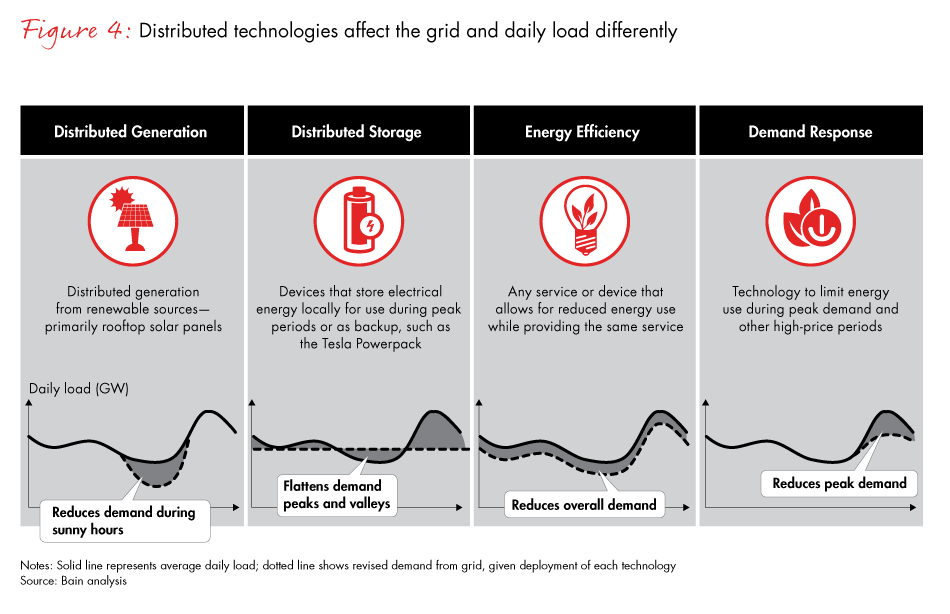 Redesign rate structures to allow price signals. Time-sensitive pricing encourages customers to reduce their electricity use during peak periods, and that can save costs for utilities. This dynamic pricing can reduce peak loads and curb consumption significantly. Some utilities, including several in California and Spain, offer rates that vary by the hour, along with day-ahead prices, so residential and business customers can plan their electricity use accordingly. For these plans to work, the price differences have to be large enough to change consumers’ behavior, and the enabling technology, including smart meters and communication infrastructure, needs to be in place. In addition, as more electricity comes from distributed resources, peak times can shift and time-of-use pricing will need to keep pace with market evolution. Deploy enabling infrastructureAn advanced grid system requires new infrastructure, including smart meters, electricity storage, broadband communication, network control and automation systems, and charging stations for electric vehicles. But uncertainty about ownership and how to recoup the investments hinders the rollout of these essential technologies. Policy infrastructure is as important as physical infrastructure, and policymakers and regulators could do several things to spur investment. Encourage test projects and define ownership clearly. Policymakers can support private sector innovation and investment through test projects like the one on Jeju Island in South Korea. Public-private partnerships are building an advanced smart-grid system that includes automated transmission and distribution, wind and solar power generation, electricity storage and electric vehicle (EV) charging stations. California’s program to deploy 12,500 EV charging stations over the next three years is another example. The most recent phase of the plan, approved by the Public Utilities Commission in December 2016, pairs utility Pacific Gas & Electric Company with privately owned companies that build and install the charging stations in a $130 million effort to deploy 7,500 stations. PG&E will connect the stations to the grid and, once the project is finished, own about one-third of them, mostly at multi-dwelling units in lower-income areas. The private contractors will retain ownership over the rest. Define clear rules for data use and ownership. Smart meters, sensors, remote control and automation systems, DERs and connected devices are all generating lots of data. Regulators need to define the rules of ownership and access for all this information. California, Colorado, Illinois and Texas have already adopted data privacy rules that set standards on how energy usage data can be shared with third parties. A proposal in New York would allow utilities to sell customer data, and includes security provisions to keep data safe. Once data rules are clear, policymakers have a role to play in connecting the data with consumers or others who can use it. The US Department of Energy’s Green Button initiative provides 60 million utility customers in the US with easy and secure access to their energy usage information, which they can then have analyzed by other online services to better understand their energy use. Several other data-sharing models are in place in Europe. In the Nordic countries, transmission system operators (TSOs) manage hubs that store data and control access by interested parties. Germany takes a decentralized approach with communication standards that allow various network operators to collect and distribute data to eligible partners. Blockchain registries also hold some promise for data sharing, although a detailed model has yet to be worked out. Simplify the customer experienceEnthusiasts may embrace new technologies like roof-top solar or electricity storage, but most customers spend only a few minutes a month thinking about their electric service. Digital technologies will make it easier and simpler for consumers to take an active role in their own energy management. Make it easy for customers. Customers want experiences that are simple and intuitive. Complexity hinders adoption in any industry, especially in this one where most customers may not fully understand the technology behind the products and services. Utilities and private companies are experimenting with new products and services that can draw consumers into a more active role. Google’s Nest thermostat is one successful example. It learns customers’ schedules and automatically adapts and programs itself. Nest says the devices have saved 8 billion kWh for its customers since 2011. Over time, other household appliances are likely to take on similar capabilities, responding to dynamic price signals and charging and discharging at optimal times. Another example is ChargeForward, a demand-response program piloted by BMW and PG&E in Northern California. The program allows the utility to send real-time signals to BMW when electricity demand is peaking. BMW can then limit the charging of some of its customers’ EVs, up to an hour delay each day. Owners receive some of the savings back, and they can opt out anytime if they need the charge sooner. In these and other programs, customer choice is important, but opt-in schemes receive less participation than opt-out plans. In Sacramento, California, a pilot program of the Municipal Utility District found that when customers were automatically enrolled in time-of-use rates, 90% stayed in the program. For a different group of customers who were invited to join the program, only 15% to 20% signed on. Regulators across California now consider participation the default option. Tailor offers to customer segments. Utilities have traditionally treated residential customers in a one-size-fits-all fashion, rather than segmenting them according to their needs, as other industries do. Digital technologies are changing that, allowing for new types of segmentation—not just by load size or residential vs. commercial, but also by their usage patterns, receptiveness to using digital technology or sharing data. This will allow utilities to offer more personalized services, including rate plans, real-time data on energy consumption and customizable bills. Embed efficiency upstream. Embedding standards and incorporating smart capabilities in household appliances and grid-edge technologies in new buildings has proved to be a useful way to speed up adoption of energy-saving technologies and reduce consumption. The phase-out of incandescent bulbs in the US between 2012 and 2014 is one such example of an upstream move that led consumers to more energy-efficient options. Incorporating smart capabilities into new buildings is also an effective way to future-proof buildings, including technologies such as electricity storage and building-integrated photovoltaics (BIPV). Embrace new business modelsFor executives of utilities and other companies in the electric sector, the greatest organizational task of the moment is to equip organizations with the capabilities they need to thrive as the industry evolves. Build digital capabilities. Digital transformation offers new opportunities for utilities, but most will need to build or acquire new capabilities to support their expansion from asset-intensive businesses to more complex organizations that also offer services and digital platforms. For example, retail utilities will see fewer customer interactions in their call centers and more online and on mobile. Energy service companies working with the commercial and industrial sectors will require fewer field technicians and more engineers who can manage energy installations remotely. All of this will require executive teams to rethink the way they deploy IT skills as they adopt more Agile methods and upgrade security to manage the risks inherent in a digital era. Identify analytics opportunities. Utilities will also have to get better at adopting and employing advanced modeling techniques to discover insights in data. Some utilities are beginning to complement their existing workforces with data-savvy talent that brings advanced analytics, modeling and visualization skills to bear on these efforts. As their analytics capabilities evolve, utilities will need to adopt more rigorous standards for capturing, storing and managing data. Cleaning up and restructuring data can be a major challenge, but more organizations are gaining the necessary capabilities that will allow them to glean valuable insights. Some leading utilities have created small centers of excellence within their organizations, tasked with advanced analytics projects. These teams typically combine skills from the business with more advanced data-science capabilities. Once teams are in place, they help raise the bar for analytics in the company, identifying and acting on opportunities with the highest potential value, such as optimizing asset repair and replacement decisions and accurately predicting outage restoration times. Shift business models toward alternative and complementary services. Integrating and exploiting distributed energy resources in the electricity system will open up new revenue streams, at both the distribution and retail levels. Distribution network operators could offer new services, including the qualification, verification and financial settlement of distributed energy resources—compliance obligations that are required and similar to traditional generators. At the retail level, utilities could offer a full set of services related to distributed resource management, provision, operation and installation. Grid-edge technologies are leading the electric industry to a new future, one that could deliver increased benefits to customers and fresh opportunities to utilities and other service providers. Policymakers and regulators have their roles cut out for them, reshaping the rules that govern the industry—not only to encourage customer adoption of grid-edge technologies but also to encourage the sector’s incumbent utilities to play a sustainable economic role in future developments. Utilities are well positioned to accelerate deployment of these technologies, given their perspective on where these technologies deliver the best returns, their experience balancing trade-offs to meet electricity demand in the most cost-effective ways, and their proven ability to ensure interoperability and reliability of the grid. Working with policymakers, regulators and DER participants, utilities have a once-in-a-generation opportunity to reshape their industry in ways that will benefit customers and investors alike. Grid-Edge Technology SolutionsBain’s work with the World Economic Forum as part of the forum’s Future of Electricity initiative identified a set of recommendations for businesses and policymakers for each of the major grid-edge technologies.
The authors would like to thank Anas Kaakeh, a manager in Bain's Dubai office, for his contributions to this work. Joseph Scalise and Joe Herger are partners with Bain & Company in San Francisco, where Christophe Guille is a manager. All three work with Bain’s Global Utilities practice. 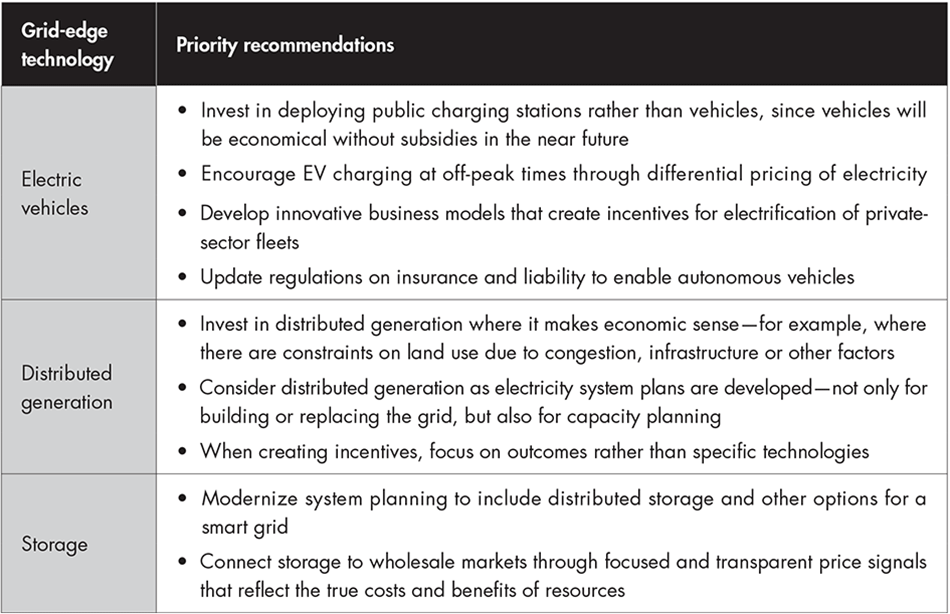 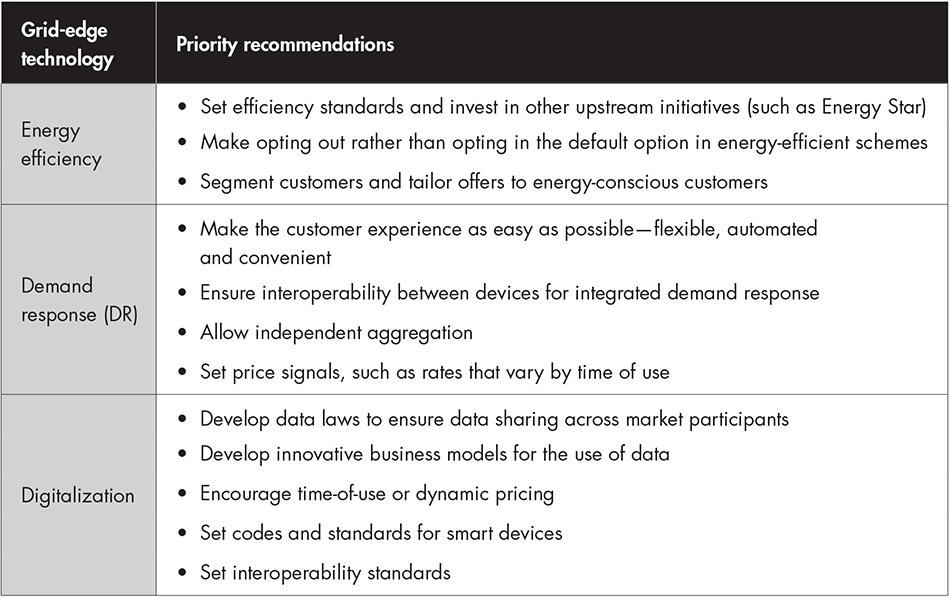 |