


Brief


|
|
When Bain & Company recently surveyed 1,000 companies around the world to gauge their level of digital readiness, two things became abundantly clear: The payoff from digital transformation can be impressively high, but the success rate is regrettably low. This gap between aspiration and reality may help explain why a surprising number of leadership teams remain tentative about investing in digital technologies and capabilities. While a strong majority of companies in every industry we surveyed told us that digital investment is among their top priorities, anecdotal evidence suggests that a great many executives are skeptical that they can translate the buzz around digital into meaningful improvements in performance. What’s clear from the data, however, is that the prize is there for the taking. Digital leaders in every industry outperform their competition by a wide margin. After comparing financial results for five categories of companies based on their degree of digital sophistication, we found that revenues at digital leaders grew more than twice as fast as those at digital laggards. Profit followed a similar pattern—leaders were nearly twice as likely as laggards to increase profit. These findings leave little doubt that digital transformation can yield significant results. 
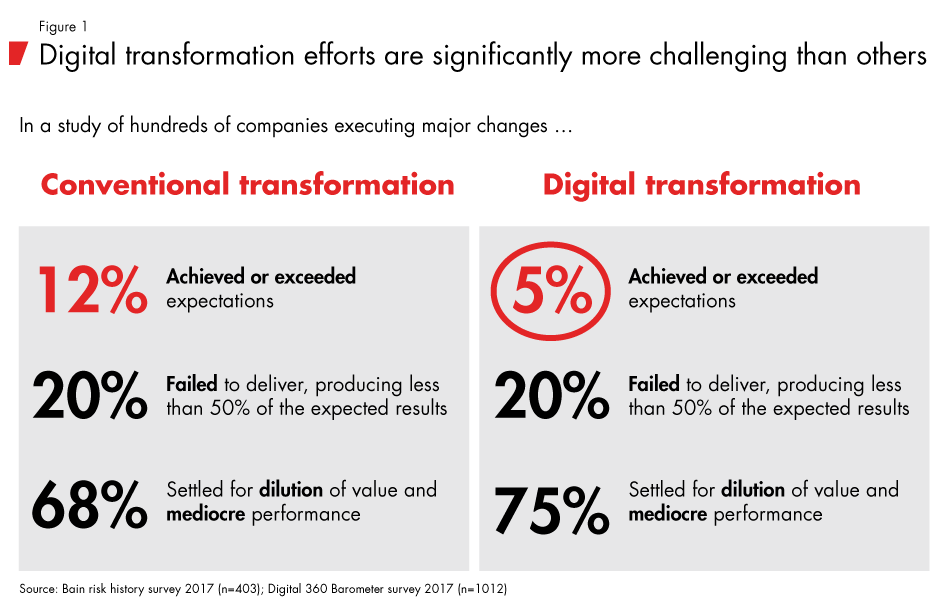
More Digital Transformation InsightsDigital transformation is a topic of rich and vital discussion in boardrooms and among executive teams around the world. Here are some insights on what it takes to lead and deliver a digital transformation. Capturing those gains is another story. The data shows that digital transformations are significantly harder than conventional change management programs (see Figure 1). In our survey, just 5% of those companies involved in digital transformation efforts reported that they had achieved or exceeded the expectations they had set for themselves (vs. a success rate of 12% for conventional transformations). A full 75% of these companies settled for dilution of value and mediocre performance. What goes wrong? The typical digital transformation effort founders on the sheer complexity of using technology to increase a company’s speed and learning at scale. Even if some traditional companies are used to innovating in the product development realm, few are adept at rapidly deploying digital technologies to solve problems and boost performance across the organization. Most leadership teams understand the opportunity but underinvest in the broad changes to the business model and culture that enable speed, learning and agility. They focus more on what we call the “outer game” of digital investment—“Should we work on customer engagement or the supply chain?”—and less on the “inner game”—“Do we know how to choose the right investments, test them in real time and scale them for maximum impact?”
 Winning is about inner-game orchestrationAmong the five categories of companies in our research, the most advanced digitally achieved the best balance between the inner and outer games (see Figure 2). Those just embarking on digital transformations typically start from a set of isolated initiatives targeting their most acute pain points (the outer game), but they struggle to translate these prototypes into products and capabilities that can have a meaningful impact on the company’s economics. More advanced businesses do a good job of clustering digital initiatives around a common strategic ambition and start to focus on improving select enabling capabilities, particularly IT. But these initiatives also tend to plateau somewhere short of broad organizational impact or end up creating “two-speed” organizations that are responsive in limited respects but still held back by legacy systems. The true digital leaders pull away from the competition by linking a bold strategic ambition to the specific inner game capabilities and behaviors that they will need to achieve it. First they translate their strategy into a clear set of digital initiatives that point the organization toward a clear vision of full potential. Then they invest heavily in the fundamental changes to their ways of working and culture that allow them to develop those initiatives rapidly and execute them at scale. 
How Prepared Is Your Company for Its Digital Transformation?This diagnostic provides a quick snapshot of your digital readiness, and guides you on next steps. If this sounds like a recipe for ripping up everything at once, it often is—digital transformation involves change at every level of the organization. But careful and deliberate orchestration makes the problem manageable. These interconnected companies learn to break big ideas down into well-defined waves of practical, achievable stepping-stones that offer steady, incremental progress. They create what amounts to a digital factory that industrializes the process—prioritizing the best ideas, nurturing them, testing them and ultimately scaling them into game changers. Collectively these waves of innovation build to sustained levels of superior performance over time. They allow for headway across many fronts simultaneously without overwhelming the organization. 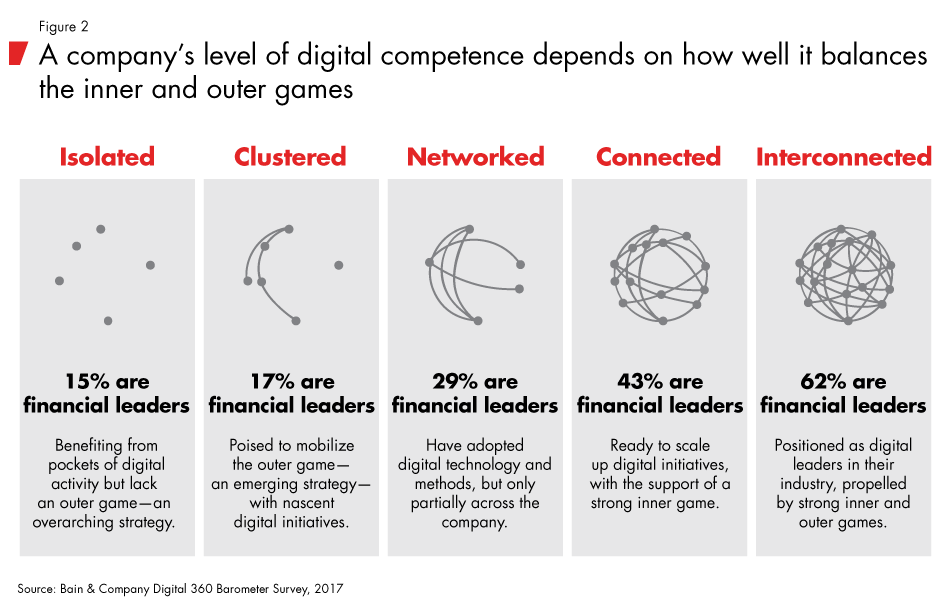 The three things great orchestrators doGreat orchestrators recognize that most companies aren’t lacking in ideas about how to put digital technology to work. The challenge is figuring out how to harness those ideas into a coherent set of strategy-based initiatives that can have broad, meaningful impact. Ideas come from everywhere—the center, the business units, the front line, partners. But if left to grow in their own corner of the organization the result is typically a well-tailored local solution that is rigorously unscalable to the rest of the company. Great orchestration boils down to a system that identifies the ideas with the most potential to have enterprise-wide impact and then rallies the organization around them, top to bottom. This requires a coordinated effort at all levels of the corporation—alignment at the top, agility in the middle and mobilization at the front line (see Figure 3). 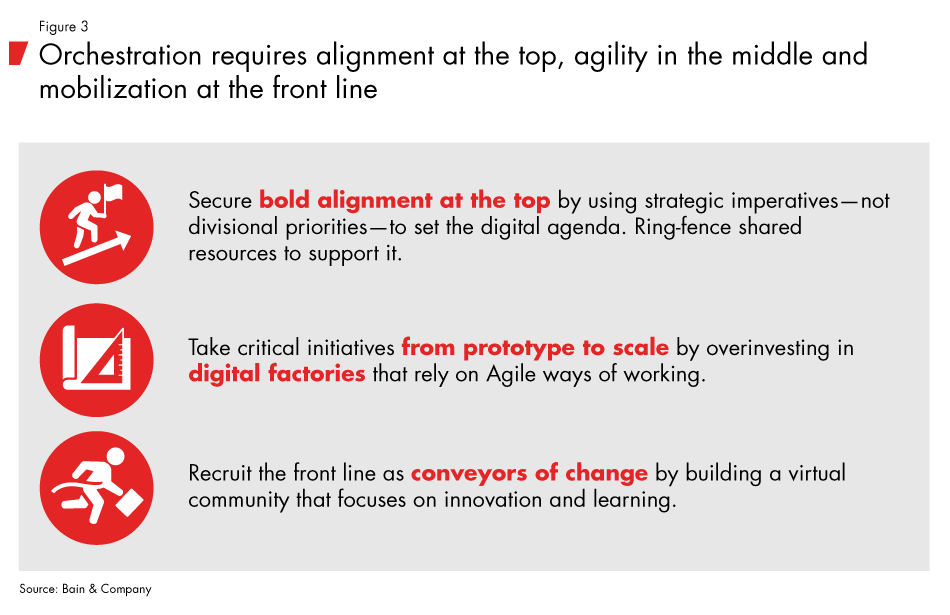 Less is more: Alignment at the topAny discussion of strategy begins with making sure that everybody is on the same page. So it’s no surprise that our survey respondents cited executive alignment as the No. 1 factor in successfully executing a digital transformation. In our experience, however, alignment is a loose concept. Agreement on broad strategic principles can often mask sharp disagreements over the specifics. It’s relatively easy, for instance, to agree on which direction digital is taking your industry, but infinitely harder to forge alignment around how to prioritize particular initiatives and support them with the right resources. This is because each member of the executive committee typically focuses on his or her own digital agenda—the business units focus on market issues, IT is preoccupied with worn-out legacy infrastructure, human resources is all about behavior change, and so on. There’s also natural tension between the corporate center and the rest of the company, which often tends to think the top executives are remote and out of touch with what’s really happening in the market. The right kind of alignment bridges these gaps by confronting a fundamental challenge—the best ideas for game-changing initiatives most often come from deep within the organization, but their success depends on the ability of top executives to spot them, elevate them and support them with the right kind of investment. In markets roiled by digital disruption, companies need a fast process for both surfacing great ideas and getting behind the right ones. This typically requires critical changes to corporate behaviors. The most effective leadership teams learn how to establish a common understanding of priorities and allocate resources against them based on clear rules and governance—rules that emphasize gang-tackling the most important priorities rather than spreading resources evenly across everyone’s pet project. The key is to use real-world data to establish alignment so the entire team agrees on how to execute at the front line. That forces business unit chiefs to cast off the “what’s best for my organization” agenda and embrace a new perspective: “How can my organization contribute to a cross-functional effort to bring this critical set of digital initiatives to life?” When one advertising company decided to accelerate its march into the digital realm, for instance, all members of its leadership team could agree that digital was forever changing how they interacted with customers. But everyone saw the challenge ahead from a different perspective. Should the company revamp its product suite to match the rise of social marketing? Should it develop self-serve and automated digital channels to complement how it normally interacts with advertisers? How much and how fast should the company build new business models to take advantage of Big Data? To find a way to agree on the right priorities, the leadership team decided to shift its viewpoint. They developed a set of tangible customer personas and identified what critical pain points each one would encounter across a variety of typical customer “episodes.” Once everybody was looking at things from the customer’s point of view—not their own—it became obvious how digital should improve the customer experience. This allowed the executive committee to break down concepts into smaller, actionable initiatives, complete with a planned sequence and an estimate of expected returns. This ensured that their inspirational vision matched the harsh financial realities of the advertising business. Forging this kind of agreement is the first step in creating real alignment. Making sure everyone remains committed to that vision is the second. For one global business-to-business (B2B) service company, that meant using its long-established budgeting process to ring-fence and protect the resources needed to achieve the company’s agreed-upon digital ambition. Each executive committee member pledged to increase his or her cost-management goal to create a discrete pool of investment capacity that they entrusted to the chief digital officer. The digital organization could then use these funds to seed actual in-market digital endeavors that fit the new digital agenda. This approach allowed a large corporation, burdened with the typical quarterly reports and cash generation objectives, to behave more like an Alphabet or Facebook, using its well-oiled core business to fund riskier initiatives aimed at future growth. The digital factory: Agility in the middleAs important as alignment is at the top, the actual work of developing and scaling digital initiatives takes place in the middle of the organization. Great orchestrators assign initiatives to cross-functional teams that use Agile development processes to test prototypes with customers, learn from real-market experience and adapt as necessary in a rapid cycle of continuous improvement and scaling. These aren’t innovation labs in the traditional sense, because they don’t stop with a winning prototype. They are more like factories: They take raw material (the organization’s most promising digital initiatives) and process it via test-and-learn cycles into Repeatable Models® that can be scaled across the enterprise. This design and scaling process begins with problem definition. Very often it involves taking a particularly important customer journey and breaking it down into “moments” that could be significantly improved via digital innovation. Because digital initiatives most often cut across organizational boundaries, speed of execution relies on bringing the right mix of capabilities to bear on a specific challenge. People from, say, marketing, IT and finance may need to be in the same room as those with expertise in data analytics or user-interface design. If those skills aren’t readily available, it may be important to round up expertise from the outside. What’s critical is to give the team authority to make decisions across functions and give it a strict set of deadlines to follow. This enforces the Agile concept of putting a “minimum viable product” in front of customers quickly and improving it incrementally based on real-world customer data. Unless the effort is time-boxed in this way, teams naturally gravitate back toward the big-company habit of overdesigning solutions that are obsolete upon delivery. This burns precious time and resources. It’s no surprise that these Agile ways of working have proliferated at digital native companies whose major products are software based. For them, testing and scaling new initiatives is relatively easy. Spotify, for instance, tests new features directly in its core software engine via smart coding and then rolls out the winners across its platform when they are ready—a quick and effective way to make incremental changes that add up to major enhancements over time. A traditional brick-and-mortar organization, on the other hand, faces hundreds more barriers and long-established industrial processes. Consider the example of a food-service operator looking to offer cafeteria customers a way to place lunch orders in advance via smartphone. This could change its business model significantly by automating many aspects of the current process and considerably reducing queues at the point of sale. But it would also mean rewiring successful systems and behaviors (of both employees and customers) that had been honed through decades of smoothly running the traditional business—a risky and potentially disruptive proposition. The answer was to break the smartphone initiative into smaller steps and test it in discrete local markets with the intent of scaling a successful prototype incrementally. The company started by rolling out menu information on an app to test customer appetite for smartphone-based interactions. It also began to measure the degree of internal change required to make the initiative work. After implementing and testing Step 1 at the local level, it then rolled out the pilot to a meaningful set of other sites, where the team could gather data to further refine the model and see whether it improved return on investment (ROI) at scale. That learning supported the launch of Step 2 at the original sites, which then supported the launch of Step 3. Eventually, some of the company’s early sites were deep into Step 4 or 5, while others were just embarking on Step 1. In this way, the company was able to go wide and deep at the same time, learning from real experience, adapting the business model as necessary and scaling an increasingly sophisticated offering step by step. This last point is essential because the fundamental assumption behind the digital factory is that you will never reach the later steps of the rollout plan as initially envisioned. By the time you get there, the initiative will have morphed many times over based on changing market conditions or encounters with organizational reality. In this case, the process itself is flexible because it is based on iterative cycles of test-and-learn that move closer in successive steps to an ever-changing target. Embedding change: Mobilization at the front linePerhaps the surest way to upend this virtuous cycle of digital innovation is to underinvest in mobilizing the front line. Survey respondents cited this as the biggest potential threat to a successful digital transformation. The typical change initiative gets cooked up at the executive level and pushed down to an often reluctant organization. Successful orchestration, on the other hand, recruits important people on the front line to play a leadership role in developing and executing the digital agenda. This has two critical benefits. It taps the expertise of those closest to the customer and wins converts among frontline stars, who can then evangelize the change among their peers. Populating the digital factory’s Agile teams with frontline leaders is one of the most tangible ways to recruit expertise from those closest to the customer. But the best orchestrators also reenvision how communication works within the enterprise. The food-services company, for instance, has built an intracompany social network using Facebook’s Workplace platform. It has evolved into a vital two-way information conduit between leadership and the rest of the company’s operations. This helps the executive team orchestrate and manage change from the top down, but it also conveys a stream of market intelligence, organizational learning and new ideas from the bottom up. The network is as much about communicating the digital transformation strategy as it is about monitoring the weak signals from the market that can potentially help shape that strategy. Stephan Zech, a partner with Bain's Performance Improvement practice, discusses how operations are key to making digital tranformations as smooth and effective as possible. This virtual community is essentially a sponsorship spine tailored for a digital world. Traditional sponsorship spines support the change effort by creating a chain of mentors and change agents at every level of the organization. But a digital community is more like a net than a chain. It is less hierarchical and more informal, which plays to the skills of a young, digitally savvy workforce, giving it a better chance of inspiring the kind of viral buy-in that helps ideas scale more organically. To build the community, leadership started by enrolling employees who were already excited about digital change. Then it hired a full-time community manager to mobilize these early adopters, while working on strategies to enroll others and increase their level of engagement. The idea was to target the company’s rank and file with the same sort of approach a social media manager would use to increase engagement with customers on the outside. Once at scale, the network has become a platform for multiple initiatives that spanned geographies and business units. It has hosted an internal innovation contest to source disruptive ideas from the company’s would-be “intrapreneurs” and a program to celebrate experiments and successes. The company hopes to build it into a broad peer-to-peer platform for sharing learning on issues like operational efficiency, the company’s environmental footprint and employee safety. The idea is to create a living place to gather and distribute the company’s combined experience and intellectual capital in an open platform akin to Google’s “share everything” approach. Few companies are succeeding so far at transforming themselves to lead their industries in a digital age. But those that have achieved leadership are reaping significant financial rewards. These leaders will tell you that orchestrating a successful digital transformation is a multiyear journey. But it begins by asking a few questions about what it takes to succeed at both the inner game and the outer game. For the outer game
For the inner game
Honest answers to these inquiries will begin to shine a light on where your company is in its digital evolution. That, in turn, will help you diagnose how prepared your team is to orchestrate a successful digital transformation. The companies that are using digital technology and innovation to pull away from the competition are those that are willing to commit to real change in how they work, how they learn from the fast-moving market and how they mobilize large organizations to scale their best ideas. Most of all, they recognize that sitting still is not an option—the time is now to progress down the learning curve toward becoming a connected digital leader.
How Prepared Is Your Company for Its Digital Transformation?This diagnostic provides a quick snapshot of your digital readiness, and guides you on next steps. Laurent-Pierre Baculard leads Bain Digital Transformation in Europe, the Middle East and Africa, where he is the regional Digital practice leader. He is a partner in Bain’s Paris office. Laurent Colombani is a Bain partner, and Virginie Flam is a principal. Both are based in Paris. Ouriel Lancry and Elizabeth Spaulding are coleaders of Bain’s Global Digital practice. Ouriel is a partner based in Chicago, and Elizabeth is a partner based in San Francisco. Repeatable Models® is a registered trademark of Bain & Company, Inc. |