

Harvard Business Review
Confronted by weakening sales and excess capacity, management teams often resort to cutting prices. It's easy to see why. Price cuts are quicker and easier to implement than, say, introducing new products or improving service levels. Customers often respond immediately to lowered prices. A swift uptick in sales can reinforce executives' belief that they did the right thing.
But there's a reason promotional price cuts are sometimes called "management heroin." Price cuts are addictive. Customers quickly develop a craving for big discounts and an aversion to full prices. Companies grow accustomed to the boost in volume and hesitate to raise prices to previous levels for fear that revenues will crater. In a deep recession, when the first goal is survival, some businesses have no option but to cut prices aggressively. But even relatively strong companies experiment with heavy discounts and then wake up to find themselves hooked.
Is there an alternative? The truth is, most companies do need to lower prices in a downturn, whether they sell primarily to businesses or to consumers. Demand is down, yet fixed capacity and costs haven't changed much. So the laws of supply and demand exert strong downward pressure on prices. Still, the range of outcomes can vary widely in both the short term and the long term. What matters most is how effectively companies manage pricing.
Unfortunately, yesterday's pricing textbook isn't much help with today's conditions. A sharp, prolonged downturn creates a volatile new environment, altering the behavior of both customers and competitors in unpredictable ways. Companies have to act quickly, even though solid information is hard to come by. And pricing decisions made now are likely to affect customers' perceptions for a long time to come. Few companies in any industry can say, "We'll lower prices today and raise them tomorrow"—at least not without risking a severe customer backlash.
To view larger version of this chart
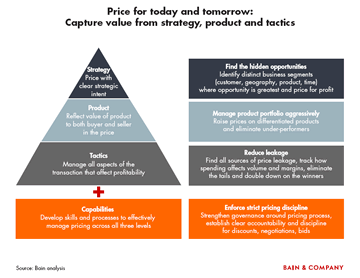
In our experience, companies that get pricing right manage it at three levels. They create a pricing strategy that fully supports their broader objectives and positioning. They set prices on individual products to reflect value to both buyer and seller. And they deploy disciplined tactics to manage the aspects of the transaction that most affect profitability. (See chart.) A severe downturn presents challenges on all three levels. Pricing strategy must address stark differences between the right short-term answers and the long-term health of the business. Pricing of individual products needs to reflect dramatic changes in the ways customers make purchasing decisions. Tactics must be carefully designed and choreographed to let companies execute quickly without losing control.
In a normal business environment the best course is almost always to map out your strategy first, then to set prices for individual products, and finally to design the suite of tactics that will allow you to execute profitably. But in a recession, time is compressed, and tactical decisions take on new importance and urgency.
To find out how some global leaders are responding to the current turbulence with pricing moves, click here for the full article.
Ouriel Lancry is a partner with Bain & Company in Chicago and a senior member of Bain's Global Customer practice. Darrell Rigby is a Bain partner and leads Bain's Global Retail and Global Innovation practices.
Published in April 2009