


Brief

|
|
Providing a great experience for customers has become a credo for many companies today. They realize that a great end-to-end experience will attract and retain customers, as well as engage the enthusiasm and creativity of employees. Customers still want a wireless plan, auto insurance policy or a mortgage with the right features at the right price, but increasingly they also expect at least a convenient, and possibly special, experience surrounding the product or service. And they want interactions to be seamless across physical and digital channels. Bain & Company analysis shows that companies that excel in the customer experience grow revenues 4%–8% above their market. That’s because a superior experience helps to earn stronger loyalty among customers, turning them into promoters who tend to buy more, stay longer and make recommendations to their friends. As a result, promoters have a lifetime value that can reach 6 to 14 times that of detractors, depending on the industry. Consider how revenue growth at Trader Joe’s, the US grocery chain, has outpaced most other large competitors in recent years. Trader Joe’s has built a devoted base of highly educated, often middle-income customers not only by providing an innovative product mix at low prices, but also through a carefully conceived experience. Its stores have an intimate, slightly exotic atmosphere, with helpful staff to provide advice. Online product guides complement the stores. And Trader Joe’s equips employees to deliver on the brand promise through comprehensive frontline training and ample autonomy to make in-store decisions. 
Are you experienced?Companies that offer a winning customer experience grow faster and develop loyal followings. Delivering a great experience becomes especially valuable at a time when loyalty has diminished in many industries; two-thirds of the 1,208 senior executives recently surveyed by Bain reported that their customers’ loyalty has diminished. In most markets, the rise of digital channels makes it easier for customers to research and switch to a competitor’s offering. Yet creating experiences that consistently impress and stand out from the crowd remains a difficult endeavor, and companies often falter after an initial burst of energy. When Bain analyzed 140 US companies’ financial, brand and loyalty data (using the Net Promoter ScoreSM, or NPS®, metric) from 2005 through 2009, only one in nine excelled in all categories. But this highlights the opportunity to create a lasting competitive advantage. How, then, can companies deliver an outstanding experience? To create an experience that can truly delight customers and then sustain the effort by making steady improvements requires senior executives to commit to a marathon, not a sprint. The senior team has to take an unflinching look in the mirror: How do they spend their time? How often do they talk with and about customers? Do they even use the company’s products and services? Executives serious about building a compelling customer experience need to develop thorough, nuanced answers to five questions (see Figure 1). 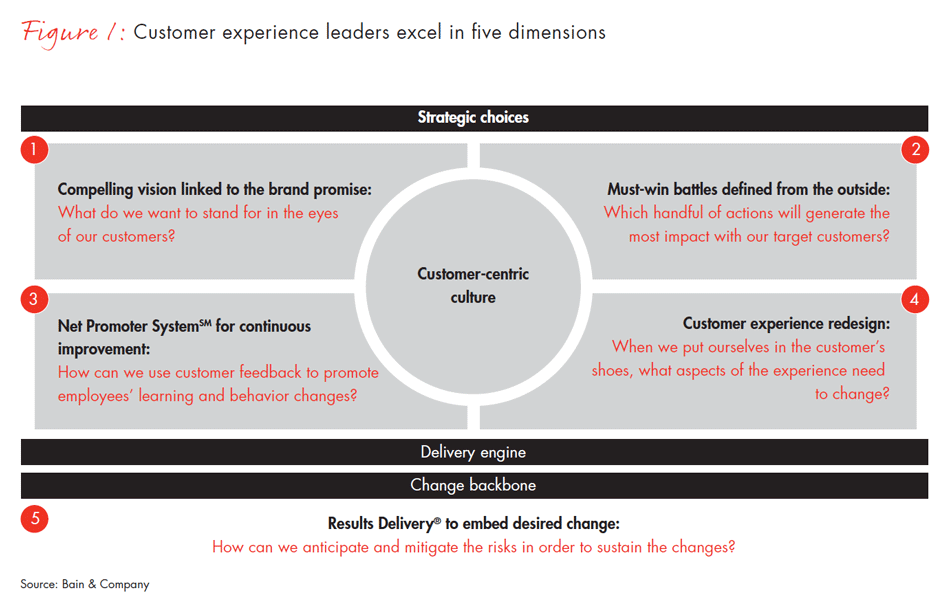 1. What do we want to stand for in the eyes of our customers? The first task is to articulate the distinctive value proposition that the company will offer to customers—and then to mobilize people throughout the organization around that proposition. Senior leaders might understand the size and contours of the opportunity to improve the customer experience, but they often fail to mobilize people at the front line. When Bain surveyed marketing and sales executives on how their companies performed in 60 areas, the largest gap between high and low performers (as measured by NPS and market share growth) occurred in “a front line that understands and passionately executes the strategy.” Beyond a slogan or slide deck, then, leaders need to paint a compelling picture of the destination—what the company should and should not stand for—so that employees know what the initiative means for them and how their behavior and approach should change. A compelling vision defines specific proof points for meeting customers’ needs and priorities, and how the company will achieve those goals. It also determines how those proof points will translate into operational metrics to help consistent delivery across all channels. One European telecommunications provider distilled its vision to being “simple and friendly”: simple through such features as clear pricing and easily installed and used Internet service; friendly through greater accessibility to service agents and follow-up on a problem until it gets resolved. The company translated that vision into specific performance indicators such as the clarity of sales pitches and the share of customers that find it easy to register online. It distributed a card to employees listing the behavior principles guiding the effort, and it charged two senior executives as Mr. Simple and Mr. Friendly to lead the efforts. In this short video, Andreas Dullweber, practice leader of Bain's Customer Strategy & Marketing practice in Europe, the Middle East and Africa, discusses how companies can tap into the power of customer loyalty. 2. Which handful of actions will generate the most impact with our target customers? Customer experience improvement plans often comprise hundreds of uncoordinated initiatives that emerged with good intent from different parts of the organization, with little clarity about which will add the most value for customers. A glut of initiatives rarely adds up to a powerful whole because each one receives too little attention or funding. Experience leaders sift through early initiatives to identify those that work well, reinforce the vision and deserve more resources, while avoiding or quickly ending initiatives that don’t matter to most target customers. Some leaders select the critical customer episodes by arraying them on two dimensions: frequency of use and emotional importance. They form these insights by analyzing customer feedback combined with data from other market research, financial data, press reports and social media listening posts. In the telecom industry, for instance, major causes of detraction include poor network quality and limited access to staff. On the upside, the variables that turn customers into promoters include knowledge of store staff and a technician’s behaviors in the home. Must-win battles in telecom thus often include fixing basic activities such as first-time-right problem resolution, retail or contact center accessibility and simplified plan structures, as well as efforts to create promoters during key episodes involving the front line. But each company faces unique challenges and should identify its own important battlefields where it must make relevant choices and trade-offs. That’s what one air carrier did to regain its standing among highly profitable segments of premium business customers who had given the airline weak NPS scores. Root-cause analysis identified a handful of initiatives under way, grouped them into themes and identified the handful that deserved more investment or that could serve as quick wins. For the theme “make it speedy,” for instance, the carrier moved gate locations to shorten the walk and accelerated VIP security lines. Improving the overall experience for key customer segments helped the carrier to regain its lost market share. With a clear vision of the value proposition and the must-win battles, the next steps are to put in place the engines for improving an existing experience or, when needed, for redesigning the experience. 3. How can we use customer feedback to promote learning and behavior change among employees? People with clarity about their mission—and who receive positive and helpful reinforcement for doing the right thing—go the extra mile to deliver. Mobilizing and harnessing employees’ energy requires two types of feedback loops deployed continuously (see Figure 2). 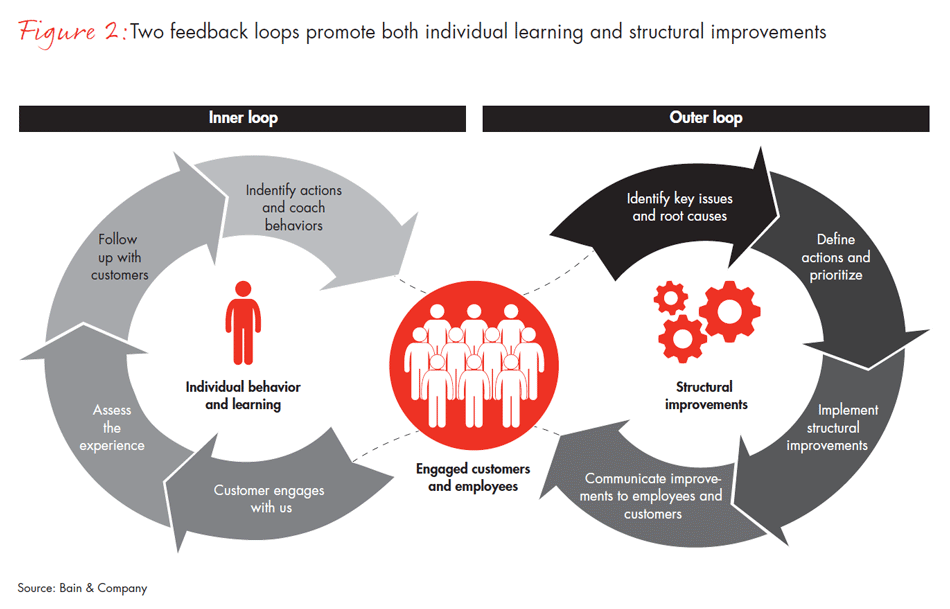 An inner loop collects customer feedback through one or two simple NPS questions—Would you recommend company X? Why?—following key episodes or touchpoints. This feedback routes quickly to the relevant employees and supervisors so that they can learn what does and does not work, change behaviors accordingly and follow up with customers. Continuous improvements work like a tennis player hitting thousands of balls in order to make adjustments to certain strokes and thereby improve her overall game. At regular huddles, teams can discuss customers’ perceptions and feedback, share learnings, escalate issues that cannot be resolved locally and follow up with select customers. In this system, supervisors take a more active role in coaching for the right customer-centered behaviors. The inner loop taps into the innate human desires to learn, innovate and receive encouragement and support in those pursuits. The richness of customer feedback, distilled the right way, will also fuel an outer loop of improvement. This outer loop aims to identify major issues and root causes of problems and strengths, which typically involve multiple functions and departments. Management can deploy resources to address these systemic issues and make structural improvements that benefit the overall customer experience. These changes should be closely communicated back to employees. A key principle behind any adjustments: Make it easy and fulfilling for employees to do the right thing and hard to do the wrong thing. Methods to do so include carefully chosen performance metrics and after-the-fact consequences. When metrics are simply stated, few in number, linked to the customer experience and transparent to everyone in the organization, they motivate employees to apply discretionary effort. Consequences should balance at roughly 80% positive and 20% negative, because positive consequences reinforce desired behaviors. 4. When we put ourselves in the customer’s shoes, what aspects of the experience need to change? With technology and competitive dynamics moving so quickly these days, leading companies don’t hesitate to completely rethink customer experiences by, for example, incorporating new digital channels and features. Effective experience design works outside in from the customer’s perspective, not inside out from an engineering standpoint. Experience leaders display deep empathy toward customers’ core needs. They generally start with a clean sheet and redesign certain important episodes, or even the entire experience, to repair breaks and seize opportunities for “wow” moments. A retail bank, for instance, would consider its customers’ main priorities—buy a home, provide for a daughter’s college education, manage cash and so on. Some leading banks have found it useful to select the critical customer episodes by ranking them according to frequency of use and emotional importance. Then they reimagine each episode from the customer’s perspective. One UK-based bank identified detecting and deterring fraud as a moment of truth that could strongly influence customers’ advocacy or detraction of the bank (see Figure 3). It described four episodes of suspected fraud, and then mapped all of the people and processes required in each episode to resolve the fraud effectively. By surveying customers after their fraud resolution experiences, the bank found that for all four journeys, higher NPS scores correlated with fast resolution of the problem and resolution in one phone call by the first agent contacted. So speed, process and service became the cornerstone of the redesign of the fraud resolution experience. 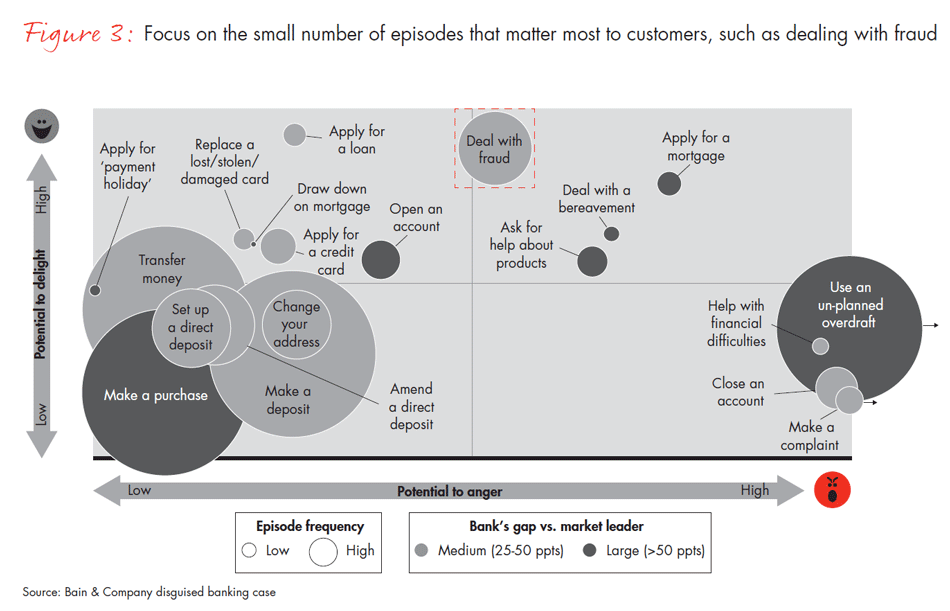 5. How can we anticipate and mitigate the risks, in order to sustain the changes? Senior leaders committed to building a superior customer experience will need an achievable plan that can be delivered while carrying on with day-to-day business. Companies that fall short of expectations they’ve set usually fail to bring their people through the change, largely due to two blind spots. First, they push initiatives without understanding the many other tasks people are juggling. Second, the mere prospect of change can be quite unsettling; employees justifiably worry about their own role, resist the change and get distracted from their work. Just as devising a winning experience starts with the customer’s priorities, an achievable plan shows empathy for employees—senior leaders put themselves in the performer’s shoes—and assesses the organization’s state of readiness by answering three practical questions: Which groups are the most critical in order to carry out the required changes? It’s useful to map a matrix showing the importance of the change to each group and the expected effect of the change on them. How can we equip each group for success? Improvements will come slowly if people have to battle outdated practices and policies. So companies may have to invest in process changes or technologies that will to help their people succeed, as well as hire people with new skills in, say, digital design. Who can best support and influence the groups? Given that a customer’s experience touches multiple parts of a company—which in turn depends on support from other departments behind the scenes—success hinges on having sponsors of the plan at all levels. This “sponsorship spine” sometimes tracks direct reporting relationships, like a call-center agent, his supervisor, her manager and so on. But it often also includes respected advocates in other units, people who have influence by virtue of their earned authority and reputation. In many cases, a complete transformation of a customer experience takes place over 18 to 24 months and comprises several phases:
Frédéric Debruyne is a partner in Bain & Company’s Customer Strategy & Marketing practice and leads the Customer Experience Transformation product globally. He is based in Brussels. Andreas Dullweber leads the Customer Strategy & Marketing practice in Europe, the Middle East and Africa and is based in Munich. Net Promoter® and NPS® are registered trademarks of Bain & Company, Inc., Fred Reichheld and Satmetrix Systems, Inc. Net Promoter SystemSM and Net Promoter ScoreSM are trademarks of Bain & Company, Inc., Fred Reichheld and Satmetrix Systems, Inc. Results Delivery® is a registered trademark of Bain & Company, Inc. |