
Skip to Content
  • Offices

    Offices

    North & Latin America
    • Atlanta
    • Austin
    • Bogota
    • Boston
    • Buenos Aires
    • Chicago
    • Dallas
    • Denver
    • Houston
    • Los Angeles
    • Mexico City
    • Minneapolis
    • Monterrey
    • Montreal
    • New York
    • Rio de Janeiro
    • San Francisco
    • Santiago
    • São Paulo
    • Seattle
    • Silicon Valley
    • Toronto
    • Washington, DC
    Europe & Africa
    • Amsterdam
    • Athens
    • Berlin
    • Brussels
    • Copenhagen
    • Dusseldorf
    • Frankfurt
    • Helsinki
    • Istanbul
    • Johannesburg
    • Kyiv
    • Lisbon
    • London
    • Madrid
    • Milan
    • Munich
    • Oslo
    • Paris
    • Rome
    • Stockholm
    • Vienna
    • Warsaw
    • Zurich
    Middle East
    • Doha
    • Dubai
    • Riyadh
    Asia & Australia
    • Bangkok
    • Beijing
    • Bengaluru
    • Brisbane
    • Ho Chi Minh City
    • Hong Kong
    • Jakarta
    • Kuala Lumpur
    • Manila
    • Melbourne
    • Mumbai
    • New Delhi
    • Perth
    • Seoul
    • Shanghai
    • Singapore
    • Sydney
    • Tokyo
    See all offices
  • Alumni
  • Media Center
  • Subscribe
  • Contact
  • Global | English

    Select your region and language

    Global
    • Global (English)
    North & Latin America
    • Brazil (Português)
    • Argentina (Español)
    • Canada (Français)
    • Chile (Español)
    • Colombia (Español)
    Europe, Middle East, & Africa
    • France (Français)
    • DACH Region (Deutsch)
    • Italy (Italiano)
    • Spain (Español)
    • Greece (Elliniká)
    Asia & Australia
    • China (中文版)
    • Korea (한국어)
    • Japan (日本語)
  • Saved items (0)
    Saved items (0)

    You have no saved items.

    Bookmark content that interests you and it will be saved here for you to read or share later.

    Explore Bain Insights
  • Industries
    Main menu

    Industries

    • Aerospace & Defense
    • Agribusiness
    • Chemicals
    • Construction & Infrastructure
    • Consumer Products
    • Financial Services
    • Healthcare & Life Sciences
    • Industrial Machinery & Equipment
    • Media & Entertainment
      Industries
      Media & Entertainment
      • Media Lab
    • Metals
    • Mining
    • Oil & Gas
    • Paper & Packaging
    • Private Equity
      Industries
      Private Equity
      • Due Diligence
      • Exit Planning
      • Firm Strategy & Operations
      • Portfolio Value Creation
    • Social Impact
    • Retail
    • Technology
    • Telecommunications
      Industries
      Telecommunications
      • Capital Expenditure
      • Telco Digital Transformation
    • Transportation
    • Travel & Leisure
    • Utilities & Renewables
  • Consulting Services
    Main menu

    Consulting Services

    • Customer Experience
    • Sustainability
    • Innovation
    • M&A
    • Operations
    • People & Organization
    • Private Equity
    • Sales & Marketing
    • Strategy
    • AI, Insights, and Solutions
    • Technology
    • Transformation
  • Digital
  • Insights
    Main menu

    Insights

    • Industry Insights
    • Services Insights
    • Bain Books
    • Webinars
    • Bain Futures
    View all Insights
    Featured topics
    • Tariff Response
    • Artificial Intelligence
    • Thriving in Uncertainty
    • Executive Conversations
    • Macro Trends
    • M&A Report
    • Healthcare Private Equity Report
    • Paper & Packaging Report
    • Technology Report
    • CEO's Guide to Sustainability
    • CEO Insights
    • CFO Insights
    • COO Insights
    • CIO Insights
    • CMO Insights
    View all featured topics
  • About
    Main menu

    About

    • What We Do
    • What We Believe
    • Our People & Leadership
    • Client Results
    • Awards & Recognition
    • Global Affiliations
    Further: Our global responsibility
    • Sustainability
    • Social Impact
    • World Economic Forum
    Learn more about Further
  • Careers
    Main menu

    Careers

    • Work with Us
      Careers
      Work with Us
      • Find Your Place
      • Our Work Areas
      • Integrated Teams
      • Students
      • Internships & Programs
      • Recruiting Events
    • Life at Bain
      Careers
      Life at Bain
      • Blog: Inside Bain
      • Career Stories
      • Our People
      • Where We Work
      • Supporting Your Growth
      • Affinity Groups
      • Benefits
    • Impact Stories
    • Hiring Process
      Careers
      Hiring Process
      • What to Expect
      • Interviewing
    FIND JOBS
  • Offices
    Main menu

    Offices

    • North & Latin America
      Offices
      North & Latin America
      • Atlanta
      • Austin
      • Bogota
      • Boston
      • Buenos Aires
      • Chicago
      • Dallas
      • Denver
      • Houston
      • Los Angeles
      • Mexico City
      • Minneapolis
      • Monterrey
      • Montreal
      • New York
      • Rio de Janeiro
      • San Francisco
      • Santiago
      • São Paulo
      • Seattle
      • Silicon Valley
      • Toronto
      • Washington, DC
    • Europe & Africa
      Offices
      Europe & Africa
      • Amsterdam
      • Athens
      • Berlin
      • Brussels
      • Copenhagen
      • Dusseldorf
      • Frankfurt
      • Helsinki
      • Istanbul
      • Johannesburg
      • Kyiv
      • Lisbon
      • London
      • Madrid
      • Milan
      • Munich
      • Oslo
      • Paris
      • Rome
      • Stockholm
      • Vienna
      • Warsaw
      • Zurich
    • Middle East
      Offices
      Middle East
      • Doha
      • Dubai
      • Riyadh
    • Asia & Australia
      Offices
      Asia & Australia
      • Bangkok
      • Beijing
      • Bengaluru
      • Brisbane
      • Ho Chi Minh City
      • Hong Kong
      • Jakarta
      • Kuala Lumpur
      • Manila
      • Melbourne
      • Mumbai
      • New Delhi
      • Perth
      • Seoul
      • Shanghai
      • Singapore
      • Sydney
      • Tokyo
    See all offices
  • Alumni
  • Media Center
  • Subscribe
  • Contact
  • Global | English
    Main menu

    Select your region and language

    • Global
      Select your region and language
      Global
      • Global (English)
    • North & Latin America
      Select your region and language
      North & Latin America
      • Brazil (Português)
      • Argentina (Español)
      • Canada (Français)
      • Chile (Español)
      • Colombia (Español)
    • Europe, Middle East, & Africa
      Select your region and language
      Europe, Middle East, & Africa
      • France (Français)
      • DACH Region (Deutsch)
      • Italy (Italiano)
      • Spain (Español)
      • Greece (Elliniká)
    • Asia & Australia
      Select your region and language
      Asia & Australia
      • China (中文版)
      • Korea (한국어)
      • Japan (日本語)
  • Saved items  (0)
    Main menu
    Saved items (0)

    You have no saved items.

    Bookmark content that interests you and it will be saved here for you to read or share later.

    Explore Bain Insights
  • Industries
    • Industries

      • Aerospace & Defense
      • Agribusiness
      • Chemicals
      • Construction & Infrastructure
      • Consumer Products
      • Financial Services
      • Healthcare & Life Sciences
      • Industrial Machinery & Equipment
      • Media & Entertainment
      • Metals
      • Mining
      • Oil & Gas
      • Paper & Packaging
      • Private Equity
      • Social Impact
      • Retail
      • Technology
      • Telecommunications
      • Transportation
      • Travel & Leisure
      • Utilities & Renewables
  • Consulting Services
    • Consulting Services

      • Customer Experience
      • Sustainability
      • Innovation
      • M&A
      • Operations
      • People & Organization
      • Private Equity
      • Sales & Marketing
      • Strategy
      • AI, Insights, and Solutions
      • Technology
      • Transformation
  • Digital
  • Insights
    • Insights

      • Industry Insights
      • Services Insights
      • Bain Books
      • Webinars
      • Bain Futures
      View all Insights
      Featured topics
      • Tariff Response
      • Artificial Intelligence
      • Thriving in Uncertainty
      • Executive Conversations
      • Macro Trends
      • M&A Report
      • Healthcare Private Equity Report
      • Paper & Packaging Report
      • Technology Report
      • CEO's Guide to Sustainability
      • CEO Insights
      • CFO Insights
      • COO Insights
      • CIO Insights
      • CMO Insights
      View all featured topics
  • About
    • About

      • What We Do
      • What We Believe
      • Our People & Leadership
      • Client Results
      • Awards & Recognition
      • Global Affiliations
      Further: Our global responsibility
      • Sustainability
      • Social Impact
      • World Economic Forum
      Learn more about Further
  • Careers
    Popular Searches
    • Agile
    • Digital
    • Strategy
    Your Previous Searches
      Recently Visited Pages

      Content added to saved items

      Saved items (0)

      Removed from saved items

      Saved items (0)

      Brief

      Customer advocacy: The path to growth in healthcare

      Customer advocacy: The path to growth in healthcare

      Purchasing decision makers have changed throughout the healthcare industry. Here's how leading companies can earn their loyalty.

      By Dave Michels and Jan Skvarka

      • min read

      Brief

      Customer advocacy: The path to growth in healthcare
      en

      Do you know who your customers really are today? Do you know who makes the buying decisions and who influences them? Do you understand the purchase criteria that inform those decisions?

      In every sector of the healthcare industry—providers and payers, pharmaceuticals and medical technology—the purchasing decision makers have changed in the last few years. And the decision processes have grown far more complex.

      In the past, for instance, the prescribing physician or the implanting surgeon was the archetypal customer for pharmaceutical and medical device companies. Today the customers who make or influence buying decisions include hospital committees, private insurers and government agencies, as well as the providers themselves. In the past, patients and their families generally went along with whatever the doctor recommended. Today’s patients and their advocates are likely to consult websites, chat rooms, blogs or other forums before making important treatment choices. The payer is likely to have a say in those choices as well.

      Decision criteria are changing, too. Cost is often as important as effectiveness in the minds of both decision makers and influencers. Patients look for evidence that proposed treatments are safe and that providers have their best interests at heart. Physicians, who are apt to spend less time with pharmaceutical or medtech sales representatives than they used to, increasingly look to other clinicians (and to medical websites) for advice.

      These dramatic shifts in the customer environment create fundamentally new challenges for healthcare executives. Many companies find they must change their frontline operations or modify the way they go to market. Many recognize the need to increase their responsiveness in order to capitalize on new opportunities. And nearly all healthcare companies are coming to understand the importance of customer advocacy. Those companies are discovering that the only sure path to sustained organic growth is to have an army of patients, providers and other customers who love doing business with them and who sing their praises to friends and colleagues.

      Responding to these challenges, many leading companies throughout the healthcare industry have adopted the Net Promoter® system. With the help of this system, these companies are learning new ways to identify their true customers, understand those customers’ needs and adapt their offerings to create powerful advocates.

      The Net Promoter system

      Net Promoter rests on a simple analytic foundation. Companies regularly ask their customers two questions. The first is, On a zero-to-10 scale, how likely would you be to recommend this company (or this product) to a friend or colleague? A customer’s answer to this question, research shows, is the single most reliable predictor of his or her behavior. Companies then divide their customers into promoters (scores of 9 and 10), passives (7 and 8) and detractors (0 to 6). This classification, too, links directly to subsequent actions. Promoters as a group, for example, stay longer, spend more and generate more referrals than other customers. They provide more (and more enthusiastic) recommendations as well.

      The second question—What is the primary reason for your score?—adds a qualitative dimension to the raw scores. It helps companies learn in detail what they are doing right and what they are doing wrong in the eyes of their customers.

      Most Net Promoter companies pose these questions in two different contexts:

      • “Top-down” or competitive Net Promoter score (NPS®) measures a company’s score relative to scores of key competitors. The prime audience for these surveys is senior management; the data informs major resource allocation and strategic decisions.
      • “Bottom-up” NPS assesses the strength of relationships with key accounts or individual customers. The process identifies promoters, passives and detractors and captures their feedback. It also allows companies to “close the loop” with detractors to learn more about the sources of their frustration and to address their problems when possible. The key audience for this kind of data is an organization’s frontline employees and their managers.

      The two sets of data enable companies to crack two parts of a complex challenge simultaneously. First, a healthcare company must figure out how to meet the most important needs of a changing set of customer groups in ways that differentiate it from competitors. Second, it must develop operating procedures that channel a steady flow of feedback to frontline employees so that they can adapt and improve the customer experience. Both elements are essential. A company needs a common framework, language and set of metrics—all embraced at every level of the organization—to accomplish both objectives.

      Let’s look more closely at three practices that are at the heart of the Net Promoter system and that help companies achieve these objectives.

      1. Linking enterprise-level survey data to customer economics

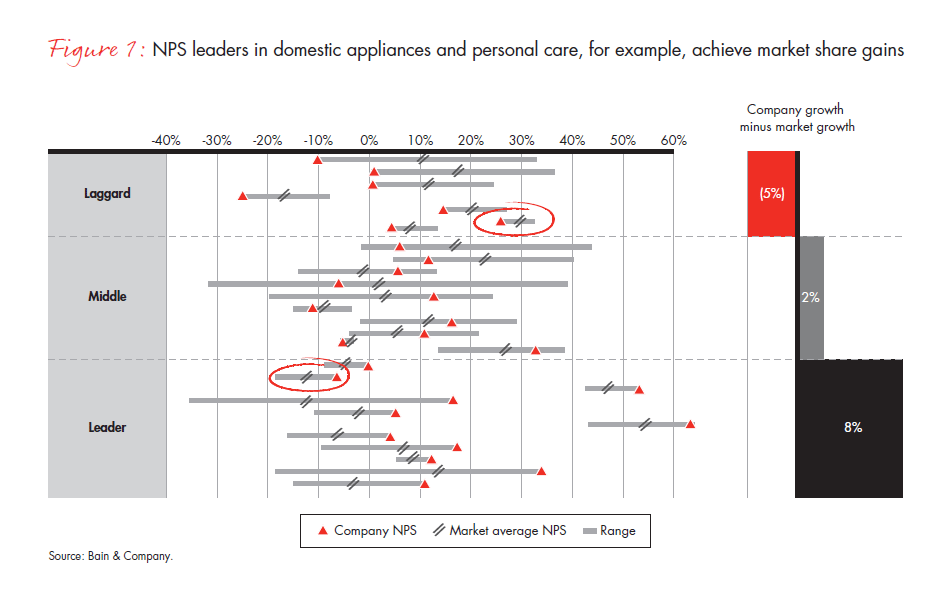
      A company’s relative NPS in individual product and geographic markets—MRI equipment in Germany, say—is likely to correlate highly with its growth rate in that market compared with competitors. Figure 1, which shows the results of a study by Philips, illustrates the correlation (see Figure 1). Philips’s businesses with best-in-class NPS results grew faster than competitors by an average of 8 percentage points, while those with the worst NPS results trailed the competition by 5 points. Such data naturally fuels an intense effort to understand the factors that create promoters, passives and detractors, so that a company can take action and improve the mix. It provides guidelines for both the kind and the level of investment necessary to boost growth.


      customer-advocacy-path-to-growth-fig-01_embed

      A hospital’s economics depend partly on how many patients in its catchment area it can attract. NPS is a good proxy for the likelihood that patients will come (or return) to a given hospital. A Bain & Company survey of hospitals in Belgium, for instance, found that patients with the highest scores were four times as likely as others to return to the same hospital and were willing to travel farther to do so. Scores reflected patients’ assessment both of the hospitals’ clinical expertise and of their administrative qualities, such as facilities and process efficiencies.

      2. Short-cycle closed-loop feedback, learning and action

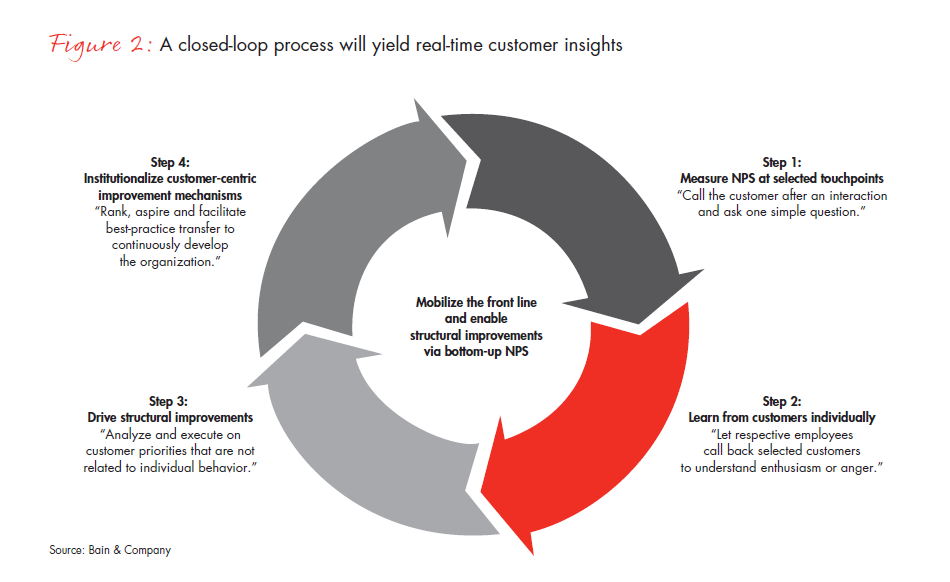
      Effective customer feedback programs start at the front line. Employees working there—sales reps, service technicians, physicians, nurses, call-center personnel, even manufacturing employees and engineers—receive evaluations of their performance from the people best able to render an appraisal, namely the customers they just served. The employees then follow up with willing customers in one-on-one conversations. In healthcare, there are usually two objectives. One is to identify all the stakeholders who influence or are affected by purchasing decisions. The other is to understand in detail what those stakeholders value and what the front line can do to deliver it better. What’s most critical is to pinpoint the “moments of truth” in a company’s interaction with its customers—the few points of contact with the greatest potential to delight or alienate a decision maker. Loyalty leaders use this closed-loop process to create effective learning, action and recovery processes at every level (see Figure 2).


      customer-advocacy-path-to-growth-fig-02_embed

      Global medtech leader Medtronic piloted just such a system in the UK. After years of putting the physician at the center of its marketing system, the company realized that nonclinical stakeholders were increasingly influential. In addition, Medtronic was now selling an increasingly complex portfolio, everything from pacemakers to insulin pumps. Its frontline employees needed ways to engage more closely with the company’s full set of customers, both clinical and nonclinical.

      So Medtronic first identified the full set of relevant stakeholders for each account. It asked sales leads to give their customers a heads-up and then sent the customers a simple online survey. To follow up, sales leaders conducted meetings with disgruntled and delighted customers alike. The resulting insights informed individual account plans; they were also collated and integrated at other organizational levels. As Medtronic took action to resolve issues—more training on new products, better account management or whatever it might be—the account leads closed the loop with customers, demonstrating that they had listened and taken action based on customers’ feedback.

      3. Making it a strategic priority to earn loyalty

      The most successful Net Promoter companies make earning the passionate loyalty of their customers a strategic priority. The goal engages everyone in the organization, from the CEO downward. Philips, for example, reports Net Promoter scores to its shareholders along with its financial results.

      Building customer loyalty and advocacy requires full alignment of investment decisions, resource deployment and supporting initiatives. A company must develop the necessary infrastructure, talent and skills. Values, principles and policies must be consistent— and consistently applied.

      Ascension Health, the largest Catholic healthcare system in the US, first deployed a bottom-up NPS program in 2006 to improve the patient experience and reduce variability across the system. The results showed that “care responsiveness,” “communication and empowerment” and “compassionate and respectful care” were the factors that created the most promoters. At the same time, process errors and facilities shortcomings had the biggest potential to anger and cause detraction.

      As a result of these first findings, the company developed a multifaceted program. The strategic goal was to deliver the patient’s desired experience in a consistent, sustainable and authentic fashion. The action plan included a cultural change program, real-time closed-loop feedback processes for patients and families, and human resource policies focused on building a more engaged and caring staff. The new approach has already led to significant systemwide improvement in customer loyalty and satisfaction, as measured by Net Promoter scores. The variation from one hospital to another has declined as well.

      Keeping up with a dynamic environment

      Healthcare is an unusual—and unusually challenging— industry because the customer landscape is both complex and dynamic. The dual challenge for a healthcare company, whichever sector it is in, is to keep up with this rapidly changing environment and to generate higher levels of customer advocacy. Leading companies are figuring out how to identify the decision makers and influencers, determine their decision criteria and deliver what these stakeholders want better than their competitors. The Net Promoter system is an invaluable tool in this pursuit. It allows a company to navigate the newly complex healthcare marketplace, learn from its customers’ feedback and incorporate that learning into daily operations. That is the path to true customer advocacy—and to competitive advantage.

      Dave Michels is a partner in Bain & Company’s Zurich office and is a member of both the Customer Strategy & Marketing and Healthcare practices. Jan Skvarka is a partner in Bain’s Boston office and is a member of the firm’s Healthcare and Customer Strategy & Marketing practices.

      customer-advocacy-path-to-growth-fig-01_full

      customer-advocacy-path-to-growth-fig-02_full
      Authors
      • Headshot of David Michels
        David Michels
        Partner, Tokyo
      Contact us
      Related Industries
      • Healthcare & Life Sciences
      Related Consulting Services
      • Sales and Marketing
      Pharmaceuticals
      The Cure for Pharma's Commercial Productivity Woes

      To earn greater loyalty and raise productivity, figure out what really matters for doctors.

      Read More
      Healthcare & Life Sciences
      Better Questions, Better Sales Calls

      Top reps dig deep even when the deal doesn’t close on the first contact.

      Read More
      Healthcare & Life Sciences
      How Life Sciences Leaders Are Widening the AI Capability Gap

      Most pharma and medtech companies agree that a strong data foundation is table stakes. Few invest equally in the behaviors needed to move from pilots to adoption.

      Read More
      Sales and Marketing
      Too Much Marketing Technology, Too Little Impact

      Marketing leaders build tightly integrated systems that fuel growth, personalization, and real ROI.

      Read More
      Healthcare & Life Sciences
      From Silos to Pods: Scaling AI in Life Sciences

      Cross-functional collaboration is the real differentiator between those that see meaningful returns and those that don’t.

      Read More
      Published in March 2012
      Tags
      • Healthcare & Life Sciences
      • Sales and Marketing

      How We've Helped Clients

      Performance Improvement A Pharma Company’s Finance Function Gets a Shot in the Arm

      Read case study

      Performance Improvement Turning bottlenecks into growth opportunities

      Read case study

      Operations Full-potential prescription makes pharmacy client better

      Read case study

      Ready to talk?

      We work with ambitious leaders who want to define the future, not hide from it. Together, we achieve extraordinary outcomes.

      Stay ahead in a rapidly changing world. Subscribe to Bain Insights, our monthly look at the critical issues facing global businesses.

      *I have read and understand Bain’s Privacy Notice.

      Please read and agree to the Privacy Policy.
      Bain & Company
      Contact us Sustainability Accessibility Terms of use Privacy Modern Slavery Act Statement Cookie Policy Sitemap Log In

      © 1996-2026 Bain & Company, Inc.

      Contact Bain

      How can we help you?

      • Business inquiry
      • Career information
      • Press relations
      • Partnership request
      • Speaker request
      See all offices