


Brief


|
|
It was only a decade ago when many industry analysts looked at two looming trends and issued warnings about the power of consumer packaged goods brands. Retail consolidation was on the rise, particularly in major markets such as the US, UK, China, Japan and Germany. At the same time, private labels were swiftly gaining space on supermarket shelves. Steady share shifts now have private label topping 30% in some developed markets. However, predictions of the decline of global brands turned out to be highly premature. In fact, Bain & Company analysis of the largest consumer goods companies and retailers globally confirms that the opposite has occurred: Consumer packaged goods brands now report 10-year high operating margins, and they are capturing a growing portion of the industry profit pool (see Figure 1). 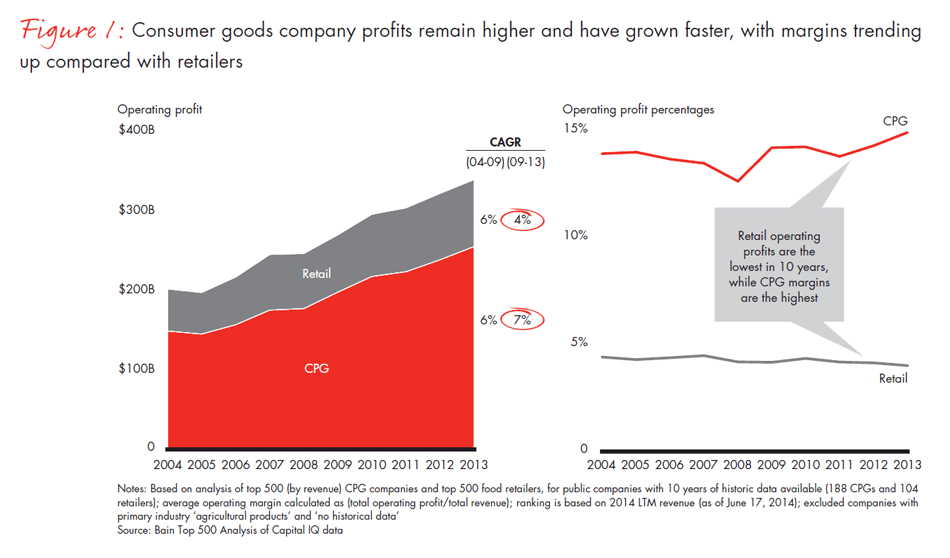 How have brands managed to beat the odds? Companies pulled three main levers to achieve their impressive profit growth. First, players aggressively managed their overhead costs. Among the nearly 200 top consumer packaged goods companies Bain analyzed, selling, general, administrative and other operating costs as a percentage of revenue dropped fairly steadily between 2004 and 2013, more than offsetting any increases in the cost of goods sold. Second, over the past 10 years, these companies benefited from dynamic growth in developing markets, where sales growth has outpaced developed markets by nearly fourfold. In 2013, many consumer goods companies enjoyed earnings before interest and tax (EBIT) margins in developing markets that matched or even exceeded companywide EBIT margins. Finally, they’ve gained scale, efficiency and entry to new markets through mergers and acquisitions (M&A), with acquisition deal values accounting for 30% to 80% of enterprise value for top consumer products acquirers. In a Bain & Company study of 1,600 companies across all industries, we observed that the rewards of M&A were greater for consumer products companies than for the average company (see the Bain Brief “Repeatable M&A in consumer goods”). Consumer products companies that engaged in M&A during the period from 2000 through 2010 turned in an average annual total shareholder return of 7.4%, while the average for all companies was 4.8%. In this short video, Bain Partner Marcello Tripodo explains how perfect sales execution in the store can increase brand visibility, increase penetration and ultimately ensure brand growth. That’s right—the doomsday scenarios didn’t quite play out. But while many consumer goods players thrived during the past decade, that’s not to say all companies fared equally well. The top 20 companies by market capitalization are constantly changing. Nearly half of the highest-valued consumer goods companies in 1999 no longer rank in the top 20 in 2015. Nine companies dropped off the list due to relative scale, split or acquisition in the past 15 years, replaced by eight new companies. Nearly all others shifted position, some significantly. For example, Nestlé leapfrogged from No. 5 to No. 1. 
Interactive: The rapidly changing order of consumer goods leadersIt may seem that the same familiar players always dominate the consumer goods industry, but the top players by market cap have shifted dramatically over the past 15 years. Leading brands also face challenges. Between 2004 and 2014, the top three brands in major categories maintained top-three status in only 30% of US categories we studied (see Figure 2). For example, in coffee, Folgers, Maxwell House and Starbucks kept their positions as the top three brands. But in yogurt, Chobani nudged into the top three. Among the top three fresh bread brands in 2004, only Pepperidge Farm remains. Even when top brands keep their status, they aren’t always maintaining share. We found that across categories, more than 50% of top three brands lost category share during the years 2004 to 2014. 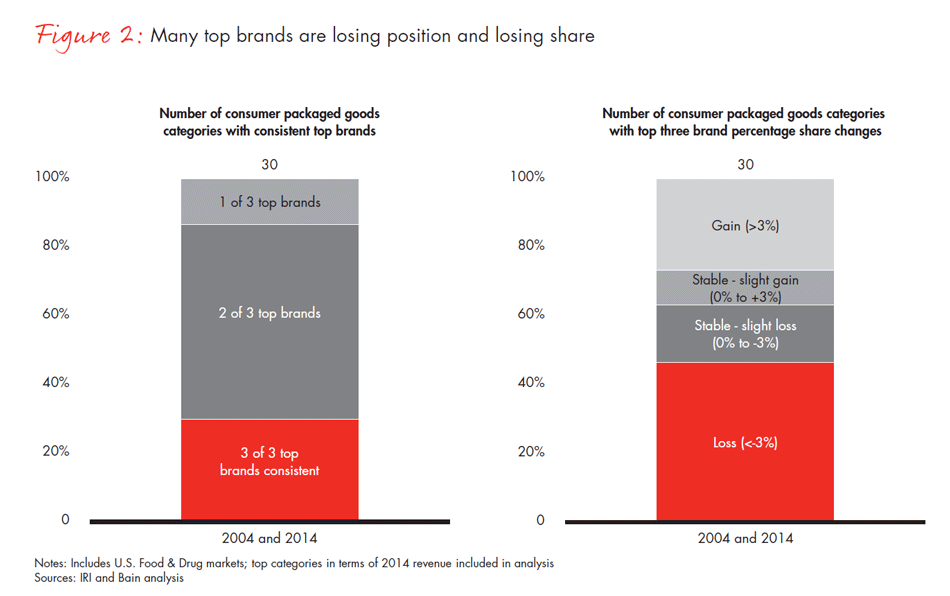 So operating margins have reached their 10-year high. There’s a lot of jostling among top companies and shifting category share. What lies ahead? Will operating margins and profit pool share growth continue on their trajectories, or will slowing market growth and intensifying investor pressures to reduce costs mark an end to the party? Future headwinds may not differ drastically from past challenges. But the scale and complexity of today’s consumer goods companies heightens the importance of discerning what has worked in the past—and what will continue to work—while understanding the future trends that will inform new and critical choices. We see five ways executives can keep their brands thriving in the new era of profits. Ignite the topline. As developed markets remain somewhat stagnant and growth in developing markets slows, revenue growth may feel elusive. We see some companies boosting their toplines by rethinking pricing strategies (see the Bain Brief “Pricing for penetration”). Indeed, price realization is a bright spot. For example, in beverage categories, price increases accounted for more than 50% of household spending increases globally and 98% within North America and 107% in Western Europe. Despite pricing gains, volume growth remains hard to achieve. Across categories and countries, increasing penetration is the primary way to build big brands. This is a key insight from the research of Ehrenberg-Bass Institute for Marketing Science, summarized by Professor Byron Sharp, director of the Institute, in his book How Brands Grow, based on decades of observations of buying behavior. Despite the importance of penetration, we continue to see many brands below the 15% household penetration threshold typically required to thrive. Winners will need to boost penetration by focusing on three areas: building brand memorability, innovating with a focus on expanding consideration and penetration of hero brands (those with the highest potential to win with shoppers), and determining ways to convert shoppers where and when they make purchase choices. There are proven playbooks that executives too often ignore. Consider a personal care brand that pushed out dozens of new innovations each year when category penetration was minimal and more than half of shoppers were buying fewer than two times a year. The company would have done far better by concentrating on the hero SKUs and zeroing in on innovations that had the potential to boost penetration and that could be adequately and sustainably supported. Contrast that company’s approach with the approach recently taken by a wine company. This brand made the radical decision to focus the majority of its resources on the 20 most promising SKUs among the 400 in its portfolio in a particular European market. The results were dramatic: a 36% increase in volume while the overall market saw a 5% volume drop. Plan to take out—and keep out—another 10% to 30% of costs. There’s no question that consumer goods companies have been successful in their aggressive approach to cost-cutting over the past decade. But too often cost savings creep back into their businesses within a few years. We see this cycle with trade programs, with general and administrative restructuring, and with manufacturing and supply chain commitments. Companies in North America that think they have best-in-class selling, general and administrative costs discover that they are almost 50% higher, based on new challenges and proven performance by peers. The inability to make savings stick and the increasing presence and power of activist investors suggest that the best consumer goods companies will follow a different approach. They will continuously improve their cost positions year after year and look at both the total amount spent and at the effectiveness of what they spend. By analyzing total spend and spend effectiveness, one global brand discovered that over half of its above-the-line marketing budget went to subscale and ineffective campaigns that ballooned nonworking media expenses. By concentrating on fewer, more quality promotional campaigns, the company was able to reduce its below-the-line spending and fund higher-reach media spend. Reinvent your supply chain. Another way companies can create lasting savings is by revisiting their supply chains. All too often, we see supply chains that limit growth and increase costs. Poor networks and aging plants hamper the flexibility necessary for profitable innovation, the funding needed for advertising and the efficiency that enables competitive pricing. And once growth starts to slow, the pressures on the supply chain only get worse, making the decline hard to stop. However, several companies have demonstrated that building a new supply chain has hugely compelling benefits such as hundreds of basis points in cost reduction, dramatically improved cash conversion and significantly better top-line growth. There are two fundamental questions any consumer goods company should consider: Does the existing supply chain provide a demonstrable (and measurable) competitive advantage? Are all growth platforms, brands and technologies on advantaged assets in optimal locations? If the answer to either question is no (or unclear), it’s likely time to reinvent the supply chain (see the Bain Brief “Turn your supply chain into a profitable growth engine”). The best companies will strive to have supply chains that are more aligned with their future commercial strategy. Instead of investing to maintain old manufacturing facilities, they’ll focus on building the capabilities that will serve their future market needs. Future-proof your capabilities. Technological innovations and consumer taste and shopping trends may not fundamentally change the actual products that consumer goods players make in the next decade—toothpaste will be toothpaste, and people will drink beer—but they are transforming where and how consumer goods companies operate and build scale. For example, the growth of developing markets, new channels and out-of-home consumption all require new approaches to shelf confrontation, store (or screen) execution, the supply chain, talent and more. Overall, online penetration of packaged goods remains low, yet there are vast differences among categories and markets. One global packaged foods player discovered that e-commerce would account for the majority of future growth in its category, yet was ill-equipped to win its fair share, which endangered its market leadership position. The company has quickly moved to improve online sales processes, digital asset management, search engine optimization and other newly critical capabilities. Further, consider that more than 90 percent of global data was generated in the past 10 years and that this data will quadruple over the next five years. Companies are aggressively discovering novel ways to use data to improve existing products and processes across the full value chain. Brands now rely on digital insights tools that reduce both development cost and time, inform how and where to confront shoppers, and enable efficiencies in everything from truck routing to shelf availability and inventory management. For example, a beverage company has incorporated real-time, image-based technology to improve planogram compliance and minimize out-of-stock items. Build agile teams. To grow in rapidly shifting markets, executives know they need to adapt their operating model for new strategies. A single example: Many are turning to an approach to product development that provides them with rapid feedback from internal and external customers to complement their traditional waterfall approach to longer-term projects. They’re speeding time to market and lowering delivery costs by reducing dependence on business analysis and project management roles and by making better use of people and time. In this so-called “scrum” approach, large, functional teams are replaced by small, cross-functional teams. Instead of involving customers and consumers only in the beginning and end of the process, teams constantly collaborate with customers and consumers. Instead of predicting all design features up front with exhaustive documentation, they’re working with adaptive designs that are shared in personal discussions. These agile teams deliver a more iterative process. They rely on continuous, real-time testing and integration instead of waiting until after development is final. Brands get to market faster, and improve their chances of delivering products that customers want. Winning in the next era of profits means getting five things right. The best companies will fuel top-line growth with proven approaches such as strategic pricing, more selective innovation and a dedication to win where shoppers make decisions. It will be critical to continue to take out costs and implement programs to keep them from creeping back in. Leaders will adapt their supply chains for future needs. They’ll build the capabilities required to win in the future, including advanced analytics to fuel insights and boost efficiencies. And the winners will hone their operating models to deliver strategies for new and changing markets. That’s how brands will continue to beat the odds. Vijay Vishwanath is a partner in Bain & Company’s Boston office. Lee Delaney is a partner in Bain & Company’s Boston office and leader of the Consumer Products practice in the Americas. Matthew Meacham, a partner in London, is the global leader of Bain’s Consumer Products practice. Suzanne Tager is a practice area senior director in Bain’s Consumer Products practice based in New York. |