
Skip to Content
  • Offices

    Offices

    North & Latin America
    • Atlanta
    • Austin
    • Bogota
    • Boston
    • Buenos Aires
    • Chicago
    • Dallas
    • Denver
    • Houston
    • Los Angeles
    • Mexico City
    • Minneapolis
    • Monterrey
    • Montreal
    • New York
    • Rio de Janeiro
    • San Francisco
    • Santiago
    • São Paulo
    • Seattle
    • Silicon Valley
    • Toronto
    • Washington, DC
    Europe & Africa
    • Amsterdam
    • Athens
    • Berlin
    • Brussels
    • Copenhagen
    • Dusseldorf
    • Frankfurt
    • Helsinki
    • Istanbul
    • Johannesburg
    • Kyiv
    • Lisbon
    • London
    • Madrid
    • Milan
    • Munich
    • Oslo
    • Paris
    • Rome
    • Stockholm
    • Vienna
    • Warsaw
    • Zurich
    Middle East
    • Doha
    • Dubai
    • Riyadh
    Asia & Australia
    • Bangkok
    • Beijing
    • Bengaluru
    • Brisbane
    • Ho Chi Minh City
    • Hong Kong
    • Jakarta
    • Kuala Lumpur
    • Manila
    • Melbourne
    • Mumbai
    • New Delhi
    • Perth
    • Shanghai
    • Singapore
    • Sydney
    • Tokyo
    See all offices
  • Alumni
  • Media Center
  • Subscribe
  • Contact
  • Global

    Select your region and language

    Global
    • Global (English)
    North & Latin America
    • Brazil (Português)
    • Argentina (Español)
    • Canada (Français)
    • Chile (Español)
    • Colombia (Español)
    Europe, Middle East, & Africa
    • France (Français)
    • DACH Region (Deutsch)
    • Italy (Italiano)
    • Spain (Español)
    • Greece (Elliniká)
    Asia & Australia
    • China (中文版)
    • Korea (한국어)
    • Japan (日本語)
  • Saved items (0)
    Saved items (0)

    You have no saved items.

    Bookmark content that interests you and it will be saved here for you to read or share later.

    Explore Bain Insights
  • Industries
    Main menu

    Industries

    • Aeroespacial y Defensa
    • Agroindustria
    • Químicos
    • Construcción e Infraestructura
    • Productos de Consumo
    • Servicios Financieros
    • Salud y Ciencias de la Vida
    • Maquinaria y Equipo Industrial
    • Medios y Entretenimiento
      Industries
      Medios y Entretenimiento
      • Media Lab
    • Metales
    • Minería
    • Petróleo y Gas
    • Papel y Empaque
    • Private Equity
      Industries
      Private Equity
      • Due Diligence
      • Exit Planning
      • Firm Strategy & Operations
      • Portfolio Value Creation
    • Sector Público y Social
    • Retail
    • Tecnología
    • Telecomunicaciones
      Industries
      Telecomunicaciones
      • Capital Expenditure
      • Telco Digital Transformation
    • Transporte
    • Viajes y Turismo
    • Servicios Públicos y Energías Renovables
  • Consulting Services
    Main menu

    Consulting Services

    • Customer Experience
    • Sustainability
    • Innovation
    • M&A
    • Operations
    • People & Organization
    • Private Equity
    • Sales & Marketing
    • Strategy
    • AI, Insights, and Solutions
    • Technology
    • Transformation
  • Digital
  • Insights
    Main menu

    Insights

    • Industry Insights
    • Services Insights
    • Bain Books
    • Webinars
    • Bain Futures
    View all Insights
    Featured topics
    • Tariff Response
    • Artificial Intelligence
    • Thriving in Uncertainty
    • Executive Conversations
    • Macro Trends
    • M&A Report
    • Healthcare Private Equity Report
    • Paper & Packaging Report
    • Technology Report
    • CEO's Guide to Sustainability
    • CEO Insights
    • CFO Insights
    • COO Insights
    • CIO Insights
    • CMO Insights
    View all featured topics
  • About
    Main menu

    About

    • What We Do
    • What We Believe
    • Our People & Leadership
    • Client Results
    • Awards & Recognition
    • Global Affiliations
    Further: Our global responsibility
    • Sustainability
    • Social Impact
    • World Economic Forum
    Learn more about Further
  • Carreras
    Main menu

    Carreras

    • Trabaja con Nosotros
      Carreras
      Trabaja con Nosotros
      • Find Your Place
      • Nuestras Áreas de Trabajo
      • Equipos Integrados
      • Estudiantes
      • Internships & Programs
      • Eventos de Reclutamiento
    • La Vida en Bain
      Carreras
      La Vida en Bain
      • Historias Profesionales
      • Nuestra Gente
      • Dónde Trabajamos
      • Apoyando tu Crecimiento
      • Grupos de Afinidad
      • Beneficios
    • Impact Stories
    • Nuestro Proceso
      Carreras
      Nuestro Proceso
      • Qué Esperar
      • Entrevistas
    FIND JOBS
  • Offices
    Main menu

    Offices

    • North & Latin America
      Offices
      North & Latin America
      • Atlanta
      • Austin
      • Bogota
      • Boston
      • Buenos Aires
      • Chicago
      • Dallas
      • Denver
      • Houston
      • Los Angeles
      • Mexico City
      • Minneapolis
      • Monterrey
      • Montreal
      • New York
      • Rio de Janeiro
      • San Francisco
      • Santiago
      • São Paulo
      • Seattle
      • Silicon Valley
      • Toronto
      • Washington, DC
    • Europe & Africa
      Offices
      Europe & Africa
      • Amsterdam
      • Athens
      • Berlin
      • Brussels
      • Copenhagen
      • Dusseldorf
      • Frankfurt
      • Helsinki
      • Istanbul
      • Johannesburg
      • Kyiv
      • Lisbon
      • London
      • Madrid
      • Milan
      • Munich
      • Oslo
      • Paris
      • Rome
      • Stockholm
      • Vienna
      • Warsaw
      • Zurich
    • Middle East
      Offices
      Middle East
      • Doha
      • Dubai
      • Riyadh
    • Asia & Australia
      Offices
      Asia & Australia
      • Bangkok
      • Beijing
      • Bengaluru
      • Brisbane
      • Ho Chi Minh City
      • Hong Kong
      • Jakarta
      • Kuala Lumpur
      • Manila
      • Melbourne
      • Mumbai
      • New Delhi
      • Perth
      • Shanghai
      • Singapore
      • Sydney
      • Tokyo
    See all offices
  • Alumni
  • Media Center
  • Subscribe
  • Contact
  • Global
    Main menu

    Select your region and language

    • Global
      Select your region and language
      Global
      • Global (English)
    • North & Latin America
      Select your region and language
      North & Latin America
      • Brazil (Português)
      • Argentina (Español)
      • Canada (Français)
      • Chile (Español)
      • Colombia (Español)
    • Europe, Middle East, & Africa
      Select your region and language
      Europe, Middle East, & Africa
      • France (Français)
      • DACH Region (Deutsch)
      • Italy (Italiano)
      • Spain (Español)
      • Greece (Elliniká)
    • Asia & Australia
      Select your region and language
      Asia & Australia
      • China (中文版)
      • Korea (한국어)
      • Japan (日本語)
  • Saved items  (0)
    Main menu
    Saved items (0)

    You have no saved items.

    Bookmark content that interests you and it will be saved here for you to read or share later.

    Explore Bain Insights
  • Industries
    • Industries

      • Aeroespacial y Defensa
      • Agroindustria
      • Químicos
      • Construcción e Infraestructura
      • Productos de Consumo
      • Servicios Financieros
      • Salud y Ciencias de la Vida
      • Maquinaria y Equipo Industrial
      • Medios y Entretenimiento
      • Metales
      • Minería
      • Petróleo y Gas
      • Papel y Empaque
      • Private Equity
      • Sector Público y Social
      • Retail
      • Tecnología
      • Telecomunicaciones
      • Transporte
      • Viajes y Turismo
      • Servicios Públicos y Energías Renovables
  • Consulting Services
    • Consulting Services

      • Customer Experience
      • Sustainability
      • Innovation
      • M&A
      • Operations
      • People & Organization
      • Private Equity
      • Sales & Marketing
      • Strategy
      • AI, Insights, and Solutions
      • Technology
      • Transformation
  • Digital
  • Insights
    • Insights

      • Industry Insights
      • Services Insights
      • Bain Books
      • Webinars
      • Bain Futures
      View all Insights
      Featured topics
      • Tariff Response
      • Artificial Intelligence
      • Thriving in Uncertainty
      • Executive Conversations
      • Macro Trends
      • M&A Report
      • Healthcare Private Equity Report
      • Paper & Packaging Report
      • Technology Report
      • CEO's Guide to Sustainability
      • CEO Insights
      • CFO Insights
      • COO Insights
      • CIO Insights
      • CMO Insights
      View all featured topics
  • About
    • About

      • What We Do
      • What We Believe
      • Our People & Leadership
      • Client Results
      • Awards & Recognition
      • Global Affiliations
      Further: Our global responsibility
      • Sustainability
      • Social Impact
      • World Economic Forum
      Learn more about Further
  • Carreras
    Popular Searches
    • Agile
    • Digital
    • Strategy
    Your Previous Searches
      Recently Visited Pages

      Content added to saved items

      Saved items (0)

      Removed from saved items

      Saved items (0)

      The Visionary CEO’s Guide to Sustainability

      AI and Sustainability: Shaping What’s Next

      AI and Sustainability: Shaping What’s Next

      Inside the approach taken by the leaders scaling AI for sustainability.

      By Torsten Lichtenau, Wissam Yassine, Jean-Charles van den Branden, Martha Moreau, and Krystle Jiang

      • min read
      }

      Report

      AI and Sustainability: Shaping What’s Next
      en
      Executive Summary
      • Although 80% of executives see AI as a powerful sustainability accelerator, more than half of projects are in early phases.
      • Unmanaged, AI could cut jobs and boost emissions, undoing three years of emissions cuts by the world’s 500 largest firms by 2035.
      • A small group of leaders are pulling ahead, capturing nearly two times more value by using AI to solve real sustainability challenges.
      • These leaders also deploy three times more AI applications in sustainability efforts and are more likely to focus on long-term value creation.

      This article is part of Bain's 2025 CEO Sustainability Guide

      EXPLORE THE REPORT

      AI adoption in sustainability has surged in the past year. Companies use AI to cut energy use, reduce waste, enhance workplace safety, and accelerate toward their sustainability goals. Early results are promising. Leaders are uncovering emissions hot spots in real time, optimizing renewables deployment, and transforming employee experience.

      This is just the beginning. Of the 400 C-suite and sustainability executives recently surveyed by Bain & Company in eight markets, almost 80% say they see high or very high opportunity for AI to contribute to their sustainability agendas. Yet more than 50% are still in the initial stages of piloting and exploring these AI applications—underscoring how much potential remains to scale AI that accelerates real-world progress on sustainability.

      This is good news, but scaling AI will also bring true environmental and workforce costs that must be carefully managed. Our proprietary climate-economic modeling tool, IntersectSM, finds that, in a high-growth scenario, AI and data centers could emit 810 million metric tons of carbon dioxide annually by 2035, or 2% of global emissions and 17% of industrial emissions. The carbon footprint of AI is closely tied to the source of electricity powering data centers. In regions such as the US, where a higher portion of the grid is still dependent on fossil fuels, the share of AI-driven industrial emissions could increase from 18% in 2022 to more than 50% by 2035. By contrast, Europe’s accelerated transition to renewable energy and more measured AI adoption are expected to keep emissions relatively stable (see Figure 1). While hyperscalers and large data center operators have committed to renewable energy, the urgency of deployment and current build-out constraints mean emissions from AI will likely reflect the regional electricity mix in the near term.

      To put this in perspective, in this scenario, the emissions added between 2025 and 2035 would cancel out three years’ worth of emissions cuts by the world’s 500 largest disclosing companies.

      Figure 1
      In our high-growth scenario, AI emissions represent more than 50% of US industrial emissions, while Europe’s faster decarbonization limits impact
      visualization

      Note: 2022 is the latest full year available for all data sources; estimates as of May 2025, prior to passage of the One Big Beautiful Bill Act; methodology assumes regional power mix projections and emissions intensity, and that data center users' energy consumption will broadly align with the regional grid in the near term

      Source: Bain Intersect(SM)

      While this setback may diminish as electric grids decarbonize, AI’s impact on employment remains far more uncertain and difficult to prepare for. In the AI era, revenue is increasingly decoupled from workforce growth. Average revenue per employee in real terms rose from $840 between 2016 and 2020 to $1,090 between 2021 and 2024, and that gap is widening. Output is rising without equivalent job creation, reshaping the future of work faster than most organizations are prepared to handle. This is no longer a distant concern; CEOs openly recognize that AI is transforming their workforces, particularly white-collar jobs.

      While many companies are still grappling with AI’s trade-offs, a small but powerful group is showing what’s possible. We identified these leaders—whom we call “shapers” and who represent about 20% of the companies in our study—based on four criteria: their maturity in scaling AI for sustainability, the breadth of sustainable AI use cases adopted, the value they report from using AI to advance sustainability, and their overall maturity in sustainability.

      The key differentiator isn’t who leads in sustainability; it’s who leads in AI. Shapers are deeply committed to AI’s potential to tackle complex sustainability challenges. They use AI in sustainability efforts three times more often than laggards and are nearly two times more likely to focus on its long-term value creation (see Figure 2). Although they’re found across industries and regions, shapers are most prevalent in the technology and manufacturing sectors.

      Figure 2
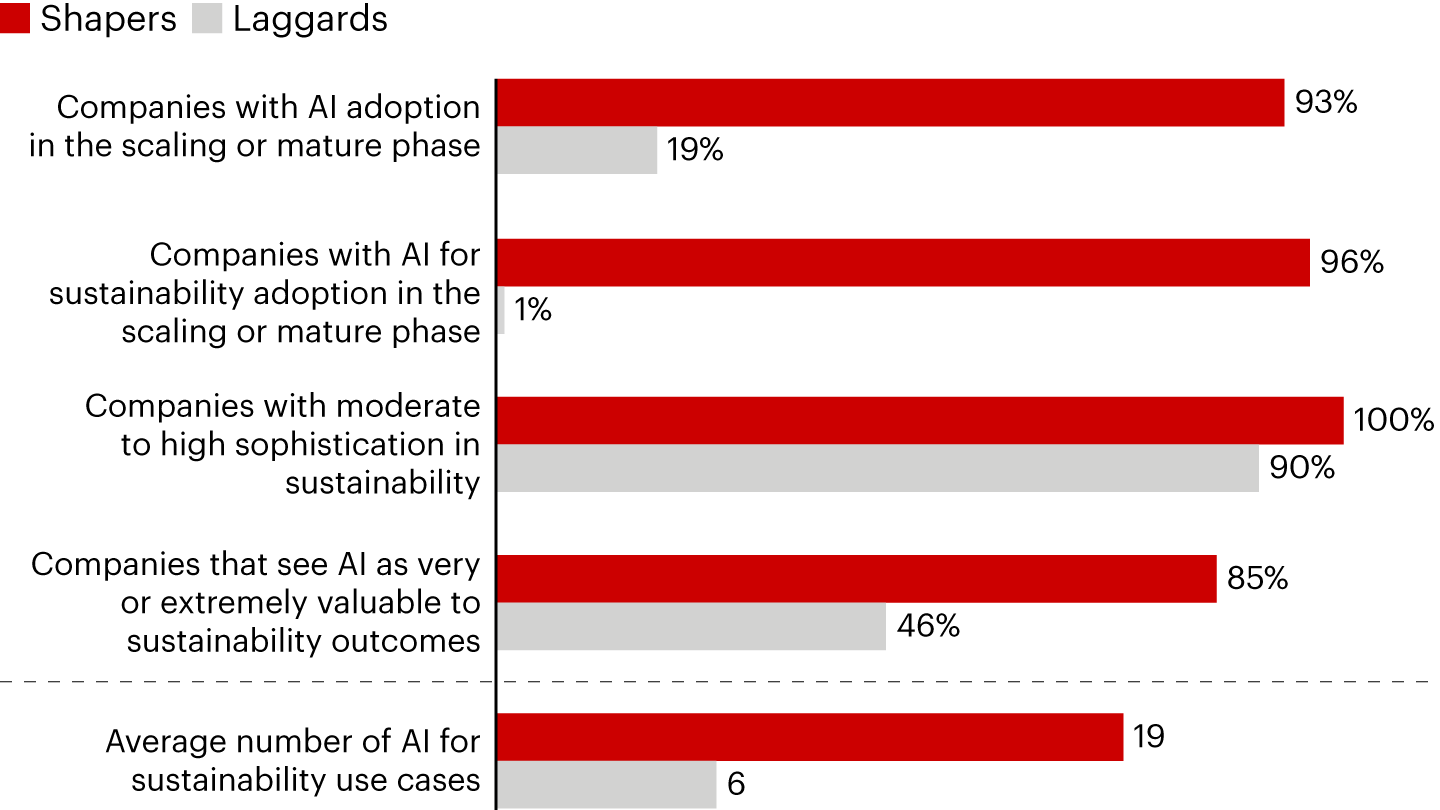
      Shapers are more sophisticated in AI—both overall and in sustainability
      Source: Bain Sustainable AI Survey 2025 (N=400)

      Shapers’ strategies, structures, and behaviors offer a playbook for balancing the sustainability benefits and costs of AI to capture its full potential.

      1. Shapers move beyond compliance, using AI to unlock lasting sustainability impact   

      With more than half of companies still in the exploring or piloting stages, there’s much to learn from those further along. Shapers take a fundamentally bolder approach to selecting, adopting, and getting value from their AI use cases. They prioritize applications with greater potential for long-term impact and enterprise value, such as scenario and risk modeling and sustainable product design—even if the path to returns is slower (see Figure 3).

      Figure 3
      Shapers perceive more value in sustainable AI use cases and are more likely to make strategic, long-term, high-value bets
      visualization
      visualization

      Note: Axes have been adjusted for presentation; variance in absolute values is low

      Source: Bain Sustainable AI Survey 2025 (N=400)

      Here are four use cases shapers are adopting that focus on both business and environmental goals:

      • Long-term scenario and risk modeling. AI helps companies manage the increasing complexity of climate volatility, regulation, and technological change by processing vast data sets for more resilient, forward-looking planning. A global logistics firm, for example, uses AI to model geopolitical and climate disruptions—guiding infrastructure investment, fleet design, and contingency planning.
      • Sustainable product and service design. As demand grows for greener products, companies must innovate without compromising on cost or performance. AI can support this by enabling generative design, material optimization, and tailored solutions. By employing an R&D digital twin to test ingredients and packaging for its cleaning and personal care products, a leading consumer goods company has been able to not only cut waste but also accelerate product innovation.
      • Energy efficiency. AI supports decarbonization by analyzing complex operational data to pinpoint emissions hot spots and optimize performance. Real-time energy monitoring, predictive maintenance, and load balancing support faster, smarter decisions and measurable efficiency gains. In Singapore, the DecarboniSME gen AI platform is guiding small and midsize businesses through emissions tracking and tailored action plans—including solar installation and energy audits that have cut energy use by up to 10%.
      • Green market opportunity identification. AI identifies high-potential markets and buyers for green products by analyzing customer behavior, sustainability goals, and competitive signals. First Abu Dhabi Bank leverages public data and large language models to prioritize sustainable finance opportunities, advancing its commitment to lend, invest, and facilitate $136 billion toward environmental and socially responsible solutions by 2030.

      2. Shapers see the risks that others miss—and manage them better

      Executives broadly agree that AI introduces new risks to sustainability, but approaches to address those risks vary widely. Shapers are four times more likely than laggards to perceive high sustainability-related risks from AI. Unlike laggards, they don’t just focus on compliance, privacy, and data security. They look further ahead to the disruptive and still-emerging risks AI poses to their teams (see Figure 4). For example, as AI reshapes roles and requires new skills, employee trust and engagement become critical. If these are not addressed, massive disruptions in productivity, morale, and organizational performance are likely.

      Shapers are twice as likely to consider sustainability risks when making AI decisions and twice as likely to involve sustainability leaders in AI governance. They hardwire sustainability into AI decision making and governance by embedding it into model design, vendor selection, and oversight processes.

      Figure 4
      Shapers focus on emerging risks like talent; laggards stay focused on compliance
      Source: Bain Sustainable AI Survey 2025 (N=400)

      A leading engineering and infrastructure firm is using these types of approaches. Its AI-powered performance management tool that delivers personalized career growth and training recommendations has boosted employee engagement by a factor of five. At the same time, the company is using AI to improve its overall HR function, with AI-powered HR assistants and HR leadership assistants dramatically accelerating analyses and reducing both ticket volume and resolution time. 

      3. Shapers build an integrated operating system

      Most companies are starting to install the basic hardware for AI in sustainability, including data infrastructure, governance, and reporting. Shapers are building something more sophisticated: an integrated operating system.

      This “OS” embeds sustainability into the way AI is selected, deployed, and governed. It connects internal users and external partners to enable smarter decisions, faster adoption, and broader innovation (see Figure 5).

      Figure 5
      Shapers move beyond the basics to embed sustainable AI across the business and build external partnerships
      Source: Bain Sustainable AI Survey 2025 (N=400)

      Shapers focus on three actions to scale sustainable AI effectively:

      • Program the core logic. Shapers hardwire sustainability into their AI strategy—targeting high-impact use cases tied to material ESG topics, even when return on investment takes time. They also reduce AI’s own footprint by setting energy limits, choosing greener models, and optimizing infrastructure.
      • Configure for internal users. As with any good OS, the approach to AI in sustainability must work for users. Shapers upskill employees on sustainable AI and involve them in determining how it affects their roles. This builds trust, accelerates adoption, and ensures the system can flex, scale, and perform.
      • Expand the network. The most effective systems are open. Shapers build external coalitions, partnering with start-ups, researchers, and policymakers to reduce risk, accelerate innovation, and influence the ecosystem around them.

      The path forward

      AI has the potential to become one of the most powerful tools in the sustainability playbook. But turning that potential into progress requires more than pilots. It demands focus, scale, and systems built for impact. The leaders we call shapers show what’s possible. Now is the moment to learn from them, raise your ambition, and embed AI for sustainability where it matters most.

      Read the Next Section

      The CEO Playbook for Climate Resilience

      Read our 2025 CEO Sustainability Guide

      EXPORE THE REPORT DOWNLOAD THE PDF

      More from the report

      • Embracing the “Do-Say” Gap

      • What’s Still Stopping Consumers from Living Sustainably?

      • How Sustainability Is Creating B2B Growth

      • AI and Sustainability: Shaping What’s Next

      • The CEO Playbook for Climate Resilience

      • Decarbonization That Works: Five Key Actions in Private Equity

      • Why Leaders Must Focus on Carbon Removal Markets Now

      • Circular Business Models Unlock New Profit and Growth

      • Can Food Companies Unwrap a New Strategy?

      Authors
      • Headshot of Torsten Lichtenau
        Torsten Lichtenau
        Partner, London
      • Headshot of Wissam Yassine
        Wissam Yassine
        Partner, Middle East
      • Headshot of Jean-Charles van den Branden
        Jean-Charles van den Branden
        Partner, Brussels
      • Headshot of Martha Moreau
        Martha Moreau
        Practice Executive Vice President, Paris
      • Headshot of Krystle Jiang
        Krystle Jiang
        Senior Manager, Atlanta
      Related Industries
      • Advanced Manufacturing & Services
      • Energy & Natural Resources
      • Financial Services
      • Healthcare & Life Sciences
      • Retail
      • Technology
      Related Consulting Services
      • AI, Insights, and Solutions
      • Digital
      • Enterprise Technology
      • Sustainability
      How We Can Help
      • Artificial Intelligence
      • Circular Economy
      • Climate Change
      Artificial Intelligence
      Top Digital Use Cases by Industry

      Bain’s research identifies the most useful digital applications, including those that offer the best opportunities for competitive advantage.

      Read more
      Advanced Manufacturing & Services
      It’s in the Contract, or Is It?

      Improving contract management can yield 100 basis points of restored revenue, which drops right to the bottom line.

      Read more
      Retail
      AI and Sustainability: The Power of Integration

      Three practices will help companies deploy a more carbon-conscious “eco-AI” approach to their technology and sustainability priorities.

      Read more
      Financial Services
      Five Themes That Will Fundamentally Change Wholesale Banking

      Slower growth raises new challenges around technology, talent, and environmental issues.

      Read more
      Advanced Manufacturing & Services
      Embracing the “Do-Say” Gap

      Three pragmatic questions that shift sustainability from ambition to action.

      Read more
      First published in septiembre 2025
      Tags
      • Advanced Manufacturing & Services
      • AI, Insights, and Solutions
      • Artificial Intelligence
      • Circular Economy
      • Climate Change
      • Digital
      • Energy & Natural Resources
      • Enterprise Technology
      • Financial Services
      • Healthcare & Life Sciences
      • Retail
      • Sustainability
      • Technology

      How We've Helped Clients

      A Manufacturer Vows to “Push to Zero” Carbon Emissions

      See more related case studies

      Constructing a best-in-class global procurement organization

      See more related case studies

      Uncovering major savings in procurement

      See more related case studies

      Want to continue the conversation

      We help global leaders with their organization's most critical issues and opportunities. Together, we create enduring change and results

      Intersect℠ is a service mark of Bain & Company, Inc.

      Bain Insights. Our perspectives on critical issues global businesses face in today's challenging environment, delivered monthly.

      *I have read and understand Bain’s Privacy Notice.

      Please read and agree to the Privacy Policy.
      Bain & Company
      Contact us Sustainability Accessibility Terms of use Privacy Modern Slavery Act Statement Cookie Policy Sitemap Log In

      © 1996-2026 Bain & Company, Inc.

      Contact Bain

      How can we help you?

      • Business inquiry
      • Career information
      • Press relations
      • Partnership request
      • Speaker request
      See all offices