

Brief

Executive Summary
- Manufacturers and other industrial businesses often struggle to deliver services efficiently while also delighting customers.
- Leaders are accomplishing both by mastering the fundamentals, tailoring service offerings, delivering service on time, limiting the cost of interventions and engaging the front line.
- Those who succeed in these areas will have a competitive advantage in customer service.
Customer service leaders outperform competitors in one crucial area: They delight their customers all the time, partly by getting it right the first time.
It sounds simple, but it’s actually difficult to achieve because it often requires a profound shift in mindset across the organization paired with smart, consistent execution.
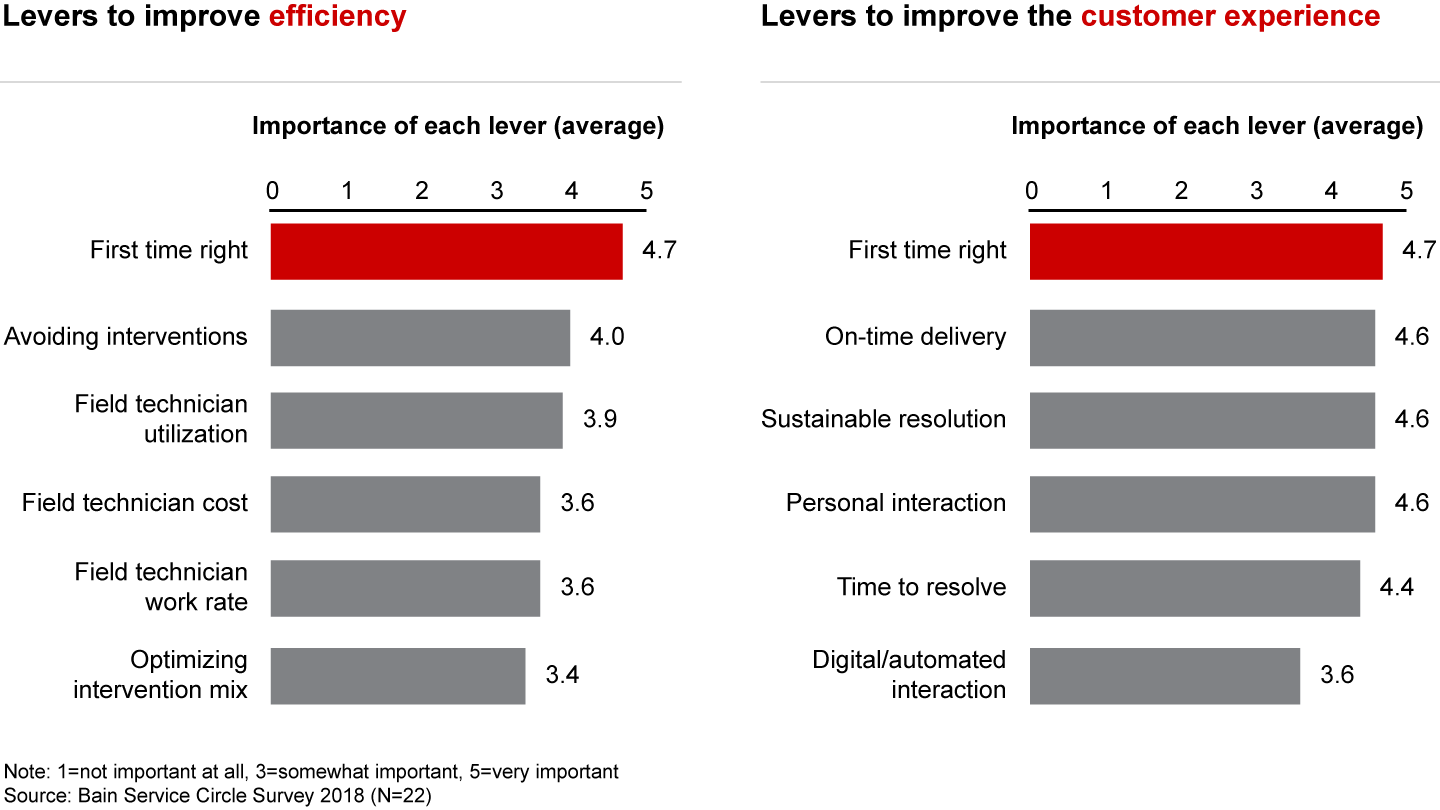
Why does this matter? Because reliably solving customers’ problems and getting it right the first time turns out to be the key to both efficiency and a positive customer experience in service delivery (see Figure 1). Many companies across manufacturing, technology equipment, medical devices and other industrial sectors assume they have to trade off one for the other—highly efficient service delivery or a strong customer experience. But the leaders excel at both.
Figure 1

They delight customers by mastering the fundamentals, tailoring service offerings and delivering service on time. They operate efficiently by leveraging digital tools and other methods to limit the number of interactions, the cost of each intervention, and the indirect and nonlabor costs. And they engage the front line to deliver great service every time.
Delighting the customer
Building an elite service operation requires delivering a top-notch customer experience virtually every time, something many service organizations haven’t kept top of mind in the past. But with the rise of e-commerce and Amazon, individuals and businesses have grown accustomed to an easy buying experience that results in products getting delivered quickly. They now expect a similarly delightful experience and response time from their customer service providers.
The emerging leaders have three common methods for delighting their customers: mastering the fundamentals, tailoring the service offering, and delivering service (and other requests) on time.
Master the fundamentals. Performing well in fundamental areas is the first step toward delighting the customer. That may sound obvious, but surprisingly, many companies fall short.
The core areas that service delivery leaders master include sales (emphasizing effective pricing and contract management); materials cost (improving inventory management); overhead costs (optimizing the back office); and field force costs (implementing standard procedures, ensuring effective technician matching and scheduling, and outsourcing service work to a contractor when necessary).
Tailor the service offering. The traditional method of creating a standard, almost uniform approach to serving every customer is no longer effective. Now, delivering an excellent customer experience requires that service organizations gain a deeper understanding of the characteristics of each customer’s business and adjust their services accordingly.
Leaders organize customer experience operations by sector. They develop a strategy to focus on specific customer segments and cater to each one’s needs and behaviors, enabling service teams to shift from reactive to proactive.
In one successful example, a manufacturing company organized its field force by end market, which allowed the company to create a stronger value proposition for priority customer segments and tailor the service agreements to meet each customer’s unique needs and account for their economic realities. For instance, some customers might want the service provider to emphasize speedy equipment fixes and preventative maintenance, while others might make regular equipment quality checks a higher priority. After a year with the new commercial model focused around customer segments, the manufacturing firm saw a 10-point jump in its Net Promoter Score® and a 12% increase in the number of days between equipment service requests in one of its key cities.
Leading firms design and manage service delivery around customer episodes that start with a need (“I need to get my machine up and running again”) and end with fulfillment of that need (“my machine is up and running again”). Doing this helps service teams get it right the first time by encouraging them to plan in advance and complete jobs through the most efficient pathway. It also focuses service providers on customers’ expectations and perceptions, and it increases the chances customers will feel like the service providers care about and are working hard to meet their requirements.
Deliver services (and other requests) on time. Companies can boost on-time service delivery by refining their field technicians’ processes. Leaders start by implementing tools that limit manual effort, automate steps in the delivery process, and remove unnecessary decision nodes and other bottlenecks.
When an aerospace company set out to improve its aftermarket parts and services delivery process, the project team identified several levers for improving cycle times. These included reducing negotiations by increasing the number of long-term supplier contracts, phasing out unnecessary manager approvals of purchase orders, raising the thresholds that trigger a purchase order sign-off by the compliance team and increasing the use of automated purchase order creation.
It can be helpful to remember that timing has several components in the context of customer service. Completing a job on time is a critical one, but there are other dimensions that influence customer perception and can be improved, such as the total time it takes to fulfill a customer’s request. This is especially crucial when repairing broken-down machines—every second the customer’s equipment is shut down means a longer production delay and lost revenue.
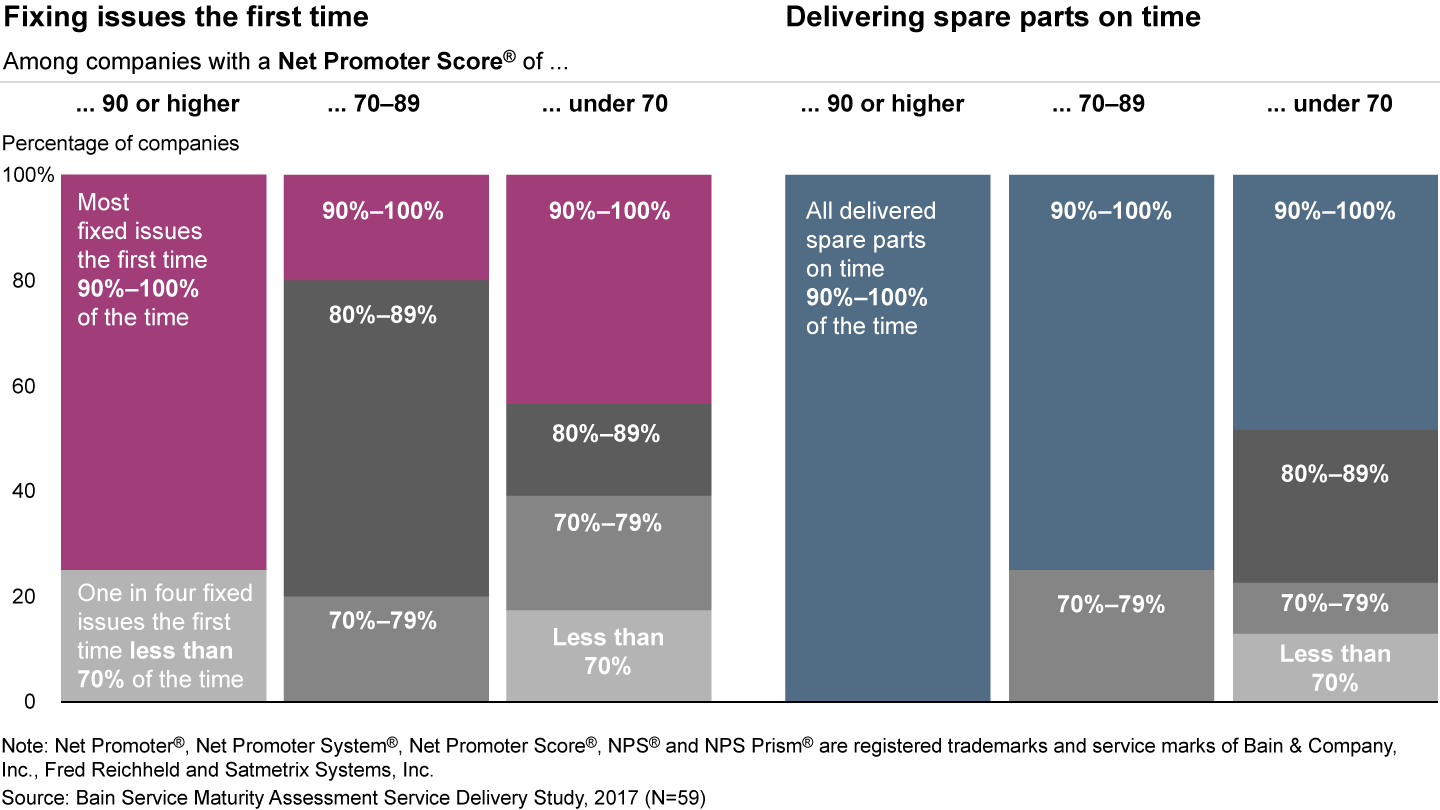
Companies that perform well across these three areas tend to improve their service operations and regularly get things right the first time. This ultimately boosts customer loyalty: Bain research has found firms with a Net Promoter Score greater than 90 are typically strong in both first-time fix rate and spare parts delivered on time (see Figure 2).
Figure 2

Boosting efficiency
Leading customer service providers don’t just emphasize the customer experience; they simultaneously strive to increase efficiency, aided by digital tools and a strong focus on getting customer service right the first time.
Leaders accomplish that by pursuing the following three goals: limiting the number of customer service interventions, limiting the cost of intervention, and limiting indirect and nonlabor costs.
Limit the number of customer service interventions. Great service operators design for serviceability from the start, designing equipment in ways that make it run more efficiently, thereby reducing the frequency of malfunctions, and easier to maintain and repair when problems do arise.
Again, it sounds obvious, but effective service teams avoid interventions entirely when possible. That doesn’t mean technicians ignore service requests. Rather, they leverage preventative maintenance capabilities and remote tools to monitor equipment, identify potential faults and proactively troubleshoot them before the equipment fails.
When unavoidable service issues pop up, leading firms take steps to home in on the optimal mix of types of interventions. For example, a telecommunications company invested in software and other tools to dispatch technicians and resolve customer issues more effectively, as well as to make it easier for customers to fix problems themselves when possible or perhaps with a technician’s guidance over the phone. This created a more efficient process for escalating service requests, with only the most difficult problems requiring an on-site technician. As a result of these and other initiatives, the firm’s Net Promoter Score jumped by approximately 60 points, and the number of service tickets completed per technician per day rose by about 65%.
There is evidence companies are growing more comfortable using remote service capabilities and increasingly finding success with them. Consider the impact of ServiceMax’s Connected Field Service, which has enabled some customers to use remote access to address issues for 70% or more of their call volume.
Lastly, increasing the “first time right” rate can also curtail the number of service interventions. Many companies are turning to software products in this endeavor. Those include a tool developed by Coresystems (a company acquired by SAP in 2018) that enables crowdsourcing on-demand field force support when a company’s service team doesn’t have any technicians immediately available to complete a common task.
Limit the cost of intervention. The best method for driving down the costs of service interventions is maximizing work time and minimizing idle time. In one successful case, a utility company implemented new workflows that better balanced the workload and employee scheduling. One crucial adjustment was ensuring technicians all had an assigned task at the start of every day, which was communicated through an online dashboard. This eliminated the unnecessary step of traveling to a depot just to find out the location of the day’s first job. Other changes included improving the routing of technicians based on their real-time location and new requests that come up during the day.
Limit indirect and nonlabor costs. Leading firms look for ways to trim the fat across the entire organization, including improving back-office efficiency and lowering administrative costs. For example, as companies digitize their administrative paperwork, they can standardize and automate such work. They might, say, make it easier to fill out repair invoices or service contracts by developing preconfigured text for the most common equipment breakdowns.
Engaging the field force
Emphasizing “first time right” is also a valuable method of engaging and motivating a company’s field force. It can help focus them on the capabilities and initiatives that result in more efficient service as well as consistently excellent customer experiences.
Some companies have found that technicians who only pay attention to efficiency can fall into a vicious circle: They put too much emphasis on fixing things quickly in order to meet productivity targets set by management, but in the rush to meet quotas and deadlines, they tend to execute their job poorly. That usually results in customer dissatisfaction and technician attrition.
Leaders find ways to strike a healthy balance between the two seemingly opposing aims of “first time right” and efficiency. They often find that sweet spot by nurturing and promoting four traits within their field forces: purpose, hope, attention and trust. Leaders link field employees’ jobs to a deeper purpose, helping them see how keeping equipment or software up and running benefits businesses and people. Inspiring hope is an unconventional business goal and hard to measure, but if companies provide technicians with better tools and a roadmap showing how equipment improvements will make their jobs easier, the field workers will tend to feel more confident about the future. Focusing the field force’s attention on a small set of key metrics, such as “first time right” and a handful of other areas, can keep them motivated and improve performance. As that focus on crucial metrics starts to generate better results, it builds trust between the field force and management—especially if management listens to technicians’ ideas and works to address their concerns.
In addition to these traits, some leading companies have deployed management teams to work hand-in-hand with field technicians at a single location, using Agile methodologies to quickly dissect the issues service teams have faced and to brainstorm ways to improve their processes to address each problem. Then, they test those solutions locally, and once perfected, they roll out the changes across the rest of the organization.
Embedding the principles of purpose, hope, attention and trust in a service delivery organization can help management and field forces collaboratively solve problems and find the optimal balance between efficiency and effectiveness. This requires a potentially difficult shift in mindset on both sides. It requires management to help technicians feel empowered to find that line between efficiency and effectiveness, and it requires field workers to step up and take ownership of developing and executing a new strategy. But if everyone can accomplish these aims, it will likely lead to better service outcomes, a better customer experience and the satisfaction of all stakeholders.
Finding a competitive advantage
Advanced manufacturers and other businesses with a strong installed base outperform their competitors in customer service by sharply emphasizing getting it right the first time. This can help boost service delivery efficiency and enhance the customer experience—the two hallmarks of elite customer service organizations.
Furthermore, companies that effectively engage their field force have an enormous competitive advantage because they’ve empowered those employees to drive the necessary service delivery changes on the front lines.
Senior executives and other decision makers seeking ways to elevate their service delivery can use the following questions as a starting point:
- How well do we understand our customers and their expectations?
- How effective are we at delivering a positive customer experience?
- What are our strengths and weaknesses when it comes to delivering efficient customer service interactions?
- How are we using digital tools to improve service efficiency and the customer experience? Are there any areas where we could use technology more effectively?
- How engaged is our field force?
- What key hurdles keep us from consistently getting service interventions right the first time? What actions could we take to respond to those hurdles?
The authors would like to thank Cristina Gutierrez for her contributions.
Net Promoter®, Net Promoter System®, Net Promoter Score®, NPS® and NPS Prism® are registered trademarks and service marks of Bain & Company, Inc., Fred Reichheld and Satmetrix Systems, Inc.
First published in julio 2020