

Brief

Executive Summary
- It often seems as if traditional strategy development processes have no place in the fast-moving, always changing technology industries.
- But in many respects the way top tech performers define a mission, shape a portfolio and allocate resources looks a lot like what companies in more traditional industries have done for decades.
- The critical difference is that they’ve discovered how to make strategy development faster, pragmatic and more agile by focusing on four key principles.
It’s not really surprising that so many tech company executives punt on the traditional corporate strategy process. Amid the chronic turbulence and rapid change of today’s technology markets, they believe there isn’t time to deliberate over three- to five-year goals that may turn out to be obsolete within the next 12 months. Growth is what moves the valuation needle and growth depends on innovation, speed and agility, not annual planning processes. Success in tech means defining the future right now.
But are corporate strategy and speed really that incompatible? Not if we’re talking about some of the world’s most successful tech players. While companies like Amazon, Alphabet, Tencent or Adobe might not label what they do a formal “strategy process,” their success owes much to tried and true principles of strategy development. They define a bold path to leadership, they make difficult portfolio choices, they allocate resources strategically and they build strong capital structures. What they don’t do is get bogged down in process or complexity. They remain action oriented by focusing on no-regret moves in the short and medium term, while laying out a clear set of stepping-stones that move the company toward its long-term aspiration. Critically, they also anticipate disruption and change by monitoring key trigger points and revisiting their long-term vision regularly. Certain paths will remain relevant, others will become moot and new ones will suggest themselves. Built-in flexibility makes strategy development faster, more pragmatic and agile.

Planning and Speed: The Balancing Act In Tech
Many tech firms don't think they have time to look ahead. But the winners know that focus and agility are not mutually exclusive.
Adobe’s evolution over the past decade or so is a good example. Although the San Jose-based company has always been a leader in developing world-class creative software like Photoshop and Illustrator, its go-to-market model (licensing boxed software) eventually slowed it down. The company’s response was to broaden its ambition for how and what it would deliver to its customer. It then laid out a careful strategy to transform Adobe, largely via M&A, into a company offering cloud-based subscriptions that would “give everyone everything they need to design and deliver exceptional digital experiences.” Creative software is still Adobe’s core, but the company is now a leader in market analytics and web development technology, and it is currently investing in artificial intelligence and machine learning. Since 2008, its revenue has tripled and its stock price has soared 14-fold in response.
Despite the turbulent, fast-changing environment in which technology companies operate, the most successful ones aren’t merely reacting to what comes in the short term. Neither are they slaves to process and budgeting. What sets them apart is the ability to infuse long-term planning with speed, make pragmatic near- and medium-term bets, learn from experience and adjust as necessary informed by real data and learning. Those companies that best manage this balancing act between careful planning and agile response rely on four key principles:
Scale matters, ownership doesn’t
The economic benefits of scale are as critical in high tech as they are in any sector. But how companies achieve scale (and how quickly) has changed dramatically, giving leaders the ability to leapfrog incumbents and get ahead of the industry experience curve. Notably, these strategies don’t rely on accumulating proprietary assets, which can be prohibitively time consuming and expensive. Instead, scale is often virtual, meaning the company acquires the economic benefits of size and scope without committing the time and capital to building scale the traditional way.
A simple example is how companies of any size can now tap capacity and capabilities rapidly and inexpensively via the cloud. That has helped insurgents like Zalando, the European e-commerce platform based in Berlin, and Paytm, the Indian e-commerce payment system, scale an innovative idea rapidly, allowing them to challenge incumbents and disrupt entire industries. More complicated—and often more powerful—are strategies aimed at tapping an ecosystem or building a platform. These “asset-light” strategies use win-win partnerships to build scale, add capabilities and accelerate innovation.
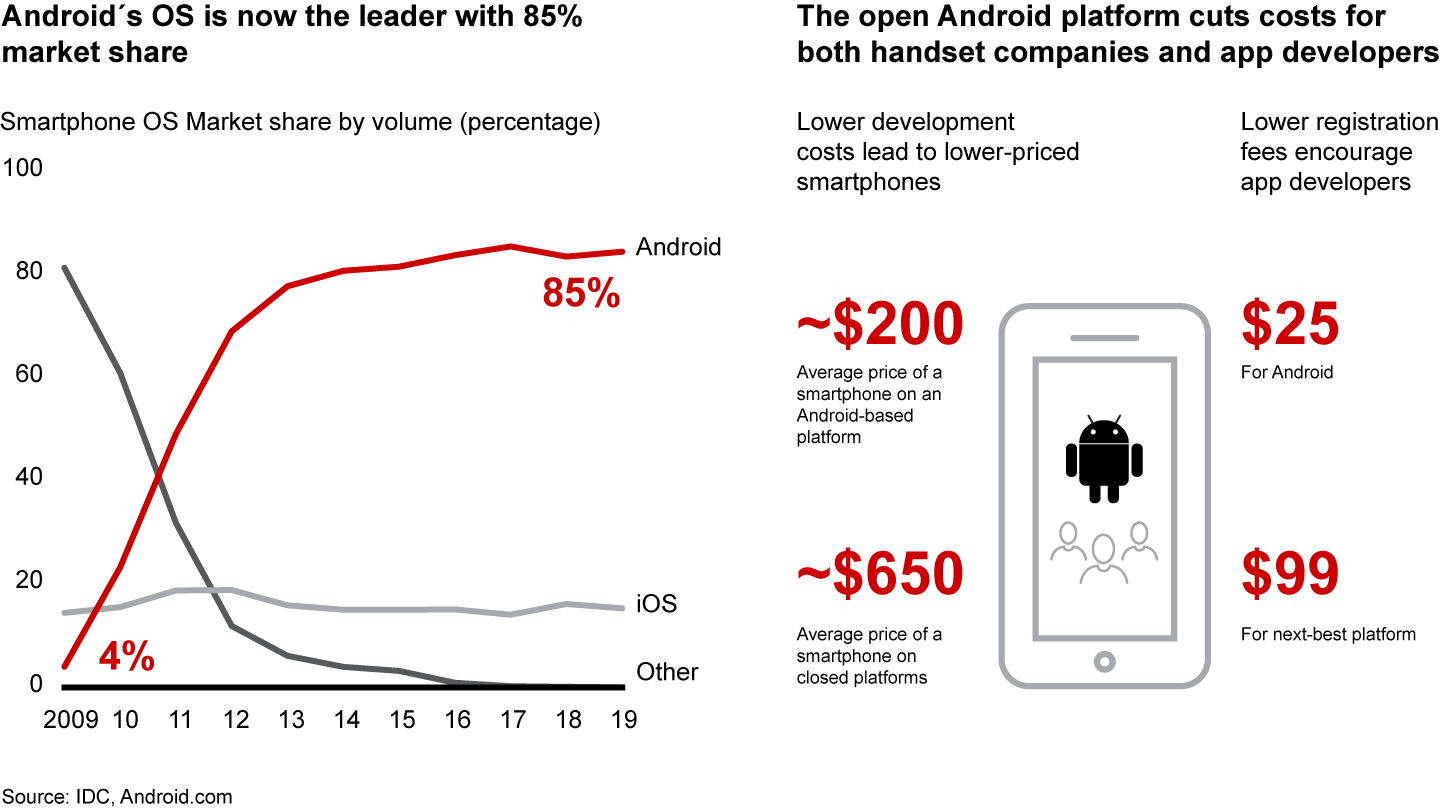
When Google launched the Android mobile operating system in 2008, for instance, it was a tiny speck in a mobile universe dominated by Symbian OS and Apple’s iOS. But working step-by-step, Google accelerated Android’s growth dramatically. First, it forged an open-source partnership with the many handset makers trying to compete with Apple’s iPhone. That created a built-in customer base among the manufacturers but also helped them trim their costs, allowing them to produce cheaper devices that proliferated widely. Next, Google built a collaborative network for app developers and gave them tools and training to accelerate the introduction of new apps. By 2013, there were 1 million Android apps on the platform, and the number has doubled to more than 2 million since then. By giving users, developers and handset makers free access to Android, Google created a potent network effect that carried the operating system from 4% market share in 2009 to 85% this year (see Figure 1). That has turned into a big win for Google. The company makes little from the operating system itself, but the more Android phones that are out there, the more Google collects in mobile ad and app revenue.
Figure 1

Accelerating growth by tapping an ecosystem or building a platform typically requires a substantial investment in developing new muscles and capabilities. It also involves adopting a new mindset. A lot of companies are reluctant to partner with others, wary that they will be giving up too much control or losing their proprietary edge when it comes to innovation. But that can be shortsighted. China’s Internet giant Tencent became the world’s largest gaming company partly by investing in smaller, pure-play gaming companies and taking advantage of their expertise. Tencent used the partnerships and acquisitions to enhance its in-house gaming capabilities while giving the smaller companies a large platform to extend their offerings in China. Similarly, Tencent has built WeChat into China’s “super app” by encouraging outside developers to create mini apps that live on the WeChat social platform. In addition to messaging and social media, these apps give users the ability to game, transfer money, pay utility bills and book doctor’s appointments, among many other functions. Subscription services also let small businesses send notifications to customer groups, set up a storefront, accept payments and offer virtual customer service. Tencent might have chosen to develop everything internally. But by taking advantage of a vibrant, innovative ecosystem it was able to use its core brand to expand rapidly, tapping into the creative energy and insight of a diverse group of partners.
Anchor in “future back” with a bias to action
Good strategy moves systematically from a strong core to logical adjacencies to well-placed bets on new engines of growth. That progression still works in technology markets. But the most effective companies shed the habit of trying to extrapolate the future from the past as they make choices about the right portfolio of assets. At most companies, strategic planning flows from a today-forward perspective, meaning leadership starts with the company’s existing products and business model and works forward from there. Making the right choices in a truly dynamic environment, however, often requires a future-back perspective. That involves understanding the raw customer need and envisioning how your core value proposition may have to change under future scenarios of disruption, regardless of how the company operates today. The challenge is that future-back thinking can become ponderous and theoretical, risking a period of inaction. So the most successful companies are ruthless about translating this future-back thinking into tangible, near- and medium-term actions that sustain pace.
For Adobe, this balance played out as revenue slowed between 2008 and 2009, raising questions about the company’s business model. While the Photoshop maker had done a great job using strategic acquisitions such as Aldus and Macromedia to expand its reach and capabilities, eventually its reliance on physical delivery of software was limiting its growth. An 18-month update cycle slowed the pace of innovation and disrupted both financial results and the stock price. What became increasingly clear from a future-back perspective was that the model would need to change radically to meet Adobe’s insurgent mission to provide great design tools and enable exceptional digital experiences. Subscription-based delivery from the cloud was a much more efficient solution than sending out CDs. Customers would get instant updates and Adobe could rely on a steady stream of recurring revenue.
Adobe translated this future-back insight into several no-regret near- and medium-term decisions. First, the company bought web analytics company Omniture, which helped build capabilities for cloud delivery and opened up a new growth engine in marketing and analytics services. Then in 2011, the company took massive leap into the future by announcing it would migrate its Creative Suite business to digital delivery and rename it the Adobe Creative Cloud. It also began to build out an enterprise business in Web development software and analytics tools, which has evolved into a fast-growing unit called the Adobe Experience Cloud. Adobe had to accept that the transition to the cloud would affect performance in the short run. It also had to commit to educating its customers, its employees and its investors as to why such a radical approach made sense. By developing a clear and compelling story that laid out a bold strategic vision, the company bridged the transition from old to new, setting up a remarkable ramp in market value.
Resource allocation is ruthless and undemocratic
Perhaps the most common failure of a traditional strategic planning process is the tendency toward incremental budgeting. At too many companies, an existing unit that meets its goals can usually count on seeing a small percentage increase in its budget every year. Fast-growing tech companies don’t operate that way. Instead of “peanut buttering” resources across a portfolio of assets annually, they are relentless about shifting investment toward the winners. Resource allocation is a fundamental extension of strategy. The patience to stick with good ideas through gestation is critical, but so is the willingness to cut off the losers. Winning requires using scarce resources to out-invest the competition where it matters most.
Amazon, for instance, is well known for making bold bets as it seeks new ways to take advantage of its sprawling online platform. As founder Jeff Bezos likes to put it, “Failure and invention are inseparable twins.” But Amazon didn’t become one of the most valuable companies in the world by sticking with losers like the Fire Phone or Amazon Wallet once it became clear they were failing. The company has developed sophisticated market sensing capabilities that use data and rapid feedback loops to determine which initiatives have the most potential to deliver on the company’s promise to provide customers convenience, price leadership and product variety. By relentlessly prioritizing what’s working and pouring resources into those businesses (at the expense of the losers), the company maintains a portfolio of bets that balance short-term results with long-term business building. Amazon wasn’t afraid to invest heavily in the Fire Phone, but it was equally bold in taking a $170 million write-off for the unit a mere three months after its ill-fated launch.
Yahoo’s trajectory, on the other hand, shows how an undirected “throw it against the wall” approach to prioritization ends up creating a lot of middling businesses. Since its heyday at the turn of the century, Yahoo has used a massive pile of cash generated by its once-dominant advertising business to fund a long list of acquisitions aimed at … well, that has never been clear. From video streaming, to shopping, to social networking, Yahoo has failed to sustain leadership in any of the businesses it has entered in recent years. The company applied a thin layer of investment across a hodgepodge of bets, and as one former executive said, “We focus on nothing in particular.” As a result, the company drifted for years. Its one crown jewel: a prescient investment in another, more strategic company, China’s Alibaba.
Long-term planning focuses on waves of discovery, not static endpoints
A clear strategic vision to guide investment is vitally important, even in markets that are constantly shifting. But it is equally important to develop market sensing abilities and the ability to act on them. Being Agile doesn’t mean a company has to abandon long-term thinking or planning. But it does require a culture of flexibility that uses Agile principles of test-and-learn to translate long-term thinking into near-term action. The goal is to develop prototypes, gather customer data early, and exploit that learning either by backing the winners to achieve scale or moving on to something more promising.
The most effective companies move in waves of discovery. Future-back analysis helps define the right point on the horizon and the strategy lays out a set of near-term stepping-stones that move the company logically in that direction. These initiatives are proof points. They offer the company an opportunity to learn and adjust. Strategy becomes a constant set of inquiries: Are we the best owner of this asset? Is it on a path to leadership? What are we learning about this business and how is it changing? What does that tell us about how to deploy scarce resources against the next wave of stepping-stones? How can M&A and partnerships accelerate our progress toward scale?
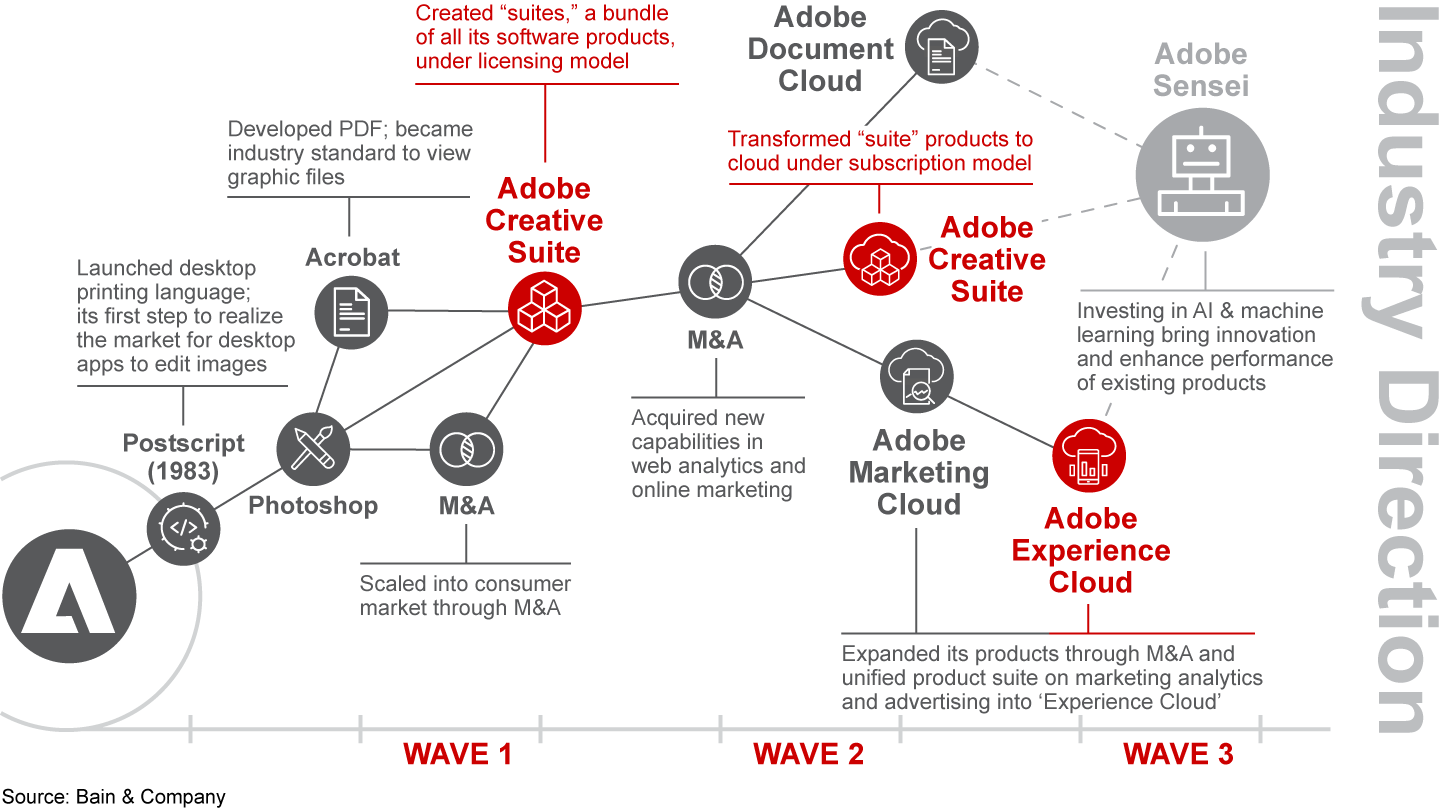
Adobe’s journey has been punctuated by these waves of discovery—periods of learning that have repeatedly transformed the company (see Figure 2). Starting with Postscript, a desktop printing language, and moving to dominance in the creative space with a bundle leading design products, Adobe transformed an industry. By embracing the cloud and recognizing the linkage between web development and marketing, it has transformed itself into a company with a vibrant portfolio of growth assets.
Figure 2

Companies that combine strategy with speed build Agile strategic development into a proprietary capability. They aren’t focused on the calendar or annual planning process. The process is continuous and dynamic, driven by opportunity and insight. That starts with maintaining a relentless focus on the raw customer need and building sophisticated market sensing skills to spot trends earlier than others. It means developing solutions through rapid test and learn processes and using that insight to confidently place big bets on the few strategic initiatives that matter. These companies rely on top talent to develop solutions internally, but they are unafraid to pursue goals by tapping their industry ecosystem to build solid partnerships or using M&A as a strategic weapon. They keep a bold, insurgent mission at the forefront of decision making and are adept at framing a story that resonates with all stakeholders—from frontline employees to Wall Street investors. Leaders can gauge where they are on this journey by asking a few key questions:
- How do I set a bold, long-term ambition in the context of constantly changing market realities?
- How can I move systematically from the core to adjacencies, but be an early mover to capture a disproportionate share of growth?
- How do I translate my long-term ambition into near- and medium-term actions to make bold bets, manage the needs of stakeholders, and bring them along on the journey?
- What are the new sources of competitive advantage beyond scale (as traditionally defined) and how do I build or acquire these?
- How can my strategy be focused on the biggest long-term sources of value but remain agile and dynamic given rapid changes to the market and competitive landscape?
In many ways, the ability to define a vision and lay out the right strategy to get there has never been more important in technology. Amid constant market turbulence, leaders need a North Star to guide investment and build the right portfolio. But tech executives are right when they say that traditional processes aren’t good enough. The essence of strategy lives on, but winners need to be faster, smarter and more agile.
David Crawford is a partner with Bain & Company and is the leader of the firm’s Technology practice. Matthew Crupi is a Bain partner and an expert in the firm’s Strategy and Technology practices. Chris Johnson is a partner and an expert in Bain’s Technology practice. Josef Ming is a senior partner and a leader in Bain’s Strategy practice. Michael Schallehn is a partner and an expert in the Technology practice. David is based in Bain's Silicon Valley office, and Matthew in Dallas. Chris is based in San Francisco, Josef in Zurich and Michael in Silicon Valley.
First published in noviembre 2019