

Brief

When financial performance tumbled well below the expectations of shareholders at a major US-based manufacturer of industrial parts, the new head of supply chain saw ways to make the supply chain part of the solution.
The firm was struggling to manage costs and still meet commitments on multiyear contracts with customers. It did business with thousands of suppliers, even though only a handful accounted for the vast majority of spending. Annual net productivity increases hovered close to zero. And decision making to award new work to suppliers was fragmented among individual product lines, undercutting the firm’s scale advantages.
With the backing of the leadership team, the new head of supply chain took action quickly, focusing on some of the highest sources of value. The company pared back the base of suppliers chosen by each product line to create a much smaller number of strategic relationships. That action reduced transaction costs, including overhead generated by the internal complexity of managing a long tail of smaller suppliers. The leadership team aggregated spending from product lines, and the higher volumes of purchasing led to immediate savings in direct costs. The team also integrated functions that formerly worked in silos—procurement, quality, logistics and so on—to work closely together and to provide a single contact for each of the product lines served.
As a result of these steps, the company tripled the annual net productivity rate of the supply base over the course of two years—from near zero to about 3% above inflation—and reduced indirect procurement costs by 12%. The commercial programs benefit from single-point accountability and now view the supply chain function as a true business partner. Investors, meanwhile, have rewarded the company with a steady rise in its stock price.
Greg Gerstenhaber, a partner in the Performance Improvement practice, outlines how a supply chain can become a competitive advantage for a company, and how to evaluate what changes your supply chain needs to become a true partner of the business.
Many other firms would like to make similar strides, turning a standalone, sometimes-reactive collection of support functions into a supply chain that’s a close partner with the business units. At its best, the supply chain function can become a true competitive weapon. At a minimum, the supply chain can aspire to be a business partner with these traits:
- It tightly aligns with the business strategy, making decisions that will accelerate growth and performance.
- It manages an integrated, end-to-end supply chain, rather than a collection of functions that operate separately.
- It identifies opportunities to create value, and brings those quantified economic trade-offs back to the business units. New digital technologies, for instance, allow companies to change complete steps in the value chain (for example, the use of 3-D printing to support aftermarket replacement parts).
- It consistently meets customer commitments with highly predictable performance.
- It delivers annual productivity improvements in excess of inflation.
High-performing supply chains yield several beneficial outcomes. These include high satisfaction among customer segments that contribute most to profits, the ability to adjust quickly to external events, a high return on capital for supply chain assets employed and consistent productivity improvements that enable reinvestment back into the business.
Supply chain leaders have realized these benefits only after a careful, deliberate approach to finding where the greatest value opportunities lie, and then capturing the value through several paths.
Finding the value
It’s worth starting with the basics, asking what type of supply chain the company currently has and how exactly the supply chain can lend strategic support to the business units. Answering these questions involves actions to assess where the specific value-creating opportunities lie. We have seen leading companies use three distinct lenses to identify potential value from the supply chain (see Figure 1), assessing:
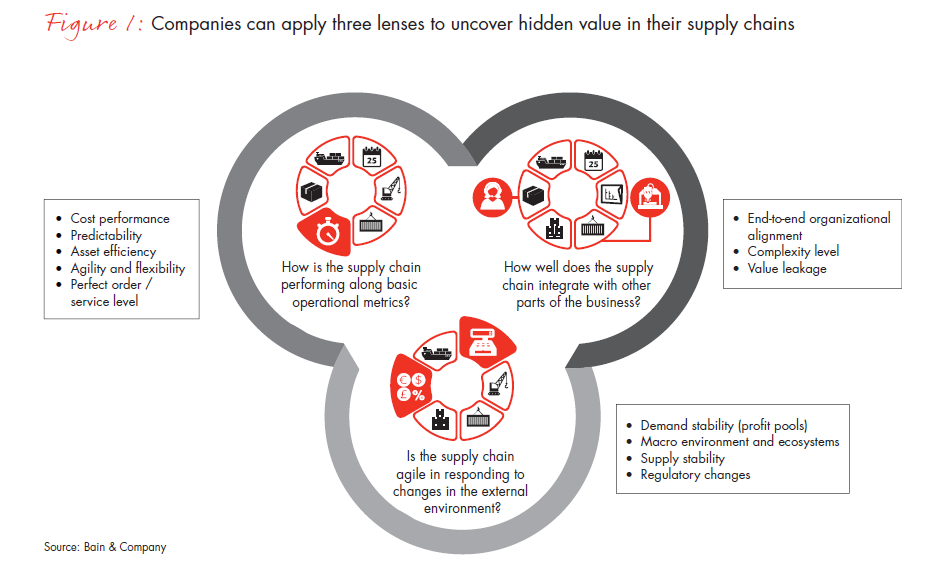
- its performance along basic output metrics;
- how well it integrates with the rest of the business; and
- its agility in responding to external market changes.
The first lens looks at how the supply chain performs along basic output metrics to be competitive in the marketplace. The metrics include total landed cost, perfect order and predictability and asset efficiency.
The second lens looks at how well the supply chain integrates with other parts of the business. Companies can often find large sources of potential value in the mismatches and misalignments in the organizational seams. The opportunities include:
- Simplifying excessive complexity caused by too many product SKUs, or gaining a better understanding of the profitability of different SKUs.
- Stemming the value leakage in the organizational seams caused by excessive rework or expediting. Often, high-level metrics mask the underlying cost and capabilities required to achieve service goals. The dirty secret of “perfect order” capabilities, for instance, is the large amount of money required to expedite an order.
- Better integrating the supply chain with other processes, such as sales and operations planning (S&OP), or sharing costs or capabilities across product lines. New digital tools allow even tighter integration and accountability of sales forecasts with the production plans.
The third lens checks the agility of the supply chain to respond to changes in the external environment. This process begins with an examination of whether and how profit pools shift from one type of customer to another, and whether growth will come from new countries or new products. Companies can scan for disruptive technologies and evaluate how customers’ adoption of digital tools is changing their research and buying behavior. These digitally enabled innovations range from changes in production, such as 3-D printing and flexible manufacturing, to new channels or ordering patterns. Companies can also anticipate legal and regulatory changes that will affect their business and thus require adjustments to the supply chain model.
Capturing the value
When companies use these three lenses, they typically uncover many opportunities to create value—often too many to realistically pursue at one time. It’s usually more effective to sort them by potential value and the effort required to realize them. Executives can take immediate action on small-scale efforts—both to make quick progress and to potentially fund longer-term, broader initiatives—using three paths to capturing value (see Figure 2).
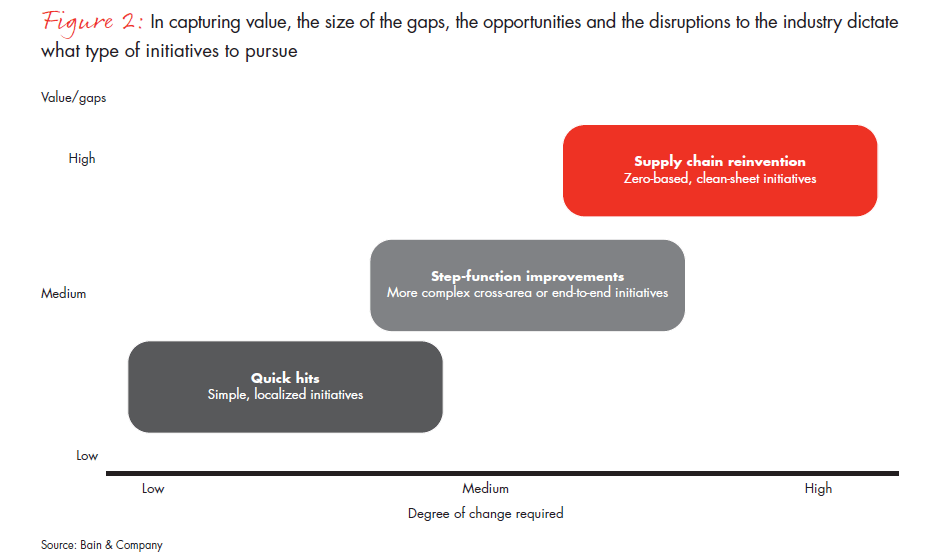
Quick hits. Companies don’t need to spend a fortune to make a difference. Working capital adjustments or minor fixes to the sales and operations planning process can rapidly unlock value. These types of initiatives free up capital that can be reinvested to improve broader supply chain capabilities.
Multiple contained, quick hits made a real difference at an electronics equipment manufacturer. The firm had long run a standard S&OP process but increasingly saw poor outcomes. A long-overdue diagnosis identified three critical weaknesses:
- The manufacturer had not tempered its overreliance on aspirations and quotas with hard analysis, so the forecasts were consistently too optimistic.
- Executive S&OP meeting participants rushed through topics rather than focusing on exceptions and big issues.
- A cultural tendency to avoid conflict masked the extent of challenges uncovered by the data.
Within three months, the electronics manufacturer moved to a process that relied more on quantitative data than gut instinct and focused on identifying and rectifying potential challenges. One early win occurred in the run-up to a global product launch, when the new data-driven approach indicated that demand for the product in Europe was well above previous forecasts, while the Americas forecasts were too optimistic. With this insight, the S&OP team was able to make timely decisions to reallocate supply. As a result, the company avoided a stock-out in Europe and increased sales 25% over the original forecast. In the Americas, the new process limited inventory risk, reducing overproduction by 75%.
Step-function improvements. Some opportunities involve more effort for a greater return, including redoing a cross-functional process or improving how people make decisions.
A specialty materials company, for instance, had been using the same 98% fulfillment level for all customers. After analyzing the overall profitability of each customer, the company realized that providing the same standard added unnecessary cost to low-margin customers in a way that the customers did not value. By revising service levels accordingly, the company was able to direct the top service to the highest-value customers while improving the profitability of other customers.
Supply chain reinvention. Very ambitious supply chain programs cost more and take more time, but they can unlock huge value, transform the economics of a business and enable profitable growth. Such programs include changing the plant network structure or scale, improving production assets, moving suppliers closer or simplifying the product assortment.
Consider the case of a global food company, which struggled with creeping complexity on several fronts. The company grappled with a large number of SKUs, formats and formulas; a fragmented supplier base; and many subscale manufacturing plants with low asset efficiency. It became clear to executives that the existing supply chain would not effectively support projected growth.
The senior team decided to redesign the entire supply network and made aggressive productivity improvements in order to free up cash for other investments to generate growth. The supply chain group worked with each business unit and with marketers to refine demand forecasts, including price elasticities and go-to-market timetables, by country. Those forecasts informed a new, smarter selection of food package sizes and prices—a level of SKU complexity that responded to market demand yet would optimize profitability.
Through scenario planning, including the more rigorous demand forecasts, the company was able to optimize its entire supply network worldwide. It understood where to build capacity, where it made sense to exit production, where suppliers should relocate and the mix of SKUs each plant should produce. The company decided, for instance, to build a new plant in Mexico and invest in process and packaging technology that was three times faster than older processes with far less scrap product. It identified raw material and packaging suppliers near the new facility.
The food company’s supply chain reinvention, which reconfigured the network with new plants strategically placed around the globe, has paid off with hundreds of millions of dollars in annual net savings from productivity improvements and additional cash flow over three years.
Reinvention has advantages over more incremental tactics. The natural inclination when reviewing an existing supply network is to examine each problem individually and build an investment case for that issue. However, such an approach fails to review all the variables at one time. Certain ingrained behaviors, moreover, limit the opportunities. A plant manager is unlikely to volunteer that his or her facility does not function well and should be closed in favor of a new plant in another country.
Optimizing the entire network requires a strong, business- oriented head of supply chain. With such a leader in place, a company might, for example, invest selectively rather than spreading capital evenly among its many plants, thereby creating the most advantaged supply chain possible.
Questions to start the conversation
Executives committed to building a supply chain that acts as a business partner can determine their next steps by addressing several questions:
- Does your supply chain integrate with the business units, identifying opportunities to create value, or does it operate as a collection of functions?
- Does your supply chain deliver the cost position needed to help the company grow, or does it struggle to keep pace with the business?
- Does the supply chain reliably and predictably meet customer commitments?
- Has the supply chain consistently delivered productivity improvements greater than inflation?
- Are you confident the supply chain can adjust quickly to changes in the external environment?
- Do you monitor digital trends that can affect your supply chain, and are you pursuing them to generate advantages faster than your competitors?
Great supply chains are geared appropriately to the business and the strategy of a company. Quick hits or step-change improvements can position a company to generate real gains in productivity and profitability. In some cases, reinvention can help change the rules of their industries. In the right hands, the supply chain becomes a competitive weapon that can adapt to the inevitable changes in strategy and competitive circumstances that lie ahead.
Greg Gerstenhaber is a Bain & Company partner in Dallas, where he leads the firm’s Americas Supply Chain Management group. Peter Guarraia is a partner based in Chicago and the leader of Bain’s Global Supply Chain Management group. Pierre-Henri Boutot and Miltiadis Athanassiou are partners based in Hong Kong and Zurich, respectively. Boutot leads Bain’s Asia-Pacific Supply Chain Management group, and Athanassiou leads the group in Europe, the Middle East and Africa.
First published in diciembre 2015