

Brief
An oil spill in Brazil, a sabotaged pipeline in Nigeria, a chemicals processing plant explosion in Thailand. One could be forgiven for thinking that the oil and gas industry is never far from the headlines for all the wrong reasons. However, dramatic headlines tell only a small part of the story of the daily operations of a global oil and gas industry. Every day, tens of thousands of wells, hundreds of thousands of miles of pipelines and millions of items of processing equipment deliver energy safely to our homes, transport systems, businesses and communities.
All that happens in an industry increasingly focused on improving its operations. For oil and gas executives, the need for operational excellence (OE) has never been greater. Exploration, development and production costs are rising, and refining margins are under pressure. Activity levels are also increasing, causing sector inflation. A shortage of technical talent and capability has bid up the cost of employees and services even further. Because one in four technical professionals will retire in the next seven years, this shortage could become even more severe.
The rise of unconventional resources like shale oil also contributes to a deeper focus on OE—primarily in North America, but elsewhere, too. The fundamentals are the same, but unconventional plays require different processes than those in conventional extraction. As integrated oil companies (IOCs) and national oil companies (NOCs) climb the learning curve on unconventional resources, successful operators are refining their approaches for these unique operating challenges.
At the same time, the oil and gas industry is under tremendous pressure to reduce risk, even as it takes on new challenges, such as drilling in ultra-deepwater or the Arctic, intensive onshore operations in populated areas (for example, shale gas in the northeastern US) and pioneering technologies like floating liquefied natural gas (FLNG) terminals. Industry executives are working to define and deliver OE at the frontiers, where few benchmarks exist.
The shift to frontier sources accompanies a changing competitive landscape that requires oil and gas players to become more nimble and to compete in new roles. The rise of the NOCs and the loss of access to easy reserves are pushing IOCs and independents to improve their technological and operational skills as well as their capabilities for working with governments and other partners. The NOCs’ rising expectations and their interest in new kinds of partnerships create huge opportunities for oil field service companies—but they too must develop their expertise and capabilities to manage more risk and project complexity while providing integrated field operations, above and below the surface.
Complicating these changes are the rising expectations of regulators, shareholders and communities, all of which are demanding more from oil and gas companies. Regulations are becoming increasingly complex and regulators more proactive, requiring a greater level of attention to ensure compliance.
These pressures combine to increase both the need for and the value of OE. Our work with oil and gas producers suggests that more than 10% of production capacity is locked up in complexity and inefficiency—a valuable opportunity for improvement. Operational excellence creates value through systematic and repeatable actions that are clear and addressable for everyone in the company. It relies on well-documented standard processes that over time lead to continuous improvement of operating performance. Everyone in the organization understands (or knows how to find out) how to perform their tasks and has access to the resources to do so.
Bain works with many oil and gas companies to help raise their level of OE. Some require wholesale transformations across capabilities; others need targeted upgrades in specific areas. This brief, part of a series, explains what we mean by operational excellence, why it is increasingly critical to oil and gas companies and how companies begin their journey to reach and maintain it.
John McCreery, a partner in Bain's Oil and Gas practice, explains why operational excellence is essential, given the rising costs in the oil and gas industry.
What is OE?
For most oil and gas companies, the aspiration for operational excellence is not new. Many have well-developed programs, codified manuals and active measurement and training—but gaps persist. One reason is that supervision ratios (between company staff and contractors) have risen from about a 1:1 ratio 20 years ago to about 1:5 today. Average experience levels are also falling even as activity levels rise. Today, in mature areas of the industry, OE is more about culture and changing behaviors while in new areas (such as Arctic operations or unconventional sources) it is more about codification and standardization.
Operational excellence allows oil and gas leaders to confidently say and prove that they are running their assets safely, reliably, sustainably and cost effectively. That requires success in six areas:
- World-class health, safety and environmental (HSE) performance in a culture that puts nonnegotiable emphasis on developing the highest standards of performance
- Top-quartile performance and return on capital across all assets
- Best-in-class standards and systems, standardized and adopted consistently across an entire business
- A high-performance culture that is always striving to improve
- Distinctive core capabilities carried out by a highly talented workforce
- Immaculate reputation, based on efficient operations and sustainable business practices
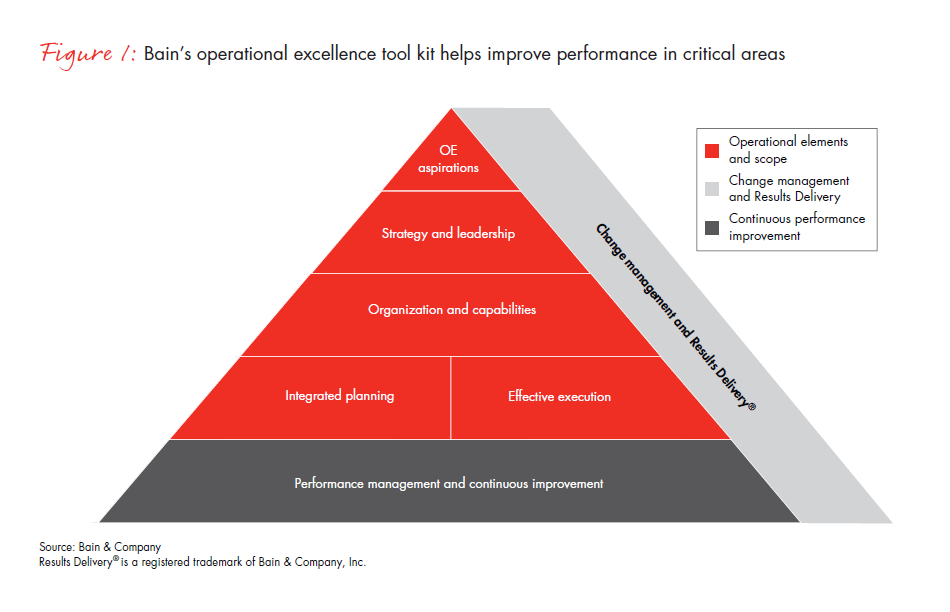
For many companies, these achievements result from a transformational program that first defines the OE strategy, principles, expectations and processes and then translates them into repeatable actions. This transformation puts into place an operational excellence management system (OEMS), which has three main components (see Figure 1).
- Operational elements and scope. An integrated framework and a globally consistent set of principles help companies define best practices across operations and activities, including integrated planning, supply chain management, organization and talent management.
- Change management and Results Delivery®. The objective of an OE transformation is to embed excellence into the company’s culture. This often involves behavioral change at every level of the organization. Executives must manage this transformation while mitigating implementation risks and ensuring compliance.
- Continuous performance improvement starts with an assessment of the potential for opportunity. Key performance indicators measure performance improvement at the asset level, and a series of checkpoints, assessments and feedback loops reinforce the habit of continual assessment and improvement.
How do companies operate differently at higher levels of excellence? Consider the example of large maintenance overhauls at production facilities. Oil and gas companies typically schedule two- or three-week over-haul periods for their upstream and refining facilities every three or four years. Traditionally, these overhauls are planned and executed by the local management. Occasionally a lack of planning—for example, not arranging for the right capabilities or materials to be on hand at the right time—can cause these planned shutdowns to overrun. These delays can cost the company hundreds of millions of dollars. However, when the planning and procedures for these maintenance overhauls are standardized throughout the company and best practices are applied, overruns can be significantly reduced.
Getting there
It is neither easy nor quick to excel. The first steps of a transformation may feel anything but “excellent.” Performance might even appear to deteriorate as leaders ask people to work and think in different ways. Like that New Year’s resolution to visit the gym, it is relatively easy to sign up on the second day of January. How do we ensure that effort is sustained and repeatable?
Operational excellence requires an unremitting focus from senior management and constant communication with the front line to sustain the OE transformation journey over several years. Some companies with less experience managing communication between the top ranks and the front lines make the mistake of sending too many messages or some that are too detailed. It is far more effective to present the case for OE in crisp, clear and short language. For example, two of Chevron’s successful internal slogans are, “Do it safely or not at all” and “There is always time to do it right”—simple, short messages that clearly articulate the company’s priority of safety over haste.
Changing corporate culture also requires leadership from the top to reinforce new behaviors. Leaders must continuously set the tone for the transformation, keeping expectations and enthusiasm high. Even so, in our experience, motivating employees delivers only 20% of the change; ensuring compliance by reinforcing consequences, positive and negative, delivers the other 80%. In other words, accountability and transparency are more important than ever. For example, when part of the business is assessed for the first time against new OE standards and expectations, leaders have to signal to the team that it is acceptable to score below par. The alternative of covering up areas of weakness (and hence potential areas for improvement) is self-serving and not in the long-term interest of the health of the business. Leaders should follow up these assessments with their expectations for considerable improvement next time around.
In fact, managers need to continually drive improvement with ongoing assessments of staff at all levels of the organization. These assessments must go deeper than simply checking with site managers to ask if things are on track. They require on-site visits to operating plat-forms, refineries and other production centers and talking to managers, engineers, operators and technicians to make sure they understand the requirements and goals of operational excellence. The expectation that management will lead, be visible and be accountable is the most critical and fundamental factor for ensuring a successful transformation.
The prize for achieving operational excellence
So what are the tangible rewards for operational excellence? ExxonMobil regularly sees returns on its operations that are several points higher than most competitors, and its executives attribute much of this advantage to operational excellence. Among the companies we have worked with over the past few years, we have seen a range of benefits across safety and operational areas, resulting from the implementation of an OEMS:
- A 40% to 50% reduction in loss of primary containment and high-potential incidents
- Increases in total water injection volumes of 15% across all E&P operations—a key driver of oil field recovery
- Zero export deferrals from top-performing fields, with an average rate of 98.5% achieved across the portfolio
- More efficient execution of maintenance activities, with a reduction of emergency and reactive work by 80% to 90%
The discussion of the quantifiable business benefits of operational excellence in IOCs has evolved in recent years, affected by inflation costs, more thoughtful use of the appropriate benchmarks and recognition that other factors, such as organizational development and capability building, are also contributing to these improvements. In North America in particular, many operators are responding to sustained low gas prices by rapidly reducing their costs through improved integrated planning and rapid feedback on continuous improvement processes, allowing economically viable production across a wider range of unconventional plays.
Pursuing higher levels of asset integrity has raised maintenance costs, as companies try to fully comply with their maintenance plans and routines. The upside is that this investment increases reliability. Industry executives are applying considerable thought to the appropriate use of benchmarks and how to achieve the optimal balance between cost, reliability and efficiency.
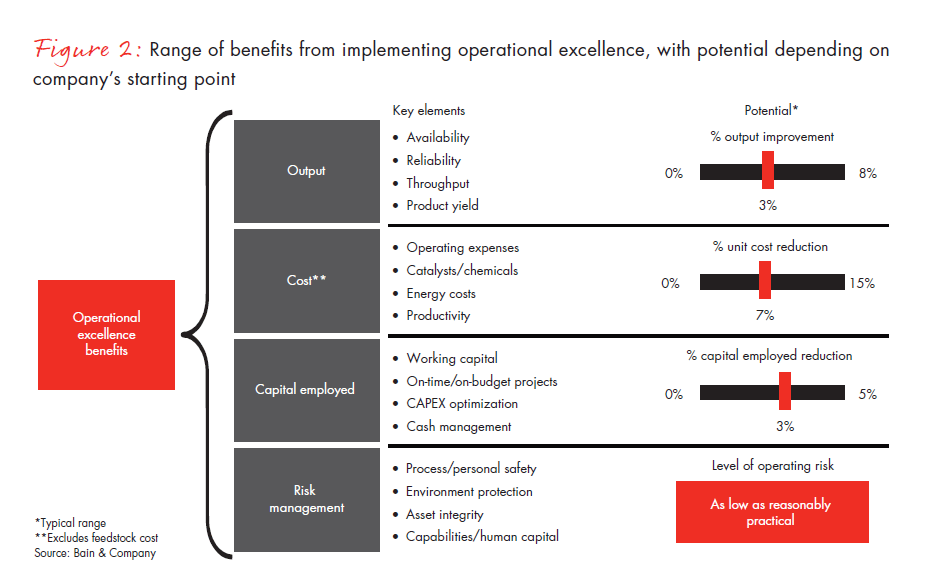
Maintenance efficiency, for example, is an important indicator of OE. Our work helping oil and gas companies boost performance suggests that improvements in revenue, conversion costs, capital employed and risk management yield significant benefits (see Figure 2).
Sustaining excellence in performance requires continuous improvement and focus—so the journey is never over. Leaders at every level of the organization must continue to demonstrate their commitment and visible leadership of OE. There is no room for complacency, from the front lines all the way up to the CEO’s desk. But executives who understand that this constant vigilance is the price of OE might just sleep a little easier at night—and that’s a prize worth striving for.
John McCreery leads Bain & Company’s Oil & Gas practice in Asia-Pacific from Singapore. Ethan Phillips is a partner in Bain’s Houston office. Francesco Cigala is a partner based in Bain’s Kuala Lumpur office.
First published in febrero 2013