

Global Private Equity Report

Executive Summary
- The global transition away from oil and gas has raised any number of complex issues for policymakers, business leaders, politicians, and investors.
- But it is also building into a clear opportunity for private equity to do what it does best: supply investment capital and help businesses accelerate growth.
- Across a broad swath of the global economy, the shift presents a fertile field for investment. It also poses important issues for how funds manage their portfolios.
This article is part of Bain’s 2023 Global Private Equity Report
The pressure on private equity firms to decarbonize their portfolios only increased in 2022.
Regulators, consumers, B2B customers, and investors all stepped up calls for change, meaning the risks and opportunities within portfolios have become critical focus areas for fund managers.
At the same time, the race to develop new alternative energy sources and other low-carbon solutions is shaping up to be a generational opportunity to put money to work. Companies supplying the technology, products, and services that will drive the shift away from carbon stretch across the global economy. They will need trillions in new capital as the world strives to ward off the worst of climate change.
While ambiguity around regulation, the pace of change, regional politics, and other issues will continue, general partners (GPs) cannot let uncertainty deter action. The firms getting ahead of the pack recognize that managing through the energy transition involves a dual imperative to play offense and defense. There are opportunities to win on both sides of the ball.
Investing in the transition
It’s easy enough to say the energy transition is opening up investment opportunities. But making sense of the evolving landscape is a challenge for any fund.
The energy transition sprawls across every sector of the economy and is as much an industrial challenge as a technological one. There are massive practical hurdles in taking such a large swath of the global economy from A to B, along with deep uncertainty about business models that are heavily reliant on government subsidies and other factors outside investors’ control. The pace and direction of change can vary across geographies and at the micro level. Politics is all too frequently a disruptive factor.
Yet investors are finding the energy transition space increasingly attractive. Between 2017 and the first half of 2022, according to PitchBook, buyout and growth equity funds had done energy transition–related deals with a total reported value of around $160 billion, the majority of it concentrated in the renewables and clean industries segments (see Figure 1).
Figure 1
The funds finding their way to the most attractive deals aren’t simply trying to increase broad exposure to the energy transition. They are investing with a clear strategy carefully calibrated to take advantage of their unique approach to creating value. Investment approaches can vary considerably based on both tactics and risk. But that means investors can dial in where they want to play based on a firm’s mandate, expertise, and capabilities (see Figure 2).
Figure 2
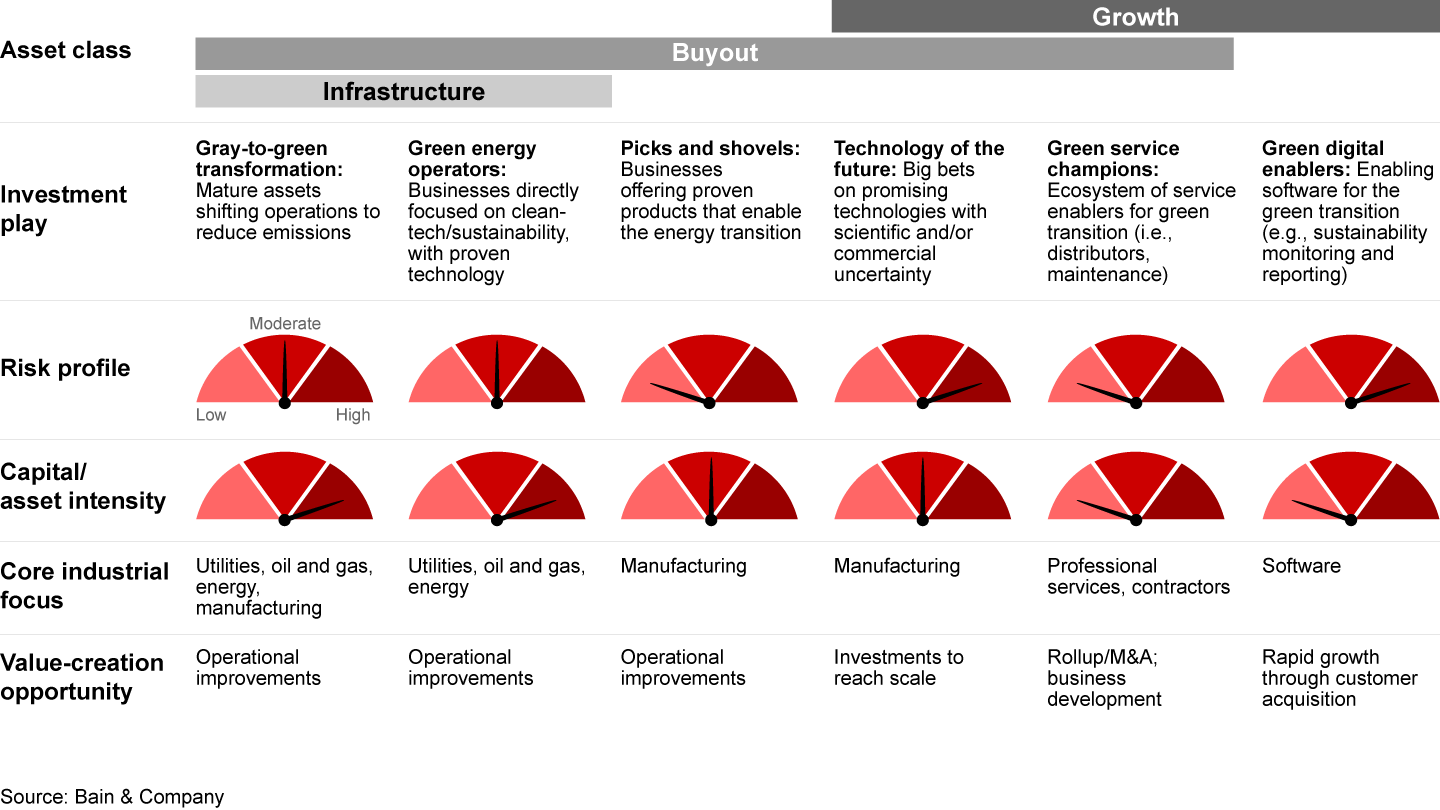

One practical way to think about risk in this space is to focus less on picking winners in these highly dynamic markets and more on finding the companies that are supplying data and tools to all competitors. The world will need innovation in battery and storage technology, for instance, no matter who wins between Tesla and GM in the electric vehicle market. Similarly, as companies face increasing demands to diagnose the sources and volume of carbon they emit, firms that can supply the software, tools, and services to collect and organize that data should thrive.
This explains the appeal of carbon-tech companies like Persefoni and Watershed. Over the last two years, these two firms have raised $101 million and $70 million, respectively, to fund expansion of software platforms that help companies achieve carbon transparency across their value chains and report the data effectively. (Disclosure: Bain has invested in Persefoni, and the firms have codeveloped a decarbonization manager to streamline companies’ scenario planning based on relevant subsector experiences.)
Another example of a notable deal in this space is Blackstone’s $1.4 billion acquisition in 2021 of Sphera, a software-as-a-service provider that helps companies manage ESG data.
Due diligence amid the transition
Ultimately, however, targeting the right company within these themes comes down to strong due diligence informed by deep expertise in these subsectors. Underwriting risk often boils down to assessing how technology, regulatory, and political considerations may impact a specific target company and when.
Bain Capital’s recent $400 million investment in EcoCeres, a biofuels company based in Hong Kong, is a good example. Biofuels can be highly dependent on subsidies and other factors outside the control of investors. But Bain Capital gained confidence that EcoCeres had built a strong business model based on fundamentals. The company, which was incubated by Towngas, Hong Kong’s first public utility, had developed a proprietary technology to convert waste-based biomass into biofuels, biochemicals, and biomaterials. It targets segments that have yet to see significant electric vehicle penetration, like aviation and heavy-duty vehicles. Unlike many renewable fuel companies, EcoCeres also operates at industrial scale with three refineries in China. It is aimed at markets with clear regulatory tailwinds: European countries subject to the EU’s Renewable Energy Directive II.
The company’s in-house technology, scale economics, and pricing power based on the sustainability value it delivers to customers give it the strong, defensible market position Bain Capital was looking for. It also offers additional ways to create value. Beyond its core biofuels emphasis, EcoCeres has opportunities to commercialize the industrial-scale production of other renewable chemicals and materials. And it has a robust R&D pipeline filled with value-added downstream products like green hydrogen. Given that Bain Capital only completed the deal in January 2023, it’s too early to measure results. But EcoCeres gives the firm a clear and promising path to profit from the energy transition.
Underwriting risk and opportunities to create value within the energy transition involves all the usual due diligence considerations. But experience suggests that it also requires paying extra attention to several critical factors, such as:
- the impacts of regulation and subsidies on company actions and consumer preferences, recognizing they can vary significantly across narrow geographies;
- how different cost and production assumptions may affect customer and competitor behaviors, especially for technologies that may be substitutable for others; and
- the potentially nonlinear impacts of technology improvements, and how likely it is those impacts will occur and be disruptive.
Underwriting risk often boils down to assessing how technology, regulatory, and political considerations may impact a specific target company and when.
Disruptive potential is an especially tricky call. When one fund began looking into an agtech firm’s claims that its real-time soil analysis technology would make farmers more efficient and less energy dependent, there was no question that the technology worked as advertised. It instantly gave a readout on chemical composition, moisture content, and a number of other crucial variables farmers need to know in order to plan effectively.
The bigger question was whether farmers really needed it. Customer inquiries showed that potential users were duly impressed by the technology but not enough to change their behavior. Large farms had in-house testing capabilities, and small ones were happy sending samples to outside labs. Revenues were growing, but projections suggested that breakout growth wouldn’t come within the deal’s time frame. The fund passed, recognizing that the market was happy enough with the status quo.
Evaluating how market growth might affect a given target company’s trajectory is also complicated, as one fund discovered in a search to tap into the rapid growth of residential solar. Unenthused by the economics of manufacturers and installers, it was attracted to a higher-margin solar finance company focused on lending to homeowners. Yet a closer look was sobering. The pressure to provide real-time approvals for these relatively long-term loans made credit risk a serious issue. While there was plenty of growth, the fund couldn’t get comfortable and decided to look elsewhere.
For Primavera Capital, however, tapping the growth of alternative energy—in this case, a maker of wind turbines called Envision Group—involved a more nuanced appraisal of growth potential. The company’s strong historical performance reflected all the factors that have made the wind turbine business one of the most vibrant in the alternative energy sector. Yet from a diligence standpoint, the potential buyers needed to know how long that growth could continue.
The wind turbine market is highly cyclical and vulnerable to regulatory changes. While the overall market was still growing, installation of new turbines in a critical market had peaked because an important government subsidy was being phased out. That meant the market was bound to get more competitive, raising a pair of questions: How defensible was Envision’s position? And was it developing new revenue streams to offset potentially slower growth?
Due diligence showed that the company’s state-of-the-art products and technology, in addition to providing relative cost advantages, positioned it well to win share as the market matured and growth stabilized. And Envision had made timely investments in key adjacencies like energy storage and wind-farm operations. Those complementary new businesses promised to contribute significantly to gross margin through 2026 and to help improve customer stickiness. They also reduced the company’s reliance on a single technology while protecting it from demand and regulatory shocks.
In ownership, the diligence findings are playing out. Over the past year, Envision has won important new turbine contracts in Spain, France, and India, and it is investing heavily to establish itself as a go-to technology provider for net-zero industrial parks. It also operates four R&D centers globally to innovate new ways to capitalize on the emerging low-carbon industrial ecosystem.
Playing offense and defense in the portfolio
While the energy transition promises to open up new areas for investment, it is also generating new risks and imperatives for PE portfolios. Between the demands of regulators, limited partners, lenders, and customers, demonstrable efforts to decarbonize are increasingly becoming table stakes for PE investment.
While the energy transition promises to open up new areas for investment, it is also generating new risks and imperatives for PE portfolios.
Companies large and small are under pressure to do more than make PR announcements about net-zero intentions. Investors and regulators are demanding that they establish clear emissions-reduction strategies that live up to standards and reporting protocols established by organizations like the Science Based Targets Initiative (SBTi) and CDP.
Until now, private companies have faced less pressure to adopt carbon-reduction strategies than their public counterparts. This explains why data from EcoVadis, the world’s leading supplier of business sustainability ratings, in which Bain has an investment, shows that 53% of large public companies achieve top scores for carbon management while only 35% of large private companies do (see Figure 3).
Figure 3
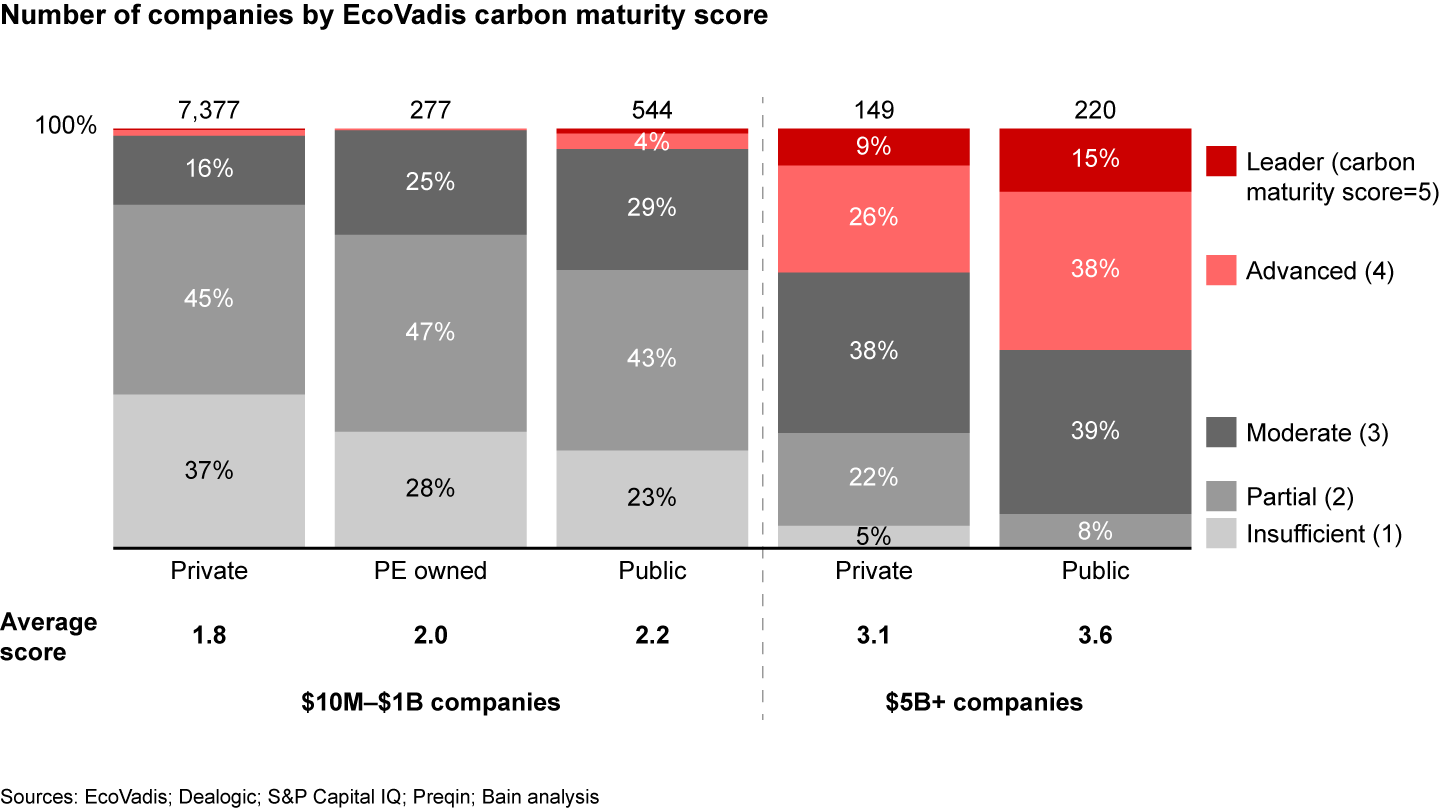

But that’s changing as companies encounter new rules focused on Scope 1 and 2 emissions (a company’s direct emissions and those generated as a result of energy purchases), as well as Scope 3 (emissions generated up- and downstream in a company’s value chain). Proposed US Securities and Exchange Commission regulations demanding that public companies report on Scope 3 emissions, for instance, would force private suppliers upstream to measure and report on their performance. They, in turn, would pressure their own suppliers, pushing the decarbonization imperative even further across the economy.
Failing to prepare for a future in which portfolio companies are under pressure to transition to net zero constitutes a real risk for GPs. The firms getting it right don’t view the challenge as a mere box to check off. Defensively, they see it as a way to shield the company’s performance. Offensively, it is an opportunity to set up the company for exit by helping it define a pragmatic path to a cleaner future, with less exposure to regulatory risk.
Making decarbonization work requires approaching the value calculation holistically. There are obviously costs to decarbonization efforts—often substantial ones. But in experienced hands, those costs can be reduced by making the right choices about priorities and solutions. In this environment, PE firms and their portfolio companies need to ask themselves a couple of key questions. First, what’s the potential downside of doing nothing about our carbon exposure? Second, how can we intelligently bring upside to the carbon challenge in the normal course of due diligence and value creation?
Failing to prepare for a future in which portfolio companies are under pressure to transition to net zero constitutes a real risk for GPs.
The carbon-reduction plan put in place at one large telecommunications company is a good example of how a well-rounded approach works. When the company was acquired a few years ago, top managers and their new private equity partners faced a complex challenge: how to balance their growth and carbon-reduction ambitions.
Investors and debtholders wanted growth and a clear decarbonization strategy. Major customers, meanwhile, were demanding explicit carbon-reduction commitments tied to SBTi standards and CDP reporting requirements throughout their supply chains. Those demands put as much as 20% of the company’s revenue at risk by 2021, prompting leadership to draw up an aggressive strategy to reduce Scope 1 and 2 emissions to net zero by 2030 and Scope 3 to net zero by 2045.
Like most companies, this one lacked a comprehensive system to capture emissions metrics. So the first step was establishing a baseline for Scope 1, 2, and 3 emissions across the organization. Then, the company used marginal abatement cost curves to identify the highest-impact initiatives—those that would both achieve emissions targets and minimize cost to the company. It also identified opportunities to deploy tools like hydrogen generators that weren’t ready now but could have major impact as the technologies matured.
What it didn’t do was launch a bunch of expensive, high-profile projects. Rather, the strategy embraced a mosaic of large and small initiatives that together drove the company toward its reduction goals. Working with 60 leaders across the company, top management encouraged the organization to own the program and find creative ways to reduce carbon within their business operations. The company could then map out priorities within the broader business context to ensure that reduction plans were practical and feasible.
The mix of initiatives included using smarter routing and scheduling algorithms to reduce fleet miles rather than making an immediate wholesale shift to electric and biodiesel vehicles. The company worked within its supply chain to add SBTi requirements into vendor contracts and reduce waste in logistics and ordering. What emerged was an SBTi-approved plan that, at run rate, would require a net investment of approximately $1 million annually—much less than anticipated. It would also protect hundreds of millions in revenues while dialing up the company’s appeal as a supply chain partner. Because the strategy—which included a detailed governance structure, clear metrics, and a comprehensive operating plan—was cocreated with the company’s line managers, it won broad organizational buy-in. That was central to minimizing financial and execution risk.
The energy transition is, in many respects, unique among the global paradigm shifts that have driven private equity dealmaking over the past three decades. It is fraught with politics, regionalism, regulatory uncertainty, and deep complexity. But it is also looking increasingly inevitable, suggesting that sitting on the sidelines is a clear risk for PE firms. As the transition builds into an engine of wealth creation (or destruction, if not addressed), firms need to develop the experience, hone the capabilities, and nurture the networks that will allow them to turn change to their advantage.
More from the report
Read our 2023 Global Private Equity Report
First published in febrero 2023