
Skip to Content
  • Offices

    Offices

    North & Latin America
    • Atlanta
    • Austin
    • Bogota
    • Boston
    • Buenos Aires
    • Chicago
    • Dallas
    • Denver
    • Houston
    • Los Angeles
    • Mexico City
    • Minneapolis
    • Monterrey
    • Montreal
    • New York
    • Rio de Janeiro
    • San Francisco
    • Santiago
    • São Paulo
    • Seattle
    • Silicon Valley
    • Toronto
    • Washington, DC
    Europe & Africa
    • Amsterdam
    • Athens
    • Berlin
    • Brussels
    • Copenhagen
    • Dusseldorf
    • Frankfurt
    • Helsinki
    • Istanbul
    • Johannesburg
    • Kyiv
    • Lisbon
    • London
    • Madrid
    • Milan
    • Munich
    • Oslo
    • Paris
    • Rome
    • Stockholm
    • Vienna
    • Warsaw
    • Zurich
    Middle East
    • Doha
    • Dubai
    • Riyadh
    Asia & Australia
    • Bangkok
    • Beijing
    • Bengaluru
    • Brisbane
    • Ho Chi Minh City
    • Hong Kong
    • Jakarta
    • Kuala Lumpur
    • Manila
    • Melbourne
    • Mumbai
    • New Delhi
    • Perth
    • Shanghai
    • Singapore
    • Sydney
    • Tokyo
    See all offices
  • Alumni
  • Media Center
  • Subscribe
  • Contact
  • Global

    Select your region and language

    Global
    • Global (English)
    North & Latin America
    • Brazil (Português)
    • Argentina (Español)
    • Canada (Français)
    • Chile (Español)
    • Colombia (Español)
    Europe, Middle East, & Africa
    • France (Français)
    • DACH Region (Deutsch)
    • Italy (Italiano)
    • Spain (Español)
    • Greece (Elliniká)
    Asia & Australia
    • China (中文版)
    • Korea (한국어)
    • Japan (日本語)
  • Saved items (0)
    Saved items (0)

    You have no saved items.

    Bookmark content that interests you and it will be saved here for you to read or share later.

    Explore Bain Insights
  • Industries
    Main menu

    Industries

    • Aeroespacial y Defensa
    • Agroindustria
    • Químicos
    • Construcción e Infraestructura
    • Productos de Consumo
    • Servicios Financieros
    • Salud y Ciencias de la Vida
    • Maquinaria y Equipo Industrial
    • Medios y Entretenimiento
      Industries
      Medios y Entretenimiento
      • Media Lab
    • Metales
    • Minería
    • Petróleo y Gas
    • Papel y Empaque
    • Private Equity
      Industries
      Private Equity
      • Due Diligence
      • Exit Planning
      • Firm Strategy & Operations
      • Portfolio Value Creation
    • Sector Público y Social
    • Retail
    • Tecnología
    • Telecomunicaciones
      Industries
      Telecomunicaciones
      • Capital Expenditure
      • Telco Digital Transformation
    • Transporte
    • Viajes y Turismo
    • Servicios Públicos y Energías Renovables
  • Consulting Services
    Main menu

    Consulting Services

    • Customer Experience
    • Sustainability
    • Innovation
    • M&A
    • Operations
    • People & Organization
    • Private Equity
    • Sales & Marketing
    • Strategy
    • AI, Insights, and Solutions
    • Technology
    • Transformation
  • Digital
  • Insights
    Main menu

    Insights

    • Industry Insights
    • Services Insights
    • Bain Books
    • Webinars
    • Bain Futures
    View all Insights
    Featured topics
    • Tariff Response
    • Artificial Intelligence
    • Thriving in Uncertainty
    • Executive Conversations
    • Macro Trends
    • M&A Report
    • Healthcare Private Equity Report
    • Paper & Packaging Report
    • Technology Report
    • CEO's Guide to Sustainability
    • CEO Insights
    • CFO Insights
    • COO Insights
    • CIO Insights
    • CMO Insights
    View all featured topics
  • About
    Main menu

    About

    • What We Do
    • What We Believe
    • Our People & Leadership
    • Client Results
    • Awards & Recognition
    • Global Affiliations
    Further: Our global responsibility
    • Sustainability
    • Social Impact
    • World Economic Forum
    Learn more about Further
  • Carreras
    Main menu

    Carreras

    • Trabaja con Nosotros
      Carreras
      Trabaja con Nosotros
      • Find Your Place
      • Nuestras Áreas de Trabajo
      • Equipos Integrados
      • Estudiantes
      • Internships & Programs
      • Eventos de Reclutamiento
    • La Vida en Bain
      Carreras
      La Vida en Bain
      • Historias Profesionales
      • Nuestra Gente
      • Dónde Trabajamos
      • Apoyando tu Crecimiento
      • Grupos de Afinidad
      • Beneficios
    • Impact Stories
    • Nuestro Proceso
      Carreras
      Nuestro Proceso
      • Qué Esperar
      • Entrevistas
    FIND JOBS
  • Offices
    Main menu

    Offices

    • North & Latin America
      Offices
      North & Latin America
      • Atlanta
      • Austin
      • Bogota
      • Boston
      • Buenos Aires
      • Chicago
      • Dallas
      • Denver
      • Houston
      • Los Angeles
      • Mexico City
      • Minneapolis
      • Monterrey
      • Montreal
      • New York
      • Rio de Janeiro
      • San Francisco
      • Santiago
      • São Paulo
      • Seattle
      • Silicon Valley
      • Toronto
      • Washington, DC
    • Europe & Africa
      Offices
      Europe & Africa
      • Amsterdam
      • Athens
      • Berlin
      • Brussels
      • Copenhagen
      • Dusseldorf
      • Frankfurt
      • Helsinki
      • Istanbul
      • Johannesburg
      • Kyiv
      • Lisbon
      • London
      • Madrid
      • Milan
      • Munich
      • Oslo
      • Paris
      • Rome
      • Stockholm
      • Vienna
      • Warsaw
      • Zurich
    • Middle East
      Offices
      Middle East
      • Doha
      • Dubai
      • Riyadh
    • Asia & Australia
      Offices
      Asia & Australia
      • Bangkok
      • Beijing
      • Bengaluru
      • Brisbane
      • Ho Chi Minh City
      • Hong Kong
      • Jakarta
      • Kuala Lumpur
      • Manila
      • Melbourne
      • Mumbai
      • New Delhi
      • Perth
      • Shanghai
      • Singapore
      • Sydney
      • Tokyo
    See all offices
  • Alumni
  • Media Center
  • Subscribe
  • Contact
  • Global
    Main menu

    Select your region and language

    • Global
      Select your region and language
      Global
      • Global (English)
    • North & Latin America
      Select your region and language
      North & Latin America
      • Brazil (Português)
      • Argentina (Español)
      • Canada (Français)
      • Chile (Español)
      • Colombia (Español)
    • Europe, Middle East, & Africa
      Select your region and language
      Europe, Middle East, & Africa
      • France (Français)
      • DACH Region (Deutsch)
      • Italy (Italiano)
      • Spain (Español)
      • Greece (Elliniká)
    • Asia & Australia
      Select your region and language
      Asia & Australia
      • China (中文版)
      • Korea (한국어)
      • Japan (日本語)
  • Saved items  (0)
    Main menu
    Saved items (0)

    You have no saved items.

    Bookmark content that interests you and it will be saved here for you to read or share later.

    Explore Bain Insights
  • Industries
    • Industries

      • Aeroespacial y Defensa
      • Agroindustria
      • Químicos
      • Construcción e Infraestructura
      • Productos de Consumo
      • Servicios Financieros
      • Salud y Ciencias de la Vida
      • Maquinaria y Equipo Industrial
      • Medios y Entretenimiento
      • Metales
      • Minería
      • Petróleo y Gas
      • Papel y Empaque
      • Private Equity
      • Sector Público y Social
      • Retail
      • Tecnología
      • Telecomunicaciones
      • Transporte
      • Viajes y Turismo
      • Servicios Públicos y Energías Renovables
  • Consulting Services
    • Consulting Services

      • Customer Experience
      • Sustainability
      • Innovation
      • M&A
      • Operations
      • People & Organization
      • Private Equity
      • Sales & Marketing
      • Strategy
      • AI, Insights, and Solutions
      • Technology
      • Transformation
  • Digital
  • Insights
    • Insights

      • Industry Insights
      • Services Insights
      • Bain Books
      • Webinars
      • Bain Futures
      View all Insights
      Featured topics
      • Tariff Response
      • Artificial Intelligence
      • Thriving in Uncertainty
      • Executive Conversations
      • Macro Trends
      • M&A Report
      • Healthcare Private Equity Report
      • Paper & Packaging Report
      • Technology Report
      • CEO's Guide to Sustainability
      • CEO Insights
      • CFO Insights
      • COO Insights
      • CIO Insights
      • CMO Insights
      View all featured topics
  • About
    • About

      • What We Do
      • What We Believe
      • Our People & Leadership
      • Client Results
      • Awards & Recognition
      • Global Affiliations
      Further: Our global responsibility
      • Sustainability
      • Social Impact
      • World Economic Forum
      Learn more about Further
  • Carreras
    Popular Searches
    • Agile
    • Digital
    • Strategy
    Your Previous Searches
      Recently Visited Pages

      Content added to saved items

      Saved items (0)

      Removed from saved items

      Saved items (0)

      Brief

      Simplify to Grow in Healthcare

      Simplify to Grow in Healthcare

      It’s time for healthcare companies to cull business extensions that fail to improve the bottom line, and then focus on the most profitable areas.

      By Preston Henske, Nirad Jain and Michael Retterath

      • min read
      }

      Brief

      Simplify to Grow in Healthcare
      en

      With all our investment in new products, new customers and new countries, why don’t we see profitable growth for the company overall? And exactly where in the company do we find the strongest profitable growth?

      When a global medical diagnostics firm reached the point at which it could no longer answer these two fundamental questions, it decided to undertake a deep analysis of economic profitability by region, customer segment, product and other dimensions, featuring a rigorous total cost allocation along each dimension. The findings shocked executives. It turned out that secondary countries significantly lagged on profitability. For instance, just 1.5 percentage points of profit growth in the largest country market was equivalent to the total profit of the entire Venezuela operation. Even in a country such as India, after years of investment, a path to profitable growth proved elusive. 

      The executive team decided they would exit or serve indirectly the unprofitable and low-profit countries. They would narrow the focus to 12 key regions where the firm could directly improve commercial effectiveness and focus innovation and supply chain capabilities on growth in those regions. Just four months after the analysis, growth in the largest country market began to run well ahead of expectations because of the increased attention and resources.

      Similarly, at a top five pharmaceuticals firm, the head of global manufacturing recently told us that products making up 5% of total revenue caused 60% of manufacturing overhead. More broadly, many healthcare supply chain executives complain vehemently that the business units don’t realize the supply chain complexity and cost they generate through their commercial decisions. 

      The call to simplify may sound obvious, but it runs counter to the growth strategies of most pharmaceuticals and medical technology companies. Many have pursued revenue growth through expansion and investment in more countries, additional product variations and new customer segments. As a result, their businesses have become rife with complexity, which has raised costs, slowed innovation time to market and impeded decision making across the entire organization, usually without delivering profitable growth. In fact, much of the investment made to grow actually creates a drag on the core business.

      How did healthcare firms wind up in this morass? There are several explanations.

      Market creep has largely involved building infrastructure and making product investments to tap into the fast-growing economies of emerging markets. Yet too often, the limited market sizes and challenging local regulatory and competitive situations have tempered any benefits and added significant complexity, not just to the new markets but also to core markets, since many corporate functions serve both types of markets. As a result of these subscale pockets of the business, some organizations have grown to two or three times the size they need to be to support the core. This bloat has the effect of distracting management from higher priorities, slowing decisions and obscuring accountability.

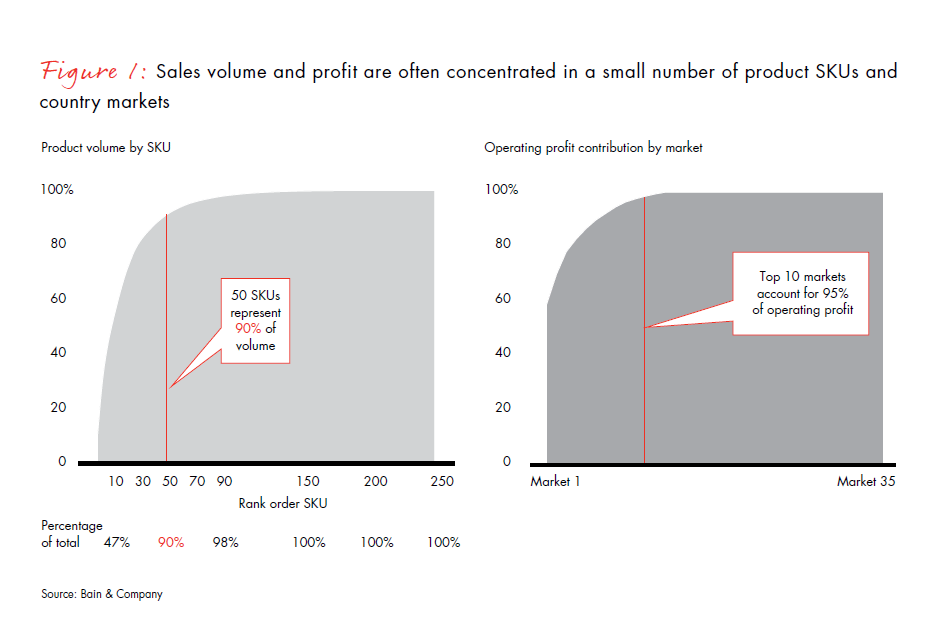
      One top-five global medical technology firm, for instance, found that a particular business unit had a long tail of unproductive regions and product SKUs (see Figure 1). The company was unintentionally shunning core customers and curbing profitability in pursuit of revenue growth. By shifting the focus back to core growth opportunities, the company dramatically increased profitability while also streamlining the business, narrowing its direct markets from 35 to fewer than 10 and its product platforms from 14 to 5, and cutting in half the number of SKUs. The research and development (R&D) pipeline could focus on a much smaller set of programs benefiting the core business.

      simplify-to-grow-in-healthcare-fig-01_embed


      Organization creep often stems from adding new capabilities or from a series of acquisitions, many of which turn out to be subscale or tangential to the core business. One large pharmaceutical company had added capabilities and functions to respond to providers and payers playing more prominent roles in decision making. New functions included health outcomes research, key account managers, institutional selling groups, customer marketing and beefed-up scientific liaison groups—each with its own management structure, meetings and boards. The resulting organizational complexity became untenable. The company decided to start with a clean sheet, redesigning its operating model with the minimum required size and scope.

      Pipeline creep derives from the scientific basis of the healthcare industry, which encourages companies to pursue interesting products or markets adjacent to their core products. Too often, pipelines have been filled with projects that make incremental improvements rather than major innovations or with single-market products that add complexity and lack the potential for large-scale adoption. Executives find it hard to know what really matters in the pipeline and how to make the right trade-offs. 

      Some pharmaceutical and medical technology companies have come to understand that simplification does more than just reduce costs; it also makes decision making easier and faster and helps functions such as R&D and supply chain to more effectively direct their resources. Once a firm identifies its profitable core products and markets, it can concentrate on attaining leadership in those few categories. The emerging leaders in this regard are actively managing complexity by following a few best practices described below.

      Find out where the money is—today and tomorrow

      Many large healthcare firms have little visibility into the profitability of individual products, customer segments or countries, given the division-within-parent structure and accounting processes oriented around functions and regions. Cost allocation methodologies overburden certain regions and only allocate direct costs to products, resulting in incomplete and misleading profitability data. Growth strategies for emerging markets tend to be broad, vague and focused more on future revenue than on profit growth. As attention and resources get diverted to hot new opportunities, the sales and service approach for primary markets typically becomes stagnant, lacking rigorous customer segmentation, tailored execution and feedback loops.

      So the quest for simplicity may well start by doing a profit cube analysis to determine the true profitability of a business across several dimensions. The profit cube allocates costs to each combination of dimensions based on an analysis of each driver of cost. Managers can view profitability at a detailed level (such as by customer or product) and at a higher level (such as by region) to inform their decisions about improving overall profitability through different levels of pricing or service.

      At one medical device business, for example, individual country heads would ask for new product permutations to meet their own market needs, because there seemed to be a business case for them. But the standard cost basis used for new SKUs didn’t adequately reflect the full supply chain complexity cost, which profit cube analysis showed was two to five times the standard costs. Presented with that new hurdle, only a few of the new SKU requests made business sense.

      Steer resources to core areas, pare back the others

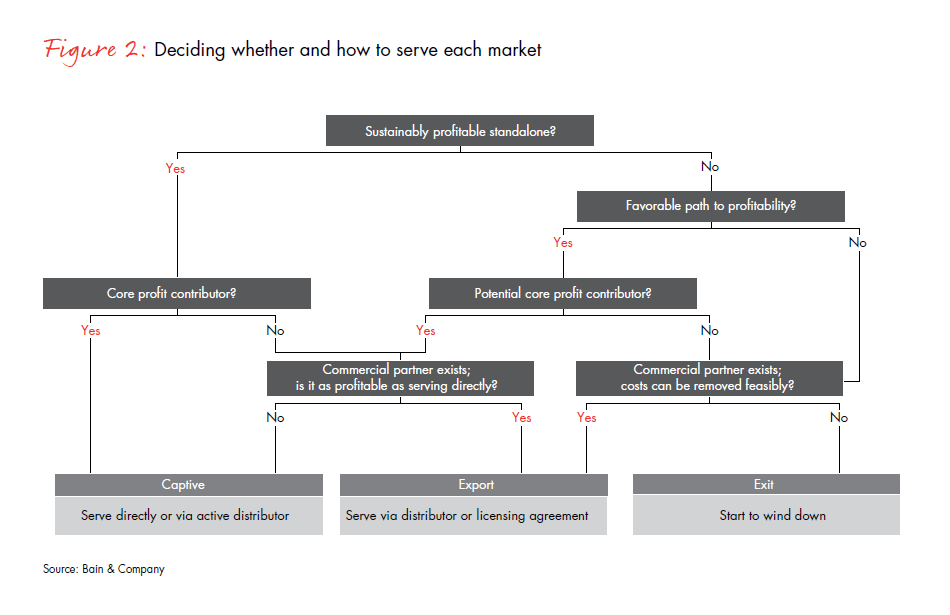
      Once the profit cube has identified where value is actually created in the business, a company can rationalize and focus its efforts on those areas, such as prioritizing R&D resources to places that will lead to profitable growth. It’s essential to figure out what will be sustainably profitable. If the demand opportunity in, say, Venezuela, suggests that investing there will generate meaningful profit growth over time, then it’s worth the investment. If not, a company can export to Venezuela from a core market, so long as the exported supply does not add undue complexity to the core operation, or it can choose to exit that market (see Figure 2).

      simplify-to-grow-in-healthcare-fig-02_embed

      At the diagnostics firm, a profit cube analysis determined that its largest country market creates half its total profit, with most of that concentrated in two product lines and two customer segments. That analysis informed the path forward, including tactics to retain the core customer segments that were already buying and to attract similar customers that were not. As for other segments, the firm would serve them but not actively seek them out, because the selling costs were prohibitive. Outside the core region, the firm narrowed its markets to 11 others that it would serve directly.

      As a result of these decisions, the firm could cut much of its long tail of unproductive SKUs. In the core market, since two product lines and two customer segments accounted for most of the profits, the selling organization and the R&D group now could clearly see where to focus their resources.

      Take a clean-sheet approach to improve decision making

      A program to reduce complexity must be cross-functional. The most insidious complexity usually occurs not within a function but rather along the seams where different groups interact. Without a cross-functional approach, eliminating complexity in one element of the business will cause it to surface elsewhere.

      For example, many pharmaceutical companies have cut costs by downsizing the army of sales representatives, pooling resources into shared services and reducing redundancies from businesses that overlap in the wake of mergers and acquisitions. But the cost trimming has not necessarily reduced the number of organizational nodes where decisions and priorities get set, so complexity remains at the seams between functions, business units or regions.

      An effective tool in this regard is a clean-sheet operating model designed for a minimum level of complexity and a limited number of organizational nodes. A key part of the design involves ensuring that resource allocation decisions get made at the right level; for instance, commercial resource trade-offs for different products should be made at a regional level, not an individual country level. Some complexity may need to be added back to address important business needs, but the bar for such additions should be high.

      Adjust incentives and processes to reinforce simplicity

      Complexity always wants to creep back into an organization, unless it’s actively managed and resisted. Such management works through two critical avenues: compensation and processes.

      Compensation generally should focus more narrowly on specific objectives aligned with the drivers of profitable growth. Incentives could be tied to some combination of metrics that a C-suite would track—for instance, revenue growth, profit growth, relative market share, Net Promoter Scorestm tracking customer advocacy, percentage of sales from new products and changes in cost of goods sold. A tailored combination of metrics will help a company attain a higher value, improve its strategic position, build the essential capabilities and enhance the culture.

      Some processes, in turn, should be designed to prevent complexity from creeping back in. A company can, for example, charge a true complexity-based cost to its regions for developing a new SKU, capability or function. When the true cost of complexity is calculated, many proposed additions will fail to yield an acceptable return on investment.


      Managing a more focused business allows executives to steer resources to the areas that create the greatest value. Streamlining enables faster and better decision making, because there are fewer nodes that could delay the process or obscure the strategic priorities. And having a clearer view of the core strategic sweet spots guides executives in designing the capabilities and organization they need to win. Thoughtful simplification, in short, helps sprawling healthcare companies return to sustained profitable growth.

      Preston Henske, Nirad Jain and Michael Retterath are partners in Bain & Company’s Healthcare practice, and they are based in New York.

      Net Promoter ScoreSM is a trademark of Bain & Company, Inc., Fred Reichheld and Satmetrix Systems, Inc.


      simplify-to-grow-in-healthcare-fig-01_full

      simplify-to-grow-in-healthcare-fig-02_full
      Authors
      • Headshot of Preston Henske
        Preston Henske
        Partner, New York
      • Headshot of Nirad Jain
        Nirad Jain
        Partner, New York
      • Michael Retterath
        Former Partner, New York
      Related Industries
      • Healthcare & Life Sciences
      Related Consulting Services
      • Performance Improvement
      How We Can Help
      • ProfitCube℠
      • Shared Services
      • Zero-based Redesign
      Healthcare & Life Sciences
      Global Healthcare Private Equity Report 2015

      Healthcare continues to be an attractive but challenging area for private equity investment.

      Read more
      Healthcare & Life Sciences
      Asia-Pacific Healthcare Delivery: Operational Excellence in the Digital Age

      Zero-based redesign and digital technologies can help invigorate profit margins and spur growth.

      Read more
      Healthcare & Life Sciences
      Accelerating Growth and Innovation in European Mid-Sized Pharma

      Insights from the last decade of growth and portfolio innovation can help crack the growth code for EU mid-size pharma.

      Read more
      Healthcare & Life Sciences
      A Path to Faster Growth for Healthcare Companies: Eliminate Complexity

      Tackling complexity can unlock growth and increase margins.

      Read more
      Performance Improvement
      Transforming Maintenance with Artificial Intelligence

      With little to no capex, companies can turn maintenance into an engine of cash flow.

      Read more
      First published in septiembre 2015
      Tags
      • Healthcare & Life Sciences
      • Performance Improvement
      • ProfitCube℠
      • Shared Services
      • Zero-based Redesign

      How We've Helped Clients

      Taking Shared Services to a New Level at a Healthcare Company

      See more related case studies

      Zero-based Redesign Puts a MedTech Leader on a Path to Sustainable Growth

      See more related case studies

      Turning bottlenecks into growth opportunities

      See more related case studies

      Want to continue the conversation

      We help global leaders with their organization's most critical issues and opportunities. Together, we create enduring change and results

      Bain Insights. Our perspectives on critical issues global businesses face in today's challenging environment, delivered monthly.

      *I have read and understand Bain’s Privacy Notice.

      Please read and agree to the Privacy Policy.
      Bain & Company
      Contact us Sustainability Accessibility Terms of use Privacy Modern Slavery Act Statement Cookie Policy Sitemap Log In

      © 1996-2026 Bain & Company, Inc.

      Contact Bain

      How can we help you?

      • Business inquiry
      • Career information
      • Press relations
      • Partnership request
      • Speaker request
      See all offices