
Skip to Content
  • Γραφεία

    Γραφεία

    North & Latin America
    • Atlanta
    • Austin
    • Bogota
    • Boston
    • Buenos Aires
    • Chicago
    • Dallas
    • Denver
    • Houston
    • Los Angeles
    • Mexico City
    • Minneapolis
    • Monterrey
    • Montreal
    • New York
    • Rio de Janeiro
    • San Francisco
    • Santiago
    • São Paulo
    • Seattle
    • Silicon Valley
    • Toronto
    • Washington, DC
    Europe & Africa
    • Amsterdam
    • Athens
    • Berlin
    • Brussels
    • Copenhagen
    • Dusseldorf
    • Frankfurt
    • Helsinki
    • Istanbul
    • Johannesburg
    • Kyiv
    • Lisbon
    • London
    • Madrid
    • Milan
    • Munich
    • Oslo
    • Paris
    • Rome
    • Stockholm
    • Vienna
    • Warsaw
    • Zurich
    Middle East
    • Doha
    • Dubai
    • Riyadh
    Asia & Australia
    • Bangkok
    • Beijing
    • Bengaluru
    • Brisbane
    • Ho Chi Minh City
    • Hong Kong
    • Jakarta
    • Kuala Lumpur
    • Manila
    • Melbourne
    • Mumbai
    • New Delhi
    • Perth
    • Shanghai
    • Singapore
    • Sydney
    • Tokyo
    See all offices
  • Alumni
  • Media Center
  • Εγγραφή
  • Επικοινωνία
  • Greece | Elliniká

    Select your region and language

    Global
    • Global (English)
    North & Latin America
    • Brazil (Português)
    • Argentina (Español)
    • Canada (Français)
    • Chile (Español)
    • Colombia (Español)
    Europe, Middle East, & Africa
    • France (Français)
    • DACH Region (Deutsch)
    • Italy (Italiano)
    • Spain (Español)
    • Greece (Elliniká)
    Asia & Australia
    • China (中文版)
    • Korea (한국어)
    • Japan (日本語)
  • Saved items (0)
    Saved items (0)

    You have no saved items.

    Bookmark content that interests you and it will be saved here for you to read or share later.

    Explore Bain Insights
  • Κλάδοι
    Main menu

    Κλάδοι

    • Aerospace & Defense
    • Agribusiness
    • Chemicals
    • Construction & Infrastructure
    • Consumer Products
    • Financial Services
    • Healthcare & Life Sciences
    • Industrial Machinery & Equipment
    • Media & Entertainment
      Κλάδοι
      Media & Entertainment
      • Media Lab
    • Metals
    • Mining
    • Oil & Gas
    • Paper & Packaging
    • Private Equity
      Κλάδοι
      Private Equity
      • Due Diligence
      • Exit Planning
      • Firm Strategy & Operations
      • Portfolio Value Creation
    • Social Impact
    • Retail
    • Technology
    • Telecommunications
      Κλάδοι
      Telecommunications
      • Capital Expenditure
      • Telco Digital Transformation
    • Transportation
    • Travel & Leisure
    • Utilities & Renewables
  • Συμβουλευτικές Υπηρεσίες
    Main menu

    Συμβουλευτικές Υπηρεσίες

    • Customer Experience
    • Sustainability
    • Innovation
    • M&A
    • Operations
    • People & Organization
    • Private Equity
    • Sales & Marketing
    • Strategy
    • AI, Insights, and Solutions
    • Technology
    • Transformation
  • Digital
  • Πληροφορίες
    Main menu

    Πληροφορίες

    • Industry Insights
    • Services Insights
    • Bain Books
    • Webinars
    • Bain Futures
    View all Insights
    Featured topics
    • Artificial Intelligence
    • Managing Inflation
    • Thriving in Uncertainty
    • The Talent Imperative
    • Macro Trends
    • Healthcare Private Equity Report
    • CEO's Guide to Sustainability
    • Technology Report
    • Energy & Natural Resources Report
    • Paper & Packaging Report
    • CEO Insights
    • CFO Insights
    • COO Insights
    • CIO Insights
    • CMO Insights
    View all featured topics
  • Σχετικά με εμάς
    Main menu

    Σχετικά με εμάς

    • What We Do
    • What We Believe
    • Our People & Leadership
    • Client Results
    • Awards & Recognition
    • Global Affiliations
    • Social Impact
    • Sustainability
    • World Economic Forum
    Learn more about Further
  • Careers
    Main menu

    Careers

    • Work with Us
      Careers
      Work with Us
      • Find Your Place
      • Our Work Areas
      • Integrated Teams
      • Students
      • Internships & Programs
      • Recruiting Events
    • Life at Bain
      Careers
      Life at Bain
      • Blog: Inside Bain
      • Career Stories
      • Our People
      • Where We Work
      • Supporting Your Growth
      • Affinity Groups
      • Benefits
    • Impact Stories
    • Hiring Process
      Careers
      Hiring Process
      • What to Expect
      • Interviewing
    FIND JOBS
  • Γραφεία
    Main menu

    Γραφεία

    • North & Latin America
      Γραφεία
      North & Latin America
      • Atlanta
      • Austin
      • Bogota
      • Boston
      • Buenos Aires
      • Chicago
      • Dallas
      • Denver
      • Houston
      • Los Angeles
      • Mexico City
      • Minneapolis
      • Monterrey
      • Montreal
      • New York
      • Rio de Janeiro
      • San Francisco
      • Santiago
      • São Paulo
      • Seattle
      • Silicon Valley
      • Toronto
      • Washington, DC
    • Europe & Africa
      Γραφεία
      Europe & Africa
      • Amsterdam
      • Athens
      • Berlin
      • Brussels
      • Copenhagen
      • Dusseldorf
      • Frankfurt
      • Helsinki
      • Istanbul
      • Johannesburg
      • Kyiv
      • Lisbon
      • London
      • Madrid
      • Milan
      • Munich
      • Oslo
      • Paris
      • Rome
      • Stockholm
      • Vienna
      • Warsaw
      • Zurich
    • Middle East
      Γραφεία
      Middle East
      • Doha
      • Dubai
      • Riyadh
    • Asia & Australia
      Γραφεία
      Asia & Australia
      • Bangkok
      • Beijing
      • Bengaluru
      • Brisbane
      • Ho Chi Minh City
      • Hong Kong
      • Jakarta
      • Kuala Lumpur
      • Manila
      • Melbourne
      • Mumbai
      • New Delhi
      • Perth
      • Shanghai
      • Singapore
      • Sydney
      • Tokyo
    See all offices
  • Alumni
  • Media Center
  • Εγγραφή
  • Επικοινωνία
  • Greece | Elliniká
    Main menu

    Select your region and language

    • Global
      Select your region and language
      Global
      • Global (English)
    • North & Latin America
      Select your region and language
      North & Latin America
      • Brazil (Português)
      • Argentina (Español)
      • Canada (Français)
      • Chile (Español)
      • Colombia (Español)
    • Europe, Middle East, & Africa
      Select your region and language
      Europe, Middle East, & Africa
      • France (Français)
      • DACH Region (Deutsch)
      • Italy (Italiano)
      • Spain (Español)
      • Greece (Elliniká)
    • Asia & Australia
      Select your region and language
      Asia & Australia
      • China (中文版)
      • Korea (한국어)
      • Japan (日本語)
  • Saved items  (0)
    Main menu
    Saved items (0)

    You have no saved items.

    Bookmark content that interests you and it will be saved here for you to read or share later.

    Explore Bain Insights
  • Κλάδοι
    • Κλάδοι

      • Aerospace & Defense
      • Agribusiness
      • Chemicals
      • Construction & Infrastructure
      • Consumer Products
      • Financial Services
      • Healthcare & Life Sciences
      • Industrial Machinery & Equipment
      • Media & Entertainment
      • Metals
      • Mining
      • Oil & Gas
      • Paper & Packaging
      • Private Equity
      • Social Impact
      • Retail
      • Technology
      • Telecommunications
      • Transportation
      • Travel & Leisure
      • Utilities & Renewables
  • Συμβουλευτικές Υπηρεσίες
    • Συμβουλευτικές Υπηρεσίες

      • Customer Experience
      • Sustainability
      • Innovation
      • M&A
      • Operations
      • People & Organization
      • Private Equity
      • Sales & Marketing
      • Strategy
      • AI, Insights, and Solutions
      • Technology
      • Transformation
  • Digital
  • Πληροφορίες
    • Πληροφορίες

      • Industry Insights
      • Services Insights
      • Bain Books
      • Webinars
      • Bain Futures
      View all Insights
      Featured topics
      • Artificial Intelligence
      • Managing Inflation
      • Thriving in Uncertainty
      • The Talent Imperative
      • Macro Trends
      • Healthcare Private Equity Report
      • CEO's Guide to Sustainability
      • Technology Report
      • Energy & Natural Resources Report
      • Paper & Packaging Report
      • CEO Insights
      • CFO Insights
      • COO Insights
      • CIO Insights
      • CMO Insights
      View all featured topics
  • Σχετικά με εμάς
    • Σχετικά με εμάς

      • What We Do
      • What We Believe
      • Our People & Leadership
      • Client Results
      • Awards & Recognition
      • Global Affiliations
      Further: Our global responsibility
      • Social Impact
      • Sustainability
      • World Economic Forum
      Learn more about Further
  • Careers
    Popular Searches
    • Agile
    • Digital
    • Strategy
    Your Previous Searches
      Recently Visited Pages

      Content added to saved items

      Saved items (0)

      Removed from saved items

      Saved items (0)

      M&A Report

      When Buying (vs. Building) Is the Right Move for Engine 2

      When Buying (vs. Building) Is the Right Move for Engine 2

      Three ways that companies turn to M&A to scale new businesses faster, cheaper, and more effectively.

      By Alex Egan, Vincent Vandierendonck, and Mikaela Boyd

      • min read
      }

      Report

      When Buying (vs. Building) Is the Right Move for Engine 2
      en
      At a Glance
      • Companies looking for a new “Engine 2” to prepare for future growth are considering the best ways to make the move amid macroeconomic uncertainty.
      • Our analysis found that among the 58 most successful Engine 2 businesses, 40 used M&A as a significant part of their scaling plans.
      • Most Engine 2 deals are rolling up businesses with similar cores, buying capabilities to create a new core, or buying the new core already at scale.

      This article is part of Bain's 2023 M&A Report.

      Explore the report

      As they face macroeconomic uncertainty in their industry, most business leaders acknowledge that it’s more vital than ever to develop and accelerate an alternative engine of growth for the future. We refer to these new businesses within existing companies that use the scale benefits of the core business to grow faster than an independent start-up could as “Engine 2s.” And downturns are the times when companies make the bold moves that enable them to emerge stronger than their competitors.

      While it can be tempting to build a new business from the ground up, our new research strongly supports the case for buying. We looked at hundreds of Engine 2 businesses over the past 25 years, and of the 58 most successful, 40 used M&A as a significant part of their scaling plans. It’s an important finding at a time when lower valuations and less competition for deals makes it a buyer’s market (see Figure 1).

      Figure 1
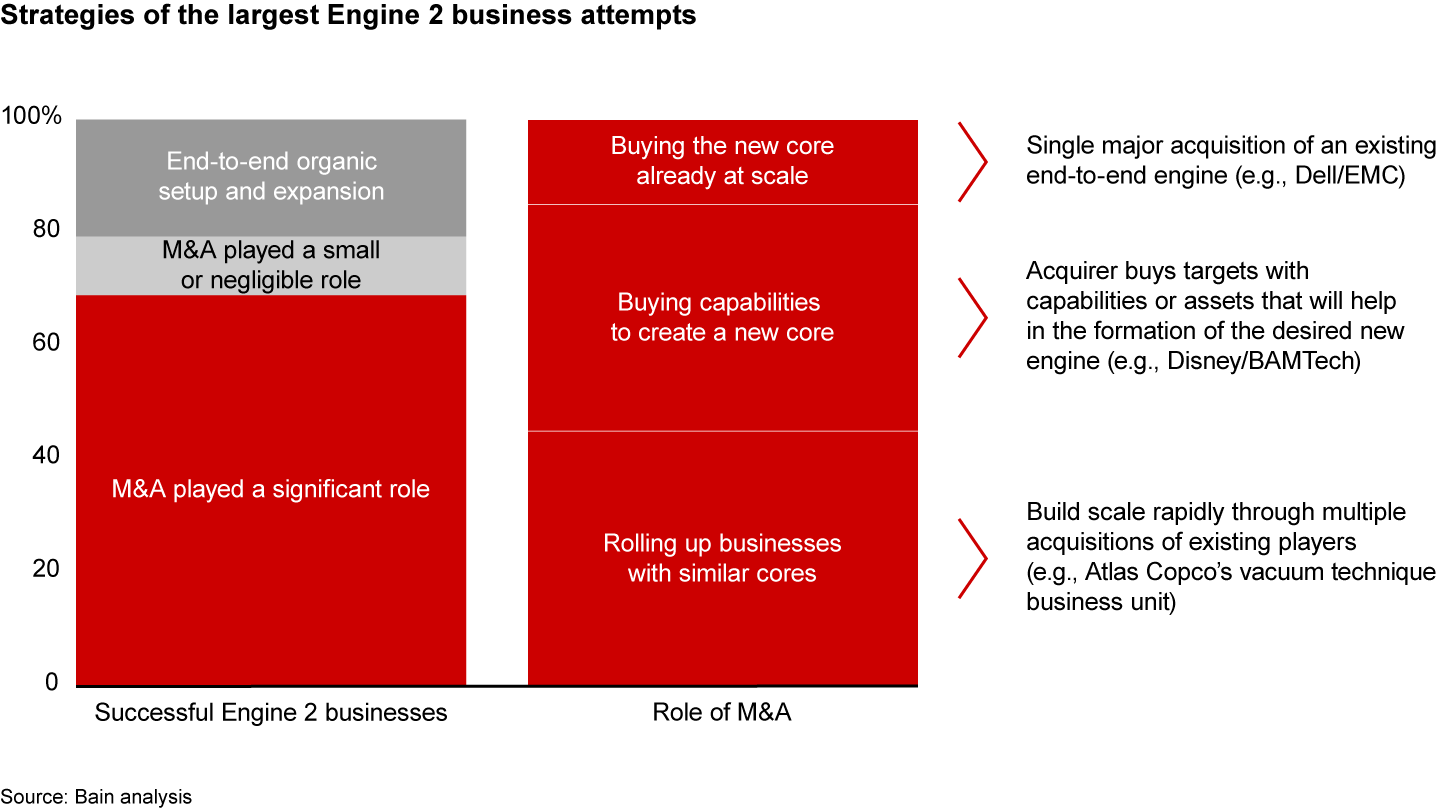
      M&A has been used to accelerate roughly two-thirds of the most successful Engine 2 businesses
      M&A has been used to accelerate roughly two-thirds of the most successful Engine 2 businesses
      M&A has been used to accelerate roughly two-thirds of the most successful Engine 2 businesses

      The first major advantage to buying involves speed. Building a team organically can take years longer than buying, which may put the company behind in a fast-moving competitive environment, allowing others to secure a strategic edge. The speed advantage is multiplied for acquirers that are skilled at integration and that design ways to begin delivering shared value on day one. The second advantage involves effectiveness. Without in-house expertise for the new business, a company could be set back by several mistakes along the scaling journey. Integration and alignment challenges are typically easier to overcome than trying to build a new business without the veteran insights. A final advantage is cost. M&A comes with premiums, for sure, but there are high premiums required to lure critical talent away individually. And building a business also often comes with costs associated with false starts, reorganizations, and executive interventions that may be necessary before the organically built organization begins to deliver on its mission.

      The key to successfully buying and scaling an Engine 2 starts with understanding that the unique assets of the target and the scaling journey of the acquirer will vary. Most, however, will generally fall into one of three common archetypes. While these archetypes all share the ultimate goal of scaling a new business, they use different acquisition strategies to get there—and each requires tailored priorities and areas of focus. We’ll look at these archetypes one by one (see Figure 2).

      Figure 2
      Three common archetypes for successfully buying and scaling an Engine 2

      Rolling up businesses with similar cores

      In these cases, an acquirer typically has some experience in the desired Engine 2 business and is looking to build scale rapidly through multiple acquisitions of existing players. This traditional business-building strategy has been more difficult in recent years because of mounting competition from well-funded private equity acquirers. To succeed, the buyer needs to be especially strong in diligence, confirming the strength of the business and how well the asset fits with the new engine. It’s also critical to emphasize integrating the new asset into the larger engine with minimal IT dis-synergies and minimal losses of customers and key talent.

      Rolling up businesses with similar cores has become more difficult with competition from well-funded private equity acquirers.

      Atlas Copco was interested in moving beyond its core of compressors with a new Engine 2 in vacuum technique. It knew from experience in similar industries that the market was poised for growth and that there would be great value in scale leadership. To build out quickly, the company acquired Edwards Group, and the subsequent success reinforced its conviction. Atlas Copco added verticals and geographic coverage to the engine with acquisitions of Leybold, CSK, Brooks Automation’s semiconductor cryogenics business, and more than 10 service and distribution assets over the past three years. Success was the result of a combination of the right strategic plan and outstanding execution, including extensive due diligence and efficient integration to scale up the new engine and build a leadership position in a growing market.

      There are a few critical steps for boosting the odds of success in roll-up acquisitions. Buyers need to assess process and technology alignment to prevent deal-breaking IT/systems surprises that could add major expenses or delay integration after signing. It’s also critical to be cautious about any changes that could have possible negative impacts with customers or sales teams, especially those resulting from IT/systems integration. The best buyers craft the systems integration roadmap with intentional choices that prioritize the long-term goals of the new engine over short-term desires for speed.

      Buying capabilities to create a new core

      In these situations, the M&A target is strategically attractive for capabilities or assets that will expand a new growth engine the company has in mind. The target may have critical talent, data, infrastructure, or domain knowledge that the acquirer lacks and that can be applied to existing or future new growth engines. These acquisitions are most common in technology, in which serial acquirers such as Google and Microsoft have bought hundreds of smaller companies with the aim of applying learnings and expertise into new and enhanced products and services. For example, Google Maps resulted in large part from the acquisitions of several mapping, visualization, and routing companies. Using this approach, assets may be smaller and have relatively lower price points, allowing for more attempts and variation in outcomes. The most skilled practitioners apply lessons from these acquisitions across multiple engines and business units, creating new value in unpredictable ways. Running this strategy successfully requires excellent talent retention, culture integration, and a patient board willing to wait out a possible multiyear journey with twists and turns.

      A target may have critical talent, data, infrastructure, or domain knowledge that the acquirer lacks.

      Consider the route taken by Disney when it envisioned the potential for streaming content as a new growth engine. Disney started on that path in 2009 by investing in Hulu, but its direct-to-consumer ambitions were greatly accelerated with its 2017 acquisition of BAMTech, a technology service and video streaming company previously formed by Major League Baseball. Disney started by applying BAMTech expertise to WatchESPN, which became ESPN+. That set the stage for ambitions beyond live sports, including the potential to distribute its flagship content through proprietary streaming. The BAMTech acquisition gave Disney several vital elements for what would eventually become Disney+, including robust back-end technology, insights into customer needs, and essential talent to tie together the value proposition with the new technology. These and other capabilities acquired through BAMTech enabled Disney+ to become a vital Engine 2 for the iconic media company.

      So what are some of the differentiators for successful capability acquirers? They test the degree to which the value of the asset can be lost if critical talent leaves. They use available data to look for the cultural fault lines that could make culture integration and talent retention more challenging. They invest in culture integration that goes far beyond day one. And they test and learn new ways of working together in the integration management office and integration environment before broadening to the entire company.

      Buying the new core already at scale

      In these deals, a company makes a single, major acquisition of an Engine 2 business that it plans to aggressively grow. China’s TCL ran this motion successfully when it bought Zhonghuan Semiconductor to add a large-scale Engine 2 of solar materials and modules with runway to grow even larger under the consumer electronics leader’s direction. Instead of rolling up smaller businesses or engineering a new core through a “string of pearls,” this approach involves buying the whole necklace. For example, if Disney had pursued this strategy, it might have considered buying Netflix to build its streaming business. Using this strategy, the acquirer must feel confident that it can rely on its existing resources and capabilities to grow the new business in ways that make the high acquisition costs worthwhile. That’s typically achieved by adding value that wasn’t possible when the target was on its own. For example, the acquirer may have sales relationships, R&D resources, unique assets, access to data or users, or operational excellence that can be used to bring the target to new heights. While this approach usually is the fastest path to scaling a new Engine 2, it also can be the most expensive, incurring the largest acquisition premiums. Additionally, it requires the highest degree of integration difficulty because of the complexities of large-scale transactions and change.

      Dell’s purchase of EMC in 2016 set the standard for large-scale Engine 2 acquisitions, and it still stands as one of the most successful in history. Dell knew the market was moving toward connected storage and servers, but it struggled to get traction with its organically developed storage products. EMC looked to be a perfect target. It was the market leader not only in storage and virtualization (with VMware) but also with enterprise customers, which Dell wanted so that it could make more of a push for its existing core. Among many potential integration priorities, Dell started with cross-selling and moved rapidly to enable its sales team to bring EMC’s storage and VMware’s solutions into Dell accounts (and vice versa), turbocharging both Dell’s traditional core and the acquired businesses. Again, the acquisition and integration strategy were viewed as huge successes, achieving synergy targets in half the expected time and hastening Dell’s ability to realize its Engine 2 ambitions in a fast-moving and highly competitive environment.

      Companies that are most successful when buying a new growth engine at scale test specific value creation theses with potential customers to confirm the magnitude of the potential benefit. They also build an operating model and management system that enable the right points of overlap to deliver new Engine 2 value while retaining the unique elements that made the asset valuable in the first place.

      Four fundamental steps to successful execution

      These archetypes for buying vs. building are all viable approaches to accelerating a new growth engine. What separates the success stories from the also-rans is execution. Many companies have learned that the priorities and choices that work for core businesses do not always translate to establishing and scaling a new business. Regardless of the archetype a company chooses, we see four fundamental steps that no acquirer should overlook.

      • Start with a laser-focused due diligence that tests the asset’s fit with the elements that will be most important to your scaling.
      • Draft a clear integration thesis, and perform the integration with the aim of preserving the unique assets and capabilities that made the target desirable while also moving rapidly to the new customer value proposition for Engine 2.
      • Design the integration plan to focus on the pivotal decisions that unlock customer value for the new engine, not just for the fastest path to day one. Work backward from the clear killer app you envisioned at deal signing, and invest integration energy in the choices and functions that will bring that vision to life. This may require a more deliberate integration with more executive attention than in-core integrations.
      • Go beyond merely financial incentives for the critical talent you identified in the integration. Include them in planning the integration and defining the vision for how to scale the new engine—both to increase retention and to leverage their unique insights, which may not exist elsewhere.

      As more companies opt to buy to speed Engine 2 growth, more success stories are emerging—and the details that contribute to that success are coming into sharper focus. Winning companies will be those that take these lessons to heart as they make bold moves in the downturn. They’ll take advantage of lower premiums and less competition for deals to accelerate their new growth engine, outpacing competitors more effectively and for less total cost.

      Read the Next Chapter

      Tougher Times: Putting the Diligence Back in Due Diligence 

      Read our 2023 M&A Report

      Download the PDF Explore the report
      Authors
      • Headshot of Alex Egan
        Alex Egan
        Partner, Los Angeles
      • Headshot of Vincent Vandierendonck
        Vincent Vandierendonck
        Partner, Brussels
      • Headshot of Mikaela Boyd
        Mikaela Boyd
        Partner, New York
      Contact us
      Related Consulting Services
      • Innovation & Business Building
      • Mergers and Acquisitions
      • Strategy
      How We Can Help
      • M&A Strategy
      M&A Report
      Consumer Products M&A

      In their quest for profitable growth, more companies are divesting brands or buying insurgents.

      More
      CEO Insights
      The 2026 Retail Executive Agenda

      Here are letters to the C-suite to help strengthen strategy, catalyze collaboration, and expand value creation in the AI age.

      More
      CEO Insights
      What CEOs Bring Home: A Holiday Special

      As the year winds down, Founder’s Mentality: The CEO Sessions takes a festive turn.

      More
      CEO Insights
      Shift to Vertical: David Haines, Group CEO, Flora Food Group

      What does it take to stay connected to your customers when scale and complexity threaten to pull you away? 

      More
      M&A Report
      Banking M&A

      As conditions shift, leading banks are fusing scale with scope to create future-ready organizations.

      More

      Overview

      • Looking Back at M&A in 2022

      • Looking Ahead to M&A in 2023

      Hot Topics

      • M&A in Times of Turbulence: Lessons from the Last Recession

      • When Buying (vs. Building) Is the Right Move for Engine 2

      • Tougher Times: Putting the Diligence Back in Due Diligence

      • How to Avoid the Fault Lines Sending Tremors through Cultural Integration in M&A

      Industry Views

      • Aerospace and Defense M&A

      • Automotive and Mobility M&A

      • Banking M&A

      • Consumer Goods M&A

      • Diversified Industrials M&A

      • Energy and Natural Resources M&A

      • Healthcare and Life Sciences M&A

      • Insurance M&A

      • Media and Entertainment M&A

      • Payments M&A

      • Retail M&A

      • Technology M&A

      • Telecommunications M&A

      • Wealth and Asset Management M&A

      Regional Perspectives

      • Brazil M&A

      • India M&A

      • Japan M&A

      • Middle East M&A

      First published in Ιανουάριος 2023
      Tags
      • CEO Insights
      • Innovation & Business Building
      • M&A Report
      • M&A Strategy
      • Mergers and Acquisitions
      • Strategy

      How We've Helped Clients

      An EPC Leader Transforms Itself Amid Intense Volatility

      Read case study

      A holding company lets go to grow

      Read case study

      Transforming a leading polymers maker into a profit powerhouse

      Read case study

      Έτοιμοι να μιλήσουμε

      Συνεργαζόμαστε με φιλόδοξους ηγέτες που θέλουν να καθορίσουν το μέλλον και όχι. Όχι να κρυφτούν από αυτό. Μαζί, επιτυγχάνουμε πετυχαίνουμε εξαιρετικά αποτελέσματα.

      Μείνετε μπροστά σε έναν γρήγορα εξελισσόμενο κόσμο. Εγγραφείτε στο Bain Insights, τη μηνιαία μας επισκόπηση των κρίσιμων θεμάτων που αντιμετωπίζουν οι παγκόσμιες επιχειρήσεις

      *Έχω διαβάσει την Πολιτική Απορρήτου και συμφωνώ με τους όρους της.

      Please read and agree to the Privacy Policy.
      Bain & Company
      Επικοινωνήστε μαζί μας Sustainability Accessibility Όροι χρήσης Privacy Cookie Policy Sitemap Log In

      © 1996-2026 Bain & Company, Inc.

      Contact Bain

      How can we help you?

      • Business inquiry
      • Career information
      • Press relations
      • Partnership request
      • Speaker request
      See all offices