
Skip to Content
  • Γραφεία

    Γραφεία

    North & Latin America
    • Atlanta
    • Austin
    • Bogota
    • Boston
    • Buenos Aires
    • Chicago
    • Dallas
    • Denver
    • Houston
    • Los Angeles
    • Mexico City
    • Minneapolis
    • Monterrey
    • Montreal
    • New York
    • Rio de Janeiro
    • San Francisco
    • Santiago
    • São Paulo
    • Seattle
    • Silicon Valley
    • Toronto
    • Washington, DC
    Europe & Africa
    • Amsterdam
    • Athens
    • Berlin
    • Brussels
    • Copenhagen
    • Dusseldorf
    • Frankfurt
    • Helsinki
    • Istanbul
    • Johannesburg
    • Kyiv
    • Lisbon
    • London
    • Madrid
    • Milan
    • Munich
    • Oslo
    • Paris
    • Rome
    • Stockholm
    • Vienna
    • Warsaw
    • Zurich
    Middle East
    • Doha
    • Dubai
    • Riyadh
    Asia & Australia
    • Bangkok
    • Beijing
    • Bengaluru
    • Brisbane
    • Ho Chi Minh City
    • Hong Kong
    • Jakarta
    • Kuala Lumpur
    • Manila
    • Melbourne
    • Mumbai
    • New Delhi
    • Perth
    • Shanghai
    • Singapore
    • Sydney
    • Tokyo
    See all offices
  • Alumni
  • Media Center
  • Εγγραφή
  • Επικοινωνία
  • Greece | Elliniká

    Select your region and language

    Global
    • Global (English)
    North & Latin America
    • Brazil (Português)
    • Argentina (Español)
    • Canada (Français)
    • Chile (Español)
    • Colombia (Español)
    Europe, Middle East, & Africa
    • France (Français)
    • DACH Region (Deutsch)
    • Italy (Italiano)
    • Spain (Español)
    • Greece (Elliniká)
    Asia & Australia
    • China (中文版)
    • Korea (한국어)
    • Japan (日本語)
  • Saved items (0)
    Saved items (0)

    You have no saved items.

    Bookmark content that interests you and it will be saved here for you to read or share later.

    Explore Bain Insights
  • Κλάδοι
    Main menu

    Κλάδοι

    • Aerospace & Defense
    • Agribusiness
    • Chemicals
    • Construction & Infrastructure
    • Consumer Products
    • Financial Services
    • Healthcare & Life Sciences
    • Industrial Machinery & Equipment
    • Media & Entertainment
      Κλάδοι
      Media & Entertainment
      • Media Lab
    • Metals
    • Mining
    • Oil & Gas
    • Paper & Packaging
    • Private Equity
      Κλάδοι
      Private Equity
      • Due Diligence
      • Exit Planning
      • Firm Strategy & Operations
      • Portfolio Value Creation
    • Social Impact
    • Retail
    • Technology
    • Telecommunications
      Κλάδοι
      Telecommunications
      • Capital Expenditure
      • Telco Digital Transformation
    • Transportation
    • Travel & Leisure
    • Utilities & Renewables
  • Συμβουλευτικές Υπηρεσίες
    Main menu

    Συμβουλευτικές Υπηρεσίες

    • Customer Experience
    • Sustainability
    • Innovation
    • M&A
    • Operations
    • People & Organization
    • Private Equity
    • Sales & Marketing
    • Strategy
    • AI, Insights, and Solutions
    • Technology
    • Transformation
  • Digital
  • Πληροφορίες
    Main menu

    Πληροφορίες

    • Industry Insights
    • Services Insights
    • Bain Books
    • Webinars
    • Bain Futures
    View all Insights
    Featured topics
    • Artificial Intelligence
    • Managing Inflation
    • Thriving in Uncertainty
    • The Talent Imperative
    • Macro Trends
    • Healthcare Private Equity Report
    • CEO's Guide to Sustainability
    • Technology Report
    • Energy & Natural Resources Report
    • Paper & Packaging Report
    • CEO Insights
    • CFO Insights
    • COO Insights
    • CIO Insights
    • CMO Insights
    View all featured topics
  • Σχετικά με εμάς
    Main menu

    Σχετικά με εμάς

    • What We Do
    • What We Believe
    • Our People & Leadership
    • Client Results
    • Awards & Recognition
    • Global Affiliations
    • Social Impact
    • Sustainability
    • World Economic Forum
    Learn more about Further
  • Careers
    Main menu

    Careers

    • Work with Us
      Careers
      Work with Us
      • Find Your Place
      • Our Work Areas
      • Integrated Teams
      • Students
      • Internships & Programs
      • Recruiting Events
    • Life at Bain
      Careers
      Life at Bain
      • Blog: Inside Bain
      • Career Stories
      • Our People
      • Where We Work
      • Supporting Your Growth
      • Affinity Groups
      • Benefits
    • Impact Stories
    • Hiring Process
      Careers
      Hiring Process
      • What to Expect
      • Interviewing
    FIND JOBS
  • Γραφεία
    Main menu

    Γραφεία

    • North & Latin America
      Γραφεία
      North & Latin America
      • Atlanta
      • Austin
      • Bogota
      • Boston
      • Buenos Aires
      • Chicago
      • Dallas
      • Denver
      • Houston
      • Los Angeles
      • Mexico City
      • Minneapolis
      • Monterrey
      • Montreal
      • New York
      • Rio de Janeiro
      • San Francisco
      • Santiago
      • São Paulo
      • Seattle
      • Silicon Valley
      • Toronto
      • Washington, DC
    • Europe & Africa
      Γραφεία
      Europe & Africa
      • Amsterdam
      • Athens
      • Berlin
      • Brussels
      • Copenhagen
      • Dusseldorf
      • Frankfurt
      • Helsinki
      • Istanbul
      • Johannesburg
      • Kyiv
      • Lisbon
      • London
      • Madrid
      • Milan
      • Munich
      • Oslo
      • Paris
      • Rome
      • Stockholm
      • Vienna
      • Warsaw
      • Zurich
    • Middle East
      Γραφεία
      Middle East
      • Doha
      • Dubai
      • Riyadh
    • Asia & Australia
      Γραφεία
      Asia & Australia
      • Bangkok
      • Beijing
      • Bengaluru
      • Brisbane
      • Ho Chi Minh City
      • Hong Kong
      • Jakarta
      • Kuala Lumpur
      • Manila
      • Melbourne
      • Mumbai
      • New Delhi
      • Perth
      • Shanghai
      • Singapore
      • Sydney
      • Tokyo
    See all offices
  • Alumni
  • Media Center
  • Εγγραφή
  • Επικοινωνία
  • Greece | Elliniká
    Main menu

    Select your region and language

    • Global
      Select your region and language
      Global
      • Global (English)
    • North & Latin America
      Select your region and language
      North & Latin America
      • Brazil (Português)
      • Argentina (Español)
      • Canada (Français)
      • Chile (Español)
      • Colombia (Español)
    • Europe, Middle East, & Africa
      Select your region and language
      Europe, Middle East, & Africa
      • France (Français)
      • DACH Region (Deutsch)
      • Italy (Italiano)
      • Spain (Español)
      • Greece (Elliniká)
    • Asia & Australia
      Select your region and language
      Asia & Australia
      • China (中文版)
      • Korea (한국어)
      • Japan (日本語)
  • Saved items  (0)
    Main menu
    Saved items (0)

    You have no saved items.

    Bookmark content that interests you and it will be saved here for you to read or share later.

    Explore Bain Insights
  • Κλάδοι
    • Κλάδοι

      • Aerospace & Defense
      • Agribusiness
      • Chemicals
      • Construction & Infrastructure
      • Consumer Products
      • Financial Services
      • Healthcare & Life Sciences
      • Industrial Machinery & Equipment
      • Media & Entertainment
      • Metals
      • Mining
      • Oil & Gas
      • Paper & Packaging
      • Private Equity
      • Social Impact
      • Retail
      • Technology
      • Telecommunications
      • Transportation
      • Travel & Leisure
      • Utilities & Renewables
  • Συμβουλευτικές Υπηρεσίες
    • Συμβουλευτικές Υπηρεσίες

      • Customer Experience
      • Sustainability
      • Innovation
      • M&A
      • Operations
      • People & Organization
      • Private Equity
      • Sales & Marketing
      • Strategy
      • AI, Insights, and Solutions
      • Technology
      • Transformation
  • Digital
  • Πληροφορίες
    • Πληροφορίες

      • Industry Insights
      • Services Insights
      • Bain Books
      • Webinars
      • Bain Futures
      View all Insights
      Featured topics
      • Artificial Intelligence
      • Managing Inflation
      • Thriving in Uncertainty
      • The Talent Imperative
      • Macro Trends
      • Healthcare Private Equity Report
      • CEO's Guide to Sustainability
      • Technology Report
      • Energy & Natural Resources Report
      • Paper & Packaging Report
      • CEO Insights
      • CFO Insights
      • COO Insights
      • CIO Insights
      • CMO Insights
      View all featured topics
  • Σχετικά με εμάς
    • Σχετικά με εμάς

      • What We Do
      • What We Believe
      • Our People & Leadership
      • Client Results
      • Awards & Recognition
      • Global Affiliations
      Further: Our global responsibility
      • Social Impact
      • Sustainability
      • World Economic Forum
      Learn more about Further
  • Careers
    Popular Searches
    • Agile
    • Digital
    • Strategy
    Your Previous Searches
      Recently Visited Pages

      Content added to saved items

      Saved items (0)

      Removed from saved items

      Saved items (0)

      Brief

      How SaaS Providers Can Use Pricing to Achieve Their Ambitions

      How SaaS Providers Can Use Pricing to Achieve Their Ambitions

      The case for considering both customers' needs and internal cost metrics.

      By Tim Cochrane, Sachin Shah, Justin Murphy and Jonny Holliday

      • min read

      Brief

      How SaaS Providers Can Use Pricing to Achieve Their Ambitions
      en

      Fast-growing adoption of cloud software by many customers is forcing providers to tear up their old pricing models. The most effective new pricing model will depend on what a provider hopes to achieve—whether that’s generating strong short-term revenue growth or ongoing profitability, developing a huge user base, maximizing value for an exit event in three years or achieving some other goal.

      Software as a service (SaaS) has rapidly penetrated many categories, including payroll, bookkeeping and customer relationship management. It will account for an estimated 22% of all enterprise software applications by 2017, based on a compilation from multiple sources.

      For customers, SaaS removes the barriers of high upfront license and service fees, reduces implementation risks and makes it easier for employees to access software. For providers, SaaS delivers stable subscription revenue flows and easier access to some customers, particularly small and medium-sized enterprises (SMEs).

      For example, Intuit’s launch of TurboTax on the cloud quickly displaced its desktop offering, despite the sensitivity of putting personal tax information on the Web. Within two years of launch, revenues from online TurboTax users were nearly double the revenues from desktop users. In addition, by building a substantial market share with a strong cloud product, Intuit thwarted Microsoft’s attempts to build out its Money software, which Microsoft killed in 2009.

      Like Intuit, many software providers have put SaaS at the heart of their plans for large-scale growth. Battle lines are being drawn between incumbents and new entrants, and between new entrants themselves. Attracted by SaaS providers’ high growth rates, venture capitalists and private equity funds have been making aggressive investments, fueling the competition. Valuations for SaaS providers have risen accordingly, based on the premise that these companies will be able to monetize their growing user base into healthy revenue streams sooner rather than later.

      But the shift to a SaaS model can be challenging. It usually takes three to four years to break even. And companies face tricky trade-offs between generating revenues and growing the user base.

      Price is one of the most important factors when customers consider whether to use a SaaS product. This is especially true for SMEs. In more than 80% of the markets Bain & Company examined, price emerges as the key purchase criterion. And for many categories, on-premise software still has a lower total cost of ownership over 5 or 10 years than the SaaS version.

      Pricing set casually or based on internal cost metrics typically fails to generate the anticipated growth, or leaves a huge amount of value on the table. Instead, companies need to set a clear pricing strategy that is informed by a deep understanding of customers’ needs. While most customers value ease of integration, some customers put a high value on ease of maintenance and upgrades, while others value around-the-clock support. Some small firms will pay a premium for a trusted brand; others are willing to go with a lesser-known provider if the product is a great fit. Understanding what features customers value most allows a provider to select the right pricing strategy for its strategic goals.

      Six ways to price

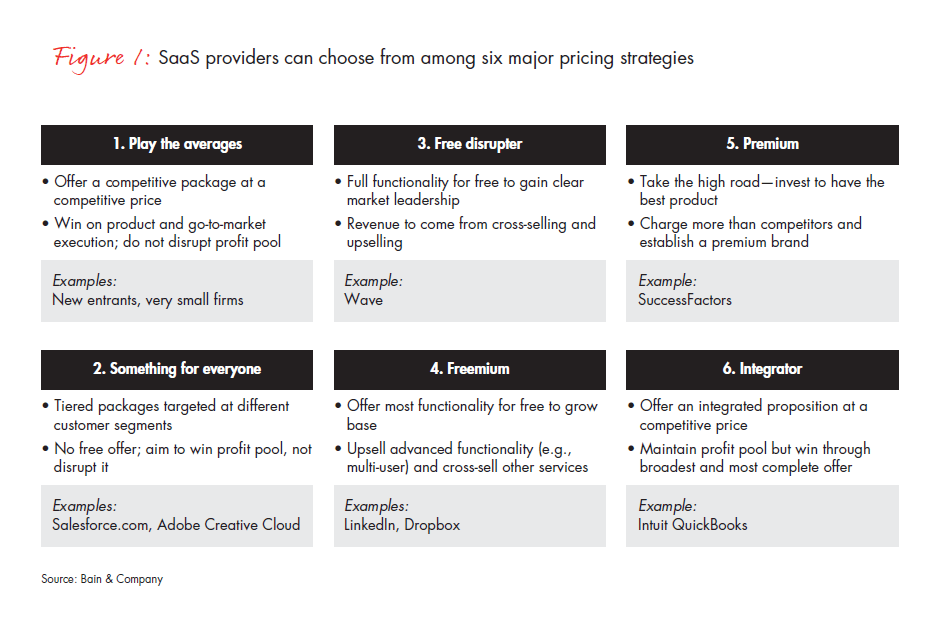
      Bain has identified six broad pricing strategies that cover virtually the entire SaaS landscape (see Figure 1):

      how-saas-providers-can-use-pricing-fig-01_embed
      • Play the averages. This one-size-fits-all strategy offers a competitive package at a competitive price. The goal is to win based on the product’s quality and on strong go-to-market execution. New entrants and small SaaS firms typically use this strategy.
      • Something for everyone. Tiered price packages, with no free package, target different customer segments and aim to cover the majority of the market’s profit pool. Salesforce.com and Adobe Creative Cloud have both adhered to this model. Providers have to know which product features to turn on and off to appeal to different segments and convince certain customers to pay a premium.
      • Free disrupter. Full functionality for free aims to gain clear leadership of the user base. Revenues come from cross-selling or from monetizing the customer base in other ways. Wave, for example, offers free integrated invoicing, payroll and other software to small firms, and provides aggregate customer data to other parties, such as advertisers.
      • Freemium. Offering most functionality for free will likely speed up growth of the user base. The provider can then upsell more advanced functionality or cross-sell other products. LinkedIn, the career networking website, and Dropbox, a file-sharing site, both give away ample functionality to build up their base. LinkedIn then charges active job seekers and recruiters for advanced features, while Dropbox charges heavy users.
      • Premium. In this strategy, a provider takes the high road by investing to have the best software package, then charges a premium accordingly. A good example is the SuccessFactors human capital management package, now part of SAP.
      • Integrator. Offering an integrated proposition at a competitive price allows a provider to win by solving customers’ needs with the broadest or most complete offer, thereby saving customers time and effort. Intuit has taken this approach with its QuickBooks bookkeeping suite.

      Each of these strategies leads to very different growth patterns in the number and type of customers, in the average revenue per customer and in the rate of customer churn.

      A free disrupter, for instance, will maximize growth in the user base and allow the company to rapidly take share, but revenues will stay low until the company devises a clear path to monetization. A something-for-everyone model tends to balance user and revenue growth but risks having some customers choose a lower-priced product, which leaves money on the table.

      To be executed effectively, each strategy requires different capabilities. Free disrupter, for example, relies on the ability to run low-cost distribution and support, whereas something for everyone requires that the provider offer many more products and be able to seamlessly turn on and off certain product features.

      Discovering what customers will really pay for

      Given the inherent trade-offs with each pricing strategy, software providers should first clarify their overarching strategic goals: Increase market share? Maximize profit? Go public, or get acquired in four years? Roll up other software vendors? Maintain independence?

      Because of the intense M&A activity in software markets, an overriding goal for some companies is to maximize the enterprise value at the time of acquisition. That means the timing for reaching a target user base and revenue stream must figure prominently in their pricing decisions.

      Articulating such goals will help create the appropriate balance between growing the user base—with the potential for future revenues—and growing revenues today. A crucial next step is to understand customers’ behaviors and priorities.

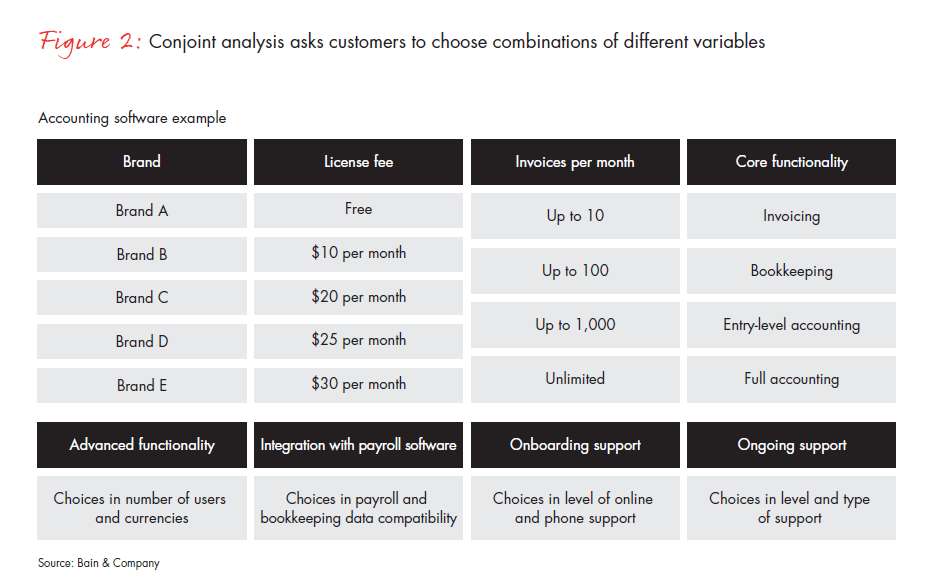
      To that end, conjoint analysis is one of the most powerful and reliable tools available. This statistical technique allows a company to quantify the influence of different variables—price, functionality, service levels, brand and more—on a customer’s decision making. A typical analysis presents customers with, say, eight variables, and three or four choices for each variable. From this set, thousands of price and package combinations can be tested (see Figure 2).

      how-saas-providers-can-use-pricing-fig-02_embed

      Survey respondents rank the variables to define which combination they find most attractive. This output can then be translated to determine a customer’s price sensitivity, or the effect on revenues of a price increase or from adding an additional element to the value proposition. Analysis might show, for instance, that a $5/$20 monthly tier may be leaving money on the table, because many customers who pay $5 would be more willing to pay $10 than leave after a price increase.

      Conjoint analysis, combined with competitor analysis, can highlight how effective a company’s go-to-market execution is relative to its competitors and whether a company has its fair share of the market, which signals how well it is executing on the current pricing strategy.

      With these analyses in hand, a company can determine the best pricing strategy for its particular circumstances. It will still need to respond to future changes in market behavior and customer needs with ongoing tactical interventions. And real-time analysis of current and potential buyer behaviors can serve to refine pricing positions. Setting the right pricing strategy at the start, however, will be the decisive factor in creating long-term value.

      IRIS makes its choice

      IRIS, the UK’s leading provider of accounting services and payroll software, has been innovating in its shift to the cloud in order to improve the user’s experience and attract new customer segments. The firm’s recent pricing work illustrates how an analytical approach to pricing plays out in practice.

      Accountants spend a lot of time translating their SME clients’ bookkeeping data into the right format for producing a set of accounts. To significantly reduce this work for accountants, IRIS decided to acquire KashFlow, an online accounting software that accountancies can use to seamlessly connect to their SME customers.

      IRIS has already employed a range of pricing models in its cloud division, including a freemium model. However, its strategic goal of disrupting the market and building a new segment among very small businesses, while also growing revenues, required a different approach.

      Conjoint analysis revealed that price, followed by brand, is the most important factor for SMEs purchasing online bookkeeping software. Very small firms are the most price-sensitive segment, suggesting that a free disrupter or freemium model would be most attractive to them. At the same time, larger SMEs have more complex bookkeeping needs and would be likely to pay more for additional features, including unlimited invoices, multiple users and integration with payroll.

      The analysis tested other important questions: What fee would the accountants be willing to charge SMEs for the bookkeeping software, and what value do accountants put on having bookkeeping integrated into their accountancy’s software? Our research showed that offering free bookkeeping would add a lot of customers, but many of them would still buy the product if they were charged more per month.

      Accountants themselves were sensitive to being charged a fee for integrating KashFlow into their practice software, but would pay a fee for the benefits of reducing their workload and being able to offer reduced prices to their SME customers.

      Finally, the research showed that investing to integrate compliance functionality was worthwhile, given that enough users valued the time savings it provides.

      Using this market research, IRIS modeled what would happen to the number of users, revenues and market share under different pricing strategies and price points. The modeling results informed a series of workshops to align the management team and board of directors around the optimal pricing strategy and investment required to disrupt the market.

      The overall conclusion was clear: A tiered model would generate the most value for IRIS’s customers and hence had the most attractive revenue and user profile. This approach would generate three-and-a-half times the number of users and almost double the revenues relative to the status quo.

      As the IRIS experience suggests, firms must align pricing strategies with their overall strategic goals. For software companies that have introduced SaaS offerings, choosing the right pricing strategy—as informed by rigorous customer and competitor analysis—will be a crucial factor in the fate of the business.

      Tim Cochrane is a partner with Bain & Company’s Private Equity practice, based in London. Sachin Shah is a partner with Bain’s Technology practice, also based in London. Justin Murphy is a Bain partner with the Technology practice and is based in San Francisco. Jonny Holliday is a principal with the Private Equity practice, based in London.


      how-saas-providers-can-use-pricing-fig-01_full

      how-saas-providers-can-use-pricing-fig-02_full
      Authors
      • Tim Cochrane
        Former Partner, London
      • Headshot of Sachin Shah
        Sachin Shah
        Partner, London
      • Headshot of Justin Murphy
        Justin Murphy
        Partner, San Francisco
      • Headshot of Jonny Holliday
        Jonny Holliday
        Partner, London
      Contact us
      Related Industries
      • Technology
      Technology
      Why Customer Experience Matters More Than Ever for Enterprise IT

      End users have a growing voice in technology buying decisions.

      More
      Technology
      Is Your Company Ready for the Internet of Things?

      The rise of machine-to-machine computing could generate as much as $1.4 trillion investment by 2017.

      More
      Technology
      Software M&A

      The good news: Most deal best practices still apply to AI acquisitions.

      More
      Technology
      Exploring AI for Packaging Circularity

      AI is already creating value across the packaging lifecycle, from optimising design and reducing material use to improving sorting and traceability.

      More
      Technology
      How Businesses Can Prepare for Post-Quantum Cybersecurity Threats

      Your company will soon face attackers armed with quantum technology. Will you be ready?

      More
      First published in Ιούλιος 2014
      Tags
      • Technology

      How We've Helped Clients

      Can Microchips Turbocharge Sustainability Improvement?

      Read case study

      Increased sales productivity frees selling time and saves millions

      Read case study

      Aggressively growing an IT service provider with a high-performance culture

      Read case study

      Έτοιμοι να μιλήσουμε

      Συνεργαζόμαστε με φιλόδοξους ηγέτες που θέλουν να καθορίσουν το μέλλον και όχι. Όχι να κρυφτούν από αυτό. Μαζί, επιτυγχάνουμε πετυχαίνουμε εξαιρετικά αποτελέσματα.

      Μείνετε μπροστά σε έναν γρήγορα εξελισσόμενο κόσμο. Εγγραφείτε στο Bain Insights, τη μηνιαία μας επισκόπηση των κρίσιμων θεμάτων που αντιμετωπίζουν οι παγκόσμιες επιχειρήσεις

      *Έχω διαβάσει την Πολιτική Απορρήτου και συμφωνώ με τους όρους της.

      Please read and agree to the Privacy Policy.
      Bain & Company
      Επικοινωνήστε μαζί μας Sustainability Accessibility Όροι χρήσης Privacy Cookie Policy Sitemap Log In

      © 1996-2026 Bain & Company, Inc.

      Contact Bain

      How can we help you?

      • Business inquiry
      • Career information
      • Press relations
      • Partnership request
      • Speaker request
      See all offices