
Skip to Content
  • Γραφεία

    Γραφεία

    North & Latin America
    • Atlanta
    • Austin
    • Bogota
    • Boston
    • Buenos Aires
    • Chicago
    • Dallas
    • Denver
    • Houston
    • Los Angeles
    • Mexico City
    • Minneapolis
    • Monterrey
    • Montreal
    • New York
    • Rio de Janeiro
    • San Francisco
    • Santiago
    • São Paulo
    • Seattle
    • Silicon Valley
    • Toronto
    • Washington, DC
    Europe & Africa
    • Amsterdam
    • Athens
    • Berlin
    • Brussels
    • Copenhagen
    • Dusseldorf
    • Frankfurt
    • Helsinki
    • Istanbul
    • Johannesburg
    • Kyiv
    • Lisbon
    • London
    • Madrid
    • Milan
    • Munich
    • Oslo
    • Paris
    • Rome
    • Stockholm
    • Vienna
    • Warsaw
    • Zurich
    Middle East
    • Doha
    • Dubai
    • Riyadh
    Asia & Australia
    • Bangkok
    • Beijing
    • Bengaluru
    • Brisbane
    • Ho Chi Minh City
    • Hong Kong
    • Jakarta
    • Kuala Lumpur
    • Manila
    • Melbourne
    • Mumbai
    • New Delhi
    • Perth
    • Shanghai
    • Singapore
    • Sydney
    • Tokyo
    See all offices
  • Alumni
  • Media Center
  • Εγγραφή
  • Επικοινωνία
  • Greece | Elliniká

    Select your region and language

    Global
    • Global (English)
    North & Latin America
    • Brazil (Português)
    • Argentina (Español)
    • Canada (Français)
    • Chile (Español)
    • Colombia (Español)
    Europe, Middle East, & Africa
    • France (Français)
    • DACH Region (Deutsch)
    • Italy (Italiano)
    • Spain (Español)
    • Greece (Elliniká)
    Asia & Australia
    • China (中文版)
    • Korea (한국어)
    • Japan (日本語)
  • Saved items (0)
    Saved items (0)

    You have no saved items.

    Bookmark content that interests you and it will be saved here for you to read or share later.

    Explore Bain Insights
  • Κλάδοι
    Main menu

    Κλάδοι

    • Aerospace & Defense
    • Agribusiness
    • Chemicals
    • Construction & Infrastructure
    • Consumer Products
    • Financial Services
    • Healthcare & Life Sciences
    • Industrial Machinery & Equipment
    • Media & Entertainment
      Κλάδοι
      Media & Entertainment
      • Media Lab
    • Metals
    • Mining
    • Oil & Gas
    • Paper & Packaging
    • Private Equity
      Κλάδοι
      Private Equity
      • Due Diligence
      • Exit Planning
      • Firm Strategy & Operations
      • Portfolio Value Creation
    • Social Impact
    • Retail
    • Technology
    • Telecommunications
      Κλάδοι
      Telecommunications
      • Capital Expenditure
      • Telco Digital Transformation
    • Transportation
    • Travel & Leisure
    • Utilities & Renewables
  • Συμβουλευτικές Υπηρεσίες
    Main menu

    Συμβουλευτικές Υπηρεσίες

    • Customer Experience
    • Sustainability
    • Innovation
    • M&A
    • Operations
    • People & Organization
    • Private Equity
    • Sales & Marketing
    • Strategy
    • AI, Insights, and Solutions
    • Technology
    • Transformation
  • Digital
  • Πληροφορίες
    Main menu

    Πληροφορίες

    • Industry Insights
    • Services Insights
    • Bain Books
    • Webinars
    • Bain Futures
    View all Insights
    Featured topics
    • Artificial Intelligence
    • Managing Inflation
    • Thriving in Uncertainty
    • The Talent Imperative
    • Macro Trends
    • Healthcare Private Equity Report
    • CEO's Guide to Sustainability
    • Technology Report
    • Energy & Natural Resources Report
    • Paper & Packaging Report
    • CEO Insights
    • CFO Insights
    • COO Insights
    • CIO Insights
    • CMO Insights
    View all featured topics
  • Σχετικά με εμάς
    Main menu

    Σχετικά με εμάς

    • What We Do
    • What We Believe
    • Our People & Leadership
    • Client Results
    • Awards & Recognition
    • Global Affiliations
    • Social Impact
    • Sustainability
    • World Economic Forum
    Learn more about Further
  • Careers
    Main menu

    Careers

    • Work with Us
      Careers
      Work with Us
      • Find Your Place
      • Our Work Areas
      • Integrated Teams
      • Students
      • Internships & Programs
      • Recruiting Events
    • Life at Bain
      Careers
      Life at Bain
      • Blog: Inside Bain
      • Career Stories
      • Our People
      • Where We Work
      • Supporting Your Growth
      • Affinity Groups
      • Benefits
    • Impact Stories
    • Hiring Process
      Careers
      Hiring Process
      • What to Expect
      • Interviewing
    FIND JOBS
  • Γραφεία
    Main menu

    Γραφεία

    • North & Latin America
      Γραφεία
      North & Latin America
      • Atlanta
      • Austin
      • Bogota
      • Boston
      • Buenos Aires
      • Chicago
      • Dallas
      • Denver
      • Houston
      • Los Angeles
      • Mexico City
      • Minneapolis
      • Monterrey
      • Montreal
      • New York
      • Rio de Janeiro
      • San Francisco
      • Santiago
      • São Paulo
      • Seattle
      • Silicon Valley
      • Toronto
      • Washington, DC
    • Europe & Africa
      Γραφεία
      Europe & Africa
      • Amsterdam
      • Athens
      • Berlin
      • Brussels
      • Copenhagen
      • Dusseldorf
      • Frankfurt
      • Helsinki
      • Istanbul
      • Johannesburg
      • Kyiv
      • Lisbon
      • London
      • Madrid
      • Milan
      • Munich
      • Oslo
      • Paris
      • Rome
      • Stockholm
      • Vienna
      • Warsaw
      • Zurich
    • Middle East
      Γραφεία
      Middle East
      • Doha
      • Dubai
      • Riyadh
    • Asia & Australia
      Γραφεία
      Asia & Australia
      • Bangkok
      • Beijing
      • Bengaluru
      • Brisbane
      • Ho Chi Minh City
      • Hong Kong
      • Jakarta
      • Kuala Lumpur
      • Manila
      • Melbourne
      • Mumbai
      • New Delhi
      • Perth
      • Shanghai
      • Singapore
      • Sydney
      • Tokyo
    See all offices
  • Alumni
  • Media Center
  • Εγγραφή
  • Επικοινωνία
  • Greece | Elliniká
    Main menu

    Select your region and language

    • Global
      Select your region and language
      Global
      • Global (English)
    • North & Latin America
      Select your region and language
      North & Latin America
      • Brazil (Português)
      • Argentina (Español)
      • Canada (Français)
      • Chile (Español)
      • Colombia (Español)
    • Europe, Middle East, & Africa
      Select your region and language
      Europe, Middle East, & Africa
      • France (Français)
      • DACH Region (Deutsch)
      • Italy (Italiano)
      • Spain (Español)
      • Greece (Elliniká)
    • Asia & Australia
      Select your region and language
      Asia & Australia
      • China (中文版)
      • Korea (한국어)
      • Japan (日本語)
  • Saved items  (0)
    Main menu
    Saved items (0)

    You have no saved items.

    Bookmark content that interests you and it will be saved here for you to read or share later.

    Explore Bain Insights
  • Κλάδοι
    • Κλάδοι

      • Aerospace & Defense
      • Agribusiness
      • Chemicals
      • Construction & Infrastructure
      • Consumer Products
      • Financial Services
      • Healthcare & Life Sciences
      • Industrial Machinery & Equipment
      • Media & Entertainment
      • Metals
      • Mining
      • Oil & Gas
      • Paper & Packaging
      • Private Equity
      • Social Impact
      • Retail
      • Technology
      • Telecommunications
      • Transportation
      • Travel & Leisure
      • Utilities & Renewables
  • Συμβουλευτικές Υπηρεσίες
    • Συμβουλευτικές Υπηρεσίες

      • Customer Experience
      • Sustainability
      • Innovation
      • M&A
      • Operations
      • People & Organization
      • Private Equity
      • Sales & Marketing
      • Strategy
      • AI, Insights, and Solutions
      • Technology
      • Transformation
  • Digital
  • Πληροφορίες
    • Πληροφορίες

      • Industry Insights
      • Services Insights
      • Bain Books
      • Webinars
      • Bain Futures
      View all Insights
      Featured topics
      • Artificial Intelligence
      • Managing Inflation
      • Thriving in Uncertainty
      • The Talent Imperative
      • Macro Trends
      • Healthcare Private Equity Report
      • CEO's Guide to Sustainability
      • Technology Report
      • Energy & Natural Resources Report
      • Paper & Packaging Report
      • CEO Insights
      • CFO Insights
      • COO Insights
      • CIO Insights
      • CMO Insights
      View all featured topics
  • Σχετικά με εμάς
    • Σχετικά με εμάς

      • What We Do
      • What We Believe
      • Our People & Leadership
      • Client Results
      • Awards & Recognition
      • Global Affiliations
      Further: Our global responsibility
      • Social Impact
      • Sustainability
      • World Economic Forum
      Learn more about Further
  • Careers
    Popular Searches
    • Agile
    • Digital
    • Strategy
    Your Previous Searches
      Recently Visited Pages

      Content added to saved items

      Saved items (0)

      Removed from saved items

      Saved items (0)

      Global Machinery & Equipment Report

      Machinery and Equipment: The Circular Path to Value

      Machinery and Equipment: The Circular Path to Value

      Leaders use circular strategies to develop new sources of value and competitive advantage.

      By Michael Staebe, Joshua Hinkel, Xavier Houot, Tessa Bysong, and Leon Lu

      • min read
      }

      Report

      Machinery and Equipment: The Circular Path to Value
      en
      At a Glance
      • Bain research shows that 47% of large machinery companies have circularity commitments, but most remain narrow in scope.
      • Circular strategies will lead to new business models and reshape profit pools.
      • Most machinery executives believe that circular practices will deliver significant cost savings.

      This article is part of Bain's Global Machinery & Equipment Report 2024

      Explore the report

      By 2030, circularity will change the way large sectors of the machinery and equipment sector operate. Profit pools will shift as companies embrace business models that preserve materials and extend the life span of machinery. Circular operating models will reconfigure value chains. And as companies begin to decouple their growth from resource consumption, a new set of winners and losers will emerge.

      A recent Bain study shows that 47% of large machinery companies have made circularity commitments. But so far, most initiatives remain narrow in scope—focused on recycling, reduction of inputs, and waste reduction. Many leadership teams view circularity as a recycling or sustainability topic linked to regulation. Few have begun to think about it as a value creation opportunity—one that can provide new revenue streams, supply chain resilience, enhanced customer intimacy, and access to new customer groups over the next 20 years (see Figure 1).

      Nearly 60% of machinery executives see their industry’s future as circular, according to Bain research. These leaders are convinced that circular business models will be table stakes for competing in a new era. A majority believe that circular practices will improve their operational capabilities, significantly reduce costs, and enhance customer loyalty.

      Emerging leaders with circular operations and Internet of Things (IoT) capabilities generate strong gains in efficiency and sustainability. The IoT data they gather creates vast opportunities to preserve assets at their maximum value for the longest possible time, improving energy efficiency and reducing the need for resource extraction. Data without a circular strategy and supply chain to extend the life span of machines and retrofit them is far less effective. Circular business models, in turn, depend on connected machines and data to reduce the use of raw materials.

      A growing number of industry executives see a win-win opportunity in which circularity lowers the cost of equipment ownership for clients and promotes closer, long-term customer relationships for machinery makers. These companies are starting to apply a circular approach to parts of the value chain, equipment portfolio, and customer segments that can benefit most from the shift. Companies that anticipate shifting profit pools will be well positioned to identify new opportunities ahead of the competition and reimagine products and services for a circular future.

      Figure 1
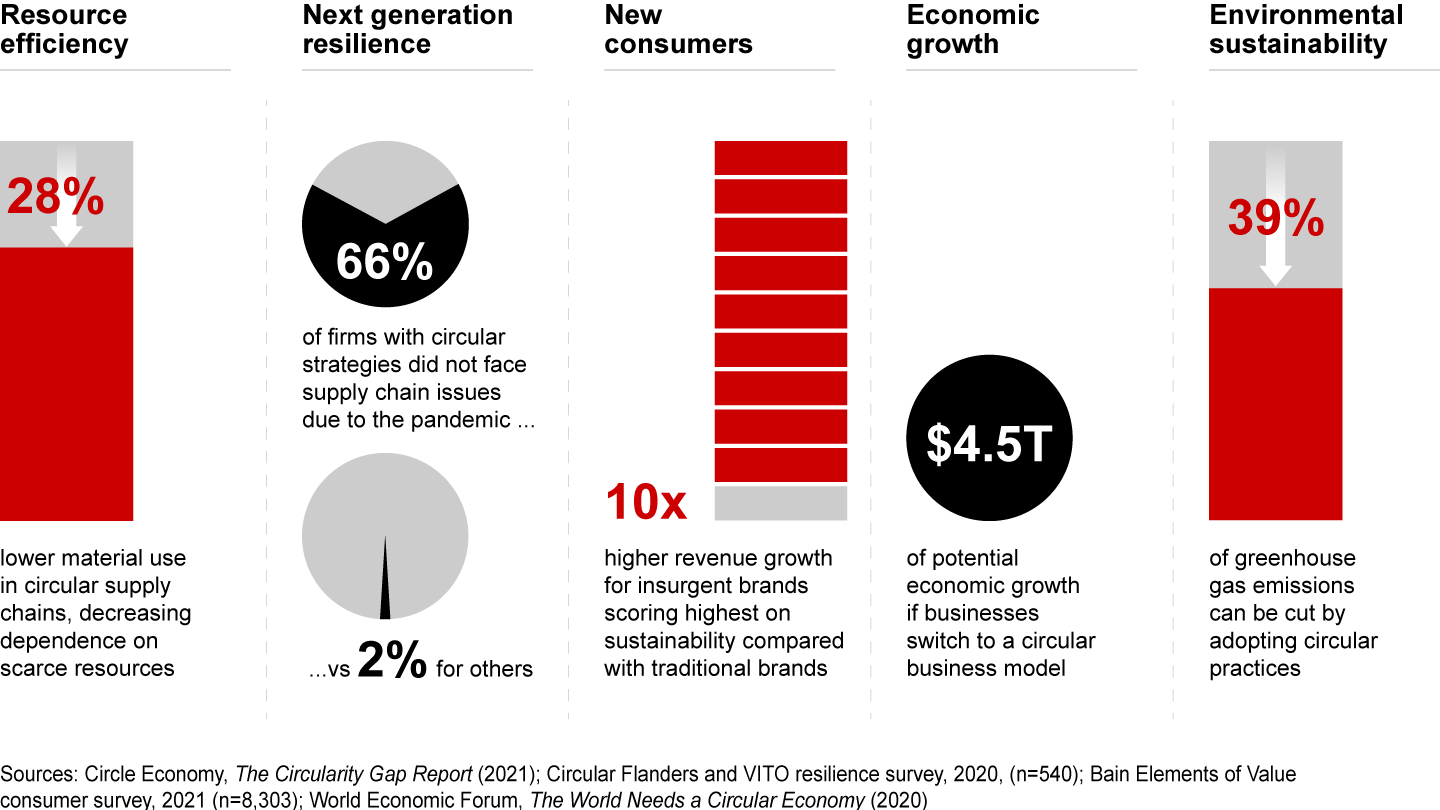
      Circular business models can deliver economic benefits

      New sources of value

      Today, new machine sales and long-running service contracts still generate the largest share of the industry’s profit. Many companies sell new equipment at low-single-digit margins and often rely on their service business for more than 50% of total profit over the lifetime of the product.

      That business model is not going to disappear. But leading machinery companies are starting to create value by combining machinery sales and service contracts with circular material models designed to reuse valuable parts and resources. In some customer segments, machinery companies are launching circular business models, including selling products as a service (see Figure 2).

      Figure 2
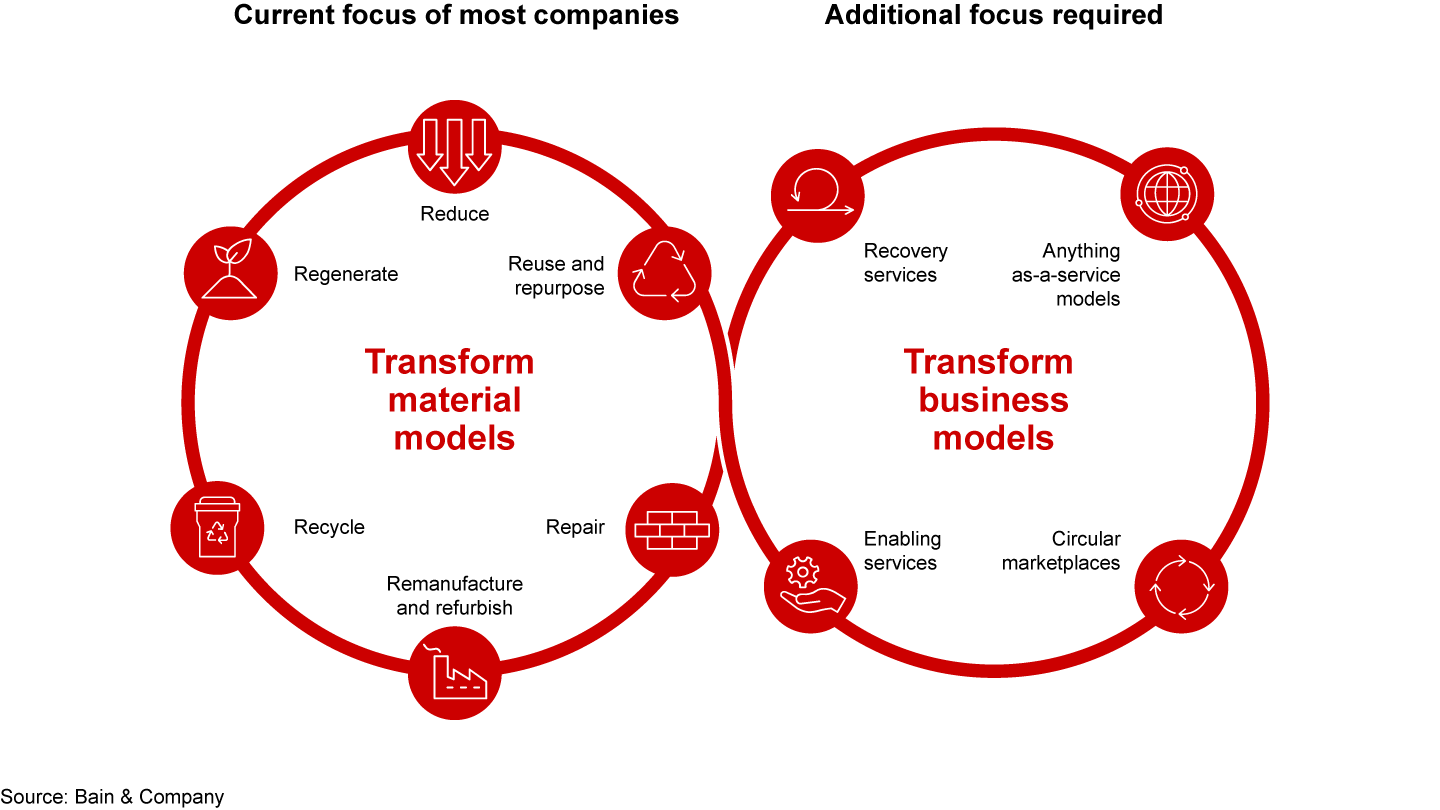
      Circular transformations will solve the most pressing business issues by redesigning existing material and business models with circular principles

      Senior executives at these companies understand that circular operations improve efficiency and boost organizational resilience by increasing raw material self-sufficiency while providing new streams of revenue. For these firms, secondary markets take on a more strategic role. While remanufacturing is not new, circularity leaders view it as an increasingly important element of operations, along with product repair and regeneration, repurposing, and recycling.

      Machinery executives expect remanufacturing to reduce costs by 20% to 60%, according to our research. Over the next 5 to 10 years, we believe that the value created by new material models could represent up to 20% of revenue. Executives report that circular supply chains reduce their material use by 28%, on average, decreasing dependence on scarce resources and cost. At the same time, they say that circular practices eliminate 39% of greenhouse gas emissions, on average.

      German pump maker Wilo, for example, aims to continually reduce its use of primary raw materials by reusing components and materials. When the company recently suffered supply chain disruptions resulting from shortages of magnets and rare earth materials from China, its leadership team launched an initiative to collect old pumps from the field in order to secure scarce raw materials. The company also introduced disassembly for returned and scrapped products. Those practices led to higher margins​. By 2025, Wilo’s management team aims to reduce annual raw material consumption by 250 tons through circular operations. The effort involves reusing 30,000 components per year, shifting to 100% reusable packaging, and boosting the recycling rate to 90%.

      Another industrial equipment maker launched a strategy to reduce its material use by replacing the wooden crates (one-time-only use) in which it packaged its outbound mowers and snow throwers with reusable metal crates. It contracted with a supplier of metal crates for the handling and transport of its goods to customers. The company forecast that the “rented metal” program would save $16 million to $19 million in annual procurement costs, of which $11 million would be realized through negotiations with suppliers and customers. In addition, the move from wooden to metal crates is expected to reduce carbon emissions related to the shipment of those goods by 75%.

      Leading machinery makers also are taking a more strategic approach to remanufacturing. Caterpillar operates nine remanufacturing locations globally and offers more than 7,000 remanufactured components and parts, which are priced 40% to 50% below the cost of new parts. It also offers machines rebuilt with used or remanufactured parts typically after two to three years in operation for key components (engine, suspension, transmission). The company has set a goal of growing its remanufacturing business by 15% per year, which is faster than its overall business.

      New business models

      In the future, machinery companies will design products for greater longevity, sell more products as a service, and tap into circular marketplaces. All three approaches can underpin a circular business model. Selling machinery as a service is not new, but in the context of the broader circularity agenda, advances in technology are making such business models more feasible and more profitable. Service-based businesses may include charging customers for extending the life of their products, upgrades or retrofits, end-of-life decommissioning, taking back equipment, and remaking used equipment. Companies may charge a one-time fee for a service, ongoing fees, or even payments based on a client’s guaranteed output.

      Such models are becoming increasingly attractive and strategically important as the commoditization of machinery and equipment starts to squeeze revenue. Service-based business models offer companies a way to improve efficiency, resource resilience, and customer loyalty while offering clients a lower cost of ownership.

      The early service-based models that are gaining traction in machinery and equipment sectors focus on creating value while also achieving sustainability benefits. In particular, companies are tapping into three new sources of value: reducing material consumption, extending a product’s life span, and increasing product utilization.

      German machinery maker Trumpf has introduced a pay-per-part business model. That is, Trumpf remains the legal owner of the machine, and the customer pays a fee per part produced. The model offers customers financial flexibility, allowing the company to avoid significant capital expenditures on machinery. Trumpf takes care of all maintenance, repairs, production planning, and programming.

      Trumpf’s pay-per-part model offers customers the advantage of a fixed price per piece prior to production, helping reduce the need for qualified workers. Though pay-per-part contracts remain less than 1% of Trumpf’s total business, they are a win-win for the company and its customers. At the same time, they give Trumpf’s management valuable experience with outcomes-based business models.

      Under pay-per-part contracts, Trumpf rents its own engineers and mechanics to its customers, who, in turn, need fewer employees. The arrangement provides Trumpf with valuable data on the performance of its machines. Overall, the pay-per-part contracts enable Trumpf engineers to manage material use more efficiently, reducing carbon-dioxide emissions by up to 65%. After 8 to 10 years, Trumpf takes back the machines and refurbishes them or reuses selected parts.

      Getting started

      Leading machinery companies begin developing a circular strategy by exploring different value creation opportunities. Executive teams examine how recycling could generate value and how to build circular design concepts into product development and engineering. They also determine whether the company will need access to raw materials or if they can harvest critical parts from the installed base. Ultimately, each company must determine how to evolve machines and equipment into a more comprehensive solution that paves the way for selling outcomes as opposed to products.

      In our experience, emerging leaders in circularity follow three key steps when launching a circular strategy:

      • They explore key market trends, including how technology and regulations will impact the business, to envision what future business models could look like and how profit pools are likely to shift.
      • These companies develop strong partner ecosystems to improve access to vital assets and capabilities because circular business models don’t work alone. Ensuring that materials and products flow through a circular chain requires a network of internal and external stakeholders.
      • Leadership teams take an Agile approach to deploying circular strategies and adopt a customer mindset, building their capabilities and operating model as they go and continually evolving them to match the pace of change in the external environment.

      In the coming decade, many machinery and equipment companies will make circular operations and business models a core part of their strategies. The shift is an opportunity to enhance resilience, efficiency, recurring revenue, and customer loyalty while lowering the use of scarce resources. Service-based business models will become increasingly attractive to customers eager to trim capital expenditures. Those that develop circular strategies ahead of rivals will have an edge competing for new sources of value.

      The authors wish to thank Hernan Saenz and Simone Doms for their contributions to this article.

      Read the Next Chapter

      The Feedback Machine: The Magic of Closed-Loop Product Life Cycle Management

      Read our Machinery & Equipment Report 2024

      Explore the full report Download the PDF

      More from the report

      • An Overlooked Ace: Finding Value in Your Installed Base

      • Digital Solutions in Machinery: Don’t Be Left Behind

      • Machinery and Equipment: The Circular Path to Value

      • The Feedback Machine: The Magic of Closed-Loop Product Life Cycle Management

      • Artificial Intelligence Rockets to the Top of the Manufacturing Priority List

      • The Factory of the Future Could Boost Productivity by 30% or More

      Authors
      • Headshot of Michael Staebe
        Michael Staebe
        Partner, Munich
      • Headshot of Joshua Hinkel
        Joshua Hinkel
        Partner, Dallas
      • Headshot of Xavier Houot
        Xavier Houot
        Partner, Paris
      • Headshot of Tessa Bysong
        Tessa Bysong
        Alumni, Chicago
      • Headshot of Leon Lu
        Leon Lu
        Partner, Shanghai
      Contact us
      Related Industries
      • Advanced Manufacturing & Services
      • Machinery & Equipment
      Related Consulting Services
      • Operations
      • Sustainability
      How We Can Help
      • Circular Economy
      COO insights
      Top Performers Unlock More Revenue from Sustainability

      Across global industries, leaders are capturing more revenue from sustainable products—and some expect the momentum to build.

      More
      Machinery & Equipment Report
      Operations Priority No. 1 in Machinery: Sustainable and Resilient Supply Chains

      Building flexible, circular supply chains requires new capabilities.

      More
      Advanced Manufacturing & Services
      Machinery & Equipment M&A

      As more companies discover software’s value as a growth engine, more will need to hone their M&A skills.

      More
      Advanced Manufacturing & Services
      Sustainability: Less Talk and More Action

      Despite elusive targets, the business case is stronger than ever.

      More
      COO insights
      How AI Is Starting to Transform Circular Packaging

      There are 15 AI use cases companies across the value chain can use today to accelerate circularity.

      More
      First published in Απρίλιος 2024
      Tags
      • Advanced Manufacturing & Services
      • Circular Economy
      • COO insights
      • Machinery & Equipment
      • Machinery & Equipment Report
      • Operations
      • Sustainability

      How We've Helped Clients

      A Steel Company Seeks to Regain Market Leadership

      Read case study

      A Conglomerate Charts a New Global Strategy

      Read case study

      A global manufacturer's reorganization restores high profits

      Read case study

      Έτοιμοι να μιλήσουμε

      Συνεργαζόμαστε με φιλόδοξους ηγέτες που θέλουν να καθορίσουν το μέλλον και όχι. Όχι να κρυφτούν από αυτό. Μαζί, επιτυγχάνουμε πετυχαίνουμε εξαιρετικά αποτελέσματα.

      Μείνετε μπροστά σε έναν γρήγορα εξελισσόμενο κόσμο. Εγγραφείτε στο Bain Insights, τη μηνιαία μας επισκόπηση των κρίσιμων θεμάτων που αντιμετωπίζουν οι παγκόσμιες επιχειρήσεις

      *Έχω διαβάσει την Πολιτική Απορρήτου και συμφωνώ με τους όρους της.

      Please read and agree to the Privacy Policy.
      Bain & Company
      Επικοινωνήστε μαζί μας Sustainability Accessibility Όροι χρήσης Privacy Cookie Policy Sitemap Log In

      © 1996-2026 Bain & Company, Inc.

      Contact Bain

      How can we help you?

      • Business inquiry
      • Career information
      • Press relations
      • Partnership request
      • Speaker request
      See all offices