

Brief

After a weekend of feasting and shopping, we’re midway through the holiday season. First reports about Thanksgiving weekend’s retail sales tallies suggest three groups of winners: innovative retailers; e-commerce channels, especially mobile; and customers, who enjoyed hefty promotions. A number of engaging innovations improved buyers’ shopping experiences ... and retailers’ profits.
In this issue, we recap the weekend’s sales results and share observations about digital shopping experiences and the innovations that support them.
Digesting Thanksgiving weekend’s mobile sales and deals
The holidays are in full swing. Trees are up, carols are playing and gifts are being bought. In the US, overall spending for the weekend (from Thanksgiving Day through Cyber Monday) was up slightly from last year. Moreover, Black Friday is increasingly an international shopping day: Barclaycard, which handles half of UK card payments, saw a record number of card transactions that day.
It’s too early to say for sure how sales split across channels (and, as channels blur, so do those splits), but Bain’s analysis suggests that holiday weekend sales growth skewed primarily online and that sales growth in stores was flat. The major change this year: For the first time, the number of people who shopped online surpassed the number who shopped in stores.
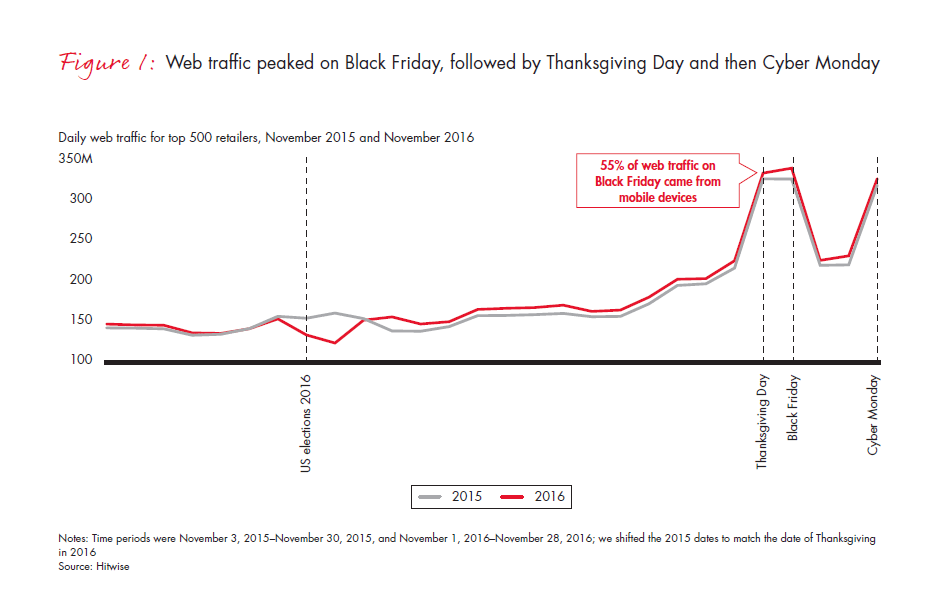
The big winner was e-commerce, especially mobile shopping. E-commerce sales were up 18% over last year, setting new records for Thanksgiving Day and Black Friday. We partnered with Hitwise to track visits to the top 500 retailers’ websites over the long weekend. We learned that this year shoppers didn’t wait until Monday to shop online from their work computers; instead they shopped straight from the couch over the holiday. Web traffic peaked on Black Friday, followed by Thanksgiving Day and then Cyber Monday (see Figure 1). With the exception of Amazon.com, all of the 10 most visited retail websites over the long weekend were retailers that also have physical stores. Online sales growth on Thanksgiving Day and Black Friday was nearly double last year’s, and exceeded growth on Cyber Monday. Reports are that most of this traffic came from mobile devices: 55% of traffic on Black Friday, leading to more than $1 billion in sales. According to Bain’s Shopping Experience Pulse, our ongoing survey in collaboration with Research Now, an increasing proportion of shoppers are using their mobile apps to shop as we get closer to the holidays. (There are more survey results below.)
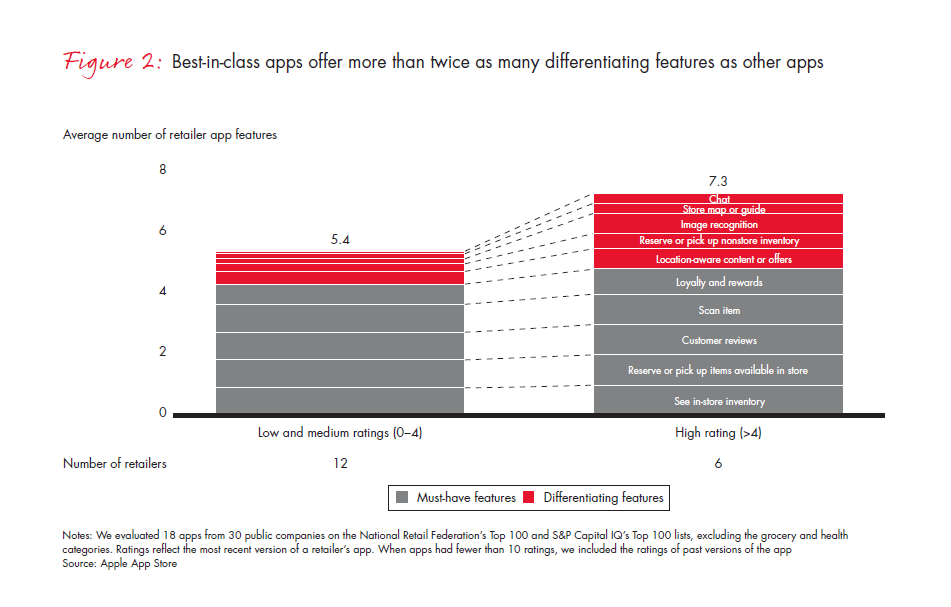
This explosion in mobile shopping makes it even more important for retailers to offer a good mobile website and app. In November we evaluated 30 top retailers’ mobile sites and apps, and found that chat, store guides and photo search are features that, when implemented effectively, differentiate the customer experience (see Figure 2).
Customers also won this holiday weekend. According to a National Retail Federation survey, 36% of shoppers reported that all of their Black Friday purchases were on sale, up from 32.5% last year. We saw particularly aggressive promotions in specialty apparel, where discounts upward of 40% were common.
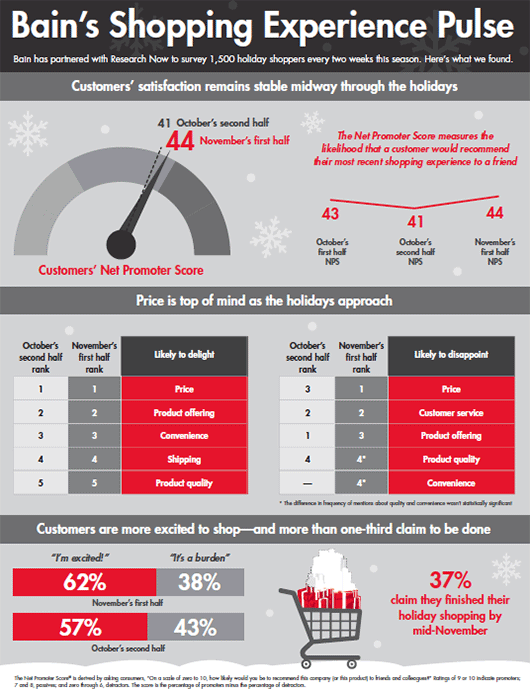
Since our last newsletter, we’ve continued measuring shopper satisfaction through Bain’s Shopping Experience Pulse. We surveyed 1,500 customers across the country, asking about their most recent shopping experience. Here are some of our latest findings:
- Shopping satisfaction is up for omnichannel retailers, but Amazon still leads. Online shoppers at brick-and-click retailers were more satisfied in the first half of November than they had been in October: Their Net Promoter Score® went up from 39 to 45.1 Although Amazon’s score remained the highest, it was nearly flat. The score for in-store shoppers also rose from 34 to 37.
- Shoppers are more excited about shopping. According to Bain’s Shopping Experience Pulse, 62% of customers reported being excited about holiday shopping, up from 57% in October. This finding is in line with strong improvement in consumer sentiment in November.
Part of the excitement about shopping for the holidays comes from the innovations retailers are introducing to create magical shopping experiences both in stores and online.
Innovations and the holiday shopping experience
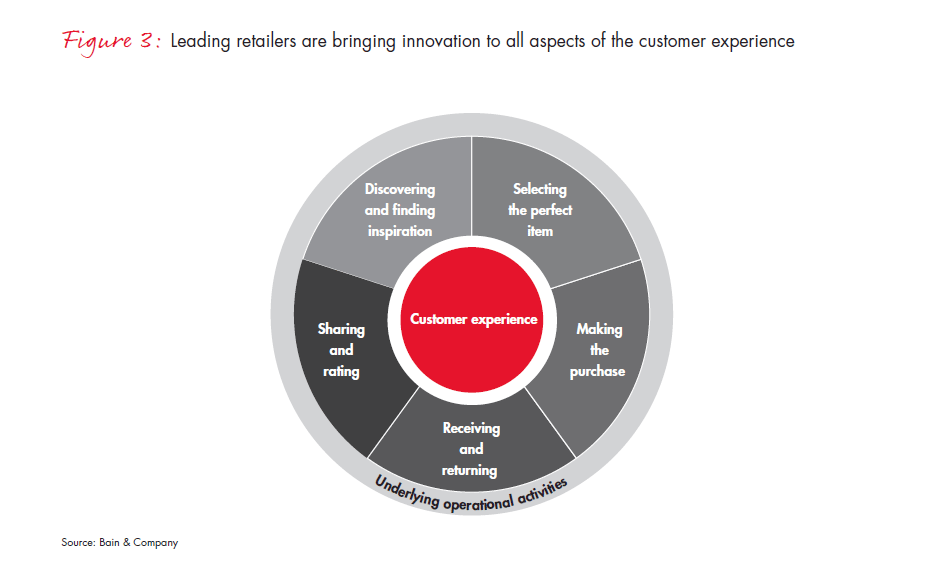
In recent weeks, heartwarming holiday ads have hit the airwaves, and clever displays have begun to brighten malls and main streets. We’ve also seen retailers debut innovations to inspire shoppers, help them find perfect gifts, make it easy to buy, receive and return items, and, of course, share their delight (see Figure 3). What follow are a few of our favorites across various parts of the customer experience.
Discovering and finding inspiration
- Appeal to customers’ emotions. Walmart, Amazon and other large retailers are cutting through the clutter of holiday advertising with emotionally engaging content that emphasizes the values of the season and how their brands fit in. Walmart’s Giving Thanks campaign focuses on family, service and unity, while Amazon’s new Amazon Prime commercial highlights friendship, religious tolerance and the special meaning of a thoughtful gift.
- Simplify gift recommendations with Big Data and advanced analytics algorithms. On its mobile app, North Face is using IBM’s Watson technology to learn what customers want and then make relevant product recommendations. The program uses feedback from shoppers about when and where they plan to use products to determine which items have the most appropriate fabrics and technical components for each customer’s specific needs. And Amazon is relying on artificial intelligence to learn from customers’ behaviors and to make personalized recommendations. The company uses machine learning to prioritize recommendations across its several-hundred-million-item assortment based on shoppers’ purchase history, items in their cart, items they’ve rated and liked, and what others have looked at or purchased.
Selecting the perfect item
- Use chat and text to offer speedy and personalized service. Saks and Bloomingdale’s are connecting online shoppers with associates at nearby stores through online chat options. And in November, Burberry introduced a “hybrid” holiday chat option within Facebook Messenger: A chatbot combines brand storytelling with an automated gift-recommendation engine, and also offers customers the chance to connect with an associate if they have questions the chatbot can’t answer.
- Enhance digital merchandising via virtual reality. Earlier this year, Ikea released a virtual reality (VR) app that connects with the HTC Vive headset to allow users to experience the “real-world” size and layout of different kitchen designs. Ahead of Singles Day (November 11), the largest shopping day in China, Alibaba introduced VR shopping, giving customers in China the experience of shopping in Macy’s flagship store in New York City. This follows on the heels of eBay’s partnership with Australian department store Myer to test a similar virtual shopping experience. Other sectors have been testing virtual reality for a while. In August 2014, travel company Thomas Cook installed Samsung Gear VR headsets in one of its UK stores to give users the experience of traveling to places like New York, Singapore and Greece. Since then the travel agency has expanded the use of VR, and it’s working. Sales of New York travel excursions, for example, have increased markedly in the period following each installation.
Making the purchase
- Enable hands-free shopping with voice-based search and checkout. Amazon’s personal assistant device, Alexa, uses voice recognition to search for and order items, allowing customers to shop and buy with just a few words. The company is heavily promoting Alexa this holiday season. The weekend before Thanksgiving, the retailer kicked off its first ever voice-shopping weekend with Alexa-exclusive deals for Prime members. Not to be outdone, Apple, Google and Microsoft are all competing with a range of smart devices that make shopping convenient anywhere, anytime.
- Help customers skip clicks by letting them shop directly from posts and videos. In November, 15 retailers, including Macy’s, J.Crew and Levi’s, partnered with Instagram to test shoppable photo tags. The tags offer customers product information and a path to purchase with the tap of a finger. Facebook, currently the largest chatbot platform, introduced its first native payment option in September. Google introduced shoppable ads for YouTube last year: Advertisers include links to their website within the videos. And some retailers have begun to experiment with their own shoppable videos. Ted Baker, for example, has produced a series of Mission Impeccable videos that allow users to “save” items as they watch and then purchase those items on the website. On November 1, the retailer released a gift-themed installment for the holidays.
Receiving and returning
- Offer e-gifting to simplify delivery and returns. Online gift registries and digital gifting, particularly in the form of digital gift cards, make last-minute shopping possible while shortening return timelines. Macy’s, Saks and other major retailers offer a digital gifting service on their websites through Loop Commerce. Shoppers can send an electronic gift notification to recipients, who can then choose to accept, exchange or return the item. Because items are “delivered” digitally, they can be gifted up to the last minute before the holiday, and returned or exchanged before they ever leave the shelves.
- Use autonomous vehicles to expand delivery options. This fall, Starship Technologies introduced sidewalk-friendly robots to bring groceries, food orders and packages to customers in Washington, DC. In New Zealand, Domino’s is piloting delivering pizzas using motorized drones. Otto, Uber’s self-driving truck company, made its first delivery—51,744 cans of Budweiser—in October. And Norwegian grocer Kolonial.no is also piloting driverless delivery.
Sharing and rating
- Reward shoppers for social media interactions. Starting in November, Sephora began distributing e-gift cards on social media both to reward customers’ loyalty and to respond to their complaints.
- Create community through online platforms. With the Clubs feature, Xbox Live users can create their own gaming communities of players who share gaming styles and preferences. Clubs give players a connection that encourages both their gaming experiences and their interactions.
Underlying operational activities
Lots more is happening behind the scenes. Robotics for one: Amazon deploys robotics to manage fulfillment, and other retailers are following suit. Walmart has been using robots to fill online apparel orders; and Hudson’s Bay has just upgraded its Toronto fulfillment center with a robotic system. And there’s so much more: Walmart recently implemented blockchain technology to identify and remove recalled foods. Amazon has a patent for anticipatory shipping, a system that allows the retailer to begin boxing and shipping products to customers based on their shopping cart and previous orders. Other operational activities include dynamic pricing, predictive maintenance sensors in fulfillment centers and cybersecurity.
Innovation observations and digital choices
At first glance, all of these innovations—customer facing and operational—seem worth copying. Certainly they’re not a bad place to start; but they would be a terrible place to stop. As we studied these examples in detail, we were struck by three facts:
- The customer experience is no longer linear. It’s not always easy to classify innovations by steps in the customer experience. For example, chatbots support product discovery and selection, and even transactions. Social media (and overall digital marketing) are increasing awareness across all parts of the experience, from being inspired to actually buying an item, receiving post-sale service and support and, ultimately, connecting with other users.
- Innovation demands digital capabilities. A remarkable number of the innovations we’re seeing in the market have strong ties to digital technologies.
- No one has mastered all things digital ... yet. With the exception of Amazon, no single retailer has implemented a large number of these innovations. It’s still early times.
Put simply, we’re seeing an explosion of digital innovations in retail. Those innovations are more than a boon for online retailers and a threat to traditional stores. They are powerful forces for change both in e-commerce and in physical stores.
Capitalizing on digital trends
Unfortunately the average retailer is poorly positioned to capitalize on digital trends. Gartner calculates that retailers spend just about 1.5% of sales on information technology. That’s less than half the cross- industry average of 3.4%. Furthermore, Gartner estimates that retailers’ rate of spending has actually slowed in 2016.
But the average retailer faces an even bigger challenge: E-commerce and legacy systems were often designed independently, which means they work at different speeds. E commerce operations (often based in Silicon Valley) run at high speed, while legacy systems plug away at a much slower pace.
The problem with two speeds is that inevitably the slower system holds back the faster one. Imagine Santa moving from house to house with a relatively small bag of goodies in a sleigh that moves at lightning speed. Now imagine that most of the presents Santa delivers arrive on a freight train that moves at a snail’s pace. Once Santa runs out of toys in his bag, he can’t move faster than that train.
This isn’t just a North Pole problem. Many major retailers’ websites offer shoppers the option of buying online and picking up in stores. But store systems can’t process the orders before customers get there; or they run out of stock because they batch-order inventory at the end of the day and aren’t able to dynamically allocate orders. Although stores want to improve service and reduce costs, most lack the technology that makes self-service possible, a workforce with the right tech talent, and the ability to coordinate among organizational silos. Yes, many retailers can deliver a few “goodies” on their separate system; but they can’t make the systemwide transformation needed to survive and thrive in the new world of retail.
Traditional retailers are very good at inspecting and managing the physical aspects of their business. They can see when a store is in bad shape. They can see customers lined up for blocks on Black Friday. They can see unsold inventory piling up in warehouses and back rooms. But digital assets are different. Most retail executives can’t see them, and few fully understand how digital innovations actually work.
If we could give our retail friends a gift this holiday season, we would give each of them a pair of “digital-reality” glasses, glasses that allow them to see their digital operations with the same clarity with which they see their physical operations. They would immediately recognize three problem areas:
- Digital demand is outstripping supply. Picture letters to Santa piling up in the mailroom. Digital demand is the growing list of issues that customers and operators would like to see addressed. Digital-reality glasses would help retailers understand the size of the problem, identify the most important requests and respond to them before it’s too late.
- Digital work in progress is chaotic. Christmas movies portray Santa’s elves happily working together, focused on one task at a time and turning out a steady stream of toys. But in the digital world, developers tend to work on many tasks at the same time, dashing frantically from project to project, which inevitably hurts quality. Digital-reality glasses would focus retailers on the flow of digital work, helping them to start less and finish more.
- Digital debt is threatening. The nightmare scenario in nearly every Christmas movie is a major breakdown at the North Pole that could mean no presents under the tree and millions of disappointed children. Of course, in the movies, heroic efforts of some sort save the day, and Santa sets off in his sleigh. Every year that retailers underinvest in digital capabilities, they raise the risk of disappointing customers and investors. They also incur a lot of labor costs with manual workarounds. These retailers may protect short-term operating cash flows, but they are ringing up digital debt and often creating processes that are not scalable. Eventually digital debt must be paid—either by selling off market share or by dramatically overinvesting to catch up and close technology gaps. The problem is that by the time the debt becomes obvious, cash flows are so weakened that it’s nearly impossible to find enough money for catch-up investments.
Transforming Santa’s workshop: Becoming omnichannel
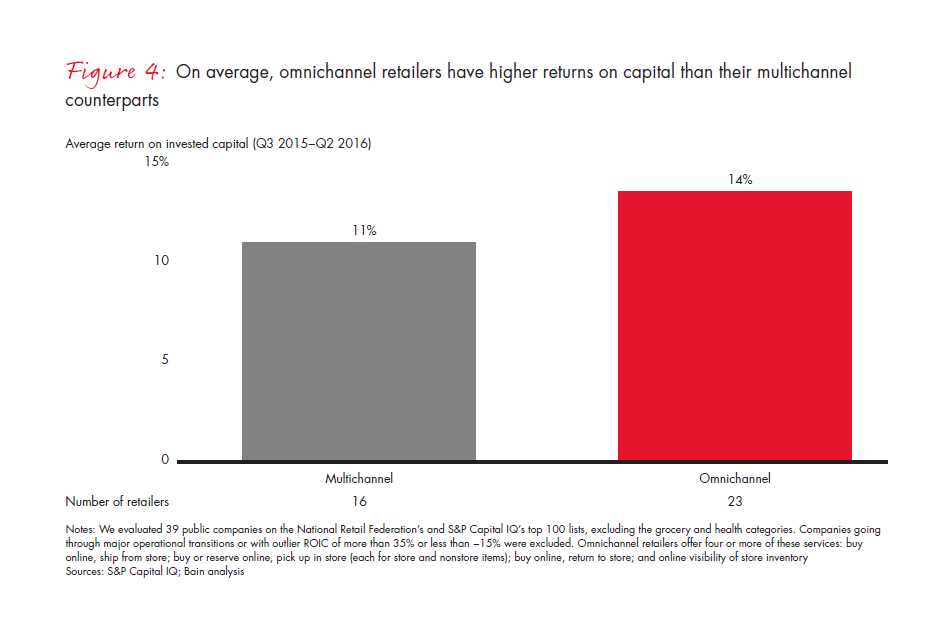
Digital innovations come at a cost to retailers, raising questions about profitability and return on investment. When capital is limited, it can be very difficult to choose among investments. Still, despite incremental expenses, we believe it’s critical for retailers to invest in omnichannel capabilities. Omnichannel retailers win on both experience and economics. We classified 40 top retailers as omnichannel or multichannel and then assessed their performance. We found that omnichannel retailers had returns on invested capital of about 300 basis points higher than their multichannel peers (see Figure 4).
Becoming a true omnichannel retailer demands a digital transformation, and that demands the successful completion of four steps:
1. Set ambition. Define a bold ambition that fits the brand and your target customer segment.
2. Assess. Take stock of new and existing ideas across the business, both customer facing and operational, acknowledging that many of the best ideas will come from deeper in the organization.
3. Prioritize. Define those digital arenas that are most valuable, and use them as guideposts in setting priorities for current and future digital initiatives.
4. Mobilize. Most initiatives will require fundamentally new ways of working across functions and projects, using data, technology and a digital-ready team.
For more about digital innovation, see “Embracing Agile” in the May 2016 issue of Harvard Business Review and “Anatomy of a Digital Forerunner."
In our next issue we will explore the role of the store in omnichannel retail and examine how retailers are bringing the best of digital and physical shopping experiences together. We’ll also discuss the latest holiday results, including sales in November. Here’s a breakdown of the last two issues:
- Issue #4, mid-December: What’s in Store This Holiday Season?
- Issue #5, late January: Bain’s Post-Holiday Outlook: New Year’s Resolutions
Please let us know if you have any questions or would like to arrange a follow-up discussion. We look forward to continuing to share news of innovations and interesting strategies with you this holiday season.
About Our Research Partners
Hitwise
Hitwise, a division of Connexity, is a leading provider of online consumer insights and analytical services measuring online behavior daily to help marketers understand and reach consumers across channels in a connected device ecosystem. Hitwise unifies rich consumer attributes such as demographics, psychographics, purchase behaviors, purchase intent, media consumption and brand loyalty with granular digital consumption and search patterns across online and mobile devices. Hitwise provides large samples of online behavior in the US, UK and Australia, enabling marketers, publishers and agencies to define audience segments in real-time, buy advertising and convert more site traffic. For more information, please visit http://connexity.com/contact/.
Research Now
Research Now Group, Inc., is a global leader in digital data collection to power analytics and insights. It enables data-driven decision making for its 3,700 market research, consulting, media and corporate clients by providing access to millions of business professionals and consumers. The company has provided proprietary, research-only online panel sample since 2001 and currently operates in over 40 countries from more than 20 offices around the globe with locations in the Americas, Europe, the Middle East and Asia-Pacific. For more information, visit www.researchnow.com.
1The Net Promoter Score® is derived by asking consumers, “On a scale of zero to 10, how likely would you be to recommend this company (or this product) to friends and colleagues?” Ratings of 9 or 10 indicate promoters; 7 and 8, passives; and zero through 6, detractors. The score is simply the percentage of promoters minus the percentage of detractors. Net Promoter®, Net Promoter System®, Net Promoter Score® and NPS® are registered trademarks of Bain & Company, Inc., Fred Reichheld and Satmetrix Systems, Inc.
First published in Νοέμβριος 2016