

Bain Classic | Brief

Westpac Group is a leading Australia-based bank, with five banking brands and 36,000 employees in the Asia-Pacific region and around the globe. It has an ambitious vision: to be “one of the world’s great companies, helping our customers, communities and people to prosper and grow.” But how to get there? Several years ago, the bank decided that one key was to build “deep and enduring customer relationships—such that customers stay with us, conduct more business with us and recommend us to others.”
In 2009, Westpac rolled out a Net Promoter System℠ as a cornerstone of this strategy. Soon employees in many of its call centers were seeing regular Net Promoter scores. The scores indicated the percentage of customers who were enthusiastic promoters of the bank minus the percentage that were detractors—an effective measure of customer relationships.
At first, Net Promoter feedback seemed to provide an immediate boost, with scores rising fairly quickly, from 40% to between 55% and 60%. But then the scores stalled. NPS seemed to have hit some sort of ceiling. Moreover, reps handling the calls seemed to be doing their jobs much as they always had. Where was the customer-centric culture that the bank’s senior leaders were envisioning?
The leaders realized that they had a challenge on their hands. Somehow, they had to help employees learn new ways of interacting with customers and then practice those new interactions until they became second nature. The leaders had to create a different kind of environment—one that changed employees’ assumptions about their jobs, and that built learning into people’s everyday experiences and expectations.
Creating a customer-centric company is tough in the best of circumstances. You have to rebuild your company’s culture, which means helping employees learn new ways of thinking about their jobs and new ways of behaving. A Net Promoter System involves particularly far-reaching cultural change: It asks people to be both self-directing and self-correcting. Frontline employees are entrusted with the critical task of generating loyalty and enthusiasm among customers. The employees themselves must learn how to achieve that result. In a call center, for instance, they must essentially transform themselves from rote workers following scripts to what American Express calls “customer care professionals.”
A good Net Promoter System confronts this challenge head-on. It makes the new expectations explicit, and it teaches employees the skills they will need to meet those expectations. The learning begins with formal training, but it doesn't end there. Indeed, most companies rely on at least six tools or mechanisms to encourage and reinforce employees in adopting new ways of doing things.
1. Training
Formal training is the traditional method of introducing new concepts to employees. The training articulates the new objectives: We want to be customer centric. We value every customer, and we want to earn their loyalty, commitment and enthusiasm. It spells out the expectations, the guidelines, the rules of thumb, and some of the tools employees will need to be successful. Westpac focused much of its training on the company’s values and what they meant for the role of call center employees, who henceforth would have the title of banker, just like the bankers in the branches. Town hall meetings, Net Promoter roadshows, and regular communications from the CEO all reinforced the idea of customer centricity and the importance of learning new ways of interacting with customers.
2. High-velocity feedback
But formal training alone is limited in its impact. Because it’s often removed from the day-to-day concerns of the job, many trainees forget what they heard in the classroom. The real learning comes when people try to apply the lessons and then get feedback on how they are doing. They take action, observe the outcome and draw a conclusion about how effective they were. Then they try again, altering their approach as necessary (see Figure). Over time, through many repetitions, they come to understand what “works”—and eventually doing what works becomes second nature. In a call center, that means learning which approaches most resonate with customers, generating the most satisfaction and earning the greatest loyalty.
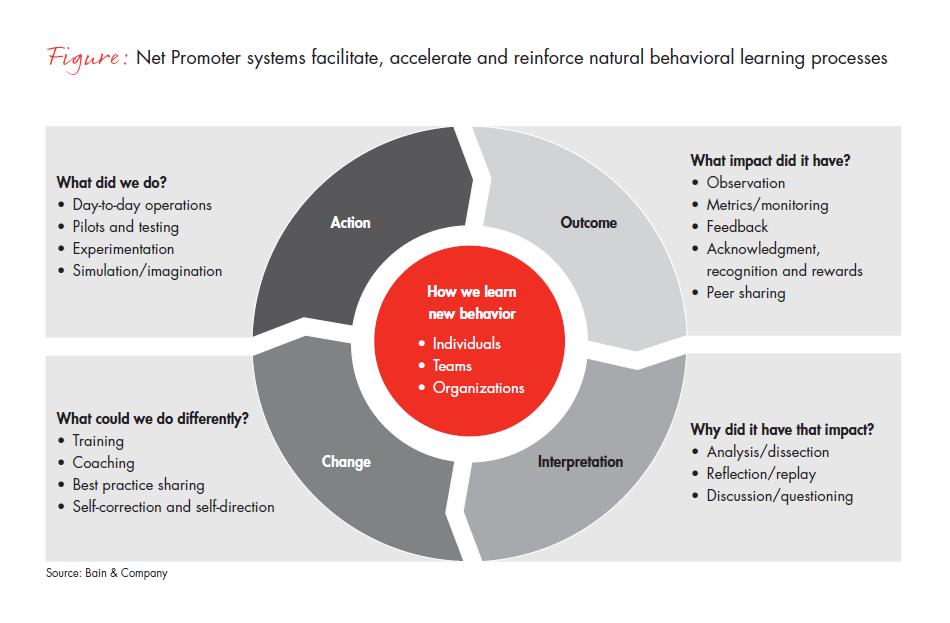
The feedback, of course, has to be both quick and accurate. When people see in real time where they have succeeded and where they have failed, they can remember exactly what they did and draw the connection. That’s one reason Net Promoter data is so powerful: Employees are likely to see customer scores and verbatim comments about their interactions and transactions every day. Westpac has been relaying scores to employees for several years now. In late 2012, it rolled out a new daily feed that provides its call center bankers with the Net Promoter score, verbatim comments and three other key performance indicators, including their “Promoter Strike Rate” (PSR), or the percentage of calls that produce promoters. Westpac also posts regular league leaders—top agents and teams—on the wall for all to see, giving rise to some friendly competition.
3. Observation and coaching
Though direct feedback from customers allows employees to see what works and what doesn't, a skilled observer or coach can speed the learning immeasurably, helping employees figure out where interactions are going wrong or how to improve them. Westpac, for instance, took four of its best team leaders—people who were unusually skilled at talking to customers, fixing their problems and getting to the root cause of the difficulty—off the line. It asked them to call back a number of customers, including both detractors and promoters, and to reflect on what they learned. The group then went back onto the floor to coach other leaders and team members.
Already armed with data about their own performance, Westpac call center agents who know they have a coaching session coming up often solicit help aimed at specifi c metrics such as NPS or PSR. The feedback they get from coaches on their behavior supplements the feedback on results provided by the scores and verbatim comments.
4. Team learning
Training helps employees become self-directing by helping them understand what is expected of them. Feedback, including knowledgeable aid from a coach or supervisor, allows them to be self-correcting. Now imagine that people also have the opportunity to share experiences, learnings and challenges with the others on their team: “Hey, did you try this?” or “Here’s what I did, and this is what happened,” or “How do we solve problem X?” Peer sharing of this sort turbocharges the learning process. StGeorge Bank, a unit of Westpac, created picture cards representing the values and behaviors expected of the call center teams. During a huddle, one of these cards would be thrown on the floor and somebody on the team would describe something he or she had done to display the given behavior in a customer situation.
5. Organizational learning
If 10 people comparing notes and helping each other is good, then 100 or 1,000 people doing the same thing is even better. Of course, it can no longer be face to face; rather, a company needs a central team to analyze the data and search for patterns. Aggregating large amounts of customer feedback may reveal patterns that wouldn't be apparent to any individual team.
For example, Westpac Group has eight contact centers across Australia, but the data suggested that Net Promoter scores were higher when customers were speaking to call center bankers in their own region. The bankers were quick to confirm that; identifying themselves as local (“Hi, you’re speaking with Andrew in Melbourne…”) often drew positive responses, and they used those responses as a way to quickly connect with customers (“Hope you’re not getting too wet in this rain today…”). Like the other steps, organizational learning is recursive: action, observation, conclusion, new action. In this case, Westpac changed the way it routed calls so that more of them were handled locally—a move that reinforced the bank’s strategy of regionally focused brands.
6. Recognition and rewards
Attempts to change people’s behavior run a critical risk: They may be perceived as coercive rather than positive and helpful, and so turn people off from trying out the new behaviors. StGeorge’s call center bankers were skeptical of the Net Promoter initiative at first, believing that many bad customer experiences could be traced to product, policy or operational issues. Detractors, in other words, weren't their fault, nor within their control to fix. Instead of pushing NPS, Westpac Group instead rolled out the Promoter Strike Rate metric, which encouraged call center bankers to solicit as many surveys as they could. The natural result: They began to learn how their own behavior affected the customer experience. A year later the bankers realized that they could influence both detractors and promoters. At that point, Westpac Group was able to incorporate the Net Promoter score as a metric into the bankers’ incentive compensation scheme.
Many companies take dramatic steps to acknowledge, recognize and reward people who learn new behaviors and begin getting great results. TD Bank, based in Toronto, has grown rapidly in the US partly because of its emphasis on service, as measured by its “Customer Wow Index,” a Net Promoter System. The bank makes a point of passing on stories about employees who went out of their way for a customer—and a traveling team of celebrants periodically shows up in crazy costumes to honor employees who consistently score high with customers.
Rob Markey, global practice leader of Bain's Customer Strategy and Marketing practice, explains how the Net Promoter SystemSM seeks to empower employees by teaching them the skills they need to generate loyalty and enthusiasm among customers.
The right people—and the right leaders
Some people take to a self-directing, self-correcting environment naturally. It’s in their personalities—they love to try things out and learn what works. They want to do a great job for customers. Others find themselves anxious and unhappy about the new expectations; they would prefer a more traditional work environment, with someone telling them what to do. Some individuals in the latter group can be persuaded to try out the new approach, but many will leave. Turnover is a company's friend in this context. If a call center, say, has a 20% annual turnover rate, managers can hire virtually an entire new workforce in just five years.
The hiring process is critical as well. When American Express revamped its call centers along customer-centric lines, it began studying which individuals were most successful in the new environment. Success didn't have much to do with “hard” call-center skills, the company found; rather, it depended almost entirely on an employee’s personality and soft skills, such as an ability to listen. To fi nd people who would thrive in the new environment, American Express explicitly sought new hires with experience in the hospitality industry rather than with call centers. It began calling them customer care professionals, and it treated them more like professionals and less like hourly workers.
Equally important is finding the right supervisors. If a leader isn't on board with the importance of feedback and learning, he or she is likely to undermine everything else the company does to encourage the acquisition of customer-service skills. Many Net Promoter companies have found that effective learning depends enormously on lynchpin employees—individual supervisors, store managers or unit managers who believe deeply in great service. These leaders create an environment where everybody feels stretched, challenged and properly recognized. They’re close enough to customers to see the problems and opportunities, and they have enough maturity and experience to accelerate change and create a customer-centric culture.
Westpac’s results
Four years after it launched its Net Promoter effort, Westpac’s attempt to build customer centricity in its call centers is, in the bank’s view, an unqualified success. Today, Net Promoter scores in the centers are consistently around 65%. Variance from one center to another has declined significantly. But that isn't all. Even though the company is now focusing on customer metrics rather than operational ones, virtually every operational measure has improved as well. Thanks to these improvements, Westpac’s call centers are now achieving year-on-year cost productivity of around 10%.
In the early 1990s, Peter Senge’s book The Learning Organization was required reading for senior managers, and many companies ever since have been trying to achieve that ideal. Today, companies pursuing customer centricity are the leaders in the quest. Westpac—along with American Express, TD Bank and dozens of other Net Promoter companies—has created an organization that is not only customer-centric but self-directing and self-correcting, thanks to its learning-oriented culture.
Fred Reichheld and Rob Markey are authors of the bestseller The Ultimate Question 2.0: How Net Promoter Companies Thrive in a Customer-Driven World. Markey is a partner and director in Bain & Company’s New York office and leads the firm’s Global Customer Strategy and Marketing practice. Reichheld is a Fellow at Bain & Company. He is the bestselling author of three other books on loyalty, published by Harvard Business Review Press, including The Loyalty Effect, Loyalty Rules! and The Ultimate Question, as well as numerous articles published in Harvard Business Review.
First published in Μάρτιος 2013