
Skip to Content
  • Γραφεία

    Γραφεία

    North & Latin America
    • Atlanta
    • Austin
    • Bogota
    • Boston
    • Buenos Aires
    • Chicago
    • Dallas
    • Denver
    • Houston
    • Los Angeles
    • Mexico City
    • Minneapolis
    • Monterrey
    • Montreal
    • New York
    • Rio de Janeiro
    • San Francisco
    • Santiago
    • São Paulo
    • Seattle
    • Silicon Valley
    • Toronto
    • Washington, DC
    Europe & Africa
    • Amsterdam
    • Athens
    • Berlin
    • Brussels
    • Copenhagen
    • Dusseldorf
    • Frankfurt
    • Helsinki
    • Istanbul
    • Johannesburg
    • Kyiv
    • Lisbon
    • London
    • Madrid
    • Milan
    • Munich
    • Oslo
    • Paris
    • Rome
    • Stockholm
    • Vienna
    • Warsaw
    • Zurich
    Middle East
    • Doha
    • Dubai
    • Riyadh
    Asia & Australia
    • Bangkok
    • Beijing
    • Bengaluru
    • Brisbane
    • Ho Chi Minh City
    • Hong Kong
    • Jakarta
    • Kuala Lumpur
    • Manila
    • Melbourne
    • Mumbai
    • New Delhi
    • Perth
    • Shanghai
    • Singapore
    • Sydney
    • Tokyo
    See all offices
  • Alumni
  • Media Center
  • Εγγραφή
  • Επικοινωνία
  • Greece | Elliniká

    Select your region and language

    Global
    • Global (English)
    North & Latin America
    • Brazil (Português)
    • Argentina (Español)
    • Canada (Français)
    • Chile (Español)
    • Colombia (Español)
    Europe, Middle East, & Africa
    • France (Français)
    • DACH Region (Deutsch)
    • Italy (Italiano)
    • Spain (Español)
    • Greece (Elliniká)
    Asia & Australia
    • China (中文版)
    • Korea (한국어)
    • Japan (日本語)
  • Saved items (0)
    Saved items (0)

    You have no saved items.

    Bookmark content that interests you and it will be saved here for you to read or share later.

    Explore Bain Insights
  • Κλάδοι
    Main menu

    Κλάδοι

    • Aerospace & Defense
    • Agribusiness
    • Chemicals
    • Construction & Infrastructure
    • Consumer Products
    • Financial Services
    • Healthcare & Life Sciences
    • Industrial Machinery & Equipment
    • Media & Entertainment
      Κλάδοι
      Media & Entertainment
      • Media Lab
    • Metals
    • Mining
    • Oil & Gas
    • Paper & Packaging
    • Private Equity
      Κλάδοι
      Private Equity
      • Due Diligence
      • Exit Planning
      • Firm Strategy & Operations
      • Portfolio Value Creation
    • Social Impact
    • Retail
    • Technology
    • Telecommunications
      Κλάδοι
      Telecommunications
      • Capital Expenditure
      • Telco Digital Transformation
    • Transportation
    • Travel & Leisure
    • Utilities & Renewables
  • Συμβουλευτικές Υπηρεσίες
    Main menu

    Συμβουλευτικές Υπηρεσίες

    • Customer Experience
    • Sustainability
    • Innovation
    • M&A
    • Operations
    • People & Organization
    • Private Equity
    • Sales & Marketing
    • Strategy
    • AI, Insights, and Solutions
    • Technology
    • Transformation
  • Digital
  • Πληροφορίες
    Main menu

    Πληροφορίες

    • Industry Insights
    • Services Insights
    • Bain Books
    • Webinars
    • Bain Futures
    View all Insights
    Featured topics
    • Artificial Intelligence
    • Managing Inflation
    • Thriving in Uncertainty
    • The Talent Imperative
    • Macro Trends
    • Healthcare Private Equity Report
    • CEO's Guide to Sustainability
    • Technology Report
    • Energy & Natural Resources Report
    • Paper & Packaging Report
    • CEO Insights
    • CFO Insights
    • COO Insights
    • CIO Insights
    • CMO Insights
    View all featured topics
  • Σχετικά με εμάς
    Main menu

    Σχετικά με εμάς

    • What We Do
    • What We Believe
    • Our People & Leadership
    • Client Results
    • Awards & Recognition
    • Global Affiliations
    • Social Impact
    • Sustainability
    • World Economic Forum
    Learn more about Further
  • Careers
    Main menu

    Careers

    • Work with Us
      Careers
      Work with Us
      • Find Your Place
      • Our Work Areas
      • Integrated Teams
      • Students
      • Internships & Programs
      • Recruiting Events
    • Life at Bain
      Careers
      Life at Bain
      • Blog: Inside Bain
      • Career Stories
      • Our People
      • Where We Work
      • Supporting Your Growth
      • Affinity Groups
      • Benefits
    • Impact Stories
    • Hiring Process
      Careers
      Hiring Process
      • What to Expect
      • Interviewing
    FIND JOBS
  • Γραφεία
    Main menu

    Γραφεία

    • North & Latin America
      Γραφεία
      North & Latin America
      • Atlanta
      • Austin
      • Bogota
      • Boston
      • Buenos Aires
      • Chicago
      • Dallas
      • Denver
      • Houston
      • Los Angeles
      • Mexico City
      • Minneapolis
      • Monterrey
      • Montreal
      • New York
      • Rio de Janeiro
      • San Francisco
      • Santiago
      • São Paulo
      • Seattle
      • Silicon Valley
      • Toronto
      • Washington, DC
    • Europe & Africa
      Γραφεία
      Europe & Africa
      • Amsterdam
      • Athens
      • Berlin
      • Brussels
      • Copenhagen
      • Dusseldorf
      • Frankfurt
      • Helsinki
      • Istanbul
      • Johannesburg
      • Kyiv
      • Lisbon
      • London
      • Madrid
      • Milan
      • Munich
      • Oslo
      • Paris
      • Rome
      • Stockholm
      • Vienna
      • Warsaw
      • Zurich
    • Middle East
      Γραφεία
      Middle East
      • Doha
      • Dubai
      • Riyadh
    • Asia & Australia
      Γραφεία
      Asia & Australia
      • Bangkok
      • Beijing
      • Bengaluru
      • Brisbane
      • Ho Chi Minh City
      • Hong Kong
      • Jakarta
      • Kuala Lumpur
      • Manila
      • Melbourne
      • Mumbai
      • New Delhi
      • Perth
      • Shanghai
      • Singapore
      • Sydney
      • Tokyo
    See all offices
  • Alumni
  • Media Center
  • Εγγραφή
  • Επικοινωνία
  • Greece | Elliniká
    Main menu

    Select your region and language

    • Global
      Select your region and language
      Global
      • Global (English)
    • North & Latin America
      Select your region and language
      North & Latin America
      • Brazil (Português)
      • Argentina (Español)
      • Canada (Français)
      • Chile (Español)
      • Colombia (Español)
    • Europe, Middle East, & Africa
      Select your region and language
      Europe, Middle East, & Africa
      • France (Français)
      • DACH Region (Deutsch)
      • Italy (Italiano)
      • Spain (Español)
      • Greece (Elliniká)
    • Asia & Australia
      Select your region and language
      Asia & Australia
      • China (中文版)
      • Korea (한국어)
      • Japan (日本語)
  • Saved items  (0)
    Main menu
    Saved items (0)

    You have no saved items.

    Bookmark content that interests you and it will be saved here for you to read or share later.

    Explore Bain Insights
  • Κλάδοι
    • Κλάδοι

      • Aerospace & Defense
      • Agribusiness
      • Chemicals
      • Construction & Infrastructure
      • Consumer Products
      • Financial Services
      • Healthcare & Life Sciences
      • Industrial Machinery & Equipment
      • Media & Entertainment
      • Metals
      • Mining
      • Oil & Gas
      • Paper & Packaging
      • Private Equity
      • Social Impact
      • Retail
      • Technology
      • Telecommunications
      • Transportation
      • Travel & Leisure
      • Utilities & Renewables
  • Συμβουλευτικές Υπηρεσίες
    • Συμβουλευτικές Υπηρεσίες

      • Customer Experience
      • Sustainability
      • Innovation
      • M&A
      • Operations
      • People & Organization
      • Private Equity
      • Sales & Marketing
      • Strategy
      • AI, Insights, and Solutions
      • Technology
      • Transformation
  • Digital
  • Πληροφορίες
    • Πληροφορίες

      • Industry Insights
      • Services Insights
      • Bain Books
      • Webinars
      • Bain Futures
      View all Insights
      Featured topics
      • Artificial Intelligence
      • Managing Inflation
      • Thriving in Uncertainty
      • The Talent Imperative
      • Macro Trends
      • Healthcare Private Equity Report
      • CEO's Guide to Sustainability
      • Technology Report
      • Energy & Natural Resources Report
      • Paper & Packaging Report
      • CEO Insights
      • CFO Insights
      • COO Insights
      • CIO Insights
      • CMO Insights
      View all featured topics
  • Σχετικά με εμάς
    • Σχετικά με εμάς

      • What We Do
      • What We Believe
      • Our People & Leadership
      • Client Results
      • Awards & Recognition
      • Global Affiliations
      Further: Our global responsibility
      • Social Impact
      • Sustainability
      • World Economic Forum
      Learn more about Further
  • Careers
    Popular Searches
    • Agile
    • Digital
    • Strategy
    Your Previous Searches
      Recently Visited Pages

      Content added to saved items

      Saved items (0)

      Removed from saved items

      Saved items (0)

      Article

      The new CIO's quick-start manual

      The new CIO's quick-start manual

      For a new CIO, learning to strike the right balance between addressing old problems and creating new capabilities is critical not only to survive but also thrive in a tough job.

      By Rudy Puryear, Nigel Cornish and Marc van der Vleugel

      • min read

      Article

      The new CIO's quick-start manual
      en

      Expectations are always high when a new senior executive takes up the reins of a demanding leadership job. But in today’s fast-changing business environment, few find themselves more under the gun than the newly hired chief information officer. As they step into that new role, CIOs face often conflicting challenges of daunting depth and breadth. They must labor to keep aging legacy systems running to meet business units’ more varied and ever-increasing demands. Meanwhile, all eyes are on them to lead the deployment of a range of new IT capabilities, including social, mobile and cloud technologies.

      Typically, greeting the new CIO on day one is an IT environment that is a patchwork of legacy systems and ill-suited technologies. In most companies, the pressure to create new IT-enabled functionality usually takes precedence over fixing what’s broken or underperforming. The perverse result of piling new capabilities on top of an increasingly rickety foundation is to add unnecessary complexity and drive up costs, making it harder for IT to serve even basic business requests in a timely manner. The unnecessary complexity of the IT environment plays havoc with IT budgets, with as much as 85% or more of total IT outlays focused on operating and maintaining the existing systems, leaving just 15% free for discretionary spending on new initiatives. Effective CIOs know that legacy systems must be tamed and the cost of operating and maintaining them reduced by 20% to 30% in order to free up resources for new investments.

      Needing to bridge this widening gap between the shortcomings of IT’s legacy systems on the one hand and the business’s emerging needs on the other, most new CIOs yield to pressures to dive into work that is urgent and postpone tackling the bigger issues that are more important. But neither can the new CIO afford to put the pressing immediate requests on hold while he or she attends to addressing underlying issues. From our extensive experience helping new CIOs establish a solid footing, Bain & Company has found that success in the new role requires a CIO to carve out time and resources amid the raging daily storm of requests on the IT organization during the critical initial months on the job. CIOs need to set the tone and direction of their tenure by appraising IT’s strengths and weaknesses, opportunities and threats, and developing a balanced plan for fixing old problems and implementing the new business priorities.

      Build the fact base. Large IT environments are sprawling and complex, and the new CIO needs to peer into a lot of dark corners to see where underlying problems are lurking—and identify the hidden assets the organization can bring to bear to fix them. Even before the new CIO first walks on to the server floor, most business users who are dependent on IT services will have formed firm opinions about what is broken in IT and how it needs to be fixed. The new CIO needs to spend a lot of time listening—both for where the sources of frustration with IT are strongest and for the subtle, sometimes unspoken, hints at how IT can truly improve its performance.

      The complaint the new CIO usually will hear is the perennial lament that everything about IT costs too much and takes too long to deliver on its promises—a reflection of pent-up demand among business users for IT support that is more responsive to their needs. Eager to demonstrate that they understand users’ frustrations and share their sense of urgency, many new CIOs are too quick to respond to users’ immediate needs without stepping back to understand the underlying strategic business goals. This may help them win small battles by satisfying the current level of demand, but it will not enable them to fundamentally shift the underlying IT paradigm.

      The CIO needs to get beneath superficial impressions to find the IT pain points that will be the core issues of an actionable agenda. One large source of IT dysfunctionality and runaway costs, where the CIO needs to shine a light is on so-called shadow IT—those hidden pockets of improvised IT capabilities and quick-and-dirty IT solutions that spring up across the company outside the purview of the IT organization. Shadow IT adds complexity, often compromises the functionality of internal systems with which it interfaces and can require heavy supplemental spending to maintain. After a detailed investigation, for example, the CIO at one global contract manufacturer discovered that nearly one-quarter of total IT spending was taking place outside the formal IT budgeting process.

      As the new CIO patiently builds the fact base, he or she will dig deep into how the businesses really work to assess where IT capabilities are up to the job and where they need to improve (see Figure). Typically, he or she will find that the root causes of IT underperformance arise in one or more of the following four areas: First, the legacy IT systems are not a sufficiently robust platform to be responsive to business needs. Second, IT governance does not support fast and effective decision making. Third, the priorities in IT are not aligned with the business’s most important strategic priorities. And finally, the capabilities of the IT organization are rooted in the legacy environment and not suited to meet the needs of the new environment.
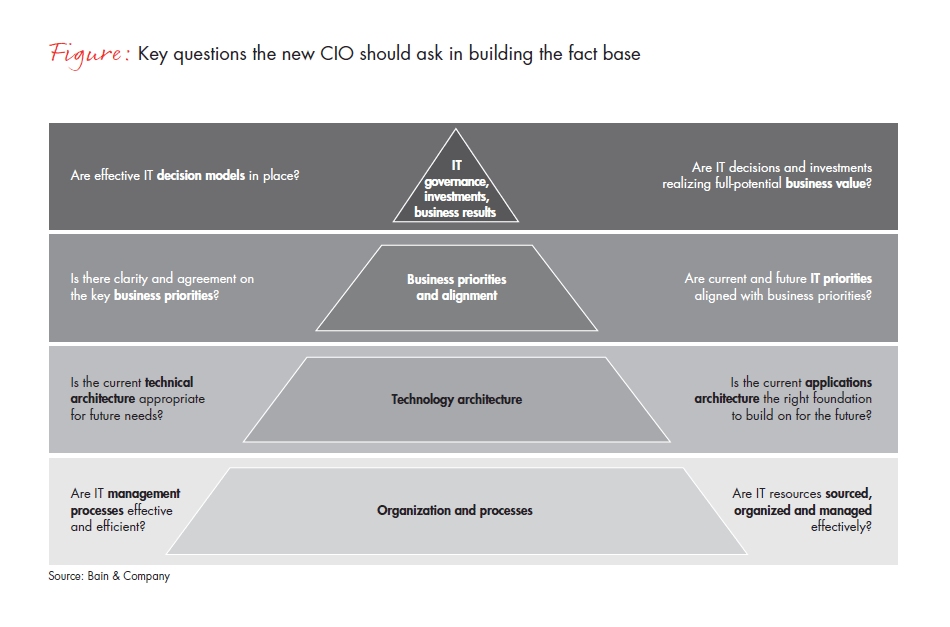

      the-new-cios-quick-start-manual-fig-01_embed

      When a new CIO at a major computer manufacturer investigated why his organization was failing to keep up with the business’s core strategic objectives, he was startled to discover that fully 60% of servers supporting the company’s main product line were obsolete. He learned that his predecessor, faced with a cyclical slump, had slashed costs indiscriminately to meet an arbitrary decision by senior leadership to cut IT spending in half—almost totally eliminating the budget to refresh IT technology.

      Set appropriate expectations. Armed with data and actionable insights from his fact-gathering mission, the new CIO’s next job is to make a compelling business case to persuade his internal clients to allow him to reposition the IT platform by fixing what’s wrong while addressing the most important new initiatives. But he also needs to reassure his business clients that redirecting IT resources and energy creates an IT foundation that will enable IT to be far more responsive to their future needs.

      It’s a tall order. The last thing most business unit leaders want to hear from an IT organization they already consider to be too expensive and too slow is that the new CIO needs more resources and time to fix old problems. Business leaders need to be convinced that the IT organization shares their sense of urgency to achieve new mission-critical capabilities. Not addressing the IT foundation simply postpones the inevitable.

      That’s what André Vanden Camp did soon after taking charge in 2011 as CIO at AXA Belgium, a subsidiary of the global financial services company and Belgium’s leading insurer. His first 100-day fact-finding mission revealed a fragmented IT organization that was operating dozens of applications running on nearly obsolete technology that needed to be overhauled. To win senior management support for his plan to replace the outdated IT architecture with a streamlined new one that would run open-source applications, Vanden Camp and his team carefully documented the cost overruns, pinpointed the sources of delay in meeting project deadlines and committed to ambitious performance improvement goals to be achieved over the following 18 months.

      Vanden Camp also persuaded AXA to redirect IT spending from lower-value projects to free up resources that would allow IT to focus on higher-value initiatives, recruit new talent and build an IT platform that would serve the organization for the next decade.

      Tackle the highest-priority initiatives. Based on Bain & Company’s research and experience working with scores of IT organizations, a key consideration for selecting initial high-impact projects that achieve alignment with urgent business priorities is they also boost the IT organization’s effectiveness.

      Focusing on strengthening IT effectiveness, the new CIO needs to find the right balance between the most important near-term and long-term IT goals. Where that fulcrum point is will depend on the quality of the underlying IT systems, team capabilities and readiness to embark on long-term strategic initiatives.

      Matthew Oakeley, the head of group IT at Schroders, the UK-based investment management firm, achieved that balance by breaking down functional silos that kept the IT organization from successfully undertaking integrated initiatives. He instilled a service mentality and challenged the IT leadership team to become more involved with the investment management teams. He was quick to replace structures that didn’t fit his strategic vision of for IT; but rather than assume that everything must change, he was careful to listen to and learn about the people and teams that remained. Scrapping a failed five-year-old project to outsource back-office processes, Oakeley made the development of a new IT application architecture a “burning platform” for change. Now eight years into the job and running one of the industry’s most respected IT teams, Oakeley is considering the challenge of whether an incumbent CIO can approach his own organization in the same way again—with an open mind and a spirit of renewal as if he had just joined. Becoming one’s own successor could prove a difficult playbook to follow.

      For a new CIO, learning to strike the right balance between addressing old problems and creating new capabilities is critical not only to survive but also thrive in a tough, big job. But seasoned veterans, too, can benefit by seeing their IT organization through the eyes of the newcomers they once were, to lay a fresh foundation for continued success.


      the-new-cios-quick-start-manual-fig-01_full
      Authors
      • Headshot of Rudy Puryear
        Rudy Puryear
        Alumni, Dallas
      • Headshot of Marc van der Vleugel
        Marc van der Vleugel
        Partner, Brussels
      Contact us
      Related Consulting Services
      • Enterprise Technology
      Wi-Fi for your customers: The toughest challenge of the decade

      Retailers and other companies know their customers want wireless access. Few executives understand how much planning (and money) is required to manage it successfully.

      More
      The dark side of the connected enterprise

      Connectivity can boost performance or get in the way.

      More
      Five problems that need more than a technology fix

      Before you add new systems to your organization, consider whether they will truly help reduce complexity—or add to it.

      More
      Enterprise Technology
      How Businesses Can Prepare for Post-Quantum Cybersecurity Threats

      Your company will soon face attackers armed with quantum technology. Will you be ready?

      More
      Enterprise Technology
      Reimagining Merchandising in the Era of Agentic AI

      The future of merchandising is not better analysis, but faster, smarter execution—and agentic AI is what makes that possible.

      More
      First published in Απρίλιος 2013
      Tags
      • Enterprise Technology

      How We've Helped Clients

      A European Banking Giant Rises to the Fintech Challenge

      Read case study

      Salvaging a Technology Outsourcing Deal Gone Bad

      Read case study

      Bridging the Gap Between Business and Technology

      Read case study

      Έτοιμοι να μιλήσουμε

      Συνεργαζόμαστε με φιλόδοξους ηγέτες που θέλουν να καθορίσουν το μέλλον και όχι. Όχι να κρυφτούν από αυτό. Μαζί, επιτυγχάνουμε πετυχαίνουμε εξαιρετικά αποτελέσματα.

      Μείνετε μπροστά σε έναν γρήγορα εξελισσόμενο κόσμο. Εγγραφείτε στο Bain Insights, τη μηνιαία μας επισκόπηση των κρίσιμων θεμάτων που αντιμετωπίζουν οι παγκόσμιες επιχειρήσεις

      *Έχω διαβάσει την Πολιτική Απορρήτου και συμφωνώ με τους όρους της.

      Please read and agree to the Privacy Policy.
      Bain & Company
      Επικοινωνήστε μαζί μας Sustainability Accessibility Όροι χρήσης Privacy Cookie Policy Sitemap Log In

      © 1996-2026 Bain & Company, Inc.

      Contact Bain

      How can we help you?

      • Business inquiry
      • Career information
      • Press relations
      • Partnership request
      • Speaker request
      See all offices