
Skip to Content
  • Γραφεία

    Γραφεία

    North & Latin America
    • Atlanta
    • Austin
    • Bogota
    • Boston
    • Buenos Aires
    • Chicago
    • Dallas
    • Denver
    • Houston
    • Los Angeles
    • Mexico City
    • Minneapolis
    • Monterrey
    • Montreal
    • New York
    • Rio de Janeiro
    • San Francisco
    • Santiago
    • São Paulo
    • Seattle
    • Silicon Valley
    • Toronto
    • Washington, DC
    Europe & Africa
    • Amsterdam
    • Athens
    • Berlin
    • Brussels
    • Copenhagen
    • Dusseldorf
    • Frankfurt
    • Helsinki
    • Istanbul
    • Johannesburg
    • Kyiv
    • Lisbon
    • London
    • Madrid
    • Milan
    • Munich
    • Oslo
    • Paris
    • Rome
    • Stockholm
    • Vienna
    • Warsaw
    • Zurich
    Middle East
    • Doha
    • Dubai
    • Riyadh
    Asia & Australia
    • Bangkok
    • Beijing
    • Bengaluru
    • Brisbane
    • Ho Chi Minh City
    • Hong Kong
    • Jakarta
    • Kuala Lumpur
    • Manila
    • Melbourne
    • Mumbai
    • New Delhi
    • Perth
    • Shanghai
    • Singapore
    • Sydney
    • Tokyo
    See all offices
  • Alumni
  • Media Center
  • Εγγραφή
  • Επικοινωνία
  • Greece | Elliniká

    Select your region and language

    Global
    • Global (English)
    North & Latin America
    • Brazil (Português)
    • Argentina (Español)
    • Canada (Français)
    • Chile (Español)
    • Colombia (Español)
    Europe, Middle East, & Africa
    • France (Français)
    • DACH Region (Deutsch)
    • Italy (Italiano)
    • Spain (Español)
    • Greece (Elliniká)
    Asia & Australia
    • China (中文版)
    • Korea (한국어)
    • Japan (日本語)
  • Saved items (0)
    Saved items (0)

    You have no saved items.

    Bookmark content that interests you and it will be saved here for you to read or share later.

    Explore Bain Insights
  • Κλάδοι
    Main menu

    Κλάδοι

    • Aerospace & Defense
    • Agribusiness
    • Chemicals
    • Construction & Infrastructure
    • Consumer Products
    • Financial Services
    • Healthcare & Life Sciences
    • Industrial Machinery & Equipment
    • Media & Entertainment
      Κλάδοι
      Media & Entertainment
      • Media Lab
    • Metals
    • Mining
    • Oil & Gas
    • Paper & Packaging
    • Private Equity
      Κλάδοι
      Private Equity
      • Due Diligence
      • Exit Planning
      • Firm Strategy & Operations
      • Portfolio Value Creation
    • Social Impact
    • Retail
    • Technology
    • Telecommunications
      Κλάδοι
      Telecommunications
      • Capital Expenditure
      • Telco Digital Transformation
    • Transportation
    • Travel & Leisure
    • Utilities & Renewables
  • Συμβουλευτικές Υπηρεσίες
    Main menu

    Συμβουλευτικές Υπηρεσίες

    • Customer Experience
    • Sustainability
    • Innovation
    • M&A
    • Operations
    • People & Organization
    • Private Equity
    • Sales & Marketing
    • Strategy
    • AI, Insights, and Solutions
    • Technology
    • Transformation
  • Digital
  • Πληροφορίες
    Main menu

    Πληροφορίες

    • Industry Insights
    • Services Insights
    • Bain Books
    • Webinars
    • Bain Futures
    View all Insights
    Featured topics
    • Artificial Intelligence
    • Managing Inflation
    • Thriving in Uncertainty
    • The Talent Imperative
    • Macro Trends
    • Healthcare Private Equity Report
    • CEO's Guide to Sustainability
    • Technology Report
    • Energy & Natural Resources Report
    • Paper & Packaging Report
    • CEO Insights
    • CFO Insights
    • COO Insights
    • CIO Insights
    • CMO Insights
    View all featured topics
  • Σχετικά με εμάς
    Main menu

    Σχετικά με εμάς

    • What We Do
    • What We Believe
    • Our People & Leadership
    • Client Results
    • Awards & Recognition
    • Global Affiliations
    • Social Impact
    • Sustainability
    • World Economic Forum
    Learn more about Further
  • Careers
    Main menu

    Careers

    • Work with Us
      Careers
      Work with Us
      • Find Your Place
      • Our Work Areas
      • Integrated Teams
      • Students
      • Internships & Programs
      • Recruiting Events
    • Life at Bain
      Careers
      Life at Bain
      • Blog: Inside Bain
      • Career Stories
      • Our People
      • Where We Work
      • Supporting Your Growth
      • Affinity Groups
      • Benefits
    • Impact Stories
    • Hiring Process
      Careers
      Hiring Process
      • What to Expect
      • Interviewing
    FIND JOBS
  • Γραφεία
    Main menu

    Γραφεία

    • North & Latin America
      Γραφεία
      North & Latin America
      • Atlanta
      • Austin
      • Bogota
      • Boston
      • Buenos Aires
      • Chicago
      • Dallas
      • Denver
      • Houston
      • Los Angeles
      • Mexico City
      • Minneapolis
      • Monterrey
      • Montreal
      • New York
      • Rio de Janeiro
      • San Francisco
      • Santiago
      • São Paulo
      • Seattle
      • Silicon Valley
      • Toronto
      • Washington, DC
    • Europe & Africa
      Γραφεία
      Europe & Africa
      • Amsterdam
      • Athens
      • Berlin
      • Brussels
      • Copenhagen
      • Dusseldorf
      • Frankfurt
      • Helsinki
      • Istanbul
      • Johannesburg
      • Kyiv
      • Lisbon
      • London
      • Madrid
      • Milan
      • Munich
      • Oslo
      • Paris
      • Rome
      • Stockholm
      • Vienna
      • Warsaw
      • Zurich
    • Middle East
      Γραφεία
      Middle East
      • Doha
      • Dubai
      • Riyadh
    • Asia & Australia
      Γραφεία
      Asia & Australia
      • Bangkok
      • Beijing
      • Bengaluru
      • Brisbane
      • Ho Chi Minh City
      • Hong Kong
      • Jakarta
      • Kuala Lumpur
      • Manila
      • Melbourne
      • Mumbai
      • New Delhi
      • Perth
      • Shanghai
      • Singapore
      • Sydney
      • Tokyo
    See all offices
  • Alumni
  • Media Center
  • Εγγραφή
  • Επικοινωνία
  • Greece | Elliniká
    Main menu

    Select your region and language

    • Global
      Select your region and language
      Global
      • Global (English)
    • North & Latin America
      Select your region and language
      North & Latin America
      • Brazil (Português)
      • Argentina (Español)
      • Canada (Français)
      • Chile (Español)
      • Colombia (Español)
    • Europe, Middle East, & Africa
      Select your region and language
      Europe, Middle East, & Africa
      • France (Français)
      • DACH Region (Deutsch)
      • Italy (Italiano)
      • Spain (Español)
      • Greece (Elliniká)
    • Asia & Australia
      Select your region and language
      Asia & Australia
      • China (中文版)
      • Korea (한국어)
      • Japan (日本語)
  • Saved items  (0)
    Main menu
    Saved items (0)

    You have no saved items.

    Bookmark content that interests you and it will be saved here for you to read or share later.

    Explore Bain Insights
  • Κλάδοι
    • Κλάδοι

      • Aerospace & Defense
      • Agribusiness
      • Chemicals
      • Construction & Infrastructure
      • Consumer Products
      • Financial Services
      • Healthcare & Life Sciences
      • Industrial Machinery & Equipment
      • Media & Entertainment
      • Metals
      • Mining
      • Oil & Gas
      • Paper & Packaging
      • Private Equity
      • Social Impact
      • Retail
      • Technology
      • Telecommunications
      • Transportation
      • Travel & Leisure
      • Utilities & Renewables
  • Συμβουλευτικές Υπηρεσίες
    • Συμβουλευτικές Υπηρεσίες

      • Customer Experience
      • Sustainability
      • Innovation
      • M&A
      • Operations
      • People & Organization
      • Private Equity
      • Sales & Marketing
      • Strategy
      • AI, Insights, and Solutions
      • Technology
      • Transformation
  • Digital
  • Πληροφορίες
    • Πληροφορίες

      • Industry Insights
      • Services Insights
      • Bain Books
      • Webinars
      • Bain Futures
      View all Insights
      Featured topics
      • Artificial Intelligence
      • Managing Inflation
      • Thriving in Uncertainty
      • The Talent Imperative
      • Macro Trends
      • Healthcare Private Equity Report
      • CEO's Guide to Sustainability
      • Technology Report
      • Energy & Natural Resources Report
      • Paper & Packaging Report
      • CEO Insights
      • CFO Insights
      • COO Insights
      • CIO Insights
      • CMO Insights
      View all featured topics
  • Σχετικά με εμάς
    • Σχετικά με εμάς

      • What We Do
      • What We Believe
      • Our People & Leadership
      • Client Results
      • Awards & Recognition
      • Global Affiliations
      Further: Our global responsibility
      • Social Impact
      • Sustainability
      • World Economic Forum
      Learn more about Further
  • Careers
    Popular Searches
    • Agile
    • Digital
    • Strategy
    Your Previous Searches
      Recently Visited Pages

      Content added to saved items

      Saved items (0)

      Removed from saved items

      Saved items (0)

      Brief

      What the Recent Oil Price Shock Teaches about Managing Uncertainty

      What the Recent Oil Price Shock Teaches about Managing Uncertainty

      Scenario planning remains the most effective way to prepare for volatility in energy markets.

      By Jorge Leis

      • min read

      Brief

      What the Recent Oil Price Shock Teaches about Managing Uncertainty
      en

      When we published the Bain Brief “Beyond forecasting: Find your future in an uncertain energy market” in 2013, the industry was wrestling with the effects of new supply shocks—primarily tight oil and shale gas from North America—and was, arguably, approaching key tipping points for solar and wind power in some geographies and under certain regulatory regimes. Our analysis indicated that a price of $60 per barrel of oil in 2030 was plausible. A slightly different scenario has transpired in recent months, but the approach we proposed earlier and our conclusions about long-term strategic planning still apply today.

      • We can best capture the dynamics that are shaping the energy ecosystem along three major supply vectors: natural gas, crude oil and renewables. For each of these fuel sources, permutations of supply levels result in eight plausible corner scenarios, which we described in our 2013 brief.
      • Interfuel substitutions (substitution between fuel types, such as natural gas for coal) and intra-fuel substitutions (substitution within fuel types, such as shale gas for coal-bed methane) bring about differences in the energy mix across the scenarios. Within each scenario, extrapolation of cost experience curves for each primary fuel source alters the shapes of competing supply curves and clearing prices, which encourage substitution.
      • Executives can track and anticipate the industry’s evolution by identifying signposts, such as increases and decreases in US tight oil production, and leading indicators, like the evolving shape of the tight oil supply curve in North America.
      • The benefits of scenario analysis lie not in assigning probabilities to each scenario, but in testing a strategy’s robustness against each scenario. This testing exposes unseen risks and allows for the development of mitigation and contingency plans that can be executed quickly when signposts trigger opportunities or threats.

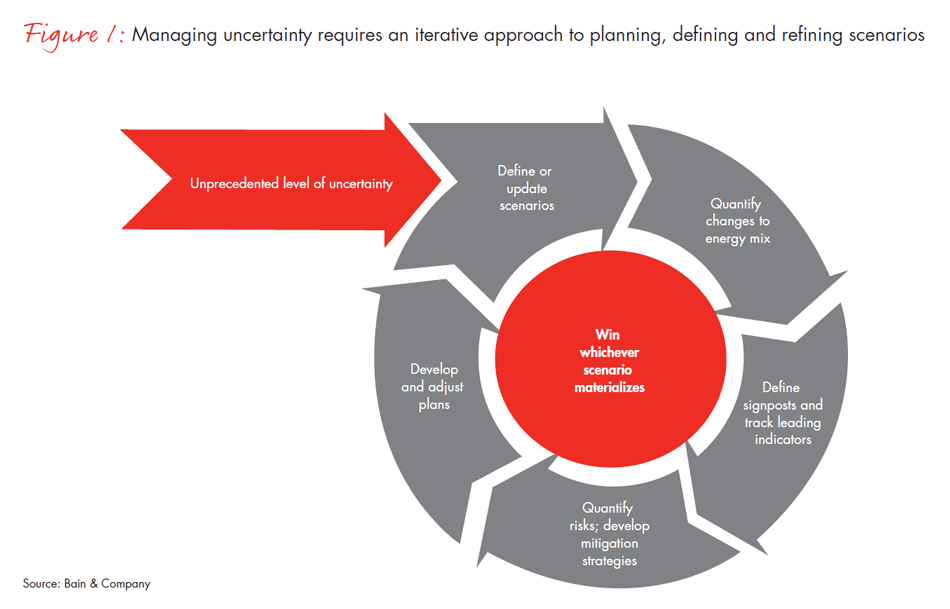
      These conclusions outline a sequence of steps that we recommend for planning in uncertainty (see Figure 1).

      what-the-recent-oil-price-shock-teaches-fig01_embed

      To achieve the best results, planners should explicitly incorporate key insights and learnings in an iterative process. Lessons from the recent crude oil price collapse reinforce this basic approach, but also underline the need for adjustments when dealing with short-term dynamics. To better understand these adjustments, we summarize the factors that led to the price collapse and offer perspectives on likely recovery scenarios.

      What led to the price drop in 2014?

      From 2009 to 2013, global liquids production grew by 5.2 million barrels per day, according to the Energy Information Administration (EIA) in the US. Roughly 4 million barrels per day of that increase came from the US and Canada, while the rest of the world contributed a net 1.2 million barrels per day. During the same period, global consumption increased by 6.2 million barrels per day. North America’s tight oil boom was offset by anemic production in the rest of the world and consumption outpacing production to mask an impending structural oversupply.

      All this changed in 2014. From September 2013 to September 2014, net global production increased by 3 million barrels per day, eclipsing consumption. Sustained production from the US and Canada, along with a resurgence of production from Iraq, Libya and Iran, led this increase. Meanwhile, in summer 2014, the International Energy Agency (IEA) revised downward its 2015 forecast for global demand by about 400,000 barrels per day—essentially forecasting that growth in production is not needed to balance the market in 2015.

      Despite this, oil still hovered around $95 per barrel in September 2014, demonstrating the difficulty of predicting short-term market outcomes, even with well-known variables. Last November, as production continued unabated and Saudi Arabia declined to shoulder the lion’s share of any cuts by OPEC, the bottom fell out. Within three weeks of OPEC’s November 27 meeting in Vienna, Brent stood at $60 per barrel.

      The oil and gas market is nearly impossible to predict. That's why strategic planners at leading oil and gas companies prepare for multiple potential outcomes rather than optimizing for one assumption, says Jorge Leis, who leads Bain's Oil & Gas practice for the Americas. 

      Where we go from here

      The shape of the recovery hinges on one demand variable and four supply variables.

      Consumption growth. China’s slowing growth and Europe’s sluggish economy are likely to hinder consumption in the short to medium term. While the range of forecasts has narrowed considerably, small differences in demand projections can have a large impact on markets and should be taken into account in the near term.

      Production from low-cost sources. Bain’s analysis forecasts 2020 OPEC production to be between 26 million and 40 million barrels per day, with the most likely range being between 34 million and 35 million barrels—more than the current production of about 31 million barrels per day. This increase will flatten the supply curve and put economic pressure on high-cost sources of oil, particularly oil from deep water, Canadian oil sands and Venezuelan heavy crude oil. High-cost sources will continue to produce in the short term because marginal costs of production are lower than current market prices, but new, high-cost production could face difficulties finding fresh capital.

      Committed capital. High-cost projects, like deepwater rigs, can take years and billions of dollars to complete, so they calculate their break-even projections based on long-range price predictions. Capital continues to flow to many projects that are already under way, even if their fully loaded costs fall below current market prices. These deepwater projects will continue to add supply for the foreseeable future.

      Inventory. With OECD crude stocks at their highest levels since record keeping began, the industry has to view inventory as a short-term supply source. In the US, inventory is approaching physical limits that could plummet WTI1 prices to new lows, if breached. Supply and demand scenarios for the near term must consider the depletion of record-high inventories.

      US tight oil. Tight oil’s unique characteristics make it one of the few resources that could react quickly to changing conditions.

      • Ramps up quickly. New wells take only weeks and millions of dollars, as opposed to years and billions, and can be drilled and held in reserve.
      • Shuts off quickly. Depletion curves are very steep, and first-year decline rates of 60% to 70% are the norm.
      • Break-even costs vary widely. Tight oil breaks even anywhere from $30 to $80 per barrel. Using assembly-line methods helps bring most production in under $60 per barrel, and the cost drops every year.

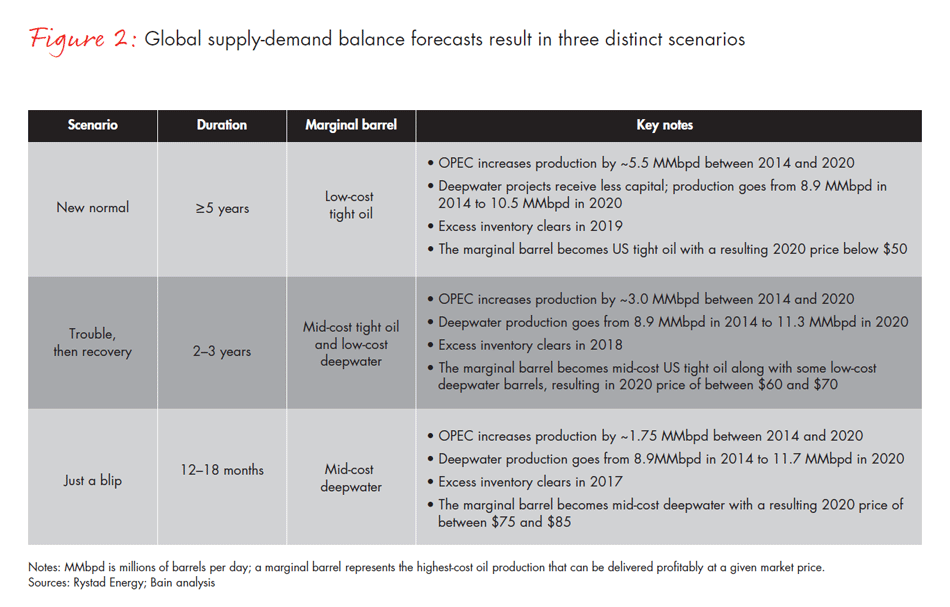
      Under a scenario in which OPEC produces at new record highs and economics inhibit new capital deployment to the highest-cost supply sources, US tight oil could become the marginal production barrel and price-setting mechanism (see Figure 2).

      what-the-recent-oil-price-shock-teaches-fig02_embed

      Managing short- and long-term uncertainty

      Predicting the future under such uncertainty is impossible, so planning around a single view of the future is a recipe for value destruction. As we noted in Figure 1, a more strategic approach for planning begins by defining scenarios and then refining the data continually while monitoring signposts that indicate market directions, with important distinctions made at each step, depending on whether the focus is short or long term.

      In the long run, changes in energy mix, more than differences in long-term forecasts for total energy demand, drive demand for any given primary fuel. Since changes in the energy mix result from changes in supply dynamics, a supply-side model is most appropriate. However, as we saw in this most recent downturn, changes in short-term demand forecasts can exacerbate supply-demand imbalances, so planners must build demand considerations into their short-term scenarios.

      Interfuel substitution is the key mechanism of shifts in the energy mix. Looking to the future, we can take out of the equation substitution barriers, such as midstream constraints or government subsidies, which prevent the physical or true economic flow of primary fuels to their most competitive use. But in the short term, substitution barriers can have profound effects on supply-demand balances and must be considered key signposts.

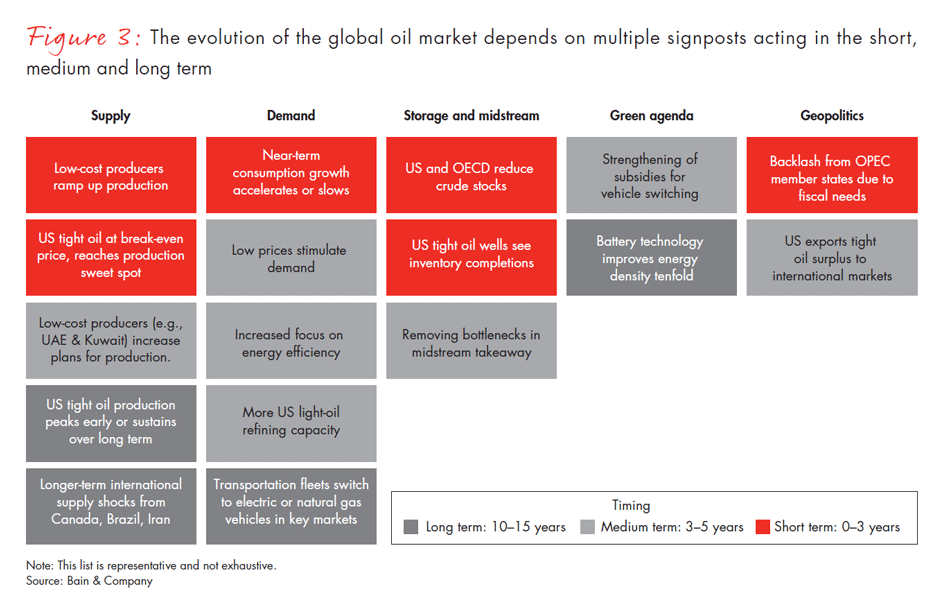
      Signposts indicating the direction of global oil markets can be relevant for the short, medium and long term (see Figure 3). Some of these signposts, such as geopolitical events, can have an immediate impact on supply and demand, but are very difficult to predict. Others, such as interfuel switching for the transportation sector, have long-term impact and are easier to track.

      what-the-recent-oil-price-shock-teaches-fig03_embed

      Companies also face different risks in the short term compared with the long term. The recent drop in oil price has created financial distress for many upstream producers and service providers—a situation that should not be considered explicitly in the long term. Cash flow is a variable to be optimized for long-term value creation, but can be a risk to short-term survival. Regardless of the objective, testing a plan against short- and long-term scenarios allows planners to identify risks, build robustness into their strategy and create optionality—and a ready contingency plan—for the future.

      Managing the unprecedented uncertainty in global energy markets requires a flexible approach and the ability to alter tactics as market conditions change. Scenario analysis helps companies meet both objectives. Short- and long-term planning are similar, but with important differences, such as the causes of scenarios, signposts, leading indicators, risks, and mitigation tools and strategies. By adopting scenario analysis, companies can maximize long-term value creation while avoiding expensive mistakes in the short term.

      Jorge Leis is a partner with Bain & Company based in Houston. He leads the firm’s Oil & Gas practice in the Americas. The author would like to acknowledge the contributions of Mile Milisavljevic, a principal with Bain & Company in Houston.

      1. West Texas Intermediate, the benchmark price for light, sweet crude in North America


      what-the-recent-oil-price-shock-teaches-fig01_full

      what-the-recent-oil-price-shock-teaches-fig02_full

      what-the-recent-oil-price-shock-teaches-fig03_full
      Authors
      • Headshot of Jorge Leis
        Jorge Leis
        Alumni, Houston
      Contact us
      Related Industries
      • Energy & Natural Resources
      • Oil & Gas
      Oil & Gas
      Oil & Gas M&A

      Why some companies are winning by a wider margin.

      More
      Oil & Gas
      Fueling the Future: How Business, Finance, and Policy Can Accelerate the Clean Fuels Market

      Why global clean fuel ambitions are outpacing investment, and what leaders must do to unlock capital and scale viable projects.

      More
      Oil & Gas
      Positioning Oil & Gas Companies for Today’s Capital Markets

      We interviewed senior investment professionals, and here’s what we heard.

      More
      Oil & Gas
      Sustaining Capital: From Chaos to Discipline

      Fragmented budgets, poor visibility, and missed forecasts are fixable with the right approach.

      More
      Oil & Gas
      Energy Capital Expenditures: Steady Growth Ahead

      Utilities, oil and gas, and mining will see uneven capex growth through 2027 as companies balance supply security with energy transition goals.

      More
      First published in Μάιος 2015
      Tags
      • Energy & Natural Resources
      • Oil & Gas

      How We've Helped Clients

      Moving Beyond an Operating Model Redesign to Live the Model

      Read case study

      An Oil and Gas Leader Creates a New Clean Energy Business

      Read case study

      An OFS captures post-merger growth synergies

      Read case study

      Έτοιμοι να μιλήσουμε

      Συνεργαζόμαστε με φιλόδοξους ηγέτες που θέλουν να καθορίσουν το μέλλον και όχι. Όχι να κρυφτούν από αυτό. Μαζί, επιτυγχάνουμε πετυχαίνουμε εξαιρετικά αποτελέσματα.

      Μείνετε μπροστά σε έναν γρήγορα εξελισσόμενο κόσμο. Εγγραφείτε στο Bain Insights, τη μηνιαία μας επισκόπηση των κρίσιμων θεμάτων που αντιμετωπίζουν οι παγκόσμιες επιχειρήσεις

      *Έχω διαβάσει την Πολιτική Απορρήτου και συμφωνώ με τους όρους της.

      Please read and agree to the Privacy Policy.
      Bain & Company
      Επικοινωνήστε μαζί μας Sustainability Accessibility Όροι χρήσης Privacy Cookie Policy Sitemap Log In

      © 1996-2026 Bain & Company, Inc.

      Contact Bain

      How can we help you?

      • Business inquiry
      • Career information
      • Press relations
      • Partnership request
      • Speaker request
      See all offices