
Skip to Content
  • Γραφεία

    Γραφεία

    North & Latin America
    • Atlanta
    • Austin
    • Bogota
    • Boston
    • Buenos Aires
    • Chicago
    • Dallas
    • Denver
    • Houston
    • Los Angeles
    • Mexico City
    • Minneapolis
    • Monterrey
    • Montreal
    • New York
    • Rio de Janeiro
    • San Francisco
    • Santiago
    • São Paulo
    • Seattle
    • Silicon Valley
    • Toronto
    • Washington, DC
    Europe & Africa
    • Amsterdam
    • Athens
    • Berlin
    • Brussels
    • Copenhagen
    • Dusseldorf
    • Frankfurt
    • Helsinki
    • Istanbul
    • Johannesburg
    • Kyiv
    • Lisbon
    • London
    • Madrid
    • Milan
    • Munich
    • Oslo
    • Paris
    • Rome
    • Stockholm
    • Vienna
    • Warsaw
    • Zurich
    Middle East
    • Doha
    • Dubai
    • Riyadh
    Asia & Australia
    • Bangkok
    • Beijing
    • Bengaluru
    • Brisbane
    • Ho Chi Minh City
    • Hong Kong
    • Jakarta
    • Kuala Lumpur
    • Manila
    • Melbourne
    • Mumbai
    • New Delhi
    • Perth
    • Shanghai
    • Singapore
    • Sydney
    • Tokyo
    See all offices
  • Alumni
  • Media Center
  • Εγγραφή
  • Επικοινωνία
  • Greece | Elliniká

    Select your region and language

    Global
    • Global (English)
    North & Latin America
    • Brazil (Português)
    • Argentina (Español)
    • Canada (Français)
    • Chile (Español)
    • Colombia (Español)
    Europe, Middle East, & Africa
    • France (Français)
    • DACH Region (Deutsch)
    • Italy (Italiano)
    • Spain (Español)
    • Greece (Elliniká)
    Asia & Australia
    • China (中文版)
    • Korea (한국어)
    • Japan (日本語)
  • Saved items (0)
    Saved items (0)

    You have no saved items.

    Bookmark content that interests you and it will be saved here for you to read or share later.

    Explore Bain Insights
  • Κλάδοι
    Main menu

    Κλάδοι

    • Aerospace & Defense
    • Agribusiness
    • Chemicals
    • Construction & Infrastructure
    • Consumer Products
    • Financial Services
    • Healthcare & Life Sciences
    • Industrial Machinery & Equipment
    • Media & Entertainment
      Κλάδοι
      Media & Entertainment
      • Media Lab
    • Metals
    • Mining
    • Oil & Gas
    • Paper & Packaging
    • Private Equity
      Κλάδοι
      Private Equity
      • Due Diligence
      • Exit Planning
      • Firm Strategy & Operations
      • Portfolio Value Creation
    • Social Impact
    • Retail
    • Technology
    • Telecommunications
      Κλάδοι
      Telecommunications
      • Capital Expenditure
      • Telco Digital Transformation
    • Transportation
    • Travel & Leisure
    • Utilities & Renewables
  • Συμβουλευτικές Υπηρεσίες
    Main menu

    Συμβουλευτικές Υπηρεσίες

    • Customer Experience
    • Sustainability
    • Innovation
    • M&A
    • Operations
    • People & Organization
    • Private Equity
    • Sales & Marketing
    • Strategy
    • AI, Insights, and Solutions
    • Technology
    • Transformation
  • Digital
  • Πληροφορίες
    Main menu

    Πληροφορίες

    • Industry Insights
    • Services Insights
    • Bain Books
    • Webinars
    • Bain Futures
    View all Insights
    Featured topics
    • Artificial Intelligence
    • Managing Inflation
    • Thriving in Uncertainty
    • The Talent Imperative
    • Macro Trends
    • Healthcare Private Equity Report
    • CEO's Guide to Sustainability
    • Technology Report
    • Energy & Natural Resources Report
    • Paper & Packaging Report
    • CEO Insights
    • CFO Insights
    • COO Insights
    • CIO Insights
    • CMO Insights
    View all featured topics
  • Σχετικά με εμάς
    Main menu

    Σχετικά με εμάς

    • What We Do
    • What We Believe
    • Our People & Leadership
    • Client Results
    • Awards & Recognition
    • Global Affiliations
    • Social Impact
    • Sustainability
    • World Economic Forum
    Learn more about Further
  • Careers
    Main menu

    Careers

    • Work with Us
      Careers
      Work with Us
      • Find Your Place
      • Our Work Areas
      • Integrated Teams
      • Students
      • Internships & Programs
      • Recruiting Events
    • Life at Bain
      Careers
      Life at Bain
      • Blog: Inside Bain
      • Career Stories
      • Our People
      • Where We Work
      • Supporting Your Growth
      • Affinity Groups
      • Benefits
    • Impact Stories
    • Hiring Process
      Careers
      Hiring Process
      • What to Expect
      • Interviewing
    FIND JOBS
  • Γραφεία
    Main menu

    Γραφεία

    • North & Latin America
      Γραφεία
      North & Latin America
      • Atlanta
      • Austin
      • Bogota
      • Boston
      • Buenos Aires
      • Chicago
      • Dallas
      • Denver
      • Houston
      • Los Angeles
      • Mexico City
      • Minneapolis
      • Monterrey
      • Montreal
      • New York
      • Rio de Janeiro
      • San Francisco
      • Santiago
      • São Paulo
      • Seattle
      • Silicon Valley
      • Toronto
      • Washington, DC
    • Europe & Africa
      Γραφεία
      Europe & Africa
      • Amsterdam
      • Athens
      • Berlin
      • Brussels
      • Copenhagen
      • Dusseldorf
      • Frankfurt
      • Helsinki
      • Istanbul
      • Johannesburg
      • Kyiv
      • Lisbon
      • London
      • Madrid
      • Milan
      • Munich
      • Oslo
      • Paris
      • Rome
      • Stockholm
      • Vienna
      • Warsaw
      • Zurich
    • Middle East
      Γραφεία
      Middle East
      • Doha
      • Dubai
      • Riyadh
    • Asia & Australia
      Γραφεία
      Asia & Australia
      • Bangkok
      • Beijing
      • Bengaluru
      • Brisbane
      • Ho Chi Minh City
      • Hong Kong
      • Jakarta
      • Kuala Lumpur
      • Manila
      • Melbourne
      • Mumbai
      • New Delhi
      • Perth
      • Shanghai
      • Singapore
      • Sydney
      • Tokyo
    See all offices
  • Alumni
  • Media Center
  • Εγγραφή
  • Επικοινωνία
  • Greece | Elliniká
    Main menu

    Select your region and language

    • Global
      Select your region and language
      Global
      • Global (English)
    • North & Latin America
      Select your region and language
      North & Latin America
      • Brazil (Português)
      • Argentina (Español)
      • Canada (Français)
      • Chile (Español)
      • Colombia (Español)
    • Europe, Middle East, & Africa
      Select your region and language
      Europe, Middle East, & Africa
      • France (Français)
      • DACH Region (Deutsch)
      • Italy (Italiano)
      • Spain (Español)
      • Greece (Elliniká)
    • Asia & Australia
      Select your region and language
      Asia & Australia
      • China (中文版)
      • Korea (한국어)
      • Japan (日本語)
  • Saved items  (0)
    Main menu
    Saved items (0)

    You have no saved items.

    Bookmark content that interests you and it will be saved here for you to read or share later.

    Explore Bain Insights
  • Κλάδοι
    • Κλάδοι

      • Aerospace & Defense
      • Agribusiness
      • Chemicals
      • Construction & Infrastructure
      • Consumer Products
      • Financial Services
      • Healthcare & Life Sciences
      • Industrial Machinery & Equipment
      • Media & Entertainment
      • Metals
      • Mining
      • Oil & Gas
      • Paper & Packaging
      • Private Equity
      • Social Impact
      • Retail
      • Technology
      • Telecommunications
      • Transportation
      • Travel & Leisure
      • Utilities & Renewables
  • Συμβουλευτικές Υπηρεσίες
    • Συμβουλευτικές Υπηρεσίες

      • Customer Experience
      • Sustainability
      • Innovation
      • M&A
      • Operations
      • People & Organization
      • Private Equity
      • Sales & Marketing
      • Strategy
      • AI, Insights, and Solutions
      • Technology
      • Transformation
  • Digital
  • Πληροφορίες
    • Πληροφορίες

      • Industry Insights
      • Services Insights
      • Bain Books
      • Webinars
      • Bain Futures
      View all Insights
      Featured topics
      • Artificial Intelligence
      • Managing Inflation
      • Thriving in Uncertainty
      • The Talent Imperative
      • Macro Trends
      • Healthcare Private Equity Report
      • CEO's Guide to Sustainability
      • Technology Report
      • Energy & Natural Resources Report
      • Paper & Packaging Report
      • CEO Insights
      • CFO Insights
      • COO Insights
      • CIO Insights
      • CMO Insights
      View all featured topics
  • Σχετικά με εμάς
    • Σχετικά με εμάς

      • What We Do
      • What We Believe
      • Our People & Leadership
      • Client Results
      • Awards & Recognition
      • Global Affiliations
      Further: Our global responsibility
      • Social Impact
      • Sustainability
      • World Economic Forum
      Learn more about Further
  • Careers
    Popular Searches
    • Agile
    • Digital
    • Strategy
    Your Previous Searches
      Recently Visited Pages

      Content added to saved items

      Saved items (0)

      Removed from saved items

      Saved items (0)

      Brief

      Winning good customers, losing bad debt

      Winning good customers, losing bad debt

      The bad-debt provisions of major European and North American utilities remain high well beyond the recession. They can ill afford to ignore such waste.

      By Patrick Manning and Tim Polack

      • min read

      Brief

      Winning good customers, losing bad debt
      en

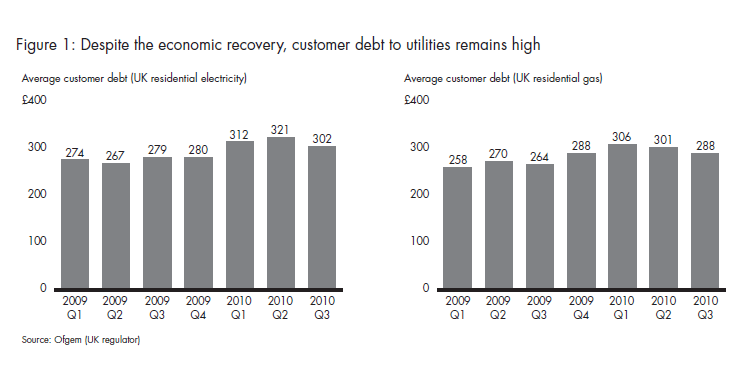
      Bad debt, the revenue that utilities write off because customers can't or won't pay their bills, continues to accumulate like barnacles clinging to a ship's hull and creating drag. As economic growth returns, utilities expect their cash flows to improve. But the bad-debt provisions of major European and North American utilities remain high well beyond the recession. Some utilities will write off as much debt in 2011 as they did last year, according to Bain & Company projections.

      Utilities can ill afford to ignore such waste, and eliminating it can generate resources to invest in future growth. In 2010 in the UK, for example, we estimate that industry players, including EDF Energy, E.ON UK, British Gas and RWE npower, wrote off more than £800 million (almost $1.3 billion) of bad debt in aggregate. That's enough cash to build roughly 650 MW of wind farm capacity, or about 540 windmills of the 1.2 MW class.

      Even though many utilities foresaw the problem early on and ramped up collection efforts significantly, bad-debt levels remain uncomfortably high. Why doesn't the wave of bad debt recede as the economy improves? In our experience, excessive levels of bad debt usually result from three related root causes:

      1. Too low a management priority. Historically, utilities have not placed bad-debt prevention high on the executive agenda. In good times, utilities (and companies in other sectors like banking and telecom) tend to disinvest in the area, focusing their efforts elsewhere. This approach backfires in recessionary periods when utilities need management focus and investment to control the rising tide of bad debt.
      2. Not a significant part of the customer strategy. While companies in some other sectors, particularly financial services and telecom, rely on a segmented approach to managing customers in arrears, many utilities still rely on a standard, one-size-fits-all approach to tackle bad debt across all customer segments. Typically, when utilities develop a customer segmentation strategy or make tactical customer decisions, they tend to focus more on how to increase customer numbers, avoid the worst customer complaints or reduce the cost to serve customers (by reducing average handling times, for instance). Few utilities take the credit risk of customers sufficiently into account.

        In fact, most debt-prevention activity kicks in very late in the cycle, when collections teams are limited to "mopping up" and collecting what they can. Often, these collections teams operate in silos, mostly disconnected from other customer activity. However, actions taken (or not taken) earlier in the customer lifecycle can determine how much customer debt builds up and will ultimately be written off. When utilities acquire high-risk customers with poor credit histories, when they offer terms and conditions inconsistent with customer risk profiles or when they manage key interactions like home/business moves sub-optimally, they increase the risk of future bad debt.

      3. Inconsistent execution levels. Often, utilities underestimate the execution challenge required to prevent bad debt. It is a multi-faceted area, both data intensive and analytically complex, and requiring continuous triage and process improvement. Credit assessment, for example, requires a core of skilled practitioners, competent in credit screening and risk management. Front-end and back-office operations typically involve large teams and require highly disciplined operational management, as well as effective people, team and supplier management skills. In addition, debt managers must consider broader customer and brand issues, as over-zealous collection activity can harm the brand. The low priority placed on credit management can mean these teams are often starved of sufficiently skilled resources to consistently execute effectively.
      winning-good-customers-fig-01_embed


      An integrated approach to reducing bad debt

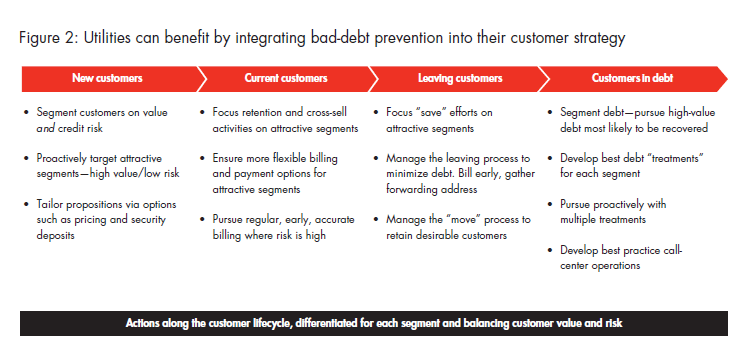
      So how can utilities overcome the bad-debt issue? The answer to this question may seem like straightforward performance improvement. In fact, reducing bad debt requires change at a more fundamental level. It first requires elevating bad-debt prevention to a higher priority on management's agenda—in good times and bad. The next step is fully integrating debt prevention into a utility's end-to-end customer strategy. This requires taking debt-prevention actions much earlier and varying the approach across different customer segments.

      winning-good-customers-fig-02_embed

      Make reducing bad debt a top priority

      Some utilities have started to elevate bad-debt prevention. Facing a mountain of bad debt, one European utility recently identified bad-debt reduction as one of its top five priorities. Management communicated that across the organization, and all executives and relevant managers now have a specific bad-debt reduction target in their 2011 performance goals. The utility's leadership team also recognized that managing bad debt provides valuable professional development for its high-potential managers, since it offered a chance to hone analytical and performance-improvement skills and to manage large teams onshore and offshore. Reducing bad debt offers those managers an opportunity to have a material impact on the value of the business.

      Integrate bad-debt prevention into the customer strategy

      The second step is to fully integrate bad-debt prevention into customer strategy. That means taking action to avoid bad debt along the entire customer lifecycle and tailoring those actions for each customer segment. The tactical first steps typically include ensuring all new customers are properly credit screened, or assessing customers to ensure that efforts to bring in cash are not wasted on the highest-risk customers who most likely won't pay anyway. Utilities increasingly use external credit agency data and scores as well as internal payment history to screen customers in this way. Over time, utilities should embed credit risk as a key factor in all customer acquisition and management decisions.

      An effective way to integrate debt prevention into customer strategy is to add risk as a criterion for customer segmentation. Utilities are increasingly using improved segmentation to focus their efforts on the most attractive, high-value customers and to make the right customer decisions. Adding credit risk into the segmentation means the focus shifts to winning and retaining high-value and lower-risk customers—and away from the highest-risk customers.

      Using this bifocal lens allows the utility to make more effective decisions, based on value and risk, throughout the customer lifecycle:

      • Whom to target for acquisition (higher value/lower risk) and whom to de-prioritize? For example, avoiding or further screening the smallest SME customers in verticals where credit risk is high, such as some retail sub-segments.
      • How and where to price differentially? What terms and conditions and propositions to offer customers? A utility might choose to request security deposits and direct debits from riskier customers (where appropriate), while offering more flexible payment options to high-value/low-risk customers.
      • How to serve customers with different needs? Lower-risk customers can be offered more flexible billing options while more regular billing or prepaying might better suit riskier customers.
      • Where to invest in and apply technology? Installing smart meters in the premises of potential bad payers can make pre-payment easier to implement.
      • Where to chase debt the most aggressively? A utility can more closely monitor high-risk debtors versus lower-risk customers.
      • How much effort to put into retaining or renewing customers? Instead of operating blind, a utility can seek to renew lower-risk customers and avoid wasted effort trying to prevent higher-risk customers from leaving.

      In the financial services sector, the best companies already follow a similar approach. Leading credit card companies, for example, thoroughly vet potential new customers based on their expected lifetime value and risk. To assess risk, they use multiple metrics—past credit history, current "balance sheet" (loans and assets), employment status, income, demographics, past credit applications—with more recent activity carrying the most weight. They then place customers in a specific segment, which determines whether they are accepted as a customer and what credit they will be offered. They regularly update their view on a customer's value and risk and take action accordingly, for example, by changing credit limits on credit cards, offering new products or loans or chasing harder for repayments. Credit card companies also factor in macro-economic risk, including modeling scenarios that assess the impact of a recession on the riskiness of the customer base.

      Utilities have not yet reached this level of sophistication in managing customer risk. But to move further in the right direction, a good starting point can be what we call a "debt X-ray"—a data-driven assessment of the key causes of bad debt. The "X-ray" penetrates deep into the current debt book to identify the root causes across customer segments and processes. Armed with this granular level of insight, utilities can then construct a program to reduce the level of write-offs. A typical X-ray includes:

      • A thorough assessment of write-offs over the last five years to identify the bad debtors and the root causes for high bad debt, such as business bankruptcies, customers moving without a forwarding address or billing problems caused by the utility.
      • Regression or other analysis to determine the customer segments with the highest propensity for debt (for example, smaller companies versus corporate customers, tenants versus homeowners, private tenants versus social tenants).
      • A risk analysis of the current customer base based on external credit scores, payment history and demographics.
      • A deeper understanding of the debt prevention/collection processes and behaviors along the full customer lifecycle—as well as a clear sense of the potential gaps relative to benchmark performance.

      Balancing priorities

      Changing the approach to bad debt at such a fundamental level can deliver substantial results, but it takes time. A utility must build the right value-risk segmentation for its customer base and create an analytical team to continually refresh the customer data and analysis.

      To make the system work over time, the utility also needs to put in place processes and incentives to ensure the right decisions are made along the customer journey, based on the value and risk segmentation.

      While the integrated approach described above can pay medium-term dividends, the pressing need for shorter term results at most utilities means that the collections engine must continue to rev as well, or in some cases, may even need to be kick-started. Utilities can take a focused and systematic approach to collections if they: (1) rapidly segment the existing debt book to determine "collectability" levels and the size of the prize; (2) set realistic stretch targets; (3) cascade incentives linked to these targets to the collections frontline, especially the collections agents; (4) set up and tightly manage initiatives to deliver the targets such as call-center dialer campaigns, letter campaigns, targeted field visits and tighter management of external collection agencies; (5) track performance weekly and make adjustments where necessary; and (6) continuously monitor effectiveness and evolve the collections approach.

      Utilities do not have to settle for high customer debt. While this is an enormous issue for the sector, it's a problem most utilities can fix, especially if they balance collections with the larger goal of de-risking their customer base. High debt levels are an onerous burden for utilities, but they also represent a major financial opportunity. Rather than leave money on the table, utilities can find ways to make good on bad debt—right through the business cycle.

      Patrick Manning and Tim Polack are partners in Bain's London office.


      winning-good-customers-fig-01_full

      winning-good-customers-fig-02_full
      Related Industries
      • Energy & Natural Resources
      • Oil & Gas
      • Utilities & Renewables
      Utilities & Renewables
      Posting profits: Beyond the meter, beyond the hype

      The market for smart meter-enabled services is small, but competitors from other industries are eager to bundle such services into larger "e-home" offerings.

      More
      Why carbon competitiveness matters: Q&A

      A utility with lower carbon exposure than its competitors can strengthen its position dramatically within the industry, says Bain partner Jorge Leis.

      More
      Utilities & Renewables
      Sustaining Capital: From Chaos to Discipline

      Fragmented budgets, poor visibility, and missed forecasts are fixable with the right approach.

      More
      Utilities & Renewables
      Energy Capital Expenditures: Steady Growth Ahead

      Utilities, oil and gas, and mining will see uneven capex growth through 2027 as companies balance supply security with energy transition goals.

      More
      Utilities & Renewables
      Business Breakthrough Barometer 2025

      The annual pulse check from leading businesses on the pace of the net-zero transition.

      More
      First published in Απρίλιος 2011
      Tags
      • Energy & Natural Resources
      • Oil & Gas
      • Utilities & Renewables

      How We've Helped Clients

      Moving Beyond an Operating Model Redesign to Live the Model

      Read case study

      An Oil and Gas Leader Creates a New Clean Energy Business

      Read case study

      An OFS captures post-merger growth synergies

      Read case study

      Έτοιμοι να μιλήσουμε

      Συνεργαζόμαστε με φιλόδοξους ηγέτες που θέλουν να καθορίσουν το μέλλον και όχι. Όχι να κρυφτούν από αυτό. Μαζί, επιτυγχάνουμε πετυχαίνουμε εξαιρετικά αποτελέσματα.

      Μείνετε μπροστά σε έναν γρήγορα εξελισσόμενο κόσμο. Εγγραφείτε στο Bain Insights, τη μηνιαία μας επισκόπηση των κρίσιμων θεμάτων που αντιμετωπίζουν οι παγκόσμιες επιχειρήσεις

      *Έχω διαβάσει την Πολιτική Απορρήτου και συμφωνώ με τους όρους της.

      Please read and agree to the Privacy Policy.
      Bain & Company
      Επικοινωνήστε μαζί μας Sustainability Accessibility Όροι χρήσης Privacy Cookie Policy Sitemap Log In

      © 1996-2026 Bain & Company, Inc.

      Contact Bain

      How can we help you?

      • Business inquiry
      • Career information
      • Press relations
      • Partnership request
      • Speaker request
      See all offices