

Etude

Many CEOs want to make a difference. Convinced that companies should play a positive role in environmental stewardship and social development, they declare sustainability a top priority, launch a transformation program, hire a chief sustainability officer, and commit millions of dollars and hundreds of hours of management time to the effort. Then momentum fades.
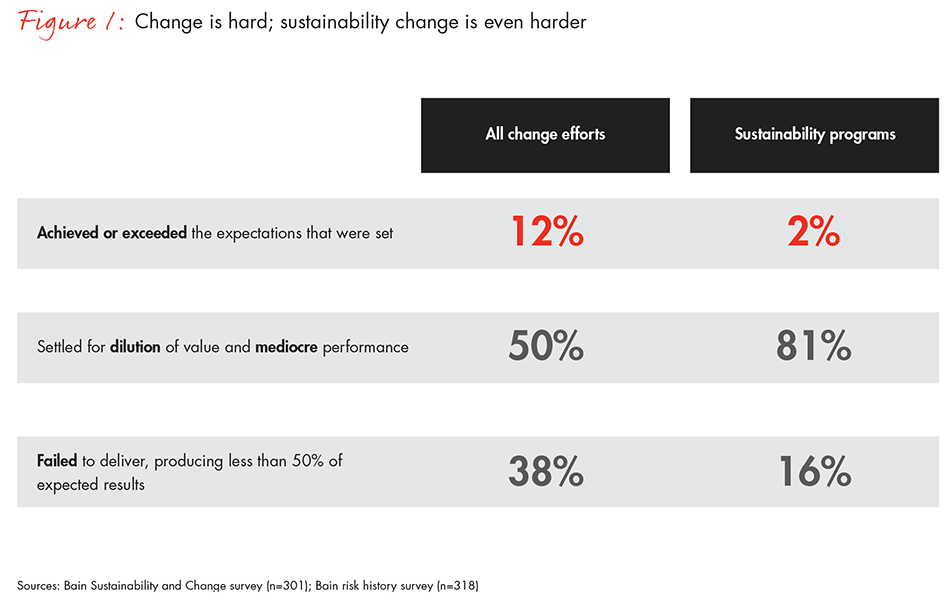
It’s a frustrating setback—and a common one. Bain research on corporate transformation programs shows only 12% achieve or exceed their aims. For sustainability, that figure is just 2% (see Figure 1). Why? Sustainability transformations add another dimension of challenge. Often, enthusiastic leadership teams overlook the difficulties frontline employees confront when implementing new approaches. If employees feel forced to choose between sustainability targets and business targets, for example, most choose business targets. As a result, corner-office passion remains stuck at the top.
Sustainability leaders overcome organizational resistance by changing attitudes and behaviors. They rethink processes and incentives and confront the prevailing mindset that sees sustainability as bad for business. Armed with a new way of thinking, employees bring about change, rather than resist it.
Organizational change takes time and management commitment, but companies that succeed say it’s worth the investment. Sustainability efforts can invigorate the core business, bolster the customer value proposition, secure the supply of key resources, lower operational costs and improve employee satisfaction.
To better understand the obstacles to sustainability efforts and how leading companies overcome them, Bain conducted a survey of more than 300 companies engaged in such transformations. We also interviewed the heads of sustainability at companies that have been recognized for their results, including Nestlé, Novozymes and Coca-Cola. Our findings include four guidelines to beat the odds and deliver impressive sustainability gains.
The first and most critical one is making clear public commitments with quantitative targets. Public targets send a ringing message throughout the ranks that helps overcome resistance to change. Second, CEOs show the way, not just with words, but by rolling up their sleeves and becoming deeply involved in the transformation. Third, leadership teams make the business case for change throughout the organization. Finally, leaders use process and incentive changes to reshape behaviors and ensure line managers incorporate sustainability into daily decision making.
Sound obvious? In fact, many companies overlook some or all of these steps and fail to lay the foundation for success.
Making a public commitment
Bold public targets create a shared sense of mission throughout the organization and help companies stay the course during difficult phases. Many executives hesitate to make their goals public, fearing reprisal from NGOs and others if they fall short. Sustainability leaders manage that downside risk by engaging proactively with stakeholders. They affirm that the benefits of creating a sense of commitment significantly outweigh the risks.
In 2012, Nestlé announced specific sustainability commitments in the areas of nutrition, water and the environment, including a pledge to reduce water withdrawals per ton of product by 40%, compared with 2005 levels. These commitments galvanized the company’s management to hit the ambitious targets and created a new level of internal discipline. The transparency, instead of heightening NGO criticism, prompted an open dialogue and stakeholder feedback that helped the company meet its goals. That virtuous circle boosted the company’s sustainability ratings. “The feedback loop of committing, acting, reporting and then getting positive feedback from ratings agencies became a real driver for positive change,” said Janet Voûte, former head of public affairs at Nestlé. In 2015, for example, Nestlé surpassed its water objective, reducing usage per ton of product by 41.2% from 2005 levels, and it set a new stretch target for 2020. Nestlé now ranks No. 1 in the food, beverage and tobacco category of the Dow Jones Sustainability Index.
Public sustainability commitments are most effective when they are strategic and selective. In 2014, Coca-Cola’s chief sustainability officer, Bea Perez, streamlined the company’s numerous publicly announced targets to 12 goals that extend across the value chain, including a franchise system of more than 200 independent bottling companies and suppliers. To manage the transition, Coca-Cola launched an open dialogue with stakeholders for input on a new sustainability framework, and implemented changes based on the feedback. Stakeholders supported the company’s focus on select targets that align with the business. In 2015, Coca-Cola met its goal five years ahead of schedule to replenish or balance the amount of water the company and its bottling partners use globally back to nature and to communities.
CEO and executive-level actions
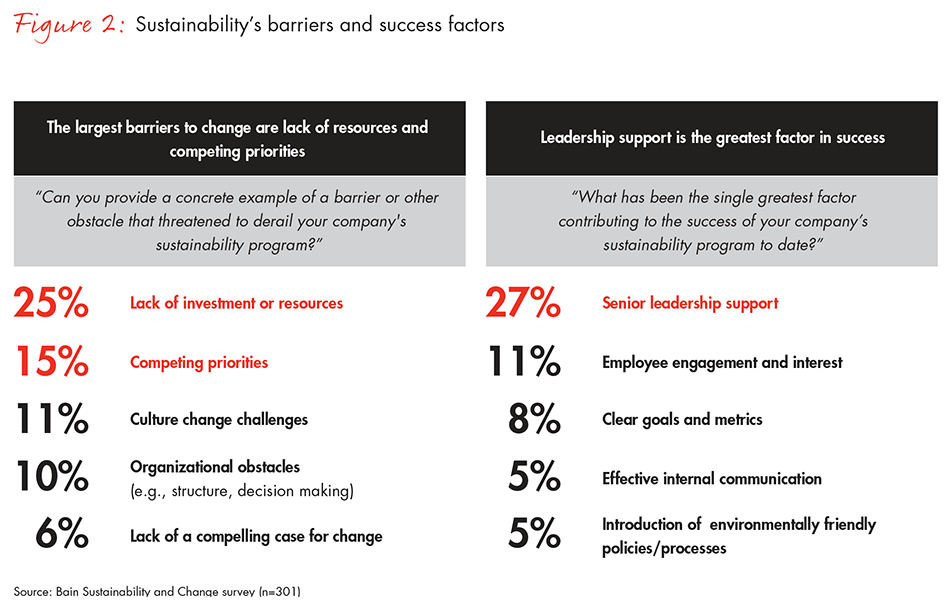
CEOs create the vital lift-off energy for sustainability efforts and regenerate momentum throughout the journey. Our research shows senior leadership support is the most important factor contributing to success, and that visible actions—not words—make the difference (see Figure 2). A CEO may be the only one able to push through tough choices that break with longstanding practices, such as changing suppliers or customer conditions. At global food retailer Delhaize Group, for example, midlevel managers were reluctant to implement tough new requirements for suppliers until CEO Frans Muller intervened to mandate them, demonstrating top-level commitment to real change. (Muller is now deputy CEO of Ahold-Delhaize, which was formed by a merger in July 2016.)
Broader executive-level actions also can play a critical role supporting change. In 2008, Novozymes created an executive sustainability board, including vice presidents of each business function, as a catalyst for change. Giving each member direct responsibility for results helped ensure that efforts to meet sustainability targets also created value for the business. Novozymes, which produces enzymes that help reduce the consumption of energy, raw materials and chemicals, estimates that in 2015, its customers reduced their carbon emissions by 60 million tons through the use of its products. By 2015, Novozymes had placed sustainability at the core of its business, incorporating it into the company’s purpose, strategy and long-term targets. The leadership team decided at that point to dissolve the sustainability board since its commitment was firmly established as a top business priority.
Changing mindsets
Despite a CEO’s enthusiasm, many employees believe sustainable products or processes are bad for business, assuming they increase cost and undermine a company’s performance. In our survey, 62% of respondents cited public reputation as the primary business rationale for sustainability programs—nice to have, but not essential to the business.
Those attitudes are a big risk factor for leadership teams intent on achieving breakthrough targets. When managers and employees regard sustainability efforts as nonessential or nonurgent, they fall to the bottom of the priority list. Our research showed lack of investment resources and competing priorities are the most common barriers to change (see Figure 2).
Sustainability leaders overcome negative attitudes by helping employees understand the business case that links sustainable products and processes with success. And there’s no shortage of global companies using these strategies to improve their performance. By doubling the fuel efficiency of its vehicle fleet, for example, Walmart saved nearly $1 billion while significantly reducing greenhouse gas emissions. Growth for brands with a demonstrated commitment to sustainability was four times faster than non-sustainable products in 2015, according to the Nielsen Global Corporate Sustainability Report.
The most effective approach is to start with a quick win-win for business and sustainability. Walmart began its sustainability journey by reducing packaging for toy trucks—an easy triple-win that saved trees, money and fuel. Since then, the company has deepened its commitment and now embraces projects in which the business case is harder to quantify. One example is the creation of a sustainability index to reward suppliers that provide sustainable products and services.
Even the most passionate sustainability executives realize that there are limits for publicly owned companies. It’s hard to make the business case for eroding the long-term economics of a brand, for example. Companies that set ambitious sustainability goals often need to launch more than one effort to persuade consumers to change their behavior. To stay competitive, they have to choose their battles.
Jenny Davis-Peccoud, who leads Bain's Global Sustainability & Corporate Responsibility practice, outlines four things companies can do to achieve their sustainability goals.
Hardwiring change
Setting sustainability objectives has become part of the annual reporting exercise. But few companies hardwire sustainability into their organizations’ processes, accountability systems and incentives. Our survey revealed only 24% of employees are held accountable for sustainability in a meaningful way. By contrast, 72% of sustainability leaders scored highly on embedding sustainability into core processes vs. 32% of companies that are just starting on the journey.
Companies that achieve ambitious sustainability goals embed sustainable behaviors and processes throughout the business and make line managers responsible for delivering results. For example, some companies change their capital-approvals process to include sustainability factors, or increase time horizons in business case assessments, allowing more initiatives to qualify for investment. Danish pharmaceutical company Novo Nordisk established an internal price on carbon so business units that achieve carbon reductions receive cash back. “We proved early on the kinds of sustainability initiatives that had an attractive return on investment, so we developed a methodology to remove barriers to these projects being approved,” said Novo Nordisk’s vice president of corporate sustainability, Susanne Stormer. In 2012, media company Corporate Knights named Novo Nordisk the world’s most sustainable company. Novo Nordisk has ranked among the top 20 on this list for the past six years.
Successful companies also embed sustainability priorities in their incentive structures alongside financial KPIs. Food retailer Delhaize Group achieved results by linking remuneration to sustainability in all areas of the business. Until it did so, only 20% of leadership had their annual bonus linked to the company’s sustainability efforts, said Megan Hellstedt, vice president of sustainability at Delhaize Group. By 2014, all Delhaize officers had annual incentive bonuses tied to sustainability goals, and sustainability performance made up 10%-30% of bonuses. That approach improved management alignment to the goals, helping the company reclaim a position on the Dow Jones Sustainability Index in 2015.

How to Get Breakthrough Results in Sustainability
Most companies want to be sustainable, but getting there is hard.
How can you accelerate results?
The upside opportunities for companies that embrace sustainability are growing, but few companies get the return on their investment that they desire. The resulting disappointment is real, but it’s not inevitable. Answering a few key questions can help reenergize your efforts.
- What stretch commitments can you make in a few key areas?
- Where can the CEO help remove barriers to change?
- What’s the best win-win test case to highlight the business benefits of sustainability?
- Which simple process changes would deliver the greatest sustainability gains?
Changing deep-seated beliefs across the organization will take time, but answering these questions will help advance you down the path toward achieving results.
Jenny Davis-Peccoud is a partner in the London office and leads Bain’s Sustainability & Corporate Responsibility practice. Paul Stone is an advisory partner in Bain’s London office and a member of the Sustainability & Corporate Responsibility practice. Clare Tovey is a sustainability senior consultant in the company’s London office.
First published in novembre 2016