
Skip to Content
  • Bureaux

    Bureaux

    Amérique du Nord et Amérique du Sud
    • Atlanta
    • Austin
    • Bogota
    • Boston
    • Buenos Aires
    • Chicago
    • Dallas
    • Denver
    • Houston
    • Los Angeles
    • Mexico City
    • Minneapolis
    • Monterrey
    • Montreal
    • New York
    • Rio de Janeiro
    • San Francisco
    • Santiago
    • São Paulo
    • Seattle
    • Silicon Valley
    • Toronto
    • Washington, DC
    Europe, Moyen-Orient et Afrique
    • Amsterdam
    • Athens
    • Berlin
    • Brussels
    • Copenhagen
    • Doha
    • Dubai
    • Dusseldorf
    • Frankfurt
    • Helsinki
    • Istanbul
    • Johannesburg
    • Kyiv
    • Lisbon
    • London
    • Madrid
    • Milan
    • Munich
    • Oslo
    • Paris
    • Riyadh
    • Rome
    • Stockholm
    • Vienna
    • Warsaw
    • Zurich
    Asie et Australie
    • Bangkok
    • Beijing
    • Bengaluru
    • Brisbane
    • Ho Chi Minh City
    • Hong Kong
    • Jakarta
    • Kuala Lumpur
    • Manila
    • Melbourne
    • Mumbai
    • New Delhi
    • Perth
    • Shanghai
    • Singapore
    • Sydney
    • Tokyo
    Voir tous les bureaux
  • Alumni
  • Presse
  • S’abonner
  • Contacter
  • Canada | Français

    Sélectionnez votre région et votre langue

    Global
    • Global (English)
    Amérique du Nord et Amérique du Sud
    • Brazil (Português)
    • Argentina (Español)
    • Canada (Français)
    • Chile (Español)
    • Colombia (Español)
    Europe, Moyen-Orient et Afrique
    • France (Français)
    • DACH Region (Deutsch)
    • Italy (Italiano)
    • Spain (Español)
    • Greece (Elliniká)
    Asie et Australie
    • China (中文版)
    • Korea (한국어)
    • Japan (日本語)
  • Saved items (0)
    Saved items (0)

    You have no saved items.

    Bookmark content that interests you and it will be saved here for you to read or share later.

    Explore Bain Insights
  • Expertises Sectorielles
    Menu principal

    Expertises Sectorielles

    • Aerospace et Défense
    • Agroalimentaire
    • Chimie
    • Infrastructures, BTP et Matériaux de Construction
    • Grande Consommation
    • Services Financiers
    • Santé
    • Engins & Equipements Industriels
    • Media et Divertissement
    • Metals
    • Mining
    • Pétrole & Gaz
    • Papier et Emballage
    • Private Equity
    • Secteur Public
    • Distribution
    • Technologie
    • Télécommunications
    • Transportation
    • Travel & Leisure
    • Utilities & Energies Renouvelables
  • Expertises Fonctionnelles
    Menu principal

    Expertises Fonctionnelles

    • Expérience Client
    • ESG
    • Innovation
    • Fusions et Acquisitions
    • Opérations
    • People & Organization
    • Private Equity
    • Sales & Marketing
    • Stratégie
    • IA, Perspectives et Solutions
    • Technology
    • Transformation
  • Digital
  • Points de Vue
  • About
    Menu principal

    About

    • Notre Activité
    • Nos Valeurs
    • Nos Collaborateurs et Notre Équipe Dirigeante
    • Notre Impact
    • Prix & Récompenses
    • Partenariats Internationaux
    Further: Our global responsibility
    • Sustainability
    • Impact Social
    • World Economic Forum
    Learn more about Further
  • Carrières
    Menu principal

    Carrières

    • Rejoignez-nous
      Carrières
      Rejoignez-nous
      • Find Your Place
      • Nos domaines d’expertise
      • Equipes multidisciplinaires
      • Étudiants
      • Stages et programmes
      • Événements de recrutement
    • La vie chez Bain
      Carrières
      La vie chez Bain
      • Blog: Inside Bain
      • Récits de carrière
      • Nos collaborateurs
      • Nos bureaux
      • Soutenir votre évolution professionnelle
      • Groupes d’affinités
      • Avantages chez Bain
    • Histoires d’impact
    • Notre processus de recrutement
      Carrières
      Notre processus de recrutement
      • Ce que vous pouvez attendre
      • Entretiens
    Trouver un poste
  • Bureaux
    Menu principal

    Bureaux

    • Amérique du Nord et Amérique du Sud
      Bureaux
      Amérique du Nord et Amérique du Sud
      • Atlanta
      • Austin
      • Bogota
      • Boston
      • Buenos Aires
      • Chicago
      • Dallas
      • Denver
      • Houston
      • Los Angeles
      • Mexico City
      • Minneapolis
      • Monterrey
      • Montreal
      • New York
      • Rio de Janeiro
      • San Francisco
      • Santiago
      • São Paulo
      • Seattle
      • Silicon Valley
      • Toronto
      • Washington, DC
    • Europe, Moyen-Orient et Afrique
      Bureaux
      Europe, Moyen-Orient et Afrique
      • Amsterdam
      • Athens
      • Berlin
      • Brussels
      • Copenhagen
      • Doha
      • Dubai
      • Dusseldorf
      • Frankfurt
      • Helsinki
      • Istanbul
      • Johannesburg
      • Kyiv
      • Lisbon
      • London
      • Madrid
      • Milan
      • Munich
      • Oslo
      • Paris
      • Riyadh
      • Rome
      • Stockholm
      • Vienna
      • Warsaw
      • Zurich
    • Asie et Australie
      Bureaux
      Asie et Australie
      • Bangkok
      • Beijing
      • Bengaluru
      • Brisbane
      • Ho Chi Minh City
      • Hong Kong
      • Jakarta
      • Kuala Lumpur
      • Manila
      • Melbourne
      • Mumbai
      • New Delhi
      • Perth
      • Shanghai
      • Singapore
      • Sydney
      • Tokyo
    Voir tous les bureaux
  • Alumni
  • Presse
  • S’abonner
  • Contacter
  • Canada | Français
    Menu principal

    Sélectionnez votre région et votre langue

    • Global
      Sélectionnez votre région et votre langue
      Global
      • Global (English)
    • Amérique du Nord et Amérique du Sud
      Sélectionnez votre région et votre langue
      Amérique du Nord et Amérique du Sud
      • Brazil (Português)
      • Argentina (Español)
      • Canada (Français)
      • Chile (Español)
      • Colombia (Español)
    • Europe, Moyen-Orient et Afrique
      Sélectionnez votre région et votre langue
      Europe, Moyen-Orient et Afrique
      • France (Français)
      • DACH Region (Deutsch)
      • Italy (Italiano)
      • Spain (Español)
      • Greece (Elliniká)
    • Asie et Australie
      Sélectionnez votre région et votre langue
      Asie et Australie
      • China (中文版)
      • Korea (한국어)
      • Japan (日本語)
  • Saved items  (0)
    Menu principal
    Saved items (0)

    You have no saved items.

    Bookmark content that interests you and it will be saved here for you to read or share later.

    Explore Bain Insights
  • Expertises Sectorielles
    • Expertises Sectorielles

      • Aerospace et Défense
      • Agroalimentaire
      • Chimie
      • Infrastructures, BTP et Matériaux de Construction
      • Grande Consommation
      • Services Financiers
      • Santé
      • Engins & Equipements Industriels
      • Media et Divertissement
      • Metals
      • Mining
      • Pétrole & Gaz
      • Papier et Emballage
      • Private Equity
      • Secteur Public
      • Distribution
      • Technologie
      • Télécommunications
      • Transportation
      • Travel & Leisure
      • Utilities & Energies Renouvelables
  • Expertises Fonctionnelles
    • Expertises Fonctionnelles

      • Expérience Client
      • ESG
      • Innovation
      • Fusions et Acquisitions
      • Opérations
      • People & Organization
      • Private Equity
      • Sales & Marketing
      • Stratégie
      • IA, Perspectives et Solutions
      • Technology
      • Transformation
  • Digital
  • Points de Vue
  • Carrières
    Recherches les plus fréquentes
    • Agile
    • Digital
    • Stratégie
    Vos recherches précédentes
      Pages récemment visitées

      Content added to saved items

      Saved items (0)

      Removed from saved items

      Saved items (0)

      Etude

      Beyond Scale: A Winning Portfolio Strategy for Semiconductor Players

      Beyond Scale: A Winning Portfolio Strategy for Semiconductor Players

      The shift from products to systems changes the game for chipmakers.

      Par Hans Joachim Heider, Daniel Suter, Josef Ming, et Michael Schallehn

      • min
      }

      Etude

      Beyond Scale: A Winning Portfolio Strategy for Semiconductor Players
      en
      En Bref
      • In some semiconductor segments, the time is over for strategies that focus purely on products.
      • A clear understanding of business boundaries has become a critical success factor for semiconductor companies.
      • Some businesses require pure scale, while others require scope across applications. Strategies need to address both.
      • Proactive portfolio strategies create substantial shareholder returns. 

      A decade’s worth of merger and acquisition activity has left many chipmakers with sprawling portfolios that include businesses outside their main areas of focus. Ideally, waves of M&A are accompanied by periods of rationalization, as companies move to divest less valuable segments of their portfolio so they can concentrate on those closer to their core. This continuous refocusing is particularly important in semiconductors, as it allows executives to focus time, talent, energy and capital on segments where they can achieve leadership and higher returns.

      However, the nature of leadership is changing rapidly, and not all executives have adjusted their portfolio strategies accordingly. Companies in the semiconductor industry, like those elsewhere in the technology sector, have tended to view their portfolios primarily from a product point of view—for example, power semiconductors, sensors, microcontroller units (MCUs) or connectivity. Their M&A playbooks have reflected this, aiming to build scale within product segments they want to lead by consolidating fragmented niches to gain product leadership.

      While this logic still holds true for some standard products, for others it’s no longer enough just to have scale. Increasingly, it’s important to build on product scale with expertise in the systems and applications of which the product is a part. This is particularly effective when the product sits at a control point of the system, enabling the company to build a complete reference design around it. Application-centric technology trends such as autonomous and electric cars, the Internet of Things, greater energy efficiency and renewable energy are creating new, high-growth semiconductor segments, while others like fixed and mobile communication are reaching their plateaus and commoditizing. In those application-centric segments, customers increasingly look for solutions that combine functionalities of multiple IP blocks or chips, software, reference design and ecosystem support. For example, many premium automobiles today have more than 100 electronic control units directing everything from tire pressure to electrical steering control units. Newer auto architectures tend to be based on more centralized domain controllers that steer integrated solutions of multiple chips (such as advanced driver assistance systems combining radar, lidar, vision sensors and associated logic). For these kinds of architectures, it becomes more critical for semiconductor vendors to take a full-system view that includes relevant ecosystems, rather than focusing only on individual products.

      As customers' needs evolve, chipmakers must revisit their portfolio strategies and their M&A and divesture plans that support them. Previously, it was enough to gain a leading position in a product category—and for some general purpose segments, gaining scale will still be enough. But increasingly, winners are likely to be those firms that continuously refine and streamline their portfolios to complement their core positions with the capabilities necessary to deliver leading solutions, while divesting other parts of their business no longer necessary for success. Capital markets tend to favor players who take an active portfolio management approach. Unless companies fully understand the business boundaries of their portfolio and where they have the highest commercial potential, they risk misjudging their market position and the areas where they should be focusing. They may wind up investing in segments that the company cannot win or, alternatively, failing to capitalize where it has definitive strengths.

      Business boundaries in the semiconductor industry have shifted

      This shift in focus from products to systems has been evolving for several years, but some chipmakers still struggle to find the right approach. Executives need to invest in a new understanding of business segments in order to define their corresponding portfolio strategy, building the right scope and necessary scale to succeed in the medium and long term—not always an easy combination. With the right portfolio strategy, they can gain synergies in cost and revenue, based on overlapping customer segments, capabilities and operations.

      A strategic approach to portfolio strategy begins by clearly defining the business ambition. What are the boundaries of the current business segments, where does it aspire to be and what are the odds of winning? At a detailed level, this includes identifying segment-related core competencies in customer and value chain relationships, go-to-market capabilities, supply chain management, application design and other capabilities. From there, it becomes easier to identify the synergies across competencies that are required to succeed within subsegments (see Figure 1). 

      Figure 1
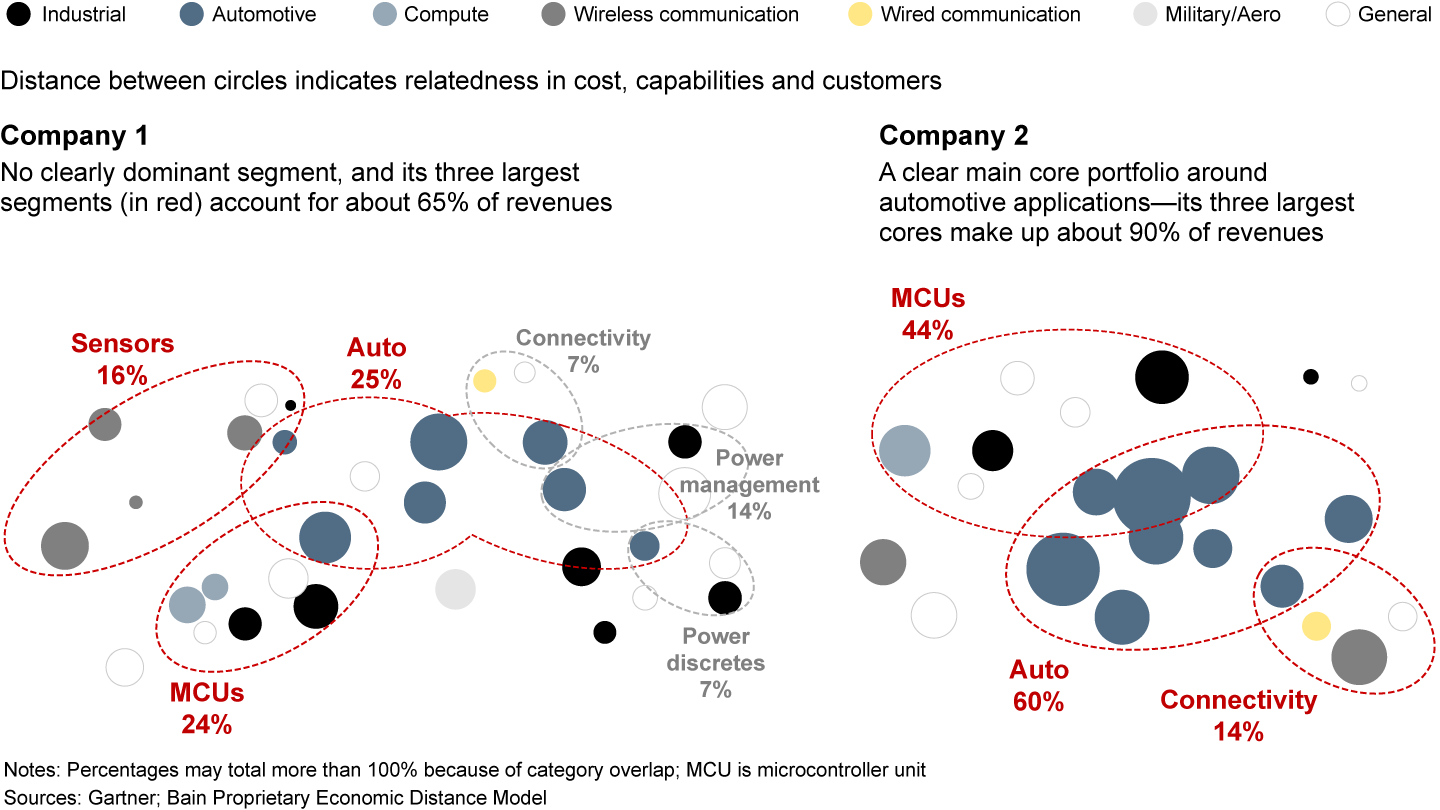
      An analysis of economic distance shows whether portfolios are coherent or fragmented
      An analysis of economic distance shows whether portfolios are coherent or fragmented
      An analysis of economic distance shows whether portfolios are coherent or fragmented

      Based on identified synergies across segments and capabilities, executives can begin to define boundaries and regroup businesses into market clusters—some that are specific to applications, others that are more general. For each new market cluster, executives must decide which products to include or exclude based on identified synergies. 

      • Cost and operational overlaps. Are there production or supply chain synergies that can be brought to bear to improve efficiency?
      • Technology capabilities. Are key, differentiating R&D capabilities, intellectual property and technologies shared across product lines and market segments?
      • Customer sharing. Are there customers shared among the businesses by end-market, region or size, which would allow a more effective go-to-market approach or differentiated positioning or branding?

      The results of a successful portfolio transformation can be significant. One semiconductor manufacturer outperformed its peers’ total shareholder return by a factor of two on share price over a 10-year period after going through a portfolio rationalization and a cost transformation at the same time.

      Building practical portfolio strategies

      It’s important to keep in mind that companies rarely find acquisition targets that perfectly match their strategic needs. Acquired targets often come with their own complex portfolios, particularly in a consolidating market. Acquirers have to assess early on which parts of a target company to keep and which to divest—and streamlining should occur in parallel or soon after the acquisition. Few semiconductor players do this systematically.

      Building a strategy for a complex semiconductor portfolio can be overwhelming. Breaking the problem down into six steps makes the challenge more manageable.

      • Define the overall business ambition, including strategic goals and financial and growth ambitions.
      • Determine core businesses based on economic business boundaries and the overlaps of costs, capabilities and customers.
      • Assess the portfolio by evaluating the attractiveness (market size, growth, profitability) and ability to gain and maintain a leading position for each segment.
      • Determine the full potential for each core based on current market position, as well as organic and inorganic growth opportunities.
      • Build portfolio scenarios and model expected shareholder returns of various portfolio and M&A scenarios, including changes in multiples due to arbitrage, reduced portfolio risk and more attractive equity stories.
      • Build multiyear roadmaps, which allow chipmakers to put in motion a proactive plan of acquisition and divestment, while assessing upcoming opportunities more quickly than competitors.

      As customer preferences continue to evolve and as products become increasingly complex and multifunctional, the opportunity for chipmakers to stay competitive will depend more and more on their ability to demonstrate their mastery of complex systems and solutions. Since this requires broader capabilities than merely building scale in individual products, most chipmakers will need to make more acquisitions and divestitures in order to maintain a streamlined portfolio that delivers against their business ambitions. A more strategic approach to portfolio management can help guide their progress.

      Hans Joachim Heider, Daniel Suter and Michael Schallehn are partners in Bain & Company’s Global Technology practice, and Josef Ming is a partner in the Advanced Manufacturing & Services practice. Hans Joachim is based in Munich, Daniel and Josef in Zurich, and Michael in Silicon Valley.

      Auteurs
      • Headshot of Hans Joachim Heider
        Hans Joachim Heider
        Partner, Munich
      • Headshot of Daniel Suter
        Daniel Suter
        Partner, Zurich
      • Headshot of Josef Ming
        Josef Ming
        Advisory Partner, Zurich
      • Headshot of Michael Schallehn
        Michael Schallehn
        Partner, Silicon Valley
      Contactez-nous
      Synergies sectorielles
      • Technologie
      Expertises fonctionnelles transverses
      • Business Strategy
      • Stratégie
      Comment pouvons-nous vous aider ?
      • Portfolio Value Creation
      Technologie
      Mapping Synergies to Shape a Semiconductor Portfolio

      The shift from products to systems raises the importance of a detailed economic analysis of how cost, capabilities and customers overlap among segments.

      Voir plus
      Technologie
      Software M&A

      The good news: Most deal best practices still apply to AI acquisitions.

      Voir plus
      Portfolio Value Creation
      A Private Equity Fund Just Bought Your Company … Now What?

      Private equity ownership can be tricky, but it doesn’t have to be fatal for the incumbent CEO.

      Voir plus
      Stratégie
      Lean Strategy: Make Smarter Moves, Faster

      Bain's Michael Mankins and Thomas Sweet, former CFO of Dell Technologies, share how a lean strategy framework accelerates smarter decision-making and enhances performance.

      Voir plus
      Technologie
      Exploring AI for Packaging Circularity

      AI is already creating value across the packaging lifecycle, from optimising design and reducing material use to improving sorting and traceability.

      Voir plus
      First published in janvier 2020
      Mots clés
      • Business Strategy
      • Portfolio Value Creation
      • Stratégie
      • Technologie

      Comment nous avons aidé nos clients

      Helping a Midsize ERP Player Compete against the Giants

      Lire l’étude de cas

      Aggressively growing an IT service provider with a high-performance culture

      Lire l’étude de cas

      Electronics manufacturer increases value of CRM investment

      Lire l’étude de cas

      Vous souhaitez continuer cette conversation ?

      Nous aidons des dirigeants du monde entier à matérialiser des impacts et des résultats pérennes et créateurs de valeur dans leurs organisations.

      Les points de vue de Bain : notre perspective sur des problématiques auxquelles sont confrontées les entreprises à travers le monde, envoyés chaque mois dans votre boîte de réception. 

      *J’ai lu la politique de confidentialité et j’accepte les conditions.

      Merci de lire notre politique de confidentialité.
      Bain & Company
      Contactez-nous Sustainability Accessibility Conditions d’utilisation Politique de Confidentialité Cookie Policy Mentions Légales Sitemap Log In

      © 1996-2026 Bain & Company, Inc.

      Contacter Bain

      Comment pouvons-nous vous aider ?

      • Business inquiry
      • Career information
      • Press relations
      • Partnership request
      • Speaker request
      Voir tous les bureaux