

Etude
Can you get excited by cost containment?
You might if you visualize your employees avidly engaged in making operations not only efficient but also more effective. Wringing out waste can be a liberating experience. Imagine looking back on cost-cutting efforts of the past five years and not having a single regret.
Companies whose business declined or even managed to hold flat during the recent recession have been squeezing more productivity from existing resources. Such efforts, especially across-the-board cuts, often are viewed as temporary and detrimental to the health of the business once robust growth returns.
But efforts to contain costs don’t have to cause gloom and doom. In the best companies, cost programs spur major improvements in operating effectiveness along financial, customer, employee and other metrics. The key is to regularly and aggressively hunt for “no regrets” initiatives that will make a company both leaner and more effective.
It may sound obvious that one should pursue cost initiatives that will make a company stronger, or at least limit the harm done. But in practice, cost-cutting often plays out differently. Companies tend to make cuts as a reaction triggered by an economic downturn or a shift in the market, or because they are under pressure from investors to deliver gains within a quarter or two. At that point, it’s too late to take more constructive measures, which require time to identify, plan and implement.
By contrast, companies that generate an evergreen portfolio of no-regrets cost initiatives do three things:
They launch a cost program before it’s needed
Some companies run cost-reduction initiatives proactively, to gain or maintain a lead in their industry. By beating their industry’s cost curve, they can generate higher returns. These returns can be reinvested in strategic priorities to further build a competitive advantage.
But time is a precious currency. It typically takes 12 to 18 months to identify, prove and build out initiatives that come with no regrets. And because IT often underpins the best initiatives, it also takes time to build the appropriate systems.
A reasonable cadence involves assembling midlevel teams every one to two years and challenging them to identify potential initiatives, so a company can build an inventory of options. The options can then be analyzed and the best handful chosen for implementation. Similar to a capital planning process, with all the projects arrayed and discussed annually, these midlevel teams refresh their commitment to the cost initiatives each year. That helps the company develop a culture of continually scouting no-regrets moves.
A leading medical device manufacturer runs an ongoing process to identify and fund the best cost-reduction ideas. Those ideas that get approved typically have a three to one value/cost ratio, or will pay back within a year. The process started in manufacturing and is now used throughout all functions. As a result of this disciplined process, the medical device firm reaps substantial savings year after year, drawing on a rich set of well-planned initiatives. The benefits go beyond cost savings, as employee teams are able to weed out non-essential tasks and devote more time to activities that promote innovation and improve the customer’s experience.
Cost-cutting initiatives can lead to a leaner, more effective company, or they can cause harm to an organization by tightening resources in the wrong places. Bain Partner Molly Kerr suggests that companies focus on three things that will help surface regret-free cuts.
They carefully analyze the impact on effectiveness
Most companies apply far more rigor to quantifying efficiency than to increasing effectiveness. Anyone can cut 10% of costs from a department, but to make intelligent and sustainable cuts, executives need to understand which activities are critical to the health of the business and which are expendable because they don’t add value. And more complicated trade-offs require even more analytical rigor.
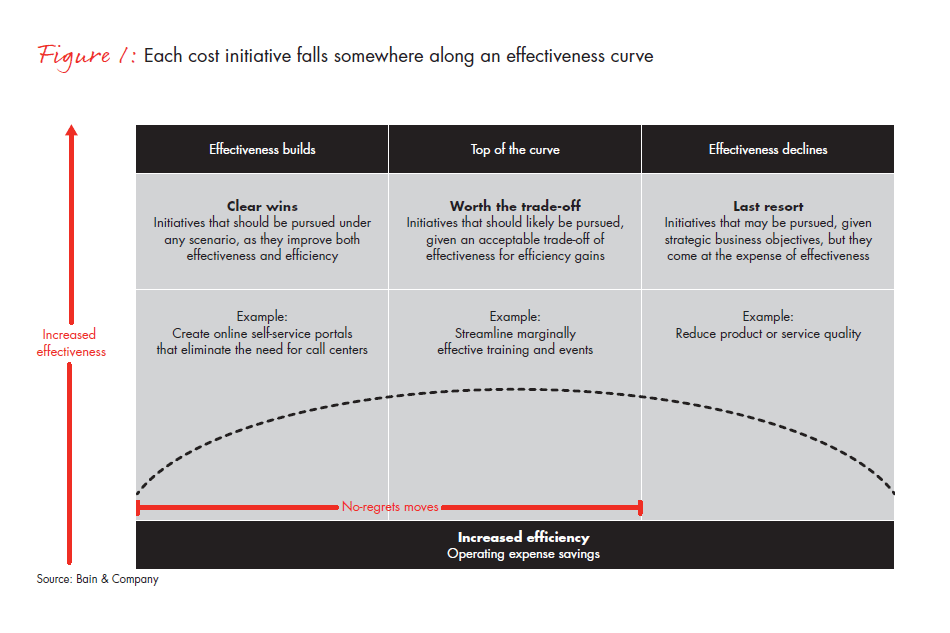
Companies that take this evergreen approach have found it useful to sort potential initiatives into three categories:
1. Clear wins. Certain initiatives will dramatically improve both efficiency and effectiveness. Consider a global beverage company that realized it could be smarter about its marketing spending. It harmonized point-of-sale materials like glassware and displays in taverns by brand worldwide and also consolidated sourcing and fulfillment. That not only reduced costs—the company is on track to cut 10% to 35% of its spending, depending on the subcategory—it also led to higher quality materials and a more consistent visual identity across countries.
The impetus for initiatives that are clear wins often starts with the need to address a particular problem, rather than the desire to cut overall costs.
Omnicare, a US pharmacy provider to long-term care facilities, some years ago wanted to regionalize and streamline its prescription order intake process. First, it needed to build an electronic workflow system that could digitize and automatically triage incoming orders from nurses. The new system proved more cost-efficient, balancing the workload across employees in different time zones, and allowed for faster, more accurate order entry and better customer service.
Vistaprint, a Netherlands-based international online supplier of promotional materials and marketing services, provides another example. Rapid growth in the employee base and expansion to 17 countries has challenged the human resources (HR) group to deliver a high level of service in a cost-effective manner. So Vistaprint is designing a combination of self-service portals and phone help lines to deliver information to employees faster. The system, currently in design, will enable the HR professional staff to focus their time on more complex issues.
2. Worth the trade-off. This category of initiatives will substantially improve efficiency and have only a small impact, either positive or negative, on effectiveness. Although these initiatives won’t have a material effect on customers or operations, they’re worth doing because of the cost benefit. They often involve stopping or reducing costly programs that don’t yield the intended benefit, such as employee training that has fallen flat.
One initiative some companies find worth the trade-off is paring sizable merit pay increases. When the CFO at one company reviewed merit raises, she realized the finance staff had consistently received higher raises than staff in other functions. The CFO determined that merit raises for finance could be reduced from 5% to 3%, on average, without putting a dent in the department’s morale, saving the company operating expenses without impacting operating effectiveness.
3. Last resort. Plenty of initiatives can reduce costs but will have a damaging effect on certain aspects of the business. Think of cutting the process improvement team at a factory or decreasing the investor relations staff from four people to one at a publicly held firm, which might eliminate road shows and same-day responses to investment analysts.
Companies should undertake this kind of initiative only under duress or when a clearly superior use of resources surfaces, which may entail diverting resources to another division or distributing higher dividends to shareholders. Executives at leading companies find it useful to visualize these three categories along a curve whose shape is defined by the categories’ impact on effectiveness, with each potential initiative arrayed along the curve (see Figure 1). Ideally, managers should undertake initiatives that raise effectiveness or are at least neutral. Initiatives just past neutral are typically worth the trade-off, as they have only a small impact on effectiveness. But moving farther to the right, companies enter a zone of value destruction.
They take an enterprise view in order to make valid comparisons of initiatives
Making fair comparisons of one business unit’s initiative with another department’s initiative requires using consistent metrics.
Start by plotting potential initiatives on a three-by-three grid, with one axis showing impact on effectiveness and the other showing efficiency gains (see Figure 2). Senior leaders should then discuss and challenge the relative placement of those initiatives, analyzing how each initiative would improve or hinder effectiveness, as well as testing the confidence level of estimated cost benefits.
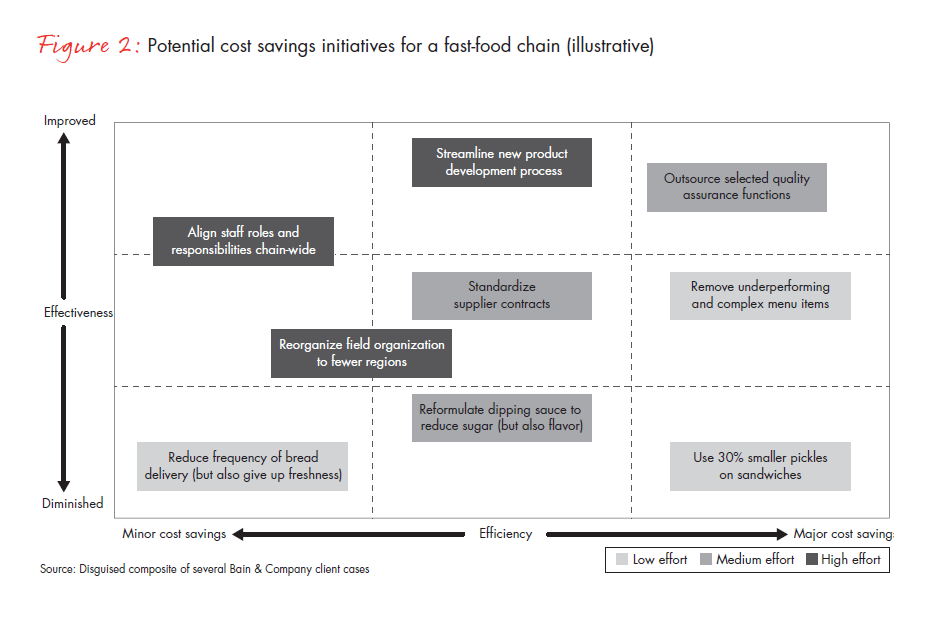
This process can yield surprising results. At a fast-food chain, a management team debated a set of potential cost-reduction initiatives. One of the leading contenders, proposed by the supply chain group, was reducing the frequency of bread delivery, but that would have also reduced product freshness and degraded the customer experience. Only after the team took an enterprise-wide view did it uncover other initiatives that could yield big savings and actually improve effectiveness, such as outsourcing some quality assurance functions. This insight would have remained buried without an enterprise-wide view.
The corporate center has an important role in defining the metrics and the language of the cost-reduction effort, as well as ensuring that everyone plays by the same rules.
Typically, a cross-unit and cross-functional committee compiles and assesses all of the potential initiatives, arrays them on the effectiveness curve and winnows them down to a recommended handful of high-priority initiatives. With those recommendations, the ultimate go/no-go decision lies with a C-level executive, often the CEO.
Cost-consciousness need not imply risk aversion, but rather a search for value in all spending. Senior leaders no longer demand a 10% cost reduction; instead, they challenge employees to lower costs in ways that “make us a better company.” This gives managers permission to be creative about possible initiatives, research the economics of each one and present a range of options. With enough time and consistently applied effort to find the no-regrets initiatives, employees will rally behind the cause and companies will be able to fuel strong growth—without putting the business at risk.
A five-step program generates the no-regrets cost opportunities
- Assemble the right teams at the department, business unit or functional level. Often it’s midlevel managers who know where the organization could be more effective and the cross-functional teams who create breakthrough ideas.
- Get all ideas on the table. For any given unit at a large company, it’s worth generating between 200 and 1,000 idea fragments to consider. Using brainstorming software can ensure anonymity.
- Cluster and evaluate the ideas. Winnow and cluster the large group of fragments into 20 to 40 ideas—a more manageable number for evaluation with the appropriate analytical rigor.
- Rank and order the ideas using the effectiveness curve. Ranking potential initiatives takes several half-day working sessions to accomplish, with incremental research and analysis being conducted between sessions.
- Decide which initiatives to launch. It always makes sense to implement the “clear wins” and many of the “worth the trade-off” initiatives. A distressed business or one that needs to hit earnings targets may need to dip into the “last resort” category. If so, pick the initiatives that have the largest savings potential for the least damage to effectiveness. Teams may also identify the ideas that cost—rather than save—money to improve effectiveness, but set those aside for a period when the firm can afford the investment.
Molly Kerr is a Boston-based partner with Bain & Company’s Performance Improvement practice. Véronique Pauwels is an Amsterdam-based partner who co-leads the Performance Improvement practice in Europe, the Middle East and Africa.
First published in août 2014