
Skip to Content
  • Bureaux

    Bureaux

    Amérique du Nord et Amérique du Sud
    • Atlanta
    • Austin
    • Bogota
    • Boston
    • Buenos Aires
    • Chicago
    • Dallas
    • Denver
    • Houston
    • Los Angeles
    • Mexico City
    • Minneapolis
    • Monterrey
    • Montreal
    • New York
    • Rio de Janeiro
    • San Francisco
    • Santiago
    • São Paulo
    • Seattle
    • Silicon Valley
    • Toronto
    • Washington, DC
    Europe, Moyen-Orient et Afrique
    • Amsterdam
    • Athens
    • Berlin
    • Brussels
    • Copenhagen
    • Doha
    • Dubai
    • Dusseldorf
    • Frankfurt
    • Helsinki
    • Istanbul
    • Johannesburg
    • Kyiv
    • Lisbon
    • London
    • Madrid
    • Milan
    • Munich
    • Oslo
    • Paris
    • Riyadh
    • Rome
    • Stockholm
    • Vienna
    • Warsaw
    • Zurich
    Asie et Australie
    • Bangkok
    • Beijing
    • Bengaluru
    • Brisbane
    • Ho Chi Minh City
    • Hong Kong
    • Jakarta
    • Kuala Lumpur
    • Manila
    • Melbourne
    • Mumbai
    • New Delhi
    • Perth
    • Shanghai
    • Singapore
    • Sydney
    • Tokyo
    Voir tous les bureaux
  • Alumni
  • Presse
  • S’abonner
  • Contacter
  • Canada | Français

    Sélectionnez votre région et votre langue

    Global
    • Global (English)
    Amérique du Nord et Amérique du Sud
    • Brazil (Português)
    • Argentina (Español)
    • Canada (Français)
    • Chile (Español)
    • Colombia (Español)
    Europe, Moyen-Orient et Afrique
    • France (Français)
    • DACH Region (Deutsch)
    • Italy (Italiano)
    • Spain (Español)
    • Greece (Elliniká)
    Asie et Australie
    • China (中文版)
    • Korea (한국어)
    • Japan (日本語)
  • Saved items (0)
    Saved items (0)

    You have no saved items.

    Bookmark content that interests you and it will be saved here for you to read or share later.

    Explore Bain Insights
  • Expertises Sectorielles
    Menu principal

    Expertises Sectorielles

    • Aerospace et Défense
    • Agroalimentaire
    • Chimie
    • Infrastructures, BTP et Matériaux de Construction
    • Grande Consommation
    • Services Financiers
    • Santé
    • Engins & Equipements Industriels
    • Media et Divertissement
    • Metals
    • Mining
    • Pétrole & Gaz
    • Papier et Emballage
    • Private Equity
    • Secteur Public
    • Distribution
    • Technologie
    • Télécommunications
    • Transportation
    • Travel & Leisure
    • Utilities & Energies Renouvelables
  • Expertises Fonctionnelles
    Menu principal

    Expertises Fonctionnelles

    • Expérience Client
    • ESG
    • Innovation
    • Fusions et Acquisitions
    • Opérations
    • People & Organization
    • Private Equity
    • Sales & Marketing
    • Stratégie
    • IA, Perspectives et Solutions
    • Technology
    • Transformation
  • Digital
  • Points de Vue
  • About
    Menu principal

    About

    • Notre Activité
    • Nos Valeurs
    • Nos Collaborateurs et Notre Équipe Dirigeante
    • Notre Impact
    • Prix & Récompenses
    • Partenariats Internationaux
    Further: Our global responsibility
    • Sustainability
    • Impact Social
    • World Economic Forum
    Learn more about Further
  • Carrières
    Menu principal

    Carrières

    • Rejoignez-nous
      Carrières
      Rejoignez-nous
      • Find Your Place
      • Nos domaines d’expertise
      • Equipes multidisciplinaires
      • Étudiants
      • Stages et programmes
      • Événements de recrutement
    • La vie chez Bain
      Carrières
      La vie chez Bain
      • Blog: Inside Bain
      • Récits de carrière
      • Nos collaborateurs
      • Nos bureaux
      • Soutenir votre évolution professionnelle
      • Groupes d’affinités
      • Avantages chez Bain
    • Histoires d’impact
    • Notre processus de recrutement
      Carrières
      Notre processus de recrutement
      • Ce que vous pouvez attendre
      • Entretiens
    Trouver un poste
  • Bureaux
    Menu principal

    Bureaux

    • Amérique du Nord et Amérique du Sud
      Bureaux
      Amérique du Nord et Amérique du Sud
      • Atlanta
      • Austin
      • Bogota
      • Boston
      • Buenos Aires
      • Chicago
      • Dallas
      • Denver
      • Houston
      • Los Angeles
      • Mexico City
      • Minneapolis
      • Monterrey
      • Montreal
      • New York
      • Rio de Janeiro
      • San Francisco
      • Santiago
      • São Paulo
      • Seattle
      • Silicon Valley
      • Toronto
      • Washington, DC
    • Europe, Moyen-Orient et Afrique
      Bureaux
      Europe, Moyen-Orient et Afrique
      • Amsterdam
      • Athens
      • Berlin
      • Brussels
      • Copenhagen
      • Doha
      • Dubai
      • Dusseldorf
      • Frankfurt
      • Helsinki
      • Istanbul
      • Johannesburg
      • Kyiv
      • Lisbon
      • London
      • Madrid
      • Milan
      • Munich
      • Oslo
      • Paris
      • Riyadh
      • Rome
      • Stockholm
      • Vienna
      • Warsaw
      • Zurich
    • Asie et Australie
      Bureaux
      Asie et Australie
      • Bangkok
      • Beijing
      • Bengaluru
      • Brisbane
      • Ho Chi Minh City
      • Hong Kong
      • Jakarta
      • Kuala Lumpur
      • Manila
      • Melbourne
      • Mumbai
      • New Delhi
      • Perth
      • Shanghai
      • Singapore
      • Sydney
      • Tokyo
    Voir tous les bureaux
  • Alumni
  • Presse
  • S’abonner
  • Contacter
  • Canada | Français
    Menu principal

    Sélectionnez votre région et votre langue

    • Global
      Sélectionnez votre région et votre langue
      Global
      • Global (English)
    • Amérique du Nord et Amérique du Sud
      Sélectionnez votre région et votre langue
      Amérique du Nord et Amérique du Sud
      • Brazil (Português)
      • Argentina (Español)
      • Canada (Français)
      • Chile (Español)
      • Colombia (Español)
    • Europe, Moyen-Orient et Afrique
      Sélectionnez votre région et votre langue
      Europe, Moyen-Orient et Afrique
      • France (Français)
      • DACH Region (Deutsch)
      • Italy (Italiano)
      • Spain (Español)
      • Greece (Elliniká)
    • Asie et Australie
      Sélectionnez votre région et votre langue
      Asie et Australie
      • China (中文版)
      • Korea (한국어)
      • Japan (日本語)
  • Saved items  (0)
    Menu principal
    Saved items (0)

    You have no saved items.

    Bookmark content that interests you and it will be saved here for you to read or share later.

    Explore Bain Insights
  • Expertises Sectorielles
    • Expertises Sectorielles

      • Aerospace et Défense
      • Agroalimentaire
      • Chimie
      • Infrastructures, BTP et Matériaux de Construction
      • Grande Consommation
      • Services Financiers
      • Santé
      • Engins & Equipements Industriels
      • Media et Divertissement
      • Metals
      • Mining
      • Pétrole & Gaz
      • Papier et Emballage
      • Private Equity
      • Secteur Public
      • Distribution
      • Technologie
      • Télécommunications
      • Transportation
      • Travel & Leisure
      • Utilities & Energies Renouvelables
  • Expertises Fonctionnelles
    • Expertises Fonctionnelles

      • Expérience Client
      • ESG
      • Innovation
      • Fusions et Acquisitions
      • Opérations
      • People & Organization
      • Private Equity
      • Sales & Marketing
      • Stratégie
      • IA, Perspectives et Solutions
      • Technology
      • Transformation
  • Digital
  • Points de Vue
  • Carrières
    Recherches les plus fréquentes
    • Agile
    • Digital
    • Stratégie
    Vos recherches précédentes
      Pages récemment visitées

      Content added to saved items

      Saved items (0)

      Removed from saved items

      Saved items (0)

      Technology Report

      Decarbonizing Technology Supply Chains

      Decarbonizing Technology Supply Chains

      Most tech companies have set ambitious targets, but only half are on track to meet them.

      Par Peter Guarraia, Joshua Hinkel, Velu Sinha, et James Baird

      • min
      }

      Rapport

      Decarbonizing Technology Supply Chains
      en
      En Bref
      • In technology, most emissions are Scope 3, resulting from upstream supply chains or downstream use of products, which are harder for companies to control than Scope 1 (operations) or Scope 2 (energy use) emissions that are under their direct control.
      • Using more renewable energy in data centers helps many software companies reduce their Scope 2 emissions.
      • Bringing supply lines closer to customers can reduce upstream Scope 3 emissions, while redesigning products to use less energy helps reduce downstream Scope 3 emissions.
      • Companies should adopt a holistic perspective so that they can take a long-term strategic approach to emissions and other sustainability issues.

      This article is part of Bain's 2023 Technology Report.

      Explore the report

      Sustainability and decarbonization efforts increasingly are top priorities for technology companies as customers, shareholders, and regulators all push for more sustainable products and services. In response, most tech companies are setting ambitious goals to reduce emissions, but only half report being on track to reach their goals (see Figure 1). Most emission reduction goals focus on Scope 1 (direct emissions from a company’s activity) and Scope 2 (emissions from purchased electricity, heat, and steam), which companies have more control over. Scope 3 emissions come from the upstream supply chain and flow downstream to customer use.

      Figure 1
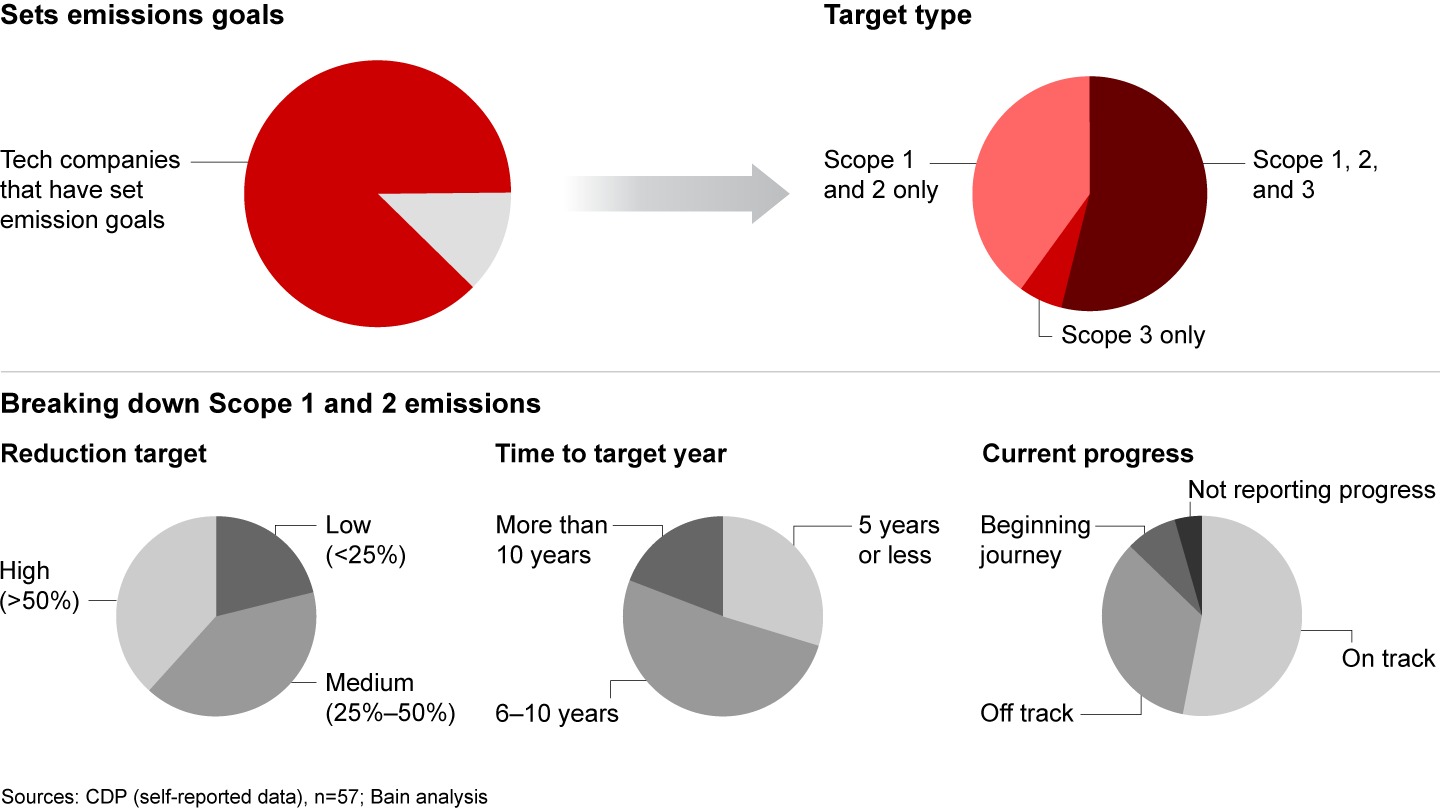
      90% of tech companies have set decarbonization targets, but results are mixed
      90% of tech companies have set decarbonization targets, but results are mixed
      90% of tech companies have set decarbonization targets, but results are mixed

      Why is reducing emissions so hard? First, most emissions are Scope 3, which are more difficult to control. Also, reductions compete with other strategic priorities. For example, PC makers need to find sustainable solutions to extend the life of their products without jeopardizing long-term sales.

      The ambitions may be clear, but the devil is in the execution. Improvement initiatives require complex coordination across manufacturing, operations, engineering, and R&D teams, as well as customers. Regulations differ across locations. Even with offset purchases as part of the strategy, companies might find it hard to source enough renewable power in some markets. Launching, tracking, and following through on implementation requires senior sponsorship and commitment—and a willingness to tackle cross-organizational and cross-regional challenges.

      Successful measures

      The causes of carbon emissions vary by subsector (see Figure 2). Emissions in semiconductors derive mostly from Scope 3 downstream usage, but the sector also has the largest Scope 1 and Scope 2 emissions. Hardware manufacturers’ emissions result from Scope 3 downstream electricity usage and the upstream supply chain for materials and minerals. The software industry’s emissions come from customers using their products (Scope 3 downstream) as well as the goods and services that software companies buy to make their products (Scope 3 upstream).

      Figure 2
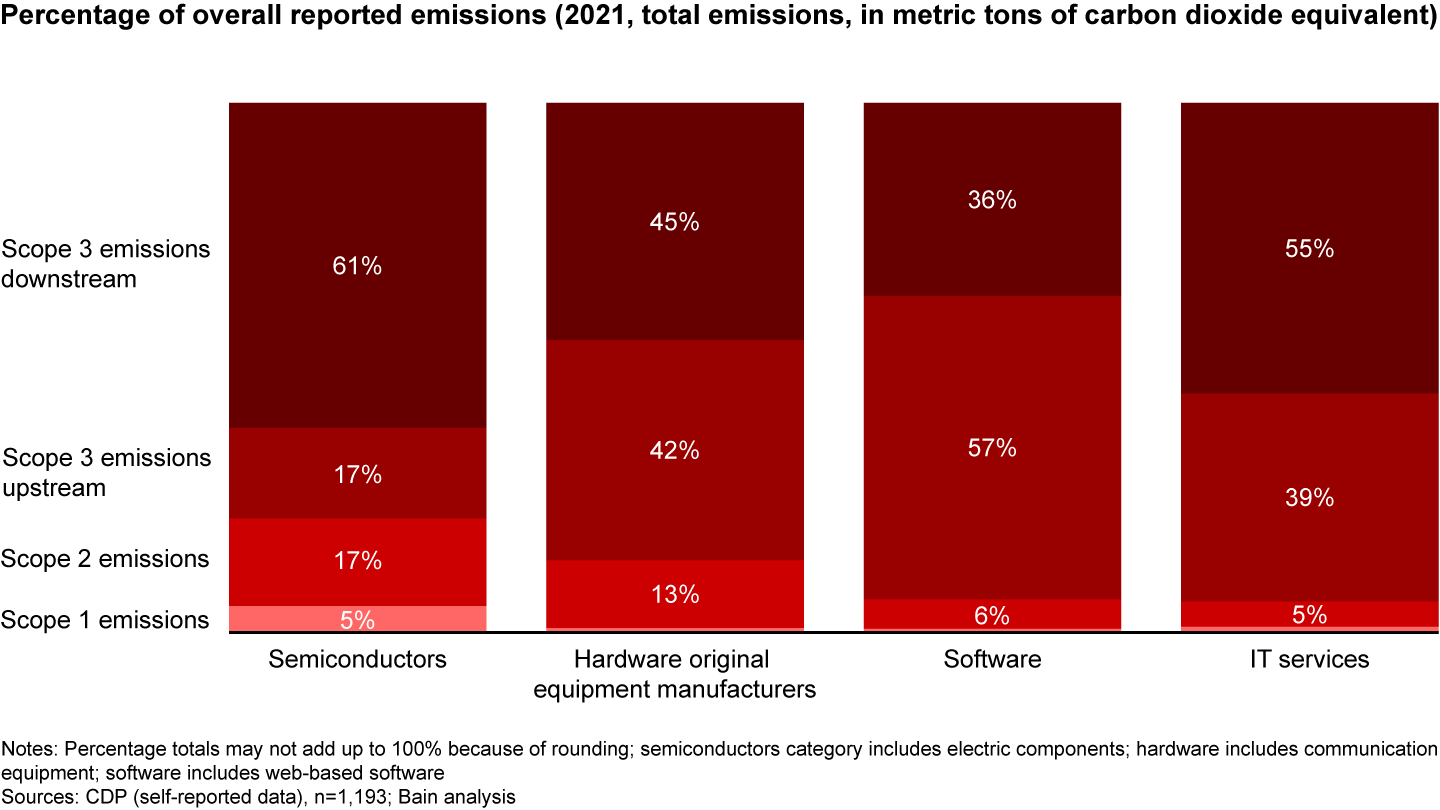
      Most emissions are Scope 3, which are difficult to track and abate
      Most emissions are Scope 3, which are difficult to track and abate
      Most emissions are Scope 3, which are difficult to track and abate

      While specific solutions may look different for hardware and software companies, all tech companies are embedding the impact of carbon into decision making around supply chain footprint, day-to-day operations, and product life cycles. Across subsectors, tech companies are finding ways to reduce carbon emissions.

      • Data centers: Many companies are using more renewable energy in their daily operations. For example, Microsoft committed to using 100% renewable energy by 2025 for electricity in its data centers and buildings, and it says it reduced Scope 2 emissions by 30% to 35% from 2021 to 2022. Some are reducing emissions by developing new, more energy-efficient ways to cool servers. Intel recently formed a partnership with specialty chemical maker Lubrizol to design and create immersion-cooling fluid solutions that don’t void the warranty on Intel microarchitectures. Immersion-cooling technology could reduce the energy required to cool servers in data centers by more than 30% vs. traditional air-cooling solutions.
      • Optimizing the supply chain: As companies evaluate bringing suppliers closer to end markets, many are looking not only at economic costs but also at their carbon footprint to help decide who to source from and where to locate new manufacturing sites. Bringing suppliers closer to customers can reduce emissions in transportation and energy consumption when the destination uses cleaner or renewable energy sources. For example, one major tech company is shifting some of its production from Asia to North America not only to help guard against future supply chain disruptions but also to increase sustainability and responsiveness by locating closer to more customers, which reduces transportation-related emissions and delivery time.
      • Redesigning products: Companies are redesigning their products so that they consume less energy or cleaner energy in order to reduce downstream Scope 3 emissions. For example, Apple’s Clean Energy Charging setting, which limits charging to periods when lower carbon-emission electricity is available, helps Apple reduce downstream Scope 3 emissions in the US.
      • New business models that balance financial and emissions trade-offs: New business models are proving to be a win-win for decarbonization efforts and for technology companies’ financials. For example, companies that adopt hardware-as-a-service models could extend the life of products or make them modular to lengthen times between replacement. This could allow them to generate revenue for longer on each asset while also reducing their carbon footprint by manufacturing less hardware.

      “No regret” actions

      A phased approach helps companies bridge the gap between sustainability goals and results.

      The first step is gaining a better understanding by mapping the major sources of carbon emissions in the supply chain. This can reveal opportunities for reductions. For example, choosing a renewable energy source for the company’s and suppliers’ energy needs is often low-hanging fruit, achievable during the early stages of decarbonization.

      Next, companies should adopt a long-term, holistic perspective and develop new business models that strengthen competitive advantages. By strategically addressing emission sources, embracing innovative business models, and making thoughtful strategic choices, companies can succeed financially while becoming more sustainable. Although most customers are still not willing to pay much of a green premium for sustainable products, they are becoming more conscious of their environmental impact and are actively seeking out eco-friendly options.

      Finally, tech companies face increasing pressure from regulators to disclose and reduce Scope 1, 2, and 3 emissions as part of their financial reporting. The EU’s Corporate Sustainability Reporting Directive and the US Security and Exchange Commission’s new reporting rules are among the measures that will help ensure that companies develop sound climate strategies for reducing emissions and that they comply with disclosure requirements.

      • Acknowledgments (click to expand)

        David Crawford, leader of Bain & Company’s Global Technology practice, and a team led by Dana Aulanier, practice director of the Technology Services practice, prepared this report.

        Bain Partners John Beaumont, Bryce Crawford, David Crawford, Matthew Crupi, Rishi Dave, David Deming, Frank Ford, Jonathan Frick, Arun Ganti, Peter Guarraia, Peter Hanbury, Karen Harris, Simon Heap, Josh Hinkel, Jens Friis Hjortegaard, Anne Hoecker, Christopher Johnson, Jordan Lee, Brian Kmet, David Lipman, Justin Murphy, Rohan Narayen, Brendan O’Rourke, Christopher Perry, Bill Radzevych, Gene Rapoport, Michael Schallehn, Christopher Schorling, Jen Smith, Balaji Thirumalai, JF Van Kerckhove, Colleen von Eckartsberg, and Jue Wang; Expert Partners Syed Ali, Sanjin Bicanic, Bala Parameshwaran, Ted Shelton, and Velu Sinha; Associate Partners James Baird, Jay Bhatnagar, Arjun Dutt, Peter Henle, and Nihar Naik; Senior Managers Neha Verma and Anshul Mital; Senior Knowledge Specialist Patrick Carroll; Vice President, Data Science Eric Sheng; and Chief Executive of Enterprise Blueprints Neil Mulholland wrote its chapters.

        The authors wish to thank Bain Partners Adam Borchert, Bhavi Mehta, and Paul Renno; Associate Partner Tanvee Rao; Senior Managers James Carlson and Ruchi Singh; Advisory Partner Mike McKay; Managers Yash Damania, Aditya Poonia, and Collin Skousen; Consultants James Adams, Gavin Cosgrave, Caro Gonzalez, Chris Ma, Deeksha Manjunath, and Dubem Mbeledogu; Associate Consultants Ramya Ajjarapu, Kush Amin, Joshua Chiang, Helena Epstein, Misty Liao, Myron Mageswaran, Alex Nielsen, and Kit Wiggin; Practice Directors Dana Aulanier, Lauren Brom, and Alex Smyth; Practice Senior Managers Elisabeth Duffy and Tarun Gupta; Associate Directors of Primary Research Mike Kates and Dawn Kix; Leads of Primary Research JP Liss and Christopher Marguette; Bain Capability Network Senior Managers Saurabh Gupta and Nishat Parveen; and John Campbell, Jeff Bauter Engel, Adam Jones, and David Sims for their editorial support.

      Read our 2023 Technology Report

      Download the PDF Explore the report
      Auteurs
      • Headshot of Peter Guarraia
        Peter Guarraia
        Alumni, Houston
      • Headshot of Joshua Hinkel
        Joshua Hinkel
        Partner, Dallas
      • Headshot of Velu Sinha
        Velu Sinha
        Partner, Austin
      • Headshot of James Baird
        James Baird
        Alumni, Houston
      Contactez-nous
      Synergies sectorielles
      • Technologie
      Expertises fonctionnelles transverses
      • Développement Durable et Responsabilité Sociétale des Entreprises (RSE)
      • Supply Chain
      Comment pouvons-nous vous aider ?
      • Climate Change
      • Supply Chain & Operations Decarbonization
      Technologie
      AI and Power: A Marriage of Necessity

      Tech and utilities are an unlikely pair, but how well they balance data center electricity demand and finite energy resources will have huge implications.

      Voir plus
      Technology Report
      Quantum Computing Moves from Theoretical to Inevitable

      Quantum will likely become part of a mosaic, working with classical computing to solve big problems.

      Voir plus
      Technologie
      Software M&A

      The good news: Most deal best practices still apply to AI acquisitions.

      Voir plus
      Supply Chain & Operations Decarbonization
      Capturing Value by Decarbonizing the Automotive Supply Chain

      While the auto industry has made progress decreasing emissions, decarbonizing the supply chain remains a challenge.

      Voir plus
      Développement Durable et Responsabilité Sociétale des Entreprises (RSE)
      How AI Is Starting to Transform Circular Packaging

      There are 15 AI use cases companies across the value chain can use today to accelerate circularity.

      Voir plus

      Value Evolution

      • Creating Value in Tech Throughout the Life Cycle

      • Preparing for Exit: A Buyer’s Market Is Coming for Tech Assets

      • AI Investors: Act Fast, Act Wisely

      • Technology Enters Its Post-Globalization Era

      Strategic Battlegrounds

      • You’re Out of Time to Wait and See on AI

      • How AI Is Recoding the Software Business Model

      • Generative AI and Cybersecurity: Strengthening Both Defenses and Threats

      • Taking the Hyperbole Out of the Metaverse

      • The Untapped Value at the Intelligent Edge

      • After the Chip Shortage, Fears of a Capacity Glut Are Overblown

      Operational Transformations

      • Digital Innovation: Getting the Architecture Foundations Right

      • The Talent Implications of Generative AI

      • How Enterprise Sales Can Supercharge Product-Led Growth

      • How Your Revenue Can Grow Faster Than Your Salesforce

      • Decarbonizing Technology Supply Chains

      First published in septembre 2023
      Mots clés
      • Climate Change
      • Développement Durable et Responsabilité Sociétale des Entreprises (RSE)
      • Supply Chain
      • Supply Chain & Operations Decarbonization
      • Technologie
      • Technology Report

      Comment nous avons aidé nos clients

      Helping a Midsize ERP Player Compete against the Giants

      Lire l’étude de cas

      Aggressively growing an IT service provider with a high-performance culture

      Lire l’étude de cas

      Electronics manufacturer increases value of CRM investment

      Lire l’étude de cas

      Vous souhaitez continuer cette conversation ?

      Nous aidons des dirigeants du monde entier à matérialiser des impacts et des résultats pérennes et créateurs de valeur dans leurs organisations.

      Les points de vue de Bain : notre perspective sur des problématiques auxquelles sont confrontées les entreprises à travers le monde, envoyés chaque mois dans votre boîte de réception. 

      *J’ai lu la politique de confidentialité et j’accepte les conditions.

      Merci de lire notre politique de confidentialité.
      Bain & Company
      Contactez-nous Sustainability Accessibility Conditions d’utilisation Politique de Confidentialité Cookie Policy Mentions Légales Sitemap Log In

      © 1996-2026 Bain & Company, Inc.

      Contacter Bain

      Comment pouvons-nous vous aider ?

      • Business inquiry
      • Career information
      • Press relations
      • Partnership request
      • Speaker request
      Voir tous les bureaux