

Etude

In recent years, most consumer goods companies have exponentially grown their digital agendas, typically resulting in higher costs of time, energy and money. Yet for many, top-line growth remains elusive and profits are under pressure.
Three years ago, when we conducted our initial research to determine what digital meant for consumer goods companies, we found most were at the early stage—learning about and exploring the digital world. At that time, the majority focused on digital marketing, primarily earned social media and select e-commerce sales channels. The big debate: Where do we find people who know how to do this?
The digital agenda for consumer goods companies has expanded rapidly in recent years, evolving from experimental digital marketing to digital initiatives that span functions across the business. Richard Webster, a partner in Bain's Consumer Products practice, discusses a few key themes that digital winners follow.
Now, that story has vastly changed. Brands today see digital as a growth lever and source of competitive advantage. The imperatives span functions and companies now fully acknowledge the need to boldly invest in a range of core digital capabilities. Digital marketing still is the primary area of focus, but brands are rapidly expanding their agendas to include a broader view of digital commerce, investments in digital operations and for some, experiments with digitalized products or packaging (see Figure 1). And while finding talent remains a priority, consumer goods companies also understand that they need to heighten their ability to use data to create insights, move to more flexible technology architectures and delivery models, and build a digital-ready culture.
There’s no arguing with the need for a digital transformation. According to Pew Research Center, consumers globally are shifting media consumption to digital channels at a staggering pace, with 55% of people in the US watching video online every day and nearly 1.86 billion monthly active Facebook users exposed to ads when they log in. In many categories and countries, e-commerce channels will contribute the majority of industry growth. Digital operations have generated great benefits, boosting stock accuracy by 18% or reducing forecast errors by 35%, for example. And the emergence of a new type of competitor—innovative, digital-first insurgents like Three Squirrels, The Honest Company and snack company Graze with healthy access to venture capital, little initial reliance on physical retail channels and no need for scale traditional advertising budgets—puts the pressure on incumbent brands to respond or fall behind.
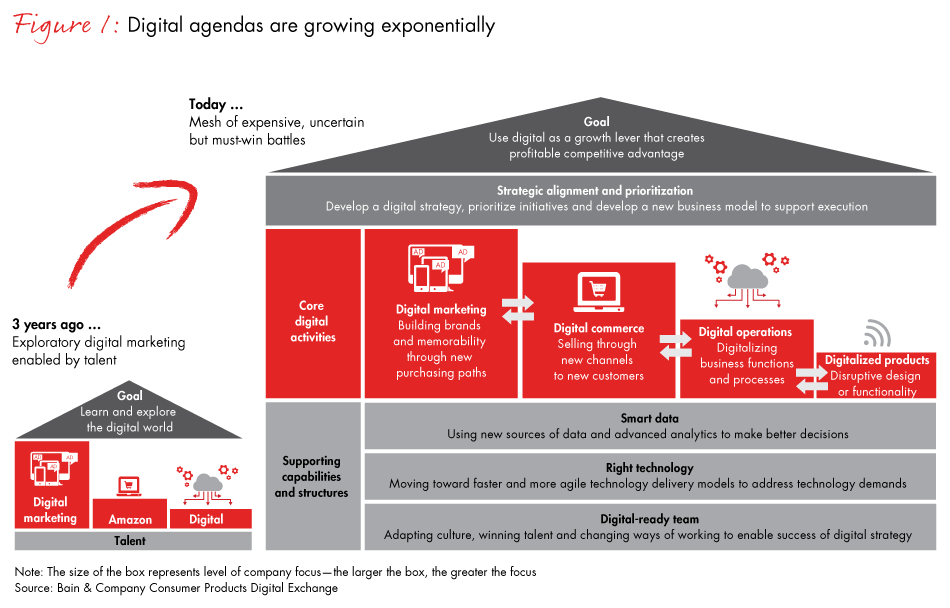
The byproduct of all this activity is what we call digital complexity and it is leaving many consumer goods companies struggling to dynamically allocate resources across digital opportunities, to spread learnings among brands and countries and to keep pace with digital innovation.
To get a clear picture of the stakes, the efforts, the headaches and the success factors, Bain & Company interviewed executives at many leading consumer goods and retail companies, technology providers and advertising agencies, among other experts, while drawing on our experience helping companies across industries adapt to digital challenges. Our insights helped us understand the dimensions of the evolving digital agenda and the best path forward for consumer goods brands hoping to outpace the competition amid these new realities.
The challenges go beyond spending more on digital initiatives without seeing improved results. We also learned that the gaps between leaders and laggards are getting bigger. The nature of digital gives trailblazers an advantage, and the less digitally mature companies will find it increasingly difficult to catch up. E-commerce search algorithms favor brands with better historical digital sales, for example. Meanwhile, targeting digital marketing to consumers in turn creates more digital engagement, which then delivers better data to target with. Digital talent and agile culture beget better talent and culture. The list goes on.
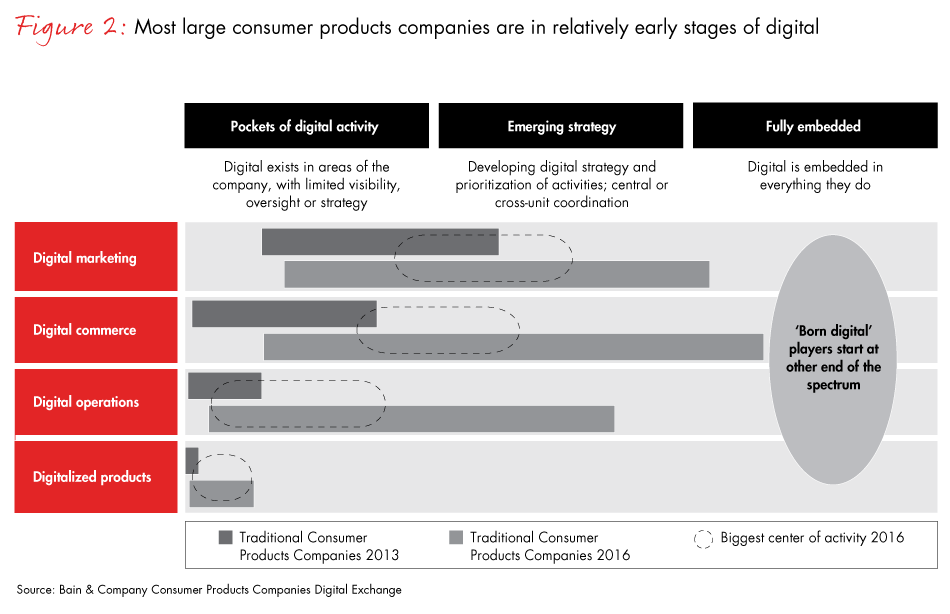
While some players have emerged as digital leaders and provide critical lessons, no single company has figured everything out. Insurgent brands start with digital fully embedded in their organizations, while most scale consumer products companies still rely on pockets of digital activity or are in relatively early stages of acting on their strategies in one or more aspects of digital (see Figure 2). However, smart choices and nimble ways of working can accelerate progress and set new standards for the industry.
Our research has helped us understand how companies looking to deliver results across the critical areas of marketing, commerce, operations and products can be guided by three fundamental rules. First, companies need to move from digital experimentation to a clear digital strategy. Also, companies need to understand the value of simplicity, both to free up funds and to realize the full potential of digital. Rather than layering on new initiatives, or digitalizing existing processes, they need to simplify instead. Finally, companies need to reboot information technology (see below, “A quiz to get you started”). We’ll look at how these rules can be applied to deliver results across four key areas.
Digital marketing: Endless possibilities but scale challenges
As the first area of investment for many brands, digital marketing remains the most advanced dimension. As consumer touchpoints evolve and grow, leading companies are investing to uncover new ways to build brand memorability and connections with shoppers as they research, purchase and recommend products. Many now experiment with contextual communication as part of content strategy, delivering relevant communications closer to the point of purchase, such as geo-targeted or personalized ads. They’re also learning new marketing paradigms—developing instincts for what makes a great 3-second ad vs. a 30-second spot, for example.
There are many challenges. Even the most digitally advanced companies grapple with growing marketing budgets that don’t produce incremental growth. They struggle to define the distinct role that digital should play across marketing vehicles and to develop inspiring, brand-right, channel-right content. In a recent Bain marketing survey, less than one-third of consumer goods company respondents described their campaigns and offers as integrated across traditional and digital marketing vehicles. Moreover, companies tell us that they face capability gaps and organizational barriers that hinder results. For example, they need to abandon their traditional, long lead-time campaign development approach in favor of “newsroom-like” decision-making speed.
Despite these and other challenges, some pioneering companies are making great strides in digital marketing. Kellogg’s developed a system to balance the advertising impressions it provides for consumers with a data management platform (DMP) that actively reallocates digital impressions from low-value, over-served consumers (those receiving 15 or more impressions a month) to high-value, under-served consumers who receive only 1-to-3 impressions a month. Kellogg’s says the program saved the company $20.5 million in advertising costs. Three Squirrels broke new ground in digital marketing by providing customer service via animated squirrels on WeChat. Meanwhile, a global energy drink company uses a digital personalization engine to develop insights from retail basket feed data. By looking beyond aggregate daily tallies, it learned that product sales spiked during morning hours. The company pushed dynamic, targeted and relevant marketing in real time.
Based on our experience, many leading consumer goods companies start with a clear objective to boost household penetration and then figure out the role digital marketing can play. For example, Coke’s pioneering “Share a Coke” campaign won marketing accolades for tapping into digital media and product personalization, yet was sparked from both a goal to expand global presence and a critical insight: 50% of Australia’s teenagers and young adults had never tasted a Coke. In an effort to create a personal connection that would spur this consumer segment to drink Coke, the company swapped out Coke branding on cans with some of the most popular Australian names. The effort included a print and digital ad campaign targeting young adults. Participants could text in their friend’s name, which would appear on a big visual display that could be messaged to the friend. Hence the idea to “Share a Coke” with friends. The result was a 7% rise in sales for that segment and Coke Australia’s most successful summer.
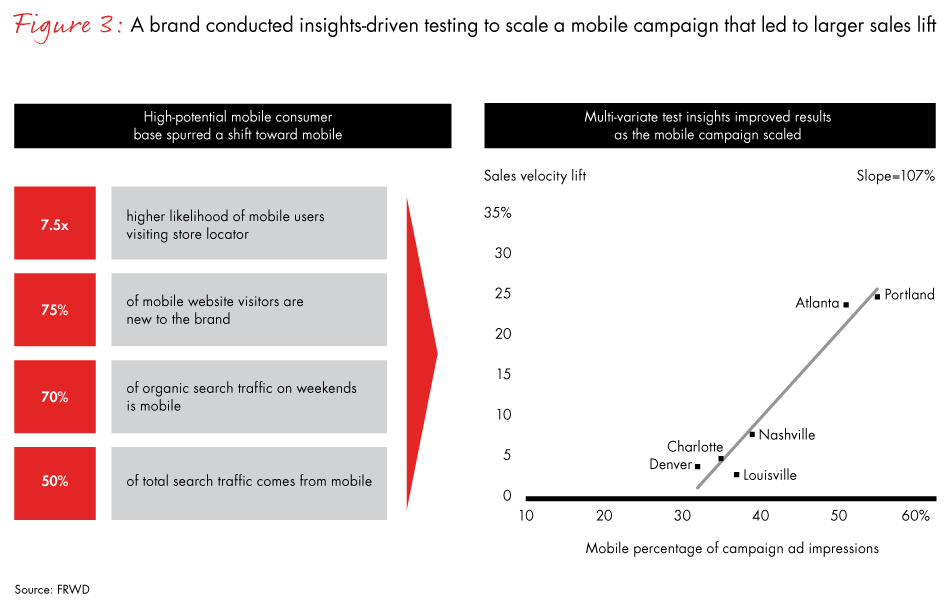
Digital marketing leaders also master test-and-learn capabilities, investing in the requisite data and technology and dedicating as much as 10%–15% of their total marketing budgets to the approach. This does not mean they try a lot of new things to see what works. Rather, they define clear hypotheses on what will prompt increased penetration, design multivariate tests and scale rapidly based on in-market results. One new snack food brand felt that consumers want the product when out and about, where mobile plays a big role. Determining that 70% of its organic search traffic and 50% of its total search traffic was from mobile, it ran a series of localized mobile campaign tests that quickly scaled to broader geographic reach based on sales lift results. It learned that video or display ads alone didn’t generate a significant amount of sales volume. What was more effective: a combination in which video was used initially, followed by a sequencing of display ads on Friday through Sunday—a heavy snack-shopping period. The mobile display ads effectively reinforced the video, keeping the product top of mind— and generated more than three times ROI in some markets. Another important finding: Ads that showcased the brand value and relevance to the consumer outperformed ads offering a 50% discount at a participating retailer. Refining the campaign based on these findings boosted results dramatically: For each point of mobile impression share growth, sales velocity grew 1.1 points (see Figure 3).
Digital commerce: Improving distribution in a fragmented and needy channel
The majority of future growth for many brands will come from digital commerce, in particular online and mobile channels. Online grocery penetration alone is expected to grow by 15% annually through 2025. That’s why leaders are gearing up to partner with the top digital retailers, optimizing web search and honing online product assortments. Some are also selectively experimenting with direct-to-consumer models.
But while digital commerce is an important path to growth and many company executives readily admit that their millennial consumers prefer buying online rather than in stores, there’s a paradox: Most traditional companies, especially food and beverage players, are moving cautiously to manage channel conflict and profitability. Some companies fail to think through the right assortments or pack sizes for digital. For example, it may be cost-effective to ship bulk packs of shampoo, but do consumers really want to purchase 24 bottles at once? Food and beverage players say online retailers are top-priority customers, yet too few assemble the required cross-functional “A” teams to turn those accounts into growth stories. Many also haven’t developed new capabilities to serve different business models and unique needs. A simple example: a supply chain built to ship pallets is not well-suited to direct-to-consumer models that ship smaller volumes or individual packs.
Leaders avoid getting stuck in the paradox. Here’s how.
- Leaders understand that winning in digital commerce means recognizing that there isn’t a single e-commerce model. Indeed, what it takes to win with click-and-mortar generalists, pure play generalists, pure play marketplaces, and direct-to-consumer companies are very different. Amazon has a product-centric approach, while Alibaba focuses more on flagship stores and brands.
- Leaders determine which categories and brands to initially target, tailoring the proposition to the digital channel—what brands, what prices, what products—just as they target products for traditional channels. The objective is to prioritize the largest customers in key markets, developing deep partnerships and using the best talent.
- Leaders strive to deliver a better shopping experience than competitors. Most companies are losing in the battle to provide the perfect online shopping experience, but to see the right approach in action, look at Unilever’s ambitious effort to improve the way its products are displayed on mobile phones, the channel of choice for a growing swath of consumers. The mobile display effort is one of the reasons Unilever’s online sales grew at twice the rate of the global e-commerce market in 2015.
Digital operations: The sleeping giant
As exponential growth of the Internet of Things, Big Data, computing power and improved hardware converges, digital disruption of operations is advancing at unprecedented rates. The benefits are powerful. Yet to date, the beneficiaries are few.
A San Francisco-based division of Nestlé tapped advanced analytics to improve demand forecasting and better understand the impact of fluctuating promotions, a move that helped reduce safety stock inventory by around 15%. At Levi’s, real-time inventory monitoring using RFID has boosted both inventory accuracy and customer service. Companies such as Costa Coffee that have installed a cloud system to enable automatic replenishment have reduced annual logistics costs by 30%.
Others, like Coca-Cola Amatil (CCA) in Australia which invested in automated warehouses, processes and guided vehicles have watched stock accuracy increase from 80% to 98%, or truck loading time fall from 25 minutes to 7 minutes. The trouble is, paralyzed by the high capital costs and risks associated with major innovation, most companies typically limit their focus to incremental improvements of existing operations as opposed to strategic moves. While many operations executives feel pressure to digitize, supply continuity is critical and disruptions can be costly.
Looking to digital only for incremental year-over-year improvements may create even greater risk, however. This approach may solve some backward-looking problems, but digital changes the entire rules of the game. As consumers increasingly value specialized—or even customized—products delivered almost immediately, it isn’t hard to imagine a scenario where smaller manufacturing sites, capable of cost-effective mass customization, are located close to demand and can produce and deliver products in near-real time. This could make existing multi-billion dollar supply chains irrelevant, or at a minimum, uncompetitive.
Instead, leaders are looking years into the future, articulating a long-term vision for operations, and establishing a governance process to support potential disruptive moves. They partner with third-party technology providers to serve key business needs and develop in-house capabilities to spur innovation.
Digitalized products: Disrupt before being disrupted
Brands are still in the early days of using digital advances to improve existing products or introduce new ones. Most of the effort thus far has been experimental, and focused mainly on relatively minor enhancements such as interactive packaging. Yet opportunities to innovate abound. Can freshness or weight-bearing replenishment sensors offer a competitive advantage? Will customized formulations or 3-D printing systems disrupt how we eat and shop? The future is uncertain but as technology costs decline, the possibilities multiply for innovations such as Laser Food’s laser-engraved fruit and produce.
Many of the most promising innovations will come from companies that apply Agile development principles to quickly test products with consumers. Agile principles, such as dividing the time spent on work into smaller “pieces” called sprints and evaluating prioritized backlogs based on value potential, will speed a company’s ability to respond to customer needs or keep them focused on the most valuable initiatives (see the Bain Brief, “Agile Innovation”).
Spanning functions for success
We’ve described digital activities in functions, but digital innovation typically requires breaking down functional silos. Transaction-enabled marketing requires partnerships with marketing and sales to ensure seamless fulfillment, for example. Excellence in e-commerce requires supply chain collaborations to solve for different logistics models. It is when more than one of the activities excels that you begin to see the most disruptive outcomes. Dollar Shave Club’s viral marketing success coupled with its direct-to-consumer subscription commerce model enabled the new company to capture 8% market share in just a few years.
Born-digital companies like Dollar Shave often have another edge on incumbents: underlying capabilities that are the foundation for cross-functional digital activities. Such companies rely on smart data to generate invaluable consumer, shopper and customer insights and dynamically make decisions across business units. IT departments are not service centers focused on efficiency and productivity; they are strategic differentiators, building the right technology for meeting the new challenges. And because digital requires a fundamentally different culture, they assemble digital-ready teams and adapt their ways of working.
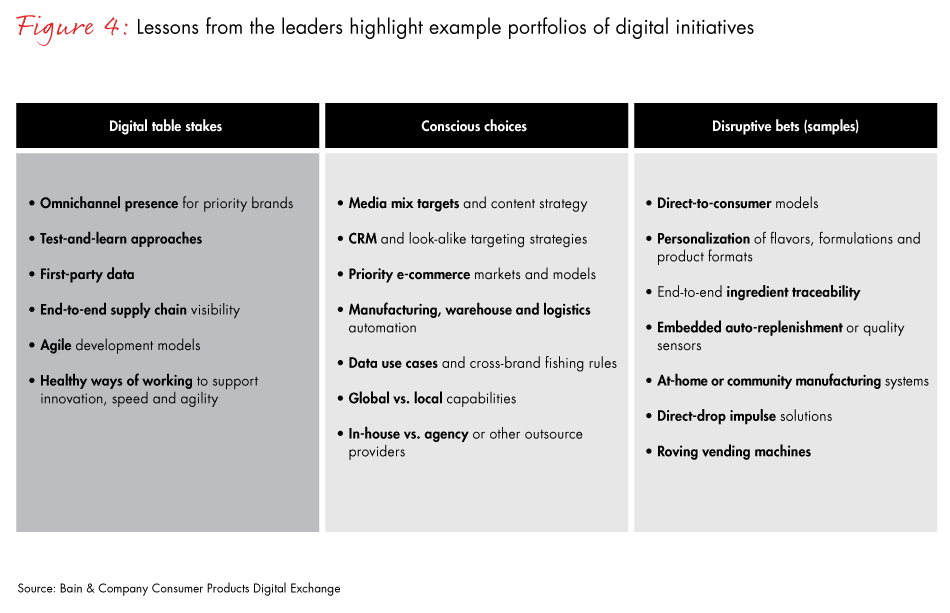
Moreover, leaders tell us they line up potential initiatives to include not only the table stakes that are necessary to stay competitive but also a mix of conscious choices that boost their capabilities as well as disruptive bets that give them an edge over rivals and can change the nature of the game (see Figure 4).
For any established company, getting started can feel daunting. In our experience, though, the most successful take a systematic approach that enables them to juggle multiple potential initiatives and then focus on those that matter most to their customers, their consumers, their brands and their business (see Figure 5). Consider the experience of a multinational foods company that knew it needed to embark on a bold digital transformation to stay relevant in its industry. The company began the journey with a series of ideation workshops to surface key digital opportunities—everything from potential new ways to use digital for increasing reach to ways to standardize processes to enable the benefits of digital. Cross-functional teams sparked holistic thinking. For example, supply chains and sales teams brainstormed with technology gurus to improve direct store distribution effectiveness and reduce vehicle operating costs.
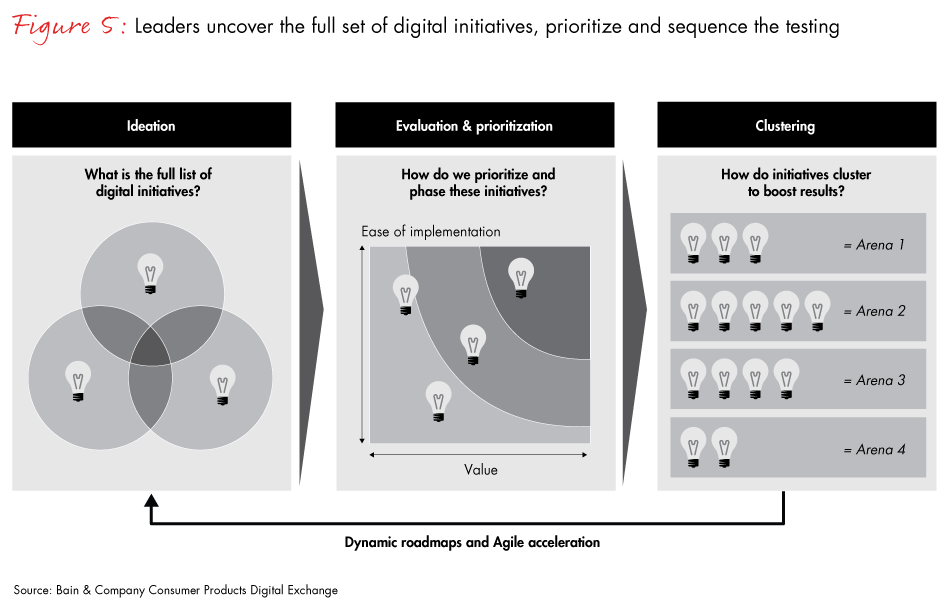
The company generated numerous initiatives, which it prioritized by clustering them into three macro themes that would enable broader corporate strategy: digital consumer engagement, digitalization of workflows and digital sales channels. Ultimately, the company refined its operating model—not only to deliver the chosen efforts but to continually evaluate and source opportunities in the future. The specific initiatives will change over time as they pilot and learn and technology evolves, but their signposts are clear and can guide a more dynamic resourcing process.
In the long run, that’s what any digital transformation should be all about: Finding new ways to market, sell, operate and innovate that don’t simply add cost and complexity but continually reinforce the company’s new and more relevant capabilities—making them future proof.
A quiz to get you started
Our executive interviews and research helped us understand what “digitally ready” companies look like and identify the questions you should ask to understand how a company fares. Answer each question yes or no. If you answer “yes” fewer than three times, you’re in trouble. More than ten means you’re a leader.
Move from digital experimentation to strategy
- Is your team aligned around the highest-impact applications of digital across the business?
- Does your portfolio of digital initiatives across marketing, commerce, operations and products support your strategic priorities?
- Is there an appropriate mix of initiatives across marketing, commerce, operations and products to defend your core plus more disruptive bets?
- Are you resourcing priorities effectively (time, talent, money) with clear decision rights and accountabilities, and building repeatable capabilities?
Embrace the power of simplicity
- Do your priorities and initiatives include cost-saving efforts to help fund digital investments?
- Are you using digital to fix faulty process vs. risking creating a faulty digital process?
- Have you identified the most important “micro-battles” to win and get started?
- Do initiative teams embrace Agile principles to deliver smaller functionality faster?
Reboot technology for digital
- Do you have a modern, flexible architecture stack that can support your digital ambitions?
- Is your software development model sufficiently Agile, including cross-functional ownership with nimble funding, governance and talent management?
- Do your technology tools (workflow software, analytics) allow you to better understand your customers and consumers and act on that data?
- Are you appropriately funding and resourcing products across (1) New initiatives, (2) “Keep the lights on” efforts, (3) Necessary technology refresh and modernization, while keeping overall costs in-line with relevant benchmarks?
Richard Webster is a Bain & Company partner based in London and a leader in Bain’s Consumer Products practice. Suzanne Tager is the Consumer Products practice area senior director based in New York and Vijay Vishwanath is a partner in Bain’s Consumer Products practice based in Boston.
First published in mars 2017