
Skip to Content
  • Bureaux

    Bureaux

    Amérique du Nord et Amérique du Sud
    • Atlanta
    • Austin
    • Bogota
    • Boston
    • Buenos Aires
    • Chicago
    • Dallas
    • Denver
    • Houston
    • Los Angeles
    • Mexico City
    • Minneapolis
    • Monterrey
    • Montreal
    • New York
    • Rio de Janeiro
    • San Francisco
    • Santiago
    • São Paulo
    • Seattle
    • Silicon Valley
    • Toronto
    • Washington, DC
    Europe, Moyen-Orient et Afrique
    • Amsterdam
    • Athens
    • Berlin
    • Brussels
    • Copenhagen
    • Doha
    • Dubai
    • Dusseldorf
    • Frankfurt
    • Helsinki
    • Istanbul
    • Johannesburg
    • Kyiv
    • Lisbon
    • London
    • Madrid
    • Milan
    • Munich
    • Oslo
    • Paris
    • Riyadh
    • Rome
    • Stockholm
    • Vienna
    • Warsaw
    • Zurich
    Asie et Australie
    • Bangkok
    • Beijing
    • Bengaluru
    • Brisbane
    • Ho Chi Minh City
    • Hong Kong
    • Jakarta
    • Kuala Lumpur
    • Manila
    • Melbourne
    • Mumbai
    • New Delhi
    • Perth
    • Shanghai
    • Singapore
    • Sydney
    • Tokyo
    Voir tous les bureaux
  • Alumni
  • Presse
  • S’abonner
  • Contacter
  • Canada | Français

    Sélectionnez votre région et votre langue

    Global
    • Global (English)
    Amérique du Nord et Amérique du Sud
    • Brazil (Português)
    • Argentina (Español)
    • Canada (Français)
    • Chile (Español)
    • Colombia (Español)
    Europe, Moyen-Orient et Afrique
    • France (Français)
    • DACH Region (Deutsch)
    • Italy (Italiano)
    • Spain (Español)
    • Greece (Elliniká)
    Asie et Australie
    • China (中文版)
    • Korea (한국어)
    • Japan (日本語)
  • Saved items (0)
    Saved items (0)

    You have no saved items.

    Bookmark content that interests you and it will be saved here for you to read or share later.

    Explore Bain Insights
  • Expertises Sectorielles
    Menu principal

    Expertises Sectorielles

    • Aerospace et Défense
    • Agroalimentaire
    • Chimie
    • Infrastructures, BTP et Matériaux de Construction
    • Grande Consommation
    • Services Financiers
    • Santé
    • Engins & Equipements Industriels
    • Media et Divertissement
    • Metals
    • Mining
    • Pétrole & Gaz
    • Papier et Emballage
    • Private Equity
    • Secteur Public
    • Distribution
    • Technologie
    • Télécommunications
    • Transportation
    • Travel & Leisure
    • Utilities & Energies Renouvelables
  • Expertises Fonctionnelles
    Menu principal

    Expertises Fonctionnelles

    • Expérience Client
    • ESG
    • Innovation
    • Fusions et Acquisitions
    • Opérations
    • People & Organization
    • Private Equity
    • Sales & Marketing
    • Stratégie
    • IA, Perspectives et Solutions
    • Technology
    • Transformation
  • Digital
  • Points de Vue
  • About
    Menu principal

    About

    • Notre Activité
    • Nos Valeurs
    • Nos Collaborateurs et Notre Équipe Dirigeante
    • Notre Impact
    • Prix & Récompenses
    • Partenariats Internationaux
    Further: Our global responsibility
    • Sustainability
    • Impact Social
    • World Economic Forum
    Learn more about Further
  • Carrières
    Menu principal

    Carrières

    • Rejoignez-nous
      Carrières
      Rejoignez-nous
      • Find Your Place
      • Nos domaines d’expertise
      • Equipes multidisciplinaires
      • Étudiants
      • Stages et programmes
      • Événements de recrutement
    • La vie chez Bain
      Carrières
      La vie chez Bain
      • Blog: Inside Bain
      • Récits de carrière
      • Nos collaborateurs
      • Nos bureaux
      • Soutenir votre évolution professionnelle
      • Groupes d’affinités
      • Avantages chez Bain
    • Histoires d’impact
    • Notre processus de recrutement
      Carrières
      Notre processus de recrutement
      • Ce que vous pouvez attendre
      • Entretiens
    Trouver un poste
  • Bureaux
    Menu principal

    Bureaux

    • Amérique du Nord et Amérique du Sud
      Bureaux
      Amérique du Nord et Amérique du Sud
      • Atlanta
      • Austin
      • Bogota
      • Boston
      • Buenos Aires
      • Chicago
      • Dallas
      • Denver
      • Houston
      • Los Angeles
      • Mexico City
      • Minneapolis
      • Monterrey
      • Montreal
      • New York
      • Rio de Janeiro
      • San Francisco
      • Santiago
      • São Paulo
      • Seattle
      • Silicon Valley
      • Toronto
      • Washington, DC
    • Europe, Moyen-Orient et Afrique
      Bureaux
      Europe, Moyen-Orient et Afrique
      • Amsterdam
      • Athens
      • Berlin
      • Brussels
      • Copenhagen
      • Doha
      • Dubai
      • Dusseldorf
      • Frankfurt
      • Helsinki
      • Istanbul
      • Johannesburg
      • Kyiv
      • Lisbon
      • London
      • Madrid
      • Milan
      • Munich
      • Oslo
      • Paris
      • Riyadh
      • Rome
      • Stockholm
      • Vienna
      • Warsaw
      • Zurich
    • Asie et Australie
      Bureaux
      Asie et Australie
      • Bangkok
      • Beijing
      • Bengaluru
      • Brisbane
      • Ho Chi Minh City
      • Hong Kong
      • Jakarta
      • Kuala Lumpur
      • Manila
      • Melbourne
      • Mumbai
      • New Delhi
      • Perth
      • Shanghai
      • Singapore
      • Sydney
      • Tokyo
    Voir tous les bureaux
  • Alumni
  • Presse
  • S’abonner
  • Contacter
  • Canada | Français
    Menu principal

    Sélectionnez votre région et votre langue

    • Global
      Sélectionnez votre région et votre langue
      Global
      • Global (English)
    • Amérique du Nord et Amérique du Sud
      Sélectionnez votre région et votre langue
      Amérique du Nord et Amérique du Sud
      • Brazil (Português)
      • Argentina (Español)
      • Canada (Français)
      • Chile (Español)
      • Colombia (Español)
    • Europe, Moyen-Orient et Afrique
      Sélectionnez votre région et votre langue
      Europe, Moyen-Orient et Afrique
      • France (Français)
      • DACH Region (Deutsch)
      • Italy (Italiano)
      • Spain (Español)
      • Greece (Elliniká)
    • Asie et Australie
      Sélectionnez votre région et votre langue
      Asie et Australie
      • China (中文版)
      • Korea (한국어)
      • Japan (日本語)
  • Saved items  (0)
    Menu principal
    Saved items (0)

    You have no saved items.

    Bookmark content that interests you and it will be saved here for you to read or share later.

    Explore Bain Insights
  • Expertises Sectorielles
    • Expertises Sectorielles

      • Aerospace et Défense
      • Agroalimentaire
      • Chimie
      • Infrastructures, BTP et Matériaux de Construction
      • Grande Consommation
      • Services Financiers
      • Santé
      • Engins & Equipements Industriels
      • Media et Divertissement
      • Metals
      • Mining
      • Pétrole & Gaz
      • Papier et Emballage
      • Private Equity
      • Secteur Public
      • Distribution
      • Technologie
      • Télécommunications
      • Transportation
      • Travel & Leisure
      • Utilities & Energies Renouvelables
  • Expertises Fonctionnelles
    • Expertises Fonctionnelles

      • Expérience Client
      • ESG
      • Innovation
      • Fusions et Acquisitions
      • Opérations
      • People & Organization
      • Private Equity
      • Sales & Marketing
      • Stratégie
      • IA, Perspectives et Solutions
      • Technology
      • Transformation
  • Digital
  • Points de Vue
  • Carrières
    Recherches les plus fréquentes
    • Agile
    • Digital
    • Stratégie
    Vos recherches précédentes
      Pages récemment visitées

      Content added to saved items

      Saved items (0)

      Removed from saved items

      Saved items (0)

      Etude

      Digital Attacker Banks’ Time Has Come

      Digital Attacker Banks’ Time Has Come

      Digital attackers are lower cost, faster to innovate and can transform their traditional parents.

      Par Fabrice Franzen, Vitor D'Agnoluzzo, et Bernardo Sebastião

      • min
      }

      Etude

      Digital Attacker Banks’ Time Has Come
      en
      En Bref
      • Digital attacker banks have demonstrated that they can delight customers, scale up quickly and expand into new products, geographies and customer segments.
      • Attackers’ cloud-native, cutting-edge technology platforms allow them to have much lower operating costs than most traditional incumbent banks.
      • As an alternative to embarking on a multiyear, hugely expensive systems transformation, some incumbent banks have launched attackers with the aim of transforming the core business.

      Digital attackers—that is, digital-only banks using a cloud-native, low-cost platform—historically were secondary banks for consumers. Many attackers garnered smaller deposits and more limited lending than traditional banks.

      Yet digital attackers have gained ground among consumers, and they hold more promise than initially meets the eye. Traditional banks risk losing market share if they don’t respond to these new models. An inflection point in adoption is near, as some attackers have shown that they can please customers and achieve a large scale. They are expanding from retail to small business accounts, from deposits and basic transactions to lending. As a result, venture capitalists and other investors have heavily funded digital attacker banks in recent years (see Figure 1).

      Figure 1
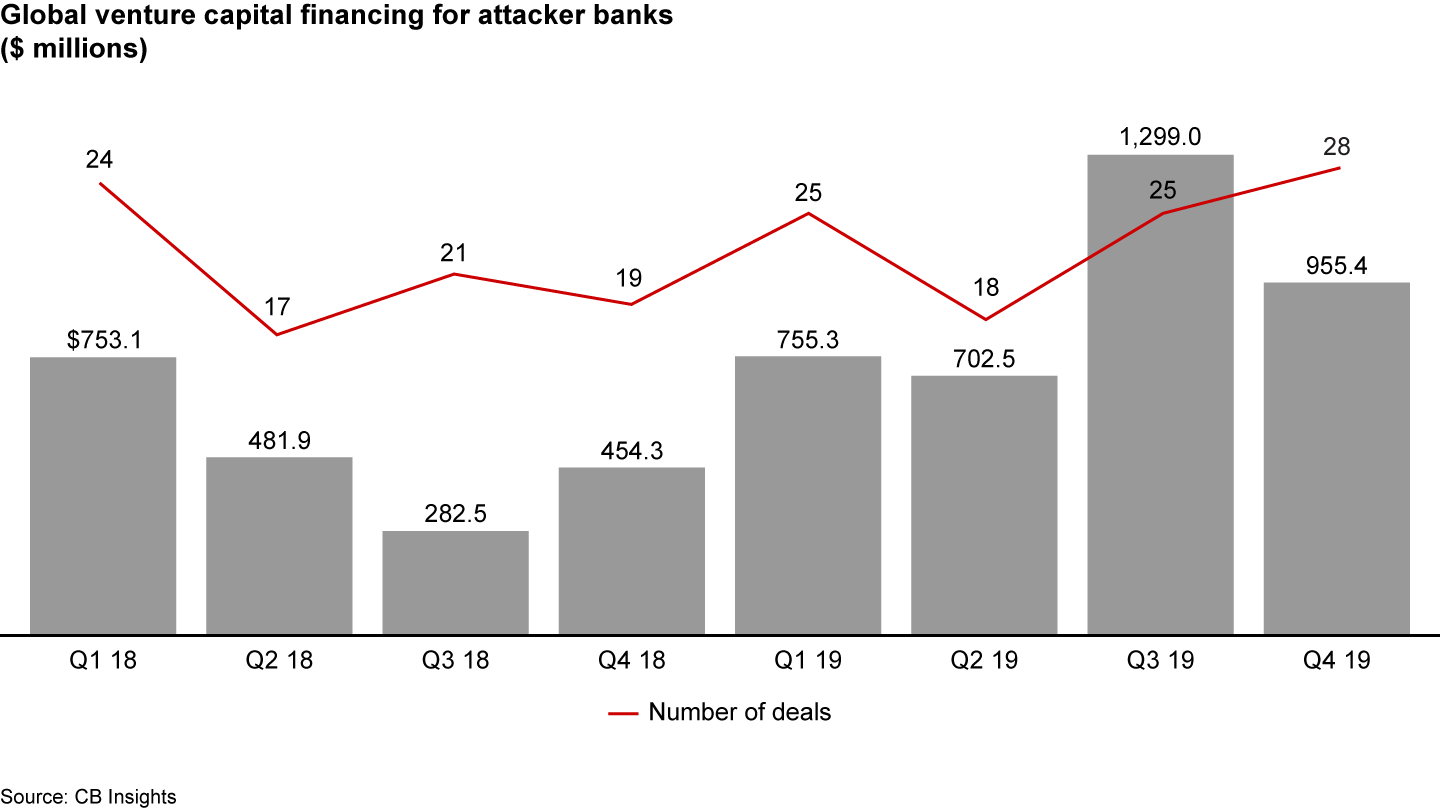
      Digital attacker banks are attracting heavy funding

      For instance, Nubank in Brazil has more than 25 million customers, making it one of the world’s largest digital banks. Nubank has put the smartphone at the heart of its strategy, and it has earned the region’s highest NPS Prism® score (a key metric of loyalty) for banks. Similarly, Kakao Bank attracted 10 million customers in just two years, and in 2019, it also had a customer loyalty score far above traditional banks in Korea, largely on the strength of its customer experience.

      In parallel, the ranks of traditional banks launching their own digital attackers has grown. Mettle, launched by NatWest, targets small UK businesses. Bradesco’s digital offering, Next, started by targeting underserved millennials in Brazil, and it has broadened its appeal to other underserved segments.

      Incumbent banks have realized the compelling logic of having a separate digital bank. Regulatory changes (such as open banking initiatives and the Revised Payment Services Directive, or PSD2, in the European Union) that are designed to promote innovation, better prices and a better experience have primed the field for more competition. Customer expectations have been redefined by technology firms offering personalized, easy, convenient services. To open a current checking account, for instance, takes an average of 81 clicks for 11 major incumbents analyzed in Europe, but it only takes 36 clicks on average for 5 attacker banks in Europe, according to the Centre for Finance, Technology and Entrepreneurship.

      Digital’s cost advantage

      On the revenue side, incumbents strategically can use an attacker bank to enter a new country or to improve their position within a customer segment such as millennials.

      Moreover, lower operating costs flow from having a modern, cloud-native technology platform. Analysis by Bain and Thought Machine finds that a digital attacker launched on such a platform could have a cost base that is 60% to 70% lower than a mid-tier legacy bank (see Figure 2). Bain’s comparison of four attackers with four major incumbents shows that attackers serve two to three times as many customers per employee.

      Figure 2
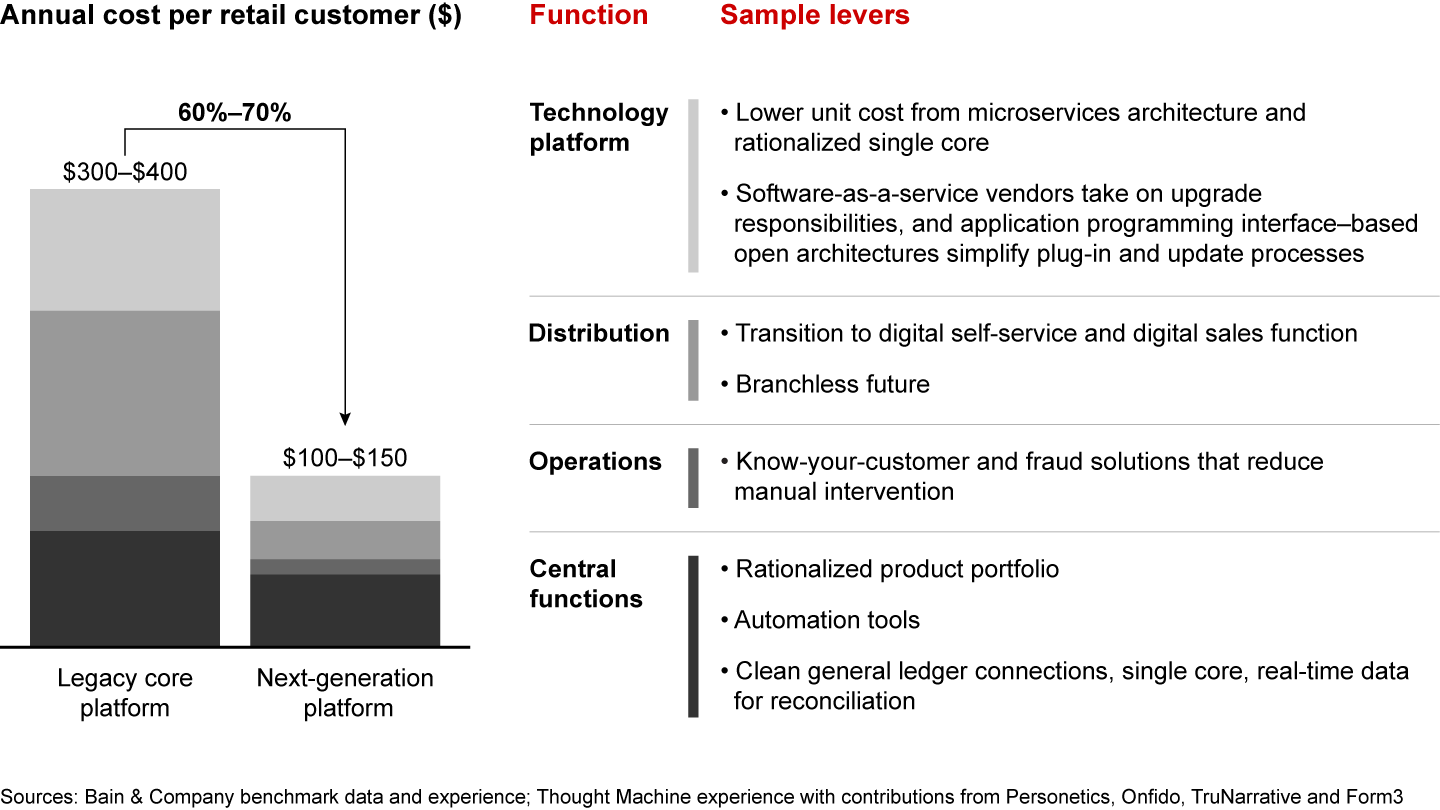
      A digital attacker bank on a cutting-edge technology platform could have a cost base 60%–70% lower than a mid-tier traditional bank

      Digital banks launched by incumbents have varying levels of integration with the parent company. Some incumbents treat their digital attacker as a separate entity with which to energize revenue growth by reaching underserved customer segments and quickly launching new products. They may also enjoy synergies with the existing business—for instance, by sharing fast, low-cost innovation.

      The child could transform the parent

      Other incumbents take a longer view, aiming to use the new bank to transform the core business by building very low-cost operations and more resilient technology. For example, Swedish bank SEB set up SEBx, a cloud-native technology platform, creating an in-house fintech to break with the traditional bank’s own legacy that will serve the broader SEB Group over time. This option holds perhaps the greatest promise as an alternative to embarking on a five-year, hugely expensive core banking transformation that risks causing a big-bang, all-at-once migration of customers.

      Whatever the motivation, success with an attacker bank hinges on several dimensions.

      • Monetization: From the outset, there should be a clear and realistic path to monetizing the strategy. Digital attackers have demonstrated that they can monetize by focusing on a specific customer segment with a narrow value proposition that addresses that segment’s needs.
      • A customer-centered proposition: The offering must align with customers’ needs and expectations. That’s why Marcus from Goldman Sachs has made inroads with affluent US millennials with its high-yield-interest savings product.
      • Speed of scaling: The ability to scale up quickly allows insurgents to penetrate their target segment. Bradesco’s Next reached 3.2 million customers in three years. By contrast, Chase shut down finn, its digital-only mobile banking platform, after only 47,000 customers had joined in a year.
      • Lean operations: The best bank platforms run low-cost operations by leveraging next-generation technology, as Revolut has demonstrated with its cloud-based core systems.
      • An ecosystem of partners: Many customers have begun to see value in obtaining related services through a single platform using open architecture for better integration. Starling’s third-party marketplace is one example, offering insurance, wealth management and tax tools.

      As with any new business, not all attackers will survive, much less thrive. Yet many have resonated with customers; digital attacker banks typically earn higher loyalty scores than regional and national incumbents. Digital attackers might start with less profitable parts of a market, but as they become the primary bank for more customers, they will grow and continue to take share from traditional banks. Younger customers are particularly open to using digital attackers, meaning that the pool of potential customers is bound to grow.

      So incumbents that embrace the scale insurgent mentality stand a better chance of defending their current business while also targeting new customer segments and new markets. It pays to act soon, however, as the window of time to build a strong attacker brand that will attract high-value customers is closing.


      NPS Prism® is a registered trademark of Bain & Company, Inc.

      Auteurs
      • Headshot of Fabrice Franzen
        Fabrice Franzen
        Partner, Middle East
      • Headshot of Vitor D'Agnoluzzo
        Vitor D'Agnoluzzo
        Partner, London
      • Headshot of Bernardo Sebastião
        Bernardo Sebastião
        Alumni, São Paulo
      Contactez-nous
      Synergies sectorielles
      • Banking
      • Fintech
      • Services Financiers
      Expertises fonctionnelles transverses
      • Digital
      • Technologies de l'information
      Services Financiers
      What Makes Digital Attacker Banks So Efficient?

      Digital-only banks have gained ground with consumers, and have lower operating costs than incumbent banks. Here’s why.

      Voir plus
      Services Financiers
      Can US Banks Protect Their Card-Issuing Business?

      Consumer payments have been gravitating to neobanks and technology firms.

      Voir plus
      Technologies de l'information
      Reimagining Merchandising in the Era of Agentic AI

      The future of merchandising is not better analysis, but faster, smarter execution—and agentic AI is what makes that possible.

      Voir plus
      Services Financiers
      The Fragmentation of Wholesale Payments Calls for Banks to Remake Their Approach

      Banks have a dominant position, but competitors look set to take market share.

      Voir plus
      Technologies de l'information
      Beyond AI Efficiency: A Conversation with Intuit’s Ivan Lazarov

      “Ultimately, we must be audacious enough to envision the impossible and bold enough to build it.”

      Voir plus
      First published in décembre 2020
      Mots clés
      • Banking
      • Digital
      • Fintech
      • Services Financiers
      • Technologies de l'information

      Comment nous avons aidé nos clients

      A Bold New Strategy Restores a Bank to a Leadership Position

      Lire l’étude de cas

      Blockchain-enabled Payment Flows: A Payments Company Reviews its Strategy

      Lire l’étude de cas

      A Digital-First Bank Finds a Customer-Driven Path to Profitability

      Lire l’étude de cas

      Vous souhaitez continuer cette conversation ?

      Nous aidons des dirigeants du monde entier à matérialiser des impacts et des résultats pérennes et créateurs de valeur dans leurs organisations.

      Les points de vue de Bain : notre perspective sur des problématiques auxquelles sont confrontées les entreprises à travers le monde, envoyés chaque mois dans votre boîte de réception. 

      *J’ai lu la politique de confidentialité et j’accepte les conditions.

      Merci de lire notre politique de confidentialité.
      Bain & Company
      Contactez-nous Sustainability Accessibility Conditions d’utilisation Politique de Confidentialité Cookie Policy Mentions Légales Sitemap Log In

      © 1996-2026 Bain & Company, Inc.

      Contacter Bain

      Comment pouvons-nous vous aider ?

      • Business inquiry
      • Career information
      • Press relations
      • Partnership request
      • Speaker request
      Voir tous les bureaux