

Etude

Chemical producers were among the first to use digital technologies extensively. From the days of the earliest digital plant controllers, they have used data to improve their operations. Their R&D teams have tapped large data sets in their search for better molecules and processes. And for at least 40 years, engineers have used computer-aided design (CAD) systems to design their plants.
However, in recent years, the chemicals sector has fallen behind companies in banking, retail, media and telecom that have explored innovative ways to use digital technology to improve their businesses—not only in running their operations, but also in engaging customers and generating new value. Now, chemical companies are innovating again to catch up. As the traditional sources of competitive advantage (access to feedstock, scale assets, process technology and market access) become well-established, new business models are emerging that threaten to disrupt traditional value chains.
In our work with chemical executives, we see a range of ways that they are seeking to use digital technologies to create new sustainable advantage for their industry. These executives want to understand how their world will be different in five to 10 years so they can take advantage of the changes, or at least future-proof their companies. At the same time, they need to identify their short-term priorities. Bombarded by unfiltered ideas, they need to frame and prioritize the opportunities to use digital technologies to improve operations and develop topline opportunities, including new products and services.
Bain’s research on this topic identifies three areas where digital technologies show potential: customer engagement, products and services, and operations (see Figure 1). To seize these opportunities, companies will need a comprehensive digital vision supported by new capabilities, platforms, data analytics and changes in business and operating model.
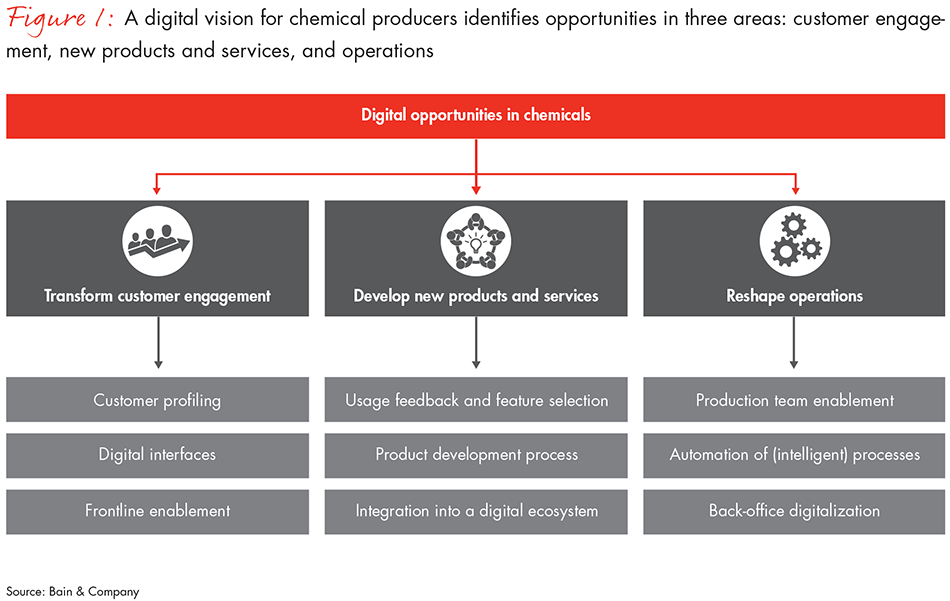
Customer engagement
Mobile, social and web interfaces give customers (businesses and consumers) greater transparency into their suppliers, including specifications, product availability, performance ratings and alternative suppliers. Digitalization provides an opportunity for chemical producers to rethink the customer relationship, to take a more customer-centric view and to focus on improving the customer experience. Analyzing customer interactions across the value chain, from shopping through purchasing and after-sales interactions, makes it possible to understand customers and their businesses better, anticipating their needs and helping them improve the way they use products and services.
Customers use new technologies differently, depending on factors like geography and age. Bain research found that while only half of UK customers look online before buying coatings, 90% of China’s buyers do. UK customers checked out paint colors and prices, while in China they were more interested in design ideas and ratings of suppliers.
Of course, chemical producers will need to revisit how they interact with their business customers, too. Digital technologies will help reconfigure supply chains to reduce inventory and speed up transactions. Companies will digitize and automate core business processes such as order-to-cash. They will equip salesforce teams with tools that simulate how their products will improve life for customers. Marketing and planning teams will have access to richer flows of real-time information to facilitate decision making.
Some chemical companies are already using digital technologies in creative ways to improve salesforce effectiveness. One lubricant producer that equipped its salesforce with computer tablets found that this not only improved the quality of sales presentations but, more important, it also enabled it to collect data on how the salesforce was spending time with customers. It then used this information to fine tune its customer segmentation and provide better coaching to individual salespeople.
New products and services
Digital technology opens the way for new products and services. At its most basic, the rise of digital technologies creates demand for associated chemicals, such as ultra-pure chemicals used in electronics production, battery chemicals, and ABS or PLA filaments,1 which are used in 3-D printing.
Beyond producing molecules, suppliers increasingly want to offer “molecules plus service” to strengthen customer loyalty and capture greater margin. This will disrupt and reform value chains, and existing models may prove inefficient. Some chemical producers are moving into completely new territory, such as software as a service (SaaS), which they bundle with products to help customers convey a value proposition while reducing costs.
Industrial gases might be perceived as the purest form of the commodity chemicals business. One retail application is supplying oxygen cylinders to patients with chronic lung conditions in their own homes. Digital technologies allow oxygen suppliers to collect huge amounts of data on these distributed cylinders, allowing them to anticipate replacement cycles and perhaps develop related pharmaceutical products. This can help reduce patients’ healthcare costs while also creating the potential for new revenue.
The pace of change is accelerating in chemicals and other industries, and product development cycles are condensing. New development processes, including rapid prototyping and parallel experimentation supported by data analytics, can help companies respond.
Peter Guarraia, who leads Bain's Chemicals practice in the Americas, identifies three areas that chemical companies must address to successfully capitalize on the emerging opportunities in digital.
Core operations
For decades, chemical producers have used remote sensing and communications technologies such as supervisory control and data acquisition to run their plants and optimize production processes. Condition monitoring of critical plant items has improved the predictability of maintenance. The main change brought on by digitalization is that the number of sensors and the amount of data that operators must manage are increasing by one or two orders of magnitude.
As the costs of thermal and vibration sensors have dropped, their use has grown. Chemical companies have more data than ever to improve product quality and yield, while reducing costs. Engineers can monitor plant operations to ensure they are within the design parameters, and they can see when equipment shows risks of failure—all of which helps improve plant reliability.
While the opportunity to improve operations grows, so does the challenge of extracting meaningful information from volumes of data. Companies need to develop new analytic capabilities to draw meaningful insights, and a whole industry of third-party solution providers that can help make the most out of their data has risen up. Already, those insights are helping producers make better decisions about when to perform maintenance or replace parts or equipment. Increasingly, these insights will help them monitor the production of chemicals in real time, offering recommendations or even adjusting processes to optimize the mix.
Digitalization also helps improve resource management, particularly with the field force. Custom apps on mobile phones and wireless tablets can help keep the entire team informed about who is where doing what job and with what capabilities. This can raise productivity by intelligently routing techs from one task to the next without the need to return to the dispatch point or warehouse. Companies can pre-stage repairs more efficiently to make better use of skilled workers’ time. In fact, with better resource management, wrench time could rise from as low as one-third of working hours to as high as two-thirds, based on Bain research.
Priorities for different chemical businesses
Chemical executives must decide where and how to invest in digital technologies, depending on their priorities and their place in the market. Deciding on the sequencing and pace of a digital transformation is a strategic exercise that depends on the goals of the business and the source of its competitive advantage, rather than the availability of new technology. As a result, no single size fits all (see Figure 2).
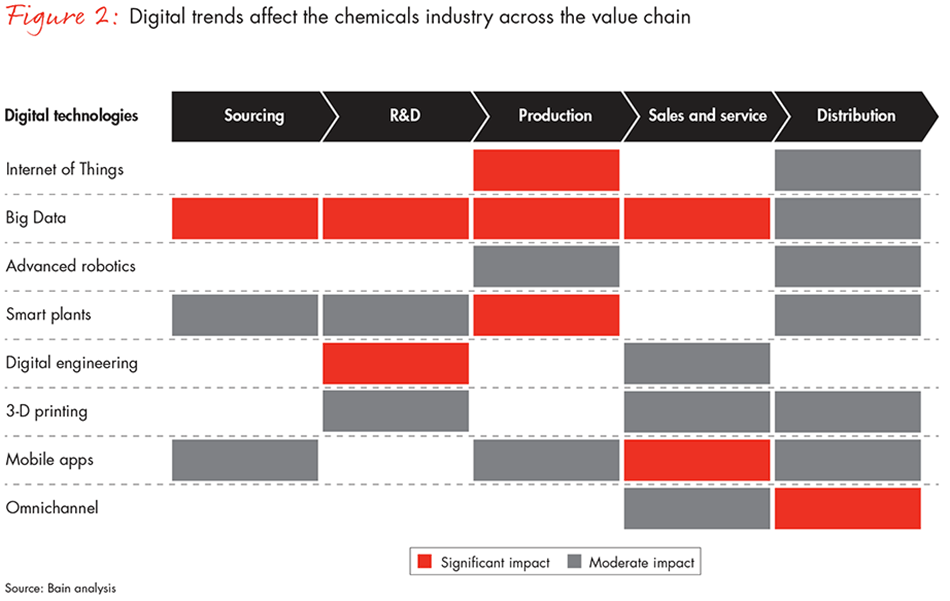
For some, customer interactions are the top priority. Data analytics and digital technologies enable sharper segmentation, higher value solutions and new customer-interaction models. Other companies may focus on improving operations: connected sensors and better analysis can help reduce downtime and speed up processes.
Another option is to invest in end-to-end digital technologies and interfaces between value chain steps. Data and analytics help producers recognize patterns and specific events, and they can apply these findings through mobile apps. These apps can provide better information in sourcing and production, or to the salesforce members who can use it to tailor offers more specifically to individual customers.
Finally, some companies may find specific opportunities at a given point in the value chain—for example, growth in 3-D printing has led to the demand for compounded and extruded filaments that retail around $30 per kilogram, compared with a base ABS polymer price around $2 to $3 per kilogram.
Making the transition
Successful transformations start by examining how digital is changing customer needs, the value chain and competitive offers. Given the bewildering array of digital solutions on offer from vendors, the critical question is “how can we better serve customers?” not “what can digital do for us?” Companies should assess their own digital initiatives (current and planned) and identify their capability gaps, their readiness for change, and the execution risks. Those risks include investing too thinly in digital initiatives, chasing too many opportunities at once, failing to develop the right roles with decision rights to put plans into action, and making do with existing IT talent where new digital capabilities are sorely needed.
With this assessment in hand, executives can begin to prioritize their digital initiatives for better customer engagement, new products and services and optimized operations. A blueprint with clear responsibilities and timelines can help focus teams and accelerate progress on the actions most likely to increase margins and raise share price.
In all cases, chemical producers should take a top-down, cross-functional approach that includes:
- Assessing opportunities and threats, by business and by function.
- Reconfiguring the operating model, the organizational design and business processes to support a digital company.
- Identifying capability gaps and learning to see technology and data skills as advantages rather than as back-office functions.
- Finding the right partners—not just technology vendors, but also those supplying complementary products. Most producers should partner with analytics service providers, rather than trying to build world-class analytics capabilities in house.
- Allocating capital and people where they can add the most value, setting targets and tracking progress with performance metrics.
Digital transformation offers a massive opportunity for chemical companies, but success requires thoughtful prioritization and investment in new talent and capabilities. Senior executives must be deliberate about picking opportunities for their market and regulatory environment. They should think of this as a multiyear journey, even though one of the most important aspects of this change will be acquiring the ability to innovate in short cycles and deploy new products and services more rapidly.
1 ABS is acrylonitrile butadiene styrene; PLA stands for polylactic acid. Both are thermoplastics used as material for 3-D printing. (For more information, see “Five Questions to Shape a Winning 3-D Printing Strategy.”)
Mark Porter is a partner with Bain & Company in London. Nathan Anderson and Peter Guarraia are Bain partners in Chicago. Francesco Cigala is a partner in Bain’s Kuala Lumpur office. All work with Bain’s Global Chemicals practice, which Guarraia leads in the Americas and Porter leads globally.
First published in août 2016