Skip to Content
  • Bureaux

    Bureaux

    Amérique du Nord et Amérique du Sud
    • Atlanta
    • Austin
    • Bogota
    • Boston
    • Buenos Aires
    • Chicago
    • Dallas
    • Denver
    • Houston
    • Los Angeles
    • Mexico City
    • Minneapolis
    • Monterrey
    • Montreal
    • New York
    • Rio de Janeiro
    • San Francisco
    • Santiago
    • São Paulo
    • Seattle
    • Silicon Valley
    • Toronto
    • Washington, DC
    Europe, Moyen-Orient et Afrique
    • Amsterdam
    • Athens
    • Berlin
    • Brussels
    • Copenhagen
    • Doha
    • Dubai
    • Dusseldorf
    • Frankfurt
    • Helsinki
    • Istanbul
    • Johannesburg
    • Kyiv
    • Lisbon
    • London
    • Madrid
    • Milan
    • Munich
    • Oslo
    • Paris
    • Riyadh
    • Rome
    • Stockholm
    • Vienna
    • Warsaw
    • Zurich
    Asie et Australie
    • Bangkok
    • Beijing
    • Bengaluru
    • Brisbane
    • Ho Chi Minh City
    • Hong Kong
    • Jakarta
    • Kuala Lumpur
    • Manila
    • Melbourne
    • Mumbai
    • New Delhi
    • Perth
    • Shanghai
    • Singapore
    • Sydney
    • Tokyo
    Voir tous les bureaux
  • Alumni
  • Presse
  • S’abonner
  • Contacter
  • Canada | Français

    Sélectionnez votre région et votre langue

    Global
    • Global (English)
    Amérique du Nord et Amérique du Sud
    • Brazil (Português)
    • Argentina (Español)
    • Canada (Français)
    • Chile (Español)
    • Colombia (Español)
    Europe, Moyen-Orient et Afrique
    • France (Français)
    • DACH Region (Deutsch)
    • Italy (Italiano)
    • Spain (Español)
    • Greece (Elliniká)
    Asie et Australie
    • China (中文版)
    • Korea (한국어)
    • Japan (日本語)
  • Saved items (0)
    Saved items (0)

    You have no saved items.

    Bookmark content that interests you and it will be saved here for you to read or share later.

    Explore Bain Insights
  • Expertises Sectorielles
    Menu principal

    Expertises Sectorielles

    • Aerospace et Défense
    • Agroalimentaire
    • Chimie
    • Infrastructures, BTP et Matériaux de Construction
    • Grande Consommation
    • Services Financiers
    • Santé
    • Engins & Equipements Industriels
    • Media et Divertissement
    • Metals
    • Mining
    • Pétrole & Gaz
    • Papier et Emballage
    • Private Equity
    • Secteur Public
    • Distribution
    • Technologie
    • Télécommunications
    • Transportation
    • Travel & Leisure
    • Utilities & Energies Renouvelables
  • Expertises Fonctionnelles
    Menu principal

    Expertises Fonctionnelles

    • Expérience Client
    • ESG
    • Innovation
    • Fusions et Acquisitions
    • Opérations
    • People & Organization
    • Private Equity
    • Sales & Marketing
    • Stratégie
    • IA, Perspectives et Solutions
    • Technology
    • Transformation
  • Digital
  • Points de Vue
  • About
    Menu principal

    About

    • Notre Activité
    • Nos Valeurs
    • Nos Collaborateurs et Notre Équipe Dirigeante
    • Notre Impact
    • Prix & Récompenses
    • Partenariats Internationaux
    Further: Our global responsibility
    • Sustainability
    • Impact Social
    • World Economic Forum
    Learn more about Further
  • Carrières
    Menu principal

    Carrières

    • Rejoignez-nous
      Carrières
      Rejoignez-nous
      • Find Your Place
      • Nos domaines d’expertise
      • Equipes multidisciplinaires
      • Étudiants
      • Stages et programmes
      • Événements de recrutement
    • La vie chez Bain
      Carrières
      La vie chez Bain
      • Blog: Inside Bain
      • Récits de carrière
      • Nos collaborateurs
      • Nos bureaux
      • Soutenir votre évolution professionnelle
      • Groupes d’affinités
      • Avantages chez Bain
    • Histoires d’impact
    • Notre processus de recrutement
      Carrières
      Notre processus de recrutement
      • Ce que vous pouvez attendre
      • Entretiens
    Trouver un poste
  • Bureaux
    Menu principal

    Bureaux

    • Amérique du Nord et Amérique du Sud
      Bureaux
      Amérique du Nord et Amérique du Sud
      • Atlanta
      • Austin
      • Bogota
      • Boston
      • Buenos Aires
      • Chicago
      • Dallas
      • Denver
      • Houston
      • Los Angeles
      • Mexico City
      • Minneapolis
      • Monterrey
      • Montreal
      • New York
      • Rio de Janeiro
      • San Francisco
      • Santiago
      • São Paulo
      • Seattle
      • Silicon Valley
      • Toronto
      • Washington, DC
    • Europe, Moyen-Orient et Afrique
      Bureaux
      Europe, Moyen-Orient et Afrique
      • Amsterdam
      • Athens
      • Berlin
      • Brussels
      • Copenhagen
      • Doha
      • Dubai
      • Dusseldorf
      • Frankfurt
      • Helsinki
      • Istanbul
      • Johannesburg
      • Kyiv
      • Lisbon
      • London
      • Madrid
      • Milan
      • Munich
      • Oslo
      • Paris
      • Riyadh
      • Rome
      • Stockholm
      • Vienna
      • Warsaw
      • Zurich
    • Asie et Australie
      Bureaux
      Asie et Australie
      • Bangkok
      • Beijing
      • Bengaluru
      • Brisbane
      • Ho Chi Minh City
      • Hong Kong
      • Jakarta
      • Kuala Lumpur
      • Manila
      • Melbourne
      • Mumbai
      • New Delhi
      • Perth
      • Shanghai
      • Singapore
      • Sydney
      • Tokyo
    Voir tous les bureaux
  • Alumni
  • Presse
  • S’abonner
  • Contacter
  • Canada | Français
    Menu principal

    Sélectionnez votre région et votre langue

    • Global
      Sélectionnez votre région et votre langue
      Global
      • Global (English)
    • Amérique du Nord et Amérique du Sud
      Sélectionnez votre région et votre langue
      Amérique du Nord et Amérique du Sud
      • Brazil (Português)
      • Argentina (Español)
      • Canada (Français)
      • Chile (Español)
      • Colombia (Español)
    • Europe, Moyen-Orient et Afrique
      Sélectionnez votre région et votre langue
      Europe, Moyen-Orient et Afrique
      • France (Français)
      • DACH Region (Deutsch)
      • Italy (Italiano)
      • Spain (Español)
      • Greece (Elliniká)
    • Asie et Australie
      Sélectionnez votre région et votre langue
      Asie et Australie
      • China (中文版)
      • Korea (한국어)
      • Japan (日本語)
  • Saved items  (0)
    Menu principal
    Saved items (0)

    You have no saved items.

    Bookmark content that interests you and it will be saved here for you to read or share later.

    Explore Bain Insights
  • Expertises Sectorielles
    • Expertises Sectorielles

      • Aerospace et Défense
      • Agroalimentaire
      • Chimie
      • Infrastructures, BTP et Matériaux de Construction
      • Grande Consommation
      • Services Financiers
      • Santé
      • Engins & Equipements Industriels
      • Media et Divertissement
      • Metals
      • Mining
      • Pétrole & Gaz
      • Papier et Emballage
      • Private Equity
      • Secteur Public
      • Distribution
      • Technologie
      • Télécommunications
      • Transportation
      • Travel & Leisure
      • Utilities & Energies Renouvelables
  • Expertises Fonctionnelles
    • Expertises Fonctionnelles

      • Expérience Client
      • ESG
      • Innovation
      • Fusions et Acquisitions
      • Opérations
      • People & Organization
      • Private Equity
      • Sales & Marketing
      • Stratégie
      • IA, Perspectives et Solutions
      • Technology
      • Transformation
  • Digital
  • Points de Vue
  • Carrières
    Recherches les plus fréquentes
    • Agile
    • Digital
    • Stratégie
    Vos recherches précédentes
      Pages récemment visitées

      Content added to saved items

      Saved items (0)

      Removed from saved items

      Saved items (0)

      Rapport

      Electric Vehicles Are Poised to Create a $100B+ Opportunity in India by 2030

      Electric Vehicles Are Poised to Create a $100B+ Opportunity in India by 2030

      Multiple new revenue and profit pools will emerge as electric vehicle growth continues.

      Par Deepak Jain, Mihir Sampat, Soojin Keum, et Sandhya K.

      • min
      }

      Rapport

      Electric Vehicles Are Poised to Create a $100B+ Opportunity in India by 2030
      en
      En Bref
      • The Indian electric vehicle (EV) market is expected to see 40%–45% EV adoption for two-wheel (2W) vehicles and 15%–20% for four-wheel (4W) passenger vehicles (PVs) by 2030, with 12 million to 13 million new 2W EVs and 1 million new 4W PVs being sold in India annually by 2030.
      • EV growth will create material new revenue and profit pools, generating $76 billion–$100 billion of cumulative revenue opportunity and $8 billion–$11 billion of profit across the EV value chain.
      • The new EV value chain will be materially different from today’s internal combustion engine (ICE) value chain: At least six new segments are emerging as promising EV-specific opportunities.


      India EV market at an inflection point

      In more mature global automotive markets, widespread EV penetration has depended on a confluence of factors. In the shift from ICE to EV, government support, original equipment manufacturer (OEM) investments, ecosystem build-out, relative vehicle cost competitiveness and performance, and consumer acceptance must marry to create a meaningful inflection point. The Indian automotive market is seeing many of these factors converge and is poised for rapid EV growth thanks to sustained stakeholder investments and efforts over the past few years.

      Government incentives

      Central and state governments are offering meaningful incentives to consumers to adopt EVs and suppliers to propel local manufacturing and ecosystem build-out.

      • Faster Adoption and Manufacturing of (Hybrid and) Electric Vehicles (FAME) offers consumer incentives across vehicle types along with a Phased Manufacturing Plan (PMP) to promote indigenous EV production and assembly. In its most recent iteration, FAME II has provisioned $1.1 billion in demand-led incentives, significantly reducing the capex gap vs. ICE for consumers while driving adoption. There is an additional $200 million provisioned for charging infrastructure setup and operation.
      • Production-linked incentive (PLI) schemes launched by the central government for advanced chemistry cell battery storage to drive local cell manufacturing.
      • Goods and Services Tax (GST) rate cuts and road tax waivers, supplemented by state-level subsidies and direct investments in electrifying fleets and setting up charging infrastructure.
      Download the PDF

      Improved cost competitiveness

      EVs offer significant operating (fuel and maintenance) cost savings over ICE vehicles, but the high up-front purchase cost has been a significant barrier to adoption. The gap in capital costs for EVs in India has materially reduced due to a sustained global decline in battery prices until 2021 (battery prices marginally increased in 2022 due to recent inflationary pressures) and continued government subsidies. For example, a high-speed 2W EV vehicle costs only 15%–20% more than its ICE equivalent in Delhi when you factor in FAME and state subsidies. Standalone capital costs are likely to decrease further, assuming an ongoing drop in battery prices (albeit at a slower rate) and increased localisation and scale of manufacturing for vehicles and components, which will eventually make EV capital costs competitive, even in the absence of material subsidies.

      From a total cost of ownership (TCO) perspective, EVs are already competitive, even at today’s pricing levels. Today’s leading 2W EVs have TCO that is up to 40% lower than comparable ICE models when used more than 40 kilometres a day. While TCO competitiveness is currently lower for electric 4W vehicles, high daily usage cases like ride-hailing and fleets are already seeing TCO advantages, and this is only improving.

      OEM investments in EV

      Cross-segment OEMs have started to take significant steps towards building an EV product slate for the Indian market and setting up the enabling ecosystem (charging and dealership networks, financing) to serve the market, often via partnerships with other players across the ecosystem.

      We have seen the most action on the 2W and three-wheel (3W) product front where, in addition to ambitious EV plans from domestic automotive incumbents like TVS and Bajaj, we have seen the emergence of a whole host of new EV OEMs, such as Ather, Ola, Ampere, Okinawa, and Hero Electric.

      Most major PV and commercial vehicle (CV) OEMs operating in India have also made preliminary market product introductions and have announced full EV product launch slates across the next few years. Domestic champions like Tata Motors and Mahindra are building an extensive EV portfolio for the Indian market, and global players like Hyundai and Mercedes are bringing their global EV platforms into India.

      Emerging EV supply chains and ecosystems

      There has been a slew of recent investments into building out an enabling ecosystem in India to drive mass adoption. This includes localised manufacturing and battery assembly, battery management systems (BMS), software and telematics, and components. There is also an emergence of charging infrastructure, mobility services, and platforms to meet end consumer needs.

      Increased customer readiness/EV awareness

      An increasing number of Indian customers are willing to buy EVs, according to a survey conducted by CarDekho and Omnicom Media Group last year. The survey found that 66% of customers are willing to buy EVs, and 68% showed environmental concern—they believe switching to EVs will help reduce air pollution. Corporate customers, especially in the e-commerce and logistics sectors, are also setting ambitious targets for electrifying their delivery fleets and reducing their overall carbon footprint. For example, both Flipkart and Zomato have pledged a 100% transition to EVs by 2030.

      These factors are leading to an inflection point for EV adoption in India—EV sales have accelerated significantly in the past year (albeit of a small base) and are likely to continue unabated. Our analysis indicates that 35%–40% of all vehicles sold in India by 2030 will be EVs (see Figure 1), up from 2% in 2022. This will equate to approximately 14 million to 16 million new EVs sold each year.

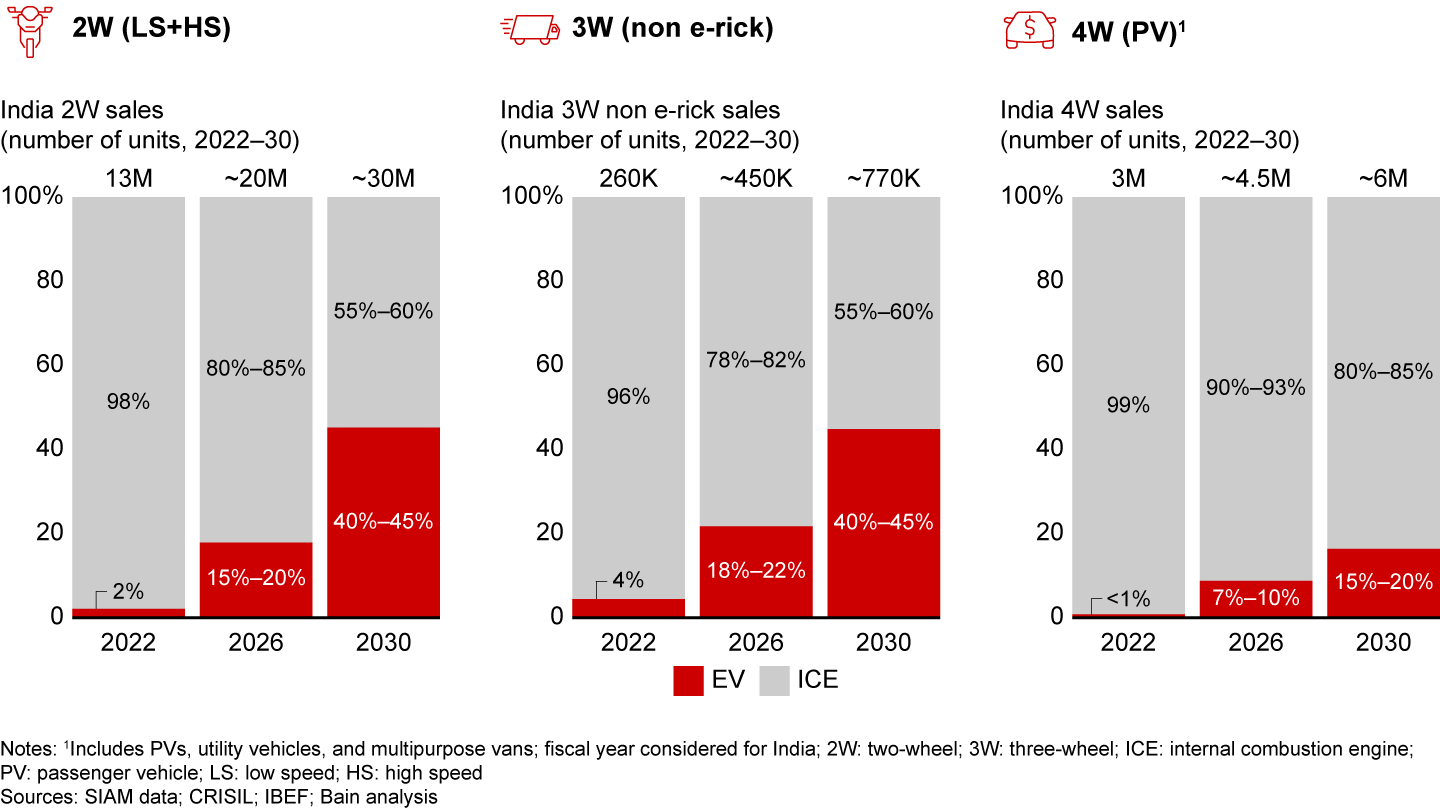
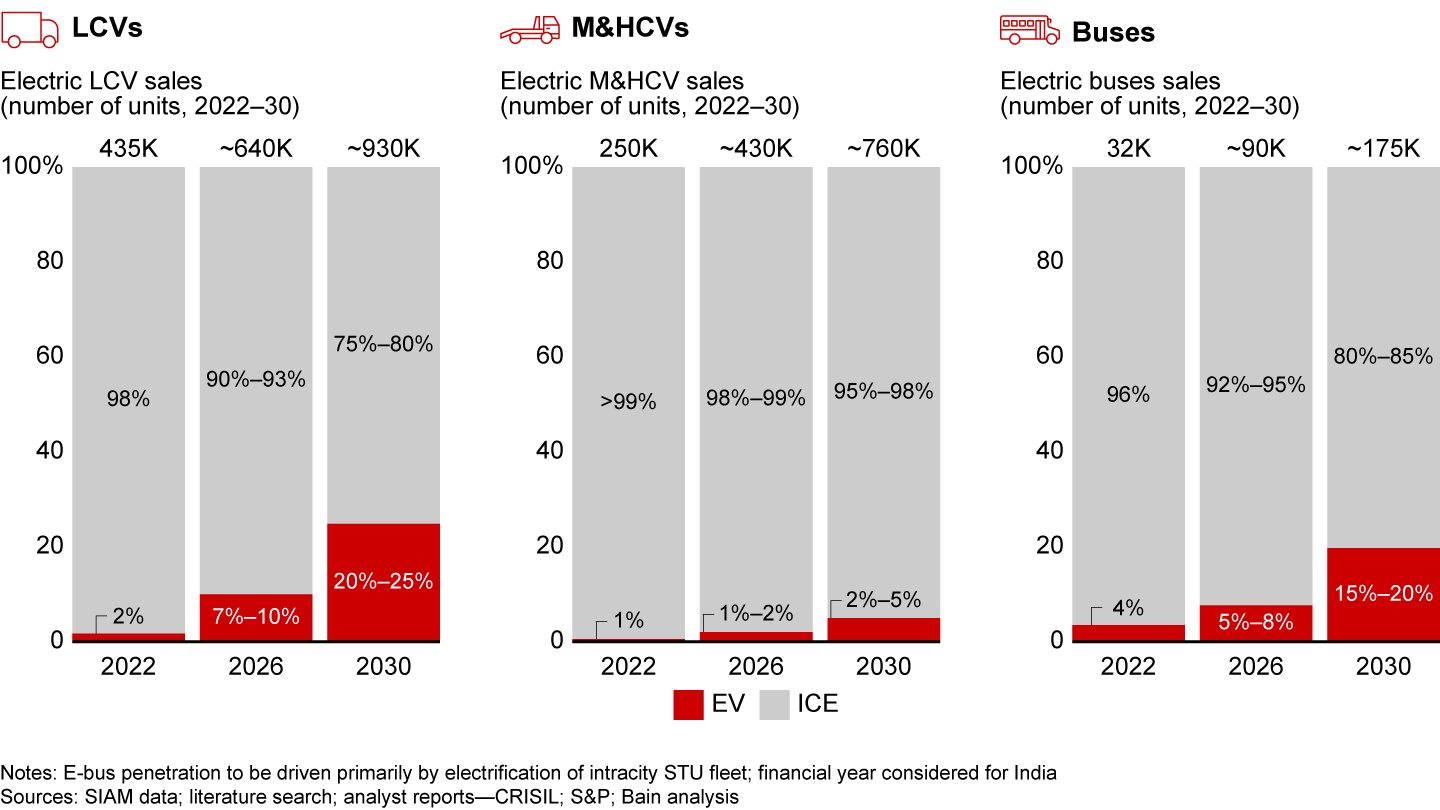
      • The 2W and 3W segments will be the vanguards for EV adoption, achieving 40%–45% penetration by 2030. This is driven by several factors, including highly competitive TCOs, limited need for public charging infrastructure given the adequacy of home charging for daily use, investments in building compelling product offerings with comparable performance to ICE vehicles, and early adoption by delivery and logistics fleets (see Figures 2a, 2b).
      • It’s likely that 4W PVs will remain behind on the adoption curve. Higher requirements for product performance and build-out of public charging infrastructure, plus higher capital cost and TCO gaps, serve as barriers to adoption. Even with these challenges, this segment is still expected to achieve 15%–20% market penetration within that same time frame.
      • Buses will see a penetration curve similar to that of PVs by 2030, driven in large part by State Transport Undertakings (STUs) focused on fleet electrification for intracity transport—already being pushed by multiple state governments.
      Figure 1
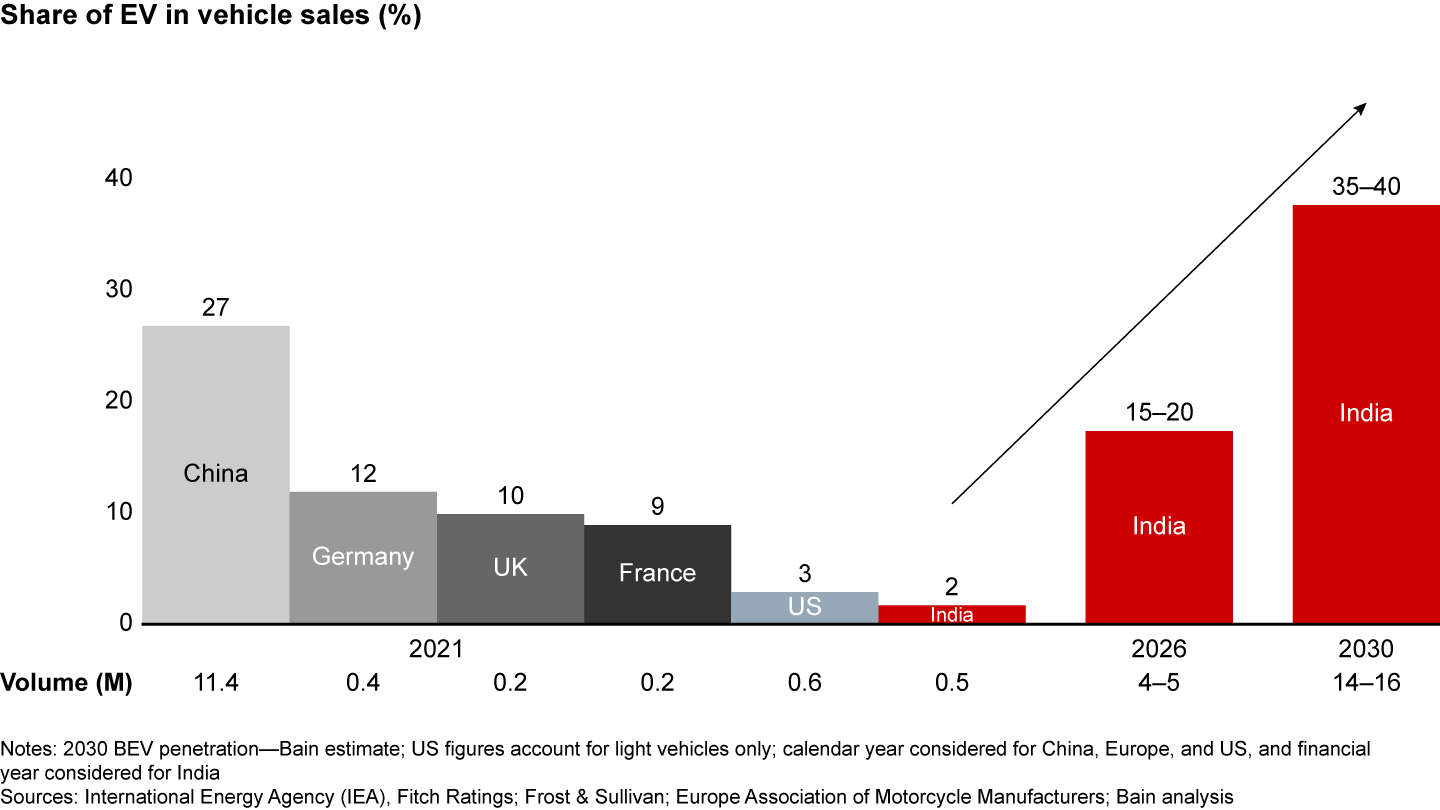
      By 2030, 35%–40% of all vehicles sold in India are expected to be battery electric vehicles (BEVs)
      By 2030, 35%–40% of all vehicles sold in India are expected to be battery electric vehicles (BEVs)
      By 2030, 35%–40% of all vehicles sold in India are expected to be battery electric vehicles (BEVs)
      Figure 2a
      BEV penetration in India for passenger vehicles is expected to reach up to 45% for 2W and 3W and 20% for 4W by fiscal year 2030 (FY30)
      BEV penetration in India for passenger vehicles is expected to reach up to 45% for 2W and 3W and 20% for 4W by fiscal year 2030 (FY30)
      BEV penetration in India for passenger vehicles is expected to reach up to 45% for 2W and 3W and 20% for 4W by fiscal year 2030 (FY30)
      Figure 2b
      For commercial vehicles in India, BEV market penetration will be more modest, with LCVs up to 25% and buses up to 20% by FY30
      For commercial vehicles in India, BEV market penetration will be more modest, with LCVs up to 25% and buses up to 20% by FY30
      For commercial vehicles in India, BEV market penetration will be more modest, with LCVs up to 25% and buses up to 20% by FY30
      Download the PDF
      Auteurs
      • Headshot of Deepak Jain
        Deepak Jain
        Alumni, New Delhi
      • Headshot of Mihir Sampat
        Mihir Sampat
        Partner, Mumbai
      • Soojin Keum
        Practice Senior Manager, Seoul
      • Sandhya K.
        Associate Partner, New Delhi
      Contactez-nous
      Synergies sectorielles
      • Produits et Services Industriels de pointe
      Electric Vehicles
      Navigating the Shifting Landscape Around EV Adoption

      At the 2025 FT Future of the Car Summit in London, Bain Partner Eric Zayer discusses how leaders are addressing the challenges facing the electric vehicle market.

      Voir plus
      Produits et Services Industriels de pointe
      Technology in Building Products: Turn Cost into Value

      Bain experts reveal how companies in the building products industry are unlocking growth with bold tech investments.

      Voir plus
      Electric Vehicles
      Renewable Fuels: Seizing the Generational Opportunity

      Leading companies are separating signal from noise and investing in a strategy reflecting their strengths.

      Voir plus
      Produits et Services Industriels de pointe
      Defense M&A

      Bold moves will determine the winners as a continent rearms.

      Voir plus
      Electric Vehicles
      When Less Is More: Shifting Gears in Automotive R&D

      To remain competitive, it’s time for traditional OEMs to prune product portfolios and boost R&D efficiency.

      Voir plus
      First published in décembre 2022
      Mots clés
      • Electric Vehicles
      • Produits et Services Industriels de pointe

      Comment nous avons aidé nos clients

      Supply Chain Security Mitigates a Sovereign Wealth Fund’s Construction Disruptions

      Lire l’étude de cas

      How an Airline Used a Global Stall to Give Procurement a Lift

      Lire l’étude de cas

      An auctioneer makes a winning online bid

      Lire l’étude de cas

      Vous souhaitez continuer cette conversation ?

      Nous aidons des dirigeants du monde entier à matérialiser des impacts et des résultats pérennes et créateurs de valeur dans leurs organisations.

      Les points de vue de Bain : notre perspective sur des problématiques auxquelles sont confrontées les entreprises à travers le monde, envoyés chaque mois dans votre boîte de réception. 

      *J’ai lu la politique de confidentialité et j’accepte les conditions.

      Merci de lire notre politique de confidentialité.
      Bain & Company
      Contactez-nous Sustainability Accessibility Conditions d’utilisation Politique de Confidentialité Cookie Policy Mentions Légales Sitemap Log In

      © 1996-2026 Bain & Company, Inc.

      Contacter Bain

      Comment pouvons-nous vous aider ?

      • Business inquiry
      • Career information
      • Press relations
      • Partnership request
      • Speaker request
      Voir tous les bureaux