

Etude

Additive manufacturing (AM) has finally moved beyond academia and hobbyists’ workshops to take hold in corporate settings. Although AM, also known as 3-D printing, accounts for slightly more than 0.03% of the $10 trillion-plus global manufacturing market, companies ranging from dental implant makers and automotive manufacturers to aerospace and defense firms now use this method to make prototypes and fully functional components.
Swiss manufacturer Sonova, for example, uses additive manufacturing to produce thousands of plastic shells for hearing aids daily. Airbus uses AM to produce plastic and metal brackets for jet aircraft. And GE Aviation has invested more than $50 million in an AM plant to mass-produce fuel nozzles for the next-generation LEAP jet engines.
Additive manufacturing, also known as 3-D printing, has reached a tipping point and many companies are now figuring out how to incorporate this technology into their own operations. Bain partner Pierluigi Serlenga explains how the best approach depends on the answers to a few key questions.
In additive manufacturing, physical items are built layer by layer, similar to how an inkjet printer lays down ink. Computer-aided design modeling takes digital images of a design or an object, then sends descriptions of these images to a machine that adds layers of plastic, metal or other material, often measured in microns, to create a 3-D object. Traditional manufacturing, on the other hand, creates components by removing excess material through turning and milling, or builds objects through injection molding, casting or forging.
What sets additive manufacturing apart is the ability to create almost any shape or structure with no geometric constraints and at little marginal cost. In fact, building certain structures—such as those resembling bamboo, lattice or trabeculae (thin columns of bone)—simply is not feasible with traditional manufacturing. And AM’s flexibility comes without the penalty of inefficiency, as AM machines have a short setup time and lend themselves to just-in-time production and low inventories.
This characteristic of “complexity for free” leads to a potential cost advantage in manufacturing complex parts, particularly for small parts produced in low volumes. Designers can focus on improving a product’s functionality and not worry as much about the manufacturability of the part (see Figure 1).
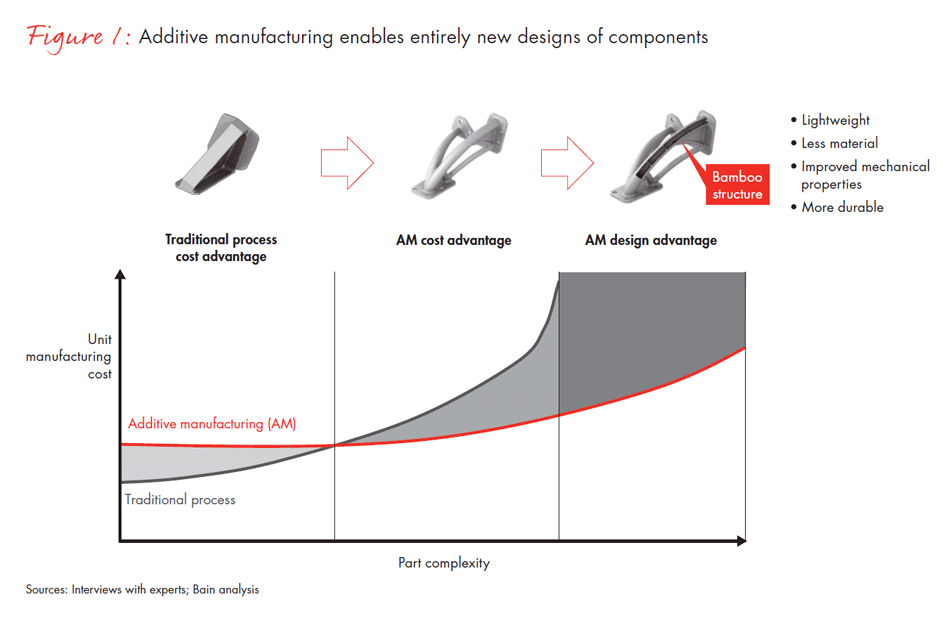
A higher-performing part, in turn, can reduce customers’ total cost of ownership, meriting a higher price for the part itself. The size of the potential benefits depends on the specific application. For example, Airbus and EOS, a leading AM systems manufacturer, analyzed a housing hinge bracket of an A320 aircraft and redesigned it using AM. The new bracket may reduce the weight of an aircraft by 10 kilograms, resulting in 40% reduction of both fuel consumption and carbon dioxide emissions related to that component over its life cycle, with consequent benefits for operating costs and the environment.
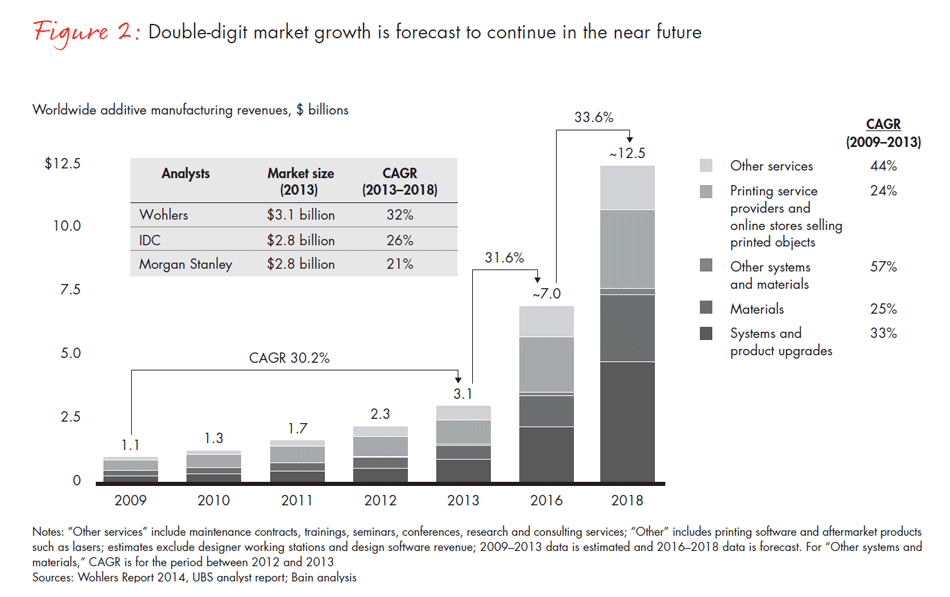
The global additive manufacturing market has experienced double-digit growth over the past five years, and an expert consensus expects a similar growth rate over the next five years, to pass $12 billion in 2018 (see Figure 2). Plastic parts still make up the bulk of production, but direct metal parts applications hold the greatest promise.
The speed of adoption will depend on how quickly companies can overcome several barriers:
-
High production costs. High prices for printing machines and consumables, combined with low throughput, result in high costs to build a given volume of material. Production costs should fall in the coming years on the back of technology improvements such as growing laser power, multiple laser adoption and better projection technology, along with lower machine prices due to increased sales. But it’s not clear when these factors will combine to push down prices.
-
Inadequate levels of tolerance and surface finish. Manufacturers still have to use traditional finishing for many parts, which limits the gains in cost, production flexibility and lead time.
-
High costs for plastics and metal materials. Systems manufacturers still apply a high markup to materials expressly developed for their machines. But as volumes increase, other competitors will likely enter the market and push down prices.
-
No uniform design and manufacturing guidelines. Companies, academic organizations and standardization institutions have just begun to cooperate in developing uniform certification standards for quality and testing methodologies.
-
Scarce talent. Outside of the system manufacturing sector, it’s hard to find people skilled in design and engineering for AM. More universities are offering courses and graduate programs in this field, but it will take a few years to fill the talent gap.
If manufacturing history serves as a guide, these barriers will crumble as customers demand better AM systems for lower prices, as suppliers innovate affordable solutions and as patents expire. When these events happen, the full power of 3-D printing will reshape competitive advantage in many industries.
For CEOs and COOs, then, it’s time to map out the appropriate role for 3-D printing in their firms. This will involve determining where in the business 3-D printing will add the most value and how the organization would have to adapt to realize that value. To identify and understand the most promising opportunities, and to build a lead over competitors, senior executives should address a set of key strategic questions. What are our ambitions?

Winning with 3D printing
How additive manufacturing—popularly known as 3-D printing—can help companies rethink product design.
What are our ambitions?
Some companies approach additive manufacturing as a niche technology suitable for only a few situations, such as prototyping or building a few unusual components. Ferrari, the sports car manufacturer, uses AM for select applications like making full-scale model parts, testing components in wind tunnels and assembling components for Formula 1 race cars.
At the other end of the spectrum, the technology could get embedded into the entire product value chain: defining the product portfolio, designing, prototyping and testing, manufacturing and after-sales service. Airbus has started using AM for tooling, prototyping and manufacturing parts for developmental and commercial aircraft. Defining the breadth of ambition at the start helps to determine the next steps. Companies with broader ambition tend to have low production volumes, critical time-to-market needs, high product complexity with small physical dimensions and a high level of customization.
What adoption route should we pursue?
Some companies start by adopting additive manufacturing in their design engineering group, resulting in longer development times, but enabling more structured, reliable learning processes. Avio Aero, now a part of GE Aviation, has taken this route; the company launched its first dedicated 3-D printing plant in late 2013, after years of conducting engineering studies.
Other companies—such as MBDA, a manufacturer of missile systems—chose direct application on the shop floor, focusing on manufacturing and qualification issues. This route speeds up the use of additive manufacturing for producing parts and actively involves many departments. The drawback, however, is suboptimal use of AM technology, because it remains limited by the constraints of traditional manufacturing processes.
Many companies, including BMW, Ducati and Logitech, take a third route by introducing additive manufacturing for prototypes, and the technology has often proven superior in cost and lead time. Prototyping could be an objective in itself or the starting point for extending end-user part production and product redesign.
How fast should we go?
Companies can learn about additive manufacturing on their own. This approach may take longer, but can be modulated to the company’s normal operating rhythm to minimize disruption. A faster, more disruptive stance using temporary partnerships with system manufacturers or service providers, as well as selective new hires, can more quickly bring a company up to speed. This approach works best with companies that have clearly identified specific opportunities for AM and want to accelerate the process of installing manufacturing capacity and filing patents and licenses.
GE Aviation chose the faster approach: In 2012, it purchased the assets of sister companies Morris Technologies and Rapid Quality Manufacturing—and with that deal owned half of the metal laser sintering capacity in the US, according to estimates by Wohlers Associates.
How integrated should we be?
Larger industrial companies with years of experience in additive manufacturing have moved to greater vertical integration of their AM activities in order to gain a competitive advantage in areas such as materials and software development. While nothing prevents companies from extending their value chain coverage over time, certain decisions early on could influence how easily or quickly they can extend coverage later. Acquiring new steps of the value chain usually requires significant investments and major changes to internal processes: At each stage, companies would have to replace protocols established for traditional methods with new protocols.
Moreover, at each phase of the value chain—from design software to final parts testing and repair—companies can choose different levels of control. Having full in-house control makes it easier to optimize and customize for a company’s particular needs. For instance, a tailored setting for machine parameters would likely result in a more suitable manufactured part, or using an internally developed powder as the source material for printing might meet specific mechanical or thermal properties better. On the other hand, more control demands a larger initial effort with higher costs, greater risks and longer implementation time.
Whatever the level of integration for internal operations, executives will also have to consider the effect on their supply chain. AM technology will influence make-or-buy decisions, so the potential effect on key suppliers should be considered with care. A decision to partner with suppliers early in the adoption of additive manufacturing could be a useful instrument for managing those relationships.
How should we realign our organizational structure?
Introducing additive manufacturing to an existing operation will likely have implications for a department’s size, responsibilities and relationships with other departments. The extent of these implications will depend on the level of control selected, the stages of the value chain covered and the business model chosen.
Adopting additive manufacturing typically shifts the effort from the production plant and supply chain management functions to the engineering and production planning and control functions. AM is a capital-intensive technology, but requires only limited labor for machine management, raw materials management and post-processing. Therefore, it also requires more intensive production planning and engineering (for optimizing parts positions and clusters, construction support, machine parameters and so on) to maximize machine utilization and performance.
Some companies take a reactive approach, making changes to the organization only in response to operational imperatives. This approach minimizes disruption to the business. Other companies prefer to realign the organization early on, tackling complex multidisciplinary issues before the implementation phase. Early realignment requires careful management to ensure that people learn the right new behaviors and skills, to deliver accurate information about AM and to convince initial detractors of the system’s merits.
It’s still early days for this breakthrough technology, and there are major opportunities for the entire product life cycle, from design and manufacturing to maintenance and repair. Companies that set a strategy based on rigorous answers to the questions posed earlier and also build their organizational capabilities to execute effectively, stand to reap remarkable benefits in the years ahead.
Pierluigi Serlenga is a partner with Bain & Company’s Performance Improvement, Industrial Goods & Services and Aerospace & Defense practices; he is based in Rome. François Montaville is a partner in Bain’s Paris office, where he leads the Performance Improvement practice in Europe, the Middle East and Africa.
First published in juillet 2015