
Skip to Content
  • Bureaux

    Bureaux

    Amérique du Nord et Amérique du Sud
    • Atlanta
    • Austin
    • Bogota
    • Boston
    • Buenos Aires
    • Chicago
    • Dallas
    • Denver
    • Houston
    • Los Angeles
    • Mexico City
    • Minneapolis
    • Monterrey
    • Montreal
    • New York
    • Rio de Janeiro
    • San Francisco
    • Santiago
    • São Paulo
    • Seattle
    • Silicon Valley
    • Toronto
    • Washington, DC
    Europe, Moyen-Orient et Afrique
    • Amsterdam
    • Athens
    • Berlin
    • Brussels
    • Copenhagen
    • Doha
    • Dubai
    • Dusseldorf
    • Frankfurt
    • Helsinki
    • Istanbul
    • Johannesburg
    • Kyiv
    • Lisbon
    • London
    • Madrid
    • Milan
    • Munich
    • Oslo
    • Paris
    • Riyadh
    • Rome
    • Stockholm
    • Vienna
    • Warsaw
    • Zurich
    Asie et Australie
    • Bangkok
    • Beijing
    • Bengaluru
    • Brisbane
    • Ho Chi Minh City
    • Hong Kong
    • Jakarta
    • Kuala Lumpur
    • Manila
    • Melbourne
    • Mumbai
    • New Delhi
    • Perth
    • Shanghai
    • Singapore
    • Sydney
    • Tokyo
    Voir tous les bureaux
  • Alumni
  • Presse
  • S’abonner
  • Contacter
  • Canada | Français

    Sélectionnez votre région et votre langue

    Global
    • Global (English)
    Amérique du Nord et Amérique du Sud
    • Brazil (Português)
    • Argentina (Español)
    • Canada (Français)
    • Chile (Español)
    • Colombia (Español)
    Europe, Moyen-Orient et Afrique
    • France (Français)
    • DACH Region (Deutsch)
    • Italy (Italiano)
    • Spain (Español)
    • Greece (Elliniká)
    Asie et Australie
    • China (中文版)
    • Korea (한국어)
    • Japan (日本語)
  • Saved items (0)
    Saved items (0)

    You have no saved items.

    Bookmark content that interests you and it will be saved here for you to read or share later.

    Explore Bain Insights
  • Expertises Sectorielles
    Menu principal

    Expertises Sectorielles

    • Aerospace et Défense
    • Agroalimentaire
    • Chimie
    • Infrastructures, BTP et Matériaux de Construction
    • Grande Consommation
    • Services Financiers
    • Santé
    • Engins & Equipements Industriels
    • Media et Divertissement
    • Metals
    • Mining
    • Pétrole & Gaz
    • Papier et Emballage
    • Private Equity
    • Secteur Public
    • Distribution
    • Technologie
    • Télécommunications
    • Transportation
    • Travel & Leisure
    • Utilities & Energies Renouvelables
  • Expertises Fonctionnelles
    Menu principal

    Expertises Fonctionnelles

    • Expérience Client
    • ESG
    • Innovation
    • Fusions et Acquisitions
    • Opérations
    • People & Organization
    • Private Equity
    • Sales & Marketing
    • Stratégie
    • IA, Perspectives et Solutions
    • Technology
    • Transformation
  • Digital
  • Points de Vue
  • About
    Menu principal

    About

    • Notre Activité
    • Nos Valeurs
    • Nos Collaborateurs et Notre Équipe Dirigeante
    • Notre Impact
    • Prix & Récompenses
    • Partenariats Internationaux
    Further: Our global responsibility
    • Sustainability
    • Impact Social
    • World Economic Forum
    Learn more about Further
  • Carrières
    Menu principal

    Carrières

    • Rejoignez-nous
      Carrières
      Rejoignez-nous
      • Find Your Place
      • Nos domaines d’expertise
      • Equipes multidisciplinaires
      • Étudiants
      • Stages et programmes
      • Événements de recrutement
    • La vie chez Bain
      Carrières
      La vie chez Bain
      • Blog: Inside Bain
      • Récits de carrière
      • Nos collaborateurs
      • Nos bureaux
      • Soutenir votre évolution professionnelle
      • Groupes d’affinités
      • Avantages chez Bain
    • Histoires d’impact
    • Notre processus de recrutement
      Carrières
      Notre processus de recrutement
      • Ce que vous pouvez attendre
      • Entretiens
    Trouver un poste
  • Bureaux
    Menu principal

    Bureaux

    • Amérique du Nord et Amérique du Sud
      Bureaux
      Amérique du Nord et Amérique du Sud
      • Atlanta
      • Austin
      • Bogota
      • Boston
      • Buenos Aires
      • Chicago
      • Dallas
      • Denver
      • Houston
      • Los Angeles
      • Mexico City
      • Minneapolis
      • Monterrey
      • Montreal
      • New York
      • Rio de Janeiro
      • San Francisco
      • Santiago
      • São Paulo
      • Seattle
      • Silicon Valley
      • Toronto
      • Washington, DC
    • Europe, Moyen-Orient et Afrique
      Bureaux
      Europe, Moyen-Orient et Afrique
      • Amsterdam
      • Athens
      • Berlin
      • Brussels
      • Copenhagen
      • Doha
      • Dubai
      • Dusseldorf
      • Frankfurt
      • Helsinki
      • Istanbul
      • Johannesburg
      • Kyiv
      • Lisbon
      • London
      • Madrid
      • Milan
      • Munich
      • Oslo
      • Paris
      • Riyadh
      • Rome
      • Stockholm
      • Vienna
      • Warsaw
      • Zurich
    • Asie et Australie
      Bureaux
      Asie et Australie
      • Bangkok
      • Beijing
      • Bengaluru
      • Brisbane
      • Ho Chi Minh City
      • Hong Kong
      • Jakarta
      • Kuala Lumpur
      • Manila
      • Melbourne
      • Mumbai
      • New Delhi
      • Perth
      • Shanghai
      • Singapore
      • Sydney
      • Tokyo
    Voir tous les bureaux
  • Alumni
  • Presse
  • S’abonner
  • Contacter
  • Canada | Français
    Menu principal

    Sélectionnez votre région et votre langue

    • Global
      Sélectionnez votre région et votre langue
      Global
      • Global (English)
    • Amérique du Nord et Amérique du Sud
      Sélectionnez votre région et votre langue
      Amérique du Nord et Amérique du Sud
      • Brazil (Português)
      • Argentina (Español)
      • Canada (Français)
      • Chile (Español)
      • Colombia (Español)
    • Europe, Moyen-Orient et Afrique
      Sélectionnez votre région et votre langue
      Europe, Moyen-Orient et Afrique
      • France (Français)
      • DACH Region (Deutsch)
      • Italy (Italiano)
      • Spain (Español)
      • Greece (Elliniká)
    • Asie et Australie
      Sélectionnez votre région et votre langue
      Asie et Australie
      • China (中文版)
      • Korea (한국어)
      • Japan (日本語)
  • Saved items  (0)
    Menu principal
    Saved items (0)

    You have no saved items.

    Bookmark content that interests you and it will be saved here for you to read or share later.

    Explore Bain Insights
  • Expertises Sectorielles
    • Expertises Sectorielles

      • Aerospace et Défense
      • Agroalimentaire
      • Chimie
      • Infrastructures, BTP et Matériaux de Construction
      • Grande Consommation
      • Services Financiers
      • Santé
      • Engins & Equipements Industriels
      • Media et Divertissement
      • Metals
      • Mining
      • Pétrole & Gaz
      • Papier et Emballage
      • Private Equity
      • Secteur Public
      • Distribution
      • Technologie
      • Télécommunications
      • Transportation
      • Travel & Leisure
      • Utilities & Energies Renouvelables
  • Expertises Fonctionnelles
    • Expertises Fonctionnelles

      • Expérience Client
      • ESG
      • Innovation
      • Fusions et Acquisitions
      • Opérations
      • People & Organization
      • Private Equity
      • Sales & Marketing
      • Stratégie
      • IA, Perspectives et Solutions
      • Technology
      • Transformation
  • Digital
  • Points de Vue
  • Carrières
    Recherches les plus fréquentes
    • Agile
    • Digital
    • Stratégie
    Vos recherches précédentes
      Pages récemment visitées

      Content added to saved items

      Saved items (0)

      Removed from saved items

      Saved items (0)

      Etude

      From Carbon Ambition to Delivery

      From Carbon Ambition to Delivery

      It will take a combination of vision and pragmatism for companies to reach their decarbonization goals.

      Par Torsten Lichtenau, Mattias C. Karlsson, Cate Hight, et Jenny Davis-Peccoud

      • min
      }

      Etude

      From Carbon Ambition to Delivery
      en
      En Bref
      • Having set aggressive decarbonization targets, companies now face the challenge of executing at pace during a time of unprecedented turbulence.
      • Indicating how difficult it is to turn that ambition into reality, more than 30% of companies missed scope 1 and 2 targets they set for 2020.
      • Companies that make the most progress will stay focused on their visionary net-zero ambition while showing ruthless pragmatism in delivering strategically.

      The year 2021 was about ambition setting. The number of companies establishing science-based targets for decarbonization had strongly increased since 2015, but it rose dramatically from 2020 to 2021, in the run-up to COP26, the United Nations Climate Change Conference (see Figure 1).

      Figure 1
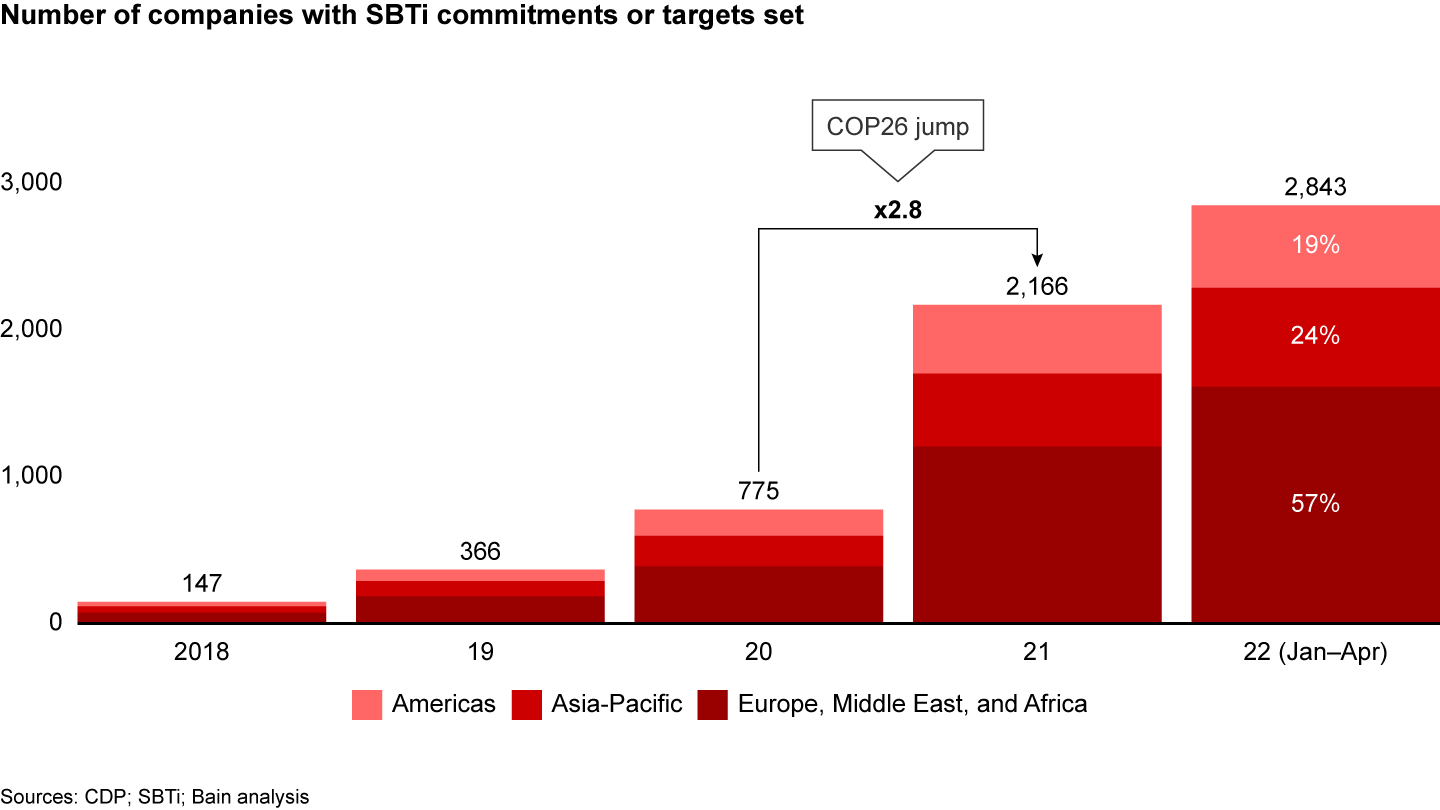
      The number of companies pursuing science-based targets has nearly quadrupled since 2020
       The number of companies pursuing science-based targets has nearly quadrupled since 2020
       The number of companies pursuing science-based targets has nearly quadrupled since 2020

      Now, 2022 and beyond will be about delivering on and monetizing those ambitions. The world will eventually get to net zero—but the critical issue is getting there in time to limit global warming to 1.5 degrees Celsius. The urgency is real: Reaching net zero by 2050 requires halving emissions between 2020 and 2030.

      It’s not surprising that many CEOs feel overwhelmed as they face the climate challenge. There’s no shortage of headlines highlighting the trillions of dollars it will take to green the economy and the seemingly endless opportunities to grow customer demand for green products.

      Yet the day-to-day work of turning ambition into reality is undeniably challenging. Consider that 31% of companies missed the absolute scope 1 and 2 targets they set for 2020 and reported via the Carbon Disclosure Project—even though these emissions are the most controllable and the first levers to address them tend to be economically attractive (see Figure 2).

      Figure 2
      Achieving emissions targets, even for scope 1 and 2 only, is difficult
      Achieving emissions targets, even for scope 1 and 2 only, is difficult
      Achieving emissions targets, even for scope 1 and 2 only, is difficult

      Of course, all of this is not happening in a green vacuum. Executives are trying to pursue their decarbonization targets during a period of turbulence that has created historic levels of uncertainty and numerous difficulties (see Figure 3). They are grappling with ways to make an orderly carbon transition amid an unsettling geopolitical atmosphere, chronic supply chain disruptions, and rampant inflation.

      Figure 3
      Even compared with the war-torn first half of the 20th century, we are in a period of significant turbulence

      To translate ambition into delivery, leaders will need to adopt a mindset that we call visionary pragmatism. Organizations that meet their decarbonization goals bring dreamers and doers on the executive team together to get five things right.

      1. Put a premium on strategic adaptability

      Companies don’t need more climate scenarios but, rather, clarity on the relevant ones. They also need to watch the signposts that will indicate what’s coming next, especially regulations and advances in technology.

      The best companies will embrace an adaptable approach to strategy. For example, instead of viewing it as a five-year exercise with some additional yearly refreshes, winners proactively drive the delivery agenda (what has been committed and needs to be delivered) and the development agenda (what needs to be advanced). Continuing assessment of signposts guides ongoing and quarterly discussions within the executive team and the board as part of the living strategy.

      2. Proactively address investor dissonance

      Investors as well as lenders are increasingly assertive and discerning about decarbonization expectations. At the same time, they may not be willing to compromise on near-term returns. There is often dissonance between a company’s green ambitions and its growth and return aspirations, and a perception that there will be trade-offs. Many capital markets day events have become longer, but not necessarily clearer.

      Executives need to strengthen the investor dialogue. That means focusing on strategic clarity, with both concrete near-term plans to achieve decarbonization commitments and pathways to net zero. They should emphasize specific proof points showing that decarbonization is happening and that it contributes to making the business more valuable. Companies need to demonstrate progress in everything from scope 1 and 2 decarbonization to customer collaboration on green products and meaningful portfolio shifts.

      3. Decarbonize customer-back

      In many sectors, the bulk of emissions happen when customers use the products that companies sell (downstream scope 3 emissions). In addition, what the customer wants deeply impacts embedded emissions generated during production and in the supply chain. Companies that are most successful in their climate transitions start decarbonization with the customer in mind and work backward across offerings, operations, and the supply chain.

      In both B2B and B2C situations, visionary pragmatists will know how to promote their green credentials and innovate with customers toward a lower-carbon, circular world. They will ask: What are the customer’s own ambitions, and how can the company support them? Decarbonization will have very clear implications for how products are designed and used, as well as for emissions in production and across the value chain. Many executives view scope 3 with trepidation, but it can provide the most powerful opportunities.

      4. Collaborate where it matters and for results

      Carbon transition is a problem far too big to be solved by any company on its own, and the need to engage the wider ecosystem of customers, suppliers, peers, governments, and civil society is increasing. Executives must decide where to collaborate vs. compete, picking the few partnerships that can make a difference. They should forge those partnerships across the value chain, or with peers or NGOs, to reach a critical mass for change.

      It’s important not to lose precious time on initiatives where there’s much talk but little action. Instead, aim to ruthlessly deliver results with a clear intent for the partnership, and with early proof points gained through experimentation.

      5. Create “net heroes” in middle management

      Top management usually is fully convinced of the need for aggressive decarbonization, given interactions with investors, the board, and key customers. New recruits often have chosen an employer based on its green credentials. Yet companies may lack committed middle management to get the job done. Too often, middle managers get bogged down when required to deliver key performance indicators for ESG on top of those for revenues, costs, and safety, for example. Sometimes, they’re asked to do it without explanation or help in making trade-offs.

      How can they become net-zero heroes? The only way to create effective green middle management is to be extremely clear about which decisions to make differently and how to resolve trade-offs. The organization needs to be trained, guided, and aligned to embed their goals as realistic deliverables. As an example, procurement is critical to address scope 3 emissions. Managers who have been trained for years to focus on optimizing cost for given specifications need clear guidance on how to reflect carbon in procurement decisions, next to specs and price (e.g., through internal carbon pricing), plus the tools to pragmatically assess where in the supply chain to push.

      The whole organization needs to be upskilled, though not to the same level or the same purpose. That starts with investing to understand who is most impacted and needs the most training, and then rolling out support accordingly.

      ***

      The urgency of decarbonization and the need to limit global warming to 1.5 degrees are largely undisputed. Most companies raced to establish their targets in time for last year’s COP26. Now, as they come face to face with the hard part—delivering on those ambitions and the opportunities available by greening the business—those that combine vision and pragmatism will get there first. 

      Auteurs
      • Headshot of Torsten Lichtenau
        Torsten Lichtenau
        Partner, London
      • Headshot of Mattias C. Karlsson
        Mattias C. Karlsson
        Partner, Stockholm
      • Headshot of Cate Hight
        Cate Hight
        Partner, Washington, DC
      • Headshot of Jenny Davis-Peccoud
        Jenny Davis-Peccoud
        Partner, Amsterdam
      Contactez-nous
      Synergies sectorielles
      • Produits et Services Industriels de pointe
      Expertises fonctionnelles transverses
      • Développement Durable et Responsabilité Sociétale des Entreprises (RSE)
      Comment pouvons-nous vous aider ?
      • Climate Change
      • Supply Chain & Operations Decarbonization
      • Sustainability in Private Equity
      Produits et Services Industriels de pointe
      Climate Week NYC 2025: Sustainability Integrates into the Core

      Leaders shift from pledges to practical solutions, revealing how energy, finance, manufacturing, and food systems are turning sustainability into strategy.

      Voir plus
      World Economic Forum
      Circular Transformation of Industries: The Role of Partnerships

      Unveiling the transformative potential of circularity in industry, this white paper delves into the vital role of partnerships as a fundamental catalyst to pave the way for a sustainable, resilient and prosperous future.

      Voir plus
      Produits et Services Industriels de pointe
      Technology in Building Products: Turn Cost into Value

      Bain experts reveal how companies in the building products industry are unlocking growth with bold tech investments.

      Voir plus
      Développement Durable et Responsabilité Sociétale des Entreprises (RSE)
      How AI Is Starting to Transform Circular Packaging

      There are 15 AI use cases companies across the value chain can use today to accelerate circularity.

      Voir plus
      World Economic Forum
      The Circularity Challenge: Expect Disruption and Get Out in Front of It

      A circular business model can spur growth, reduce costs, and build resilience.

      Voir plus
      First published in mai 2022
      Mots clés
      • Bain Insights for the World Economic Forum
      • Climate Change
      • Développement Durable et Responsabilité Sociétale des Entreprises (RSE)
      • Produits et Services Industriels de pointe
      • Supply Chain & Operations Decarbonization
      • Sustainability in Private Equity
      • World Economic Forum

      Comment nous avons aidé nos clients

      A Conglomerate Charts a New Global Strategy

      Lire l’étude de cas

      An Auto Parts Company Revs Up Its Competitive Position

      Lire l’étude de cas

      A Powerful Carbon Accounting Platform Helps IndustrialCo Optimize Its ESG Strategy

      Lire l’étude de cas

      Vous souhaitez continuer cette conversation ?

      Nous aidons des dirigeants du monde entier à matérialiser des impacts et des résultats pérennes et créateurs de valeur dans leurs organisations.

      Les points de vue de Bain : notre perspective sur des problématiques auxquelles sont confrontées les entreprises à travers le monde, envoyés chaque mois dans votre boîte de réception. 

      *J’ai lu la politique de confidentialité et j’accepte les conditions.

      Merci de lire notre politique de confidentialité.
      Bain & Company
      Contactez-nous Sustainability Accessibility Conditions d’utilisation Politique de Confidentialité Cookie Policy Mentions Légales Sitemap Log In

      © 1996-2026 Bain & Company, Inc.

      Contacter Bain

      Comment pouvons-nous vous aider ?

      • Business inquiry
      • Career information
      • Press relations
      • Partnership request
      • Speaker request
      Voir tous les bureaux