

Etude
 }
}
En Bref
- Manufacturers are faced with market uncertainty, supply chain volatility, and environmental sustainability, plus new challenges caused by natural disasters and tightening regulation.
- The data and connectedness promised by Industry 4.0 are key to unlocking the future of manufacturing. But many organizations are only making incremental improvements with current digitization efforts.
- Modernization needs to marry the digital and the practical. A holistic approach that builds on connected and circular workflows will reshape lean manufacturing systems for the future, translating the goals of Industry 4.0 and circularity into practical, day-to-day operations.
- The future requires a new systematic approach that combines lean manufacturing, digitalization, and circularity. It also needs to be applied at scale and as part of a companywide, sustainable business model.
In times of crisis, strong companies make bold moves that set them apart from the competition. But where do manufacturers build strength?
Historically, strengths have been built onFigure technology. Steam engines and machines surpassed humans’ capacity for manual work in the 18th century. Then, electrification increased speed and communication. More recently, computers overtook powerful computation tasks. In each era of disruption, technology helped humans overcome finite, physical boundaries and become stronger.
Written in collaboration with
Written in collaboration with

Now, manufacturers are faced with the unintended consequences of progress: Product options and supply chains are so numerous they’re difficult to manage, and resources and raw materials are running dangerously thin.
Recent global crises, such as the Covid-19 pandemic, also highlighted the importance of resilient supply chains—and exposed many organizations’ sensitivity to external shocks. Demand volatility and resource constraints are creating significant, simultaneous limitations on manufacturers worldwide.
How did we get here?
Thanks to customization, consumers expect individualized products, made to the highest standards and in short order. Plants are running small orders of many variants, making it harder for manufacturers to forecast demand and standardize processes.
More complex, globalized supply networks were necessary to optimize costs and delivery—but they also introduced new challenges and increased exposure and vulnerability to external shocks, like supply shortages.
Industry 4.0 technologies (e.g., AI and machine learning, Internet of Things, blockchain, and robots) are heralded as the answer. But these tools—and other important advances—have been driven by IT teams and digital transformation dreams, without enough insight into practical, day-to-day floor operations. Many modernization projects ran into trouble when operations workers didn’t embrace new digital practices.
Meanwhile, the global carbon budget is rapidly diminishing. Failure to act will increase the severity of floods, droughts, and other environmental effects. Moral obligation aside, there is an economic reality: The global economy relies on finite resources that will eventually run out or become prohibitively expensive to extract.
Consumers, regulators, and the financial markets agree that environmental action is required, and they’re all expecting manufacturers to respond. Sustainability and environmental responsibility are a necessity, both for consumer satisfaction and agility.
Today’s manufacturers have to balance it all perfectly: product personalization, massive supply chains, rapidly changing technology, and a sustainability imperative.
Pushing the limits of today’s production systems
For decades, companies have drawn heavily on the principles and learnings of “lean” manufacturing. By eliminating non-value-adding activities, lean thinking and its associated production systems have guided many companies to higher levels of efficiency and effectiveness. But manufacturers must seriously consider whether lean thinking is enough to overcome the challenges they’re faced with today.
Lean was designed to standardize and level production, and to incorporate visual management tools that connect operators to processes and deliver greater transparency. These methods and tools served manufacturing well in the past but could limit its agility moving forward. To reach the highest levels of efficiency and total transparency, manufacturers need Industry 4.0 technologies.
In today’s environment, production-improvement systems that are based on lean thinking have three clear limitations: flexibility, transparency, and end-to-end synchronization.
Limited flexibility
Lean manufacturing works when production standards can be established across a set of products. As personalization, customization, and volatility increase, companies are moving closer to a lot size of one, and manufacturers are facing extreme fluctuations across the value stream. Today’s plants require more flexibility and responsiveness than lean has offered historically. Traditional Kanban cycles with printed cards, parking spots painted on the floor, and static milk-run routes are just a few examples where lean practices are too inflexible for the future. Quicker (sometimes on-demand) adjustments to standards are now mandatory.
Limited transparency
It takes time to record and report on key performance indicators—a process that’s often manual, resource intensive, and prone to error. Key data is collected regularly but not visualized until the end of a shift or workweek. That lag can prevent manufacturing organizations from taking the right corrective actions at the right times. Dynamic and systemic issues can hide in the data, resulting in decisions that are out of sync with reality.
Limited end-to-end synchronization
With lean manufacturing, optimizations along the value chain can often be isolated, which allows problems to hide until they arrive at the factory or the next process step (e.g., faulty parts or supply chain bottlenecks). Value stream mapping and value stream design solve some of these issues—but not all. Either intentionally or because of complexity, some silos along the value chain escape correction. Isolated optimization creates vulnerabilities, especially to external shocks, and contingency planning is prohibited by the complexity of influencing factors. It’s also difficult to cascade and plan for changes along the value chain.
Industry 4.0 technologies have the potential to solve for some of these shortcomings and can overcome some of the rigidity and inflexibility that lives in the lean system—if they are applied to production systems holistically.
To realize the future that we need for manufacturing—for business continuity, performance, and environmental sustainability—manufacturers need a totally new approach.
Manufacturing needs a revolution, not an evolution.
The missing piece
To become fit for the future, manufacturers have pursued lean, digitization, and circularity. Rather than choose one over the other, manufacturers need a systematic approach to implement all three.
By converging and scaling these ideals, we imagine a manufacturing world where:
- every step in the value chain is circular, synchronized, and connected;
- workstations and production lines are self-steering and self-learning;
- factories can maintain, repair, upgrade, and keep assets longer to increase their lifetime value;
- workstation-level insights can be cascaded and leveraged toward joint solutions;
- processes are free of emissions and waste and reach the highest levels of effectiveness and efficiency;
- failures and non-value-added tasks are drastically reduced or eliminated; and
- manufacturers are more resilient, flexible, and prepared for new demands.
Lean will always be the foundation of advanced and clean manufacturing systems, but in the future, it will be applied differently—more widely and radically. Digital and circular tools won’t be layered on top of lean principles as they’re developed or updated. Instead, flexibility will be embedded into the heart of the production system. Manufacturing must be designed from the plant floor first, then connected end-to-end across the organization and beyond (e.g., customers, suppliers).
By bringing together the elements of connectivity and circular workflow, lean thinking, and Industry 4.0, an advanced and clean manufacturing process has the power to align everyone’s goals around products, the planet, and profit.
Demystifying Industry 4.0: Transparency and synchronization are key
Lean production systems start with customer demand and build strength by standardizing the shop floor and leveling production orders. But those strengths become restraints when demand and inputs change frequently or unpredictably.
Industry 4.0 solutions are supposed to give manufacturers the agility and flexibility to address volatile demand and quickly changing orders. But most companies have struggled to expand Industry 4.0 technologies beyond isolated point solutions.
So, why would another approach succeed where the current methodologies or digital transformation projects have not? How is advanced and clean manufacturing different?
Industry 4.0 is a concept that needs to be translated into a production system and realized along the value chain. In practice, several key differences bring advanced and clean manufacturing to life.
For one, technology and digitization don’t belong exclusively to the IT department. In advanced and clean manufacturing organizations, workforce and plant management are the driving force behind workflow and process designs. The day-to-day plant perspective is constant, and teams work jointly on conceptual planning, line layouts, and setups. By working as one, companies can eliminate rework and significantly reduce the time and effort related to planning.
Factories of the future also apply their technologies system-wide, not just to individual use cases. Issues like waste are tracked across the entire value chain, which creates visibility into systemic problems and more effective solutions. The data flow across the value chain—from suppliers to operators to customers—is more inclusive and tightly coordinated. Every machine is connected and sends data into one large “data lake”—the epicenter of the organization.
A centralized system becomes the “beating heart” of the organization. With technology at the center of operations, manufacturers can set production tasks, plan material needs, and synchronize operations with all of their factories and customer demand.
For example, advanced and clean manufacturers can track individual parts from their supply chain, through production and into the field. If an active component fails in the field, it can be traced back to an individual supplier and process step—even if production data was within spec. Being able to pinpoint root causes quickly, accurately, and along an entire product life cycle speeds up resolution and reduces scrap, waste, and repair costs.
With greater visibility, manufacturers can develop quicker, more accurate, and coordinated responses. In a traditional plant, output is measured in real time, but overall operations effectiveness is often reviewed in weekly or monthly intervals, and deviations across the production line are averaged for the timespan. But in a fully connected organization, each individual machine can share live data. Overall equipment effectiveness can be examined at the individual workpiece level and optimized immediately.
Where current practices are rigid, advanced, and clean manufacturing allows for more dynamically generated, product-specific operating procedures. Advanced and clean manufacturers can leverage digital twins to gain real-time transparency into workstation and process performance. End-to-end transparency gives manufacturers earlier warning signs that external shocks are ahead, plus the power to simulate interventions and scenarios before they respond (see Figure 1).
Figure 1
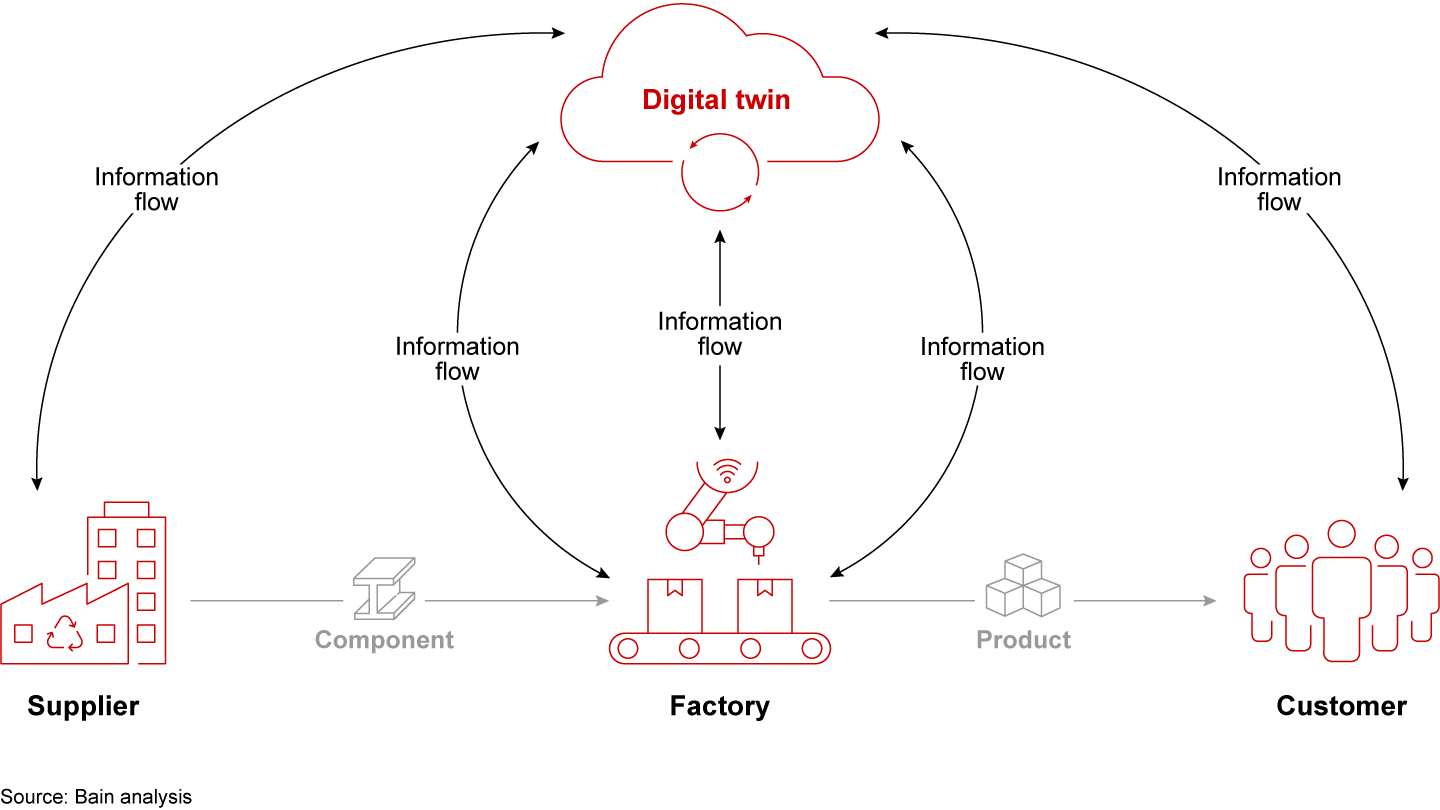

With an advanced and clean manufacturing approach, companies can deliver perfect-quality, mass-customized products to customers without waste or wait times. Product life cycles can be maximized through permanent upgrades, maintenance, and repairs, and quality can be reinforced piece by piece, not by averaged standards. In the future of manufacturing, humans and machines can collaborate in harmony, constantly learning from each other.
By augmenting existing performance-improvement methodologies with Industry 4.0 technologies, manufacturers can redistribute insight and value across the company. Stronger, more in-sync systems help manufacturers address bigger problems and build resiliency.
The environmental imperative: How circularity can drive sustainable profit
Today, production and supply chains are optimized around efficiency. The goal is to deliver everything the customer needs at the lowest possible cost. Unfortunately, the efficiency-only approach is flawed, and the costs of a linear economy are becoming too heavy to bear.
Take plastics as one example. An Ellen MacArthur Foundation study found that 95% of discarded material is lost after one use. Even recycling “success stories” like paper, PET, and steel have very low recovery rates.
Valuable raw materials are critical to long-term competitiveness. As materials become more limited, manufacturers are forced to rely on only a few players. According to Critical Raw Materials for Strategic Technologies and Sectors in the EU: A Foresight Study, China, Africa, and Latin America supply the EU with 74% of all battery raw materials. China has nearly monopolized the permanent magnets needed in wind turbines and traction motors; and together, China, South Africa, and Russia supply the majority of the raw materials needed for robotics.
Product usage and end-of-life cause environmental and social externalities, too. Land use, erosion, greenhouse gas emissions, and water consumption may not be calculated in a P&L or business case for manufacturers, yet they are real consequences—and costlier to remediate than companies can afford.
In reality, most companies don’t shoulder the cost of externalities—and consumers have taken notice. The market is no longer accepting environmental and social impacts as “costs of doing business.” Consumers are demanding more transparency into sourcing and manufacturing processes and showing a preference for sustainable practices with their dollars. According to a Sustainable Market Share Index report from NYU Stern’s Center for Sustainable Business, sustainability-marketed products delivered nearly 55% of consumer-packaged goods market growth in 2019, despite owning only 16% of the category.
Financial markets are reacting accordingly and treating non-sustainable behaviors as business risks. Regulators are also tightening their rules and introducing countermeasures to curtail waste and carbon emissions.
The problem is these measures treat sustainability as an additional cost. Instead of trying to treat and recycle waste to recoup (minimal) value at the end of the pipeline, manufacturing companies can take another tack: They can keep products and materials in use longer. They can pursue circularity.
Products that are designed for circularity retain value throughout their life cycle, and factories become places to keep and upgrade existing materials. Products are used, maintained, repaired, and upgraded before eventually being remanufactured and recycled.
When designing for circularity, one man’s trash is another’s treasure. Other companies’ waste could become a valuable input, while the offloading company gains a new revenue stream. Companies can design new business models to ensure circularity, perhaps renting instead of selling their products, so end-of-life items return to the factory. New revenue streams could be created by recovering and reusing finite resources and rare earth metals, or from developing synthetic substitutes.
Circular workflows keep end-of-life products out of landfills and incinerators, and manufacturers get a second chance to create value with the same inputs by disassembling or recycling materials. Reusing materials reduces (or eliminates) many externalities of production. At scale, circular economies promote environmental sustainability—and drive value (see Figure 2).
Figure 2
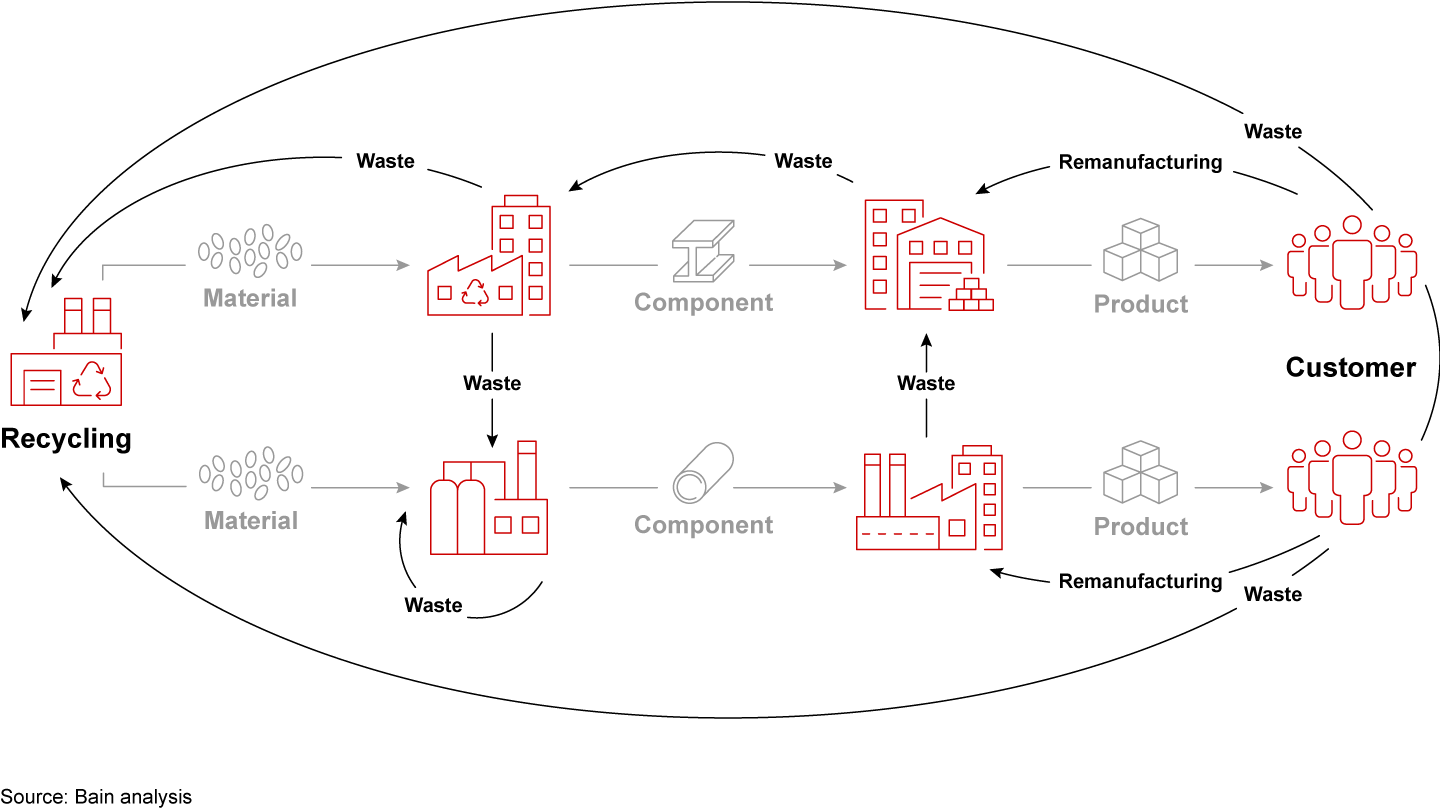

Caterpillar’s Cat® Certified Rebuild Program is a well-known example of circularity. Caterpillar designs its machines, systems, and components so they can be returned and rebuilt for “multiple lives.” Once parts are returned, they are disassembled, cleaned, and inspected, then converted into production-ready material.
Manufacturers have an opportunity to positively shape a large share of environmental and social issues by adopting circular workflows. The key is to go big. Currently, companies only apply circularity to individual use cases, not at scale, and very few companies adopt sustainability and circularity as a core belief. That must change. A more holistic production system can help manufacturers integrate circularity into more meaningful processes, and ultimately, their business models.
The path to advanced and clean manufacturing
Why haven’t more manufacturing companies used technology to move past the limitations of lean? If circular workflows are necessary for a more sustainable economy and can contribute to sustainable profit generation, then why isn’t this mainstream practice?
Manufacturers’ need to deliver day to day, month to month can cause them to be apprehensive when it comes to change. Solutions that can be implemented over a weekend with little disruption are often prioritized over radical change. As such, many manufacturers have been trained to embrace smaller step, continuous improvements.
It’s also hard. A Bitkom study of German manufacturers found that most companies feel behind the curve on their journey to Industry 4.0. They understand the benefits of becoming more tightly connected, but there’s no clear blueprint for how to achieve it. Opportunities like Industry 4.0 and circularity remain concepts; somewhat abstract, without a clear plan that’s designed for the future and rolled back to today.
Most examples are use case-based and fail to integrate practical experiences on the floor with the IT vision. Even though companies understand the benefits of a holistic, companywide approach to circularity and Industry 4.0, they don’t know where or how to begin.
This is your starting point.
Five design principles to build your future on
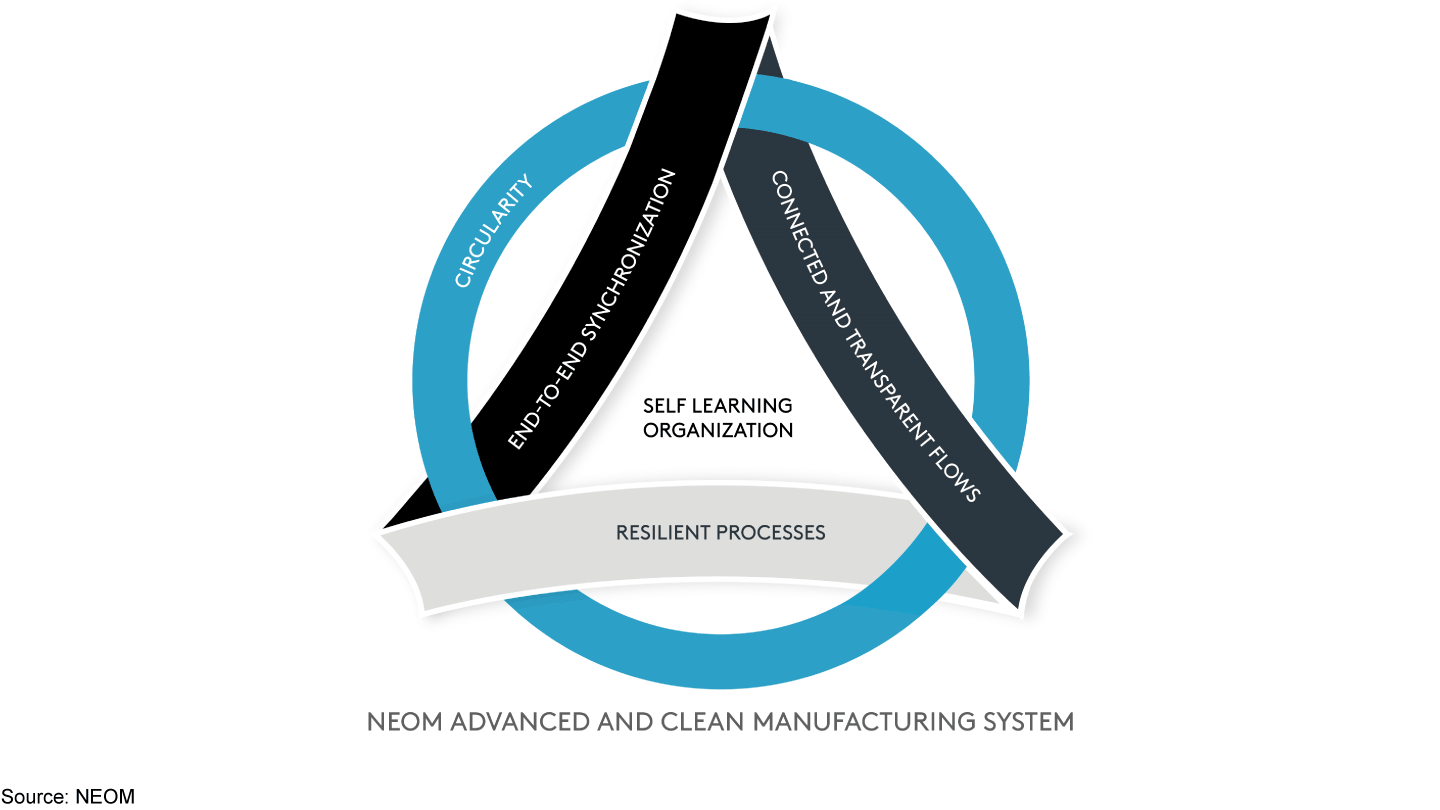
To realize advanced and clean manufacturing, companies need supporting technologies, including Industry 4.0 tools that have been minimally explored or only practiced in isolation. They should be applied through a new, organization-wide approach, alongside best practices from traditional process improvement methodologies (see Figure 3).
The five design principles you can build your manufacturing future on are:
- Resilient processes
Standardize the entire operation to increase adaptability and build stability. - Connected and transparent flows
Fully connect material and information flows and make them visible along production lines.
- End-to-end synchronization
Coordinate continuous improvements across the entire value chain, in sync with customer demands, supply chain partners, and societal needs. - Circularity
Redesign business models and manufacturing around a circular flow of products and materials. - Self-learning organization
Enable proactive, continuous improvement across the entire system.
Figure 3

How to advance manufacturing
Manufacturers can replace rigid protocols with more adaptable practices and apply the benefits to the entire organization, not just a single workstation. An advanced and clean manufacturing approach requires whole-system participation, from each workstation and line to the plant level and beyond.
To reset the boundaries and realize advanced and clean manufacturing, companies need the following:
Resilient Processes
To build resiliency, manufacturers need both historical and live process data. Embedded sensors can track the health of assets and machines, allowing for predictive and prescriptive maintenance. Resilient production systems can self-plan optimal maintenance, accounting for failure risk, production loss, maintenance cost and capacity.
Work instructions should be adaptable and trackable so they can accommodate variables but retain accountability. At the workstation level, that means being able to produce a number of parts and variables and being able to easily reconfigure stations for new tasks or processing steps.
A mining company applied this principle to combat high contamination and processing costs. It collected hundreds of variables from multiple data sources, then trained a machine learning algorithm to tell the difference between “good” and “bad” batches. The algorithm identified parameter combinations that led to most of the company’s quality issues and helped determine the most effective mitigating actions. In this case, the miner refined its blending strategy and process operating parameters and changed its mine plan to avoid problematic bench patterns. With these and other mitigating actions, the miner cut contamination by more than 50% and eliminated reprocessing costs.
In this example, quality control became fully automated, and information flowed directly to operators and process experts to optimize performance.
Connected and transparent flows
Nothing happens in isolation. When manufacturers can see—and hold accountable—all the inputs to quality, downtime, and cost, they can respond more appropriately.
In connected and transparent organizations, every line, workstation, and shop floor device is digitally interconnected and continuously collecting data. AI-driven tools aid production planning and line balancing for optimal material flow, and digital twins can identify impacts before they’re felt.
End-to-end synchronization
When manufacturers are digitally in sync with customers’ and suppliers’ realities, inventory levels can be managed automatically and in real time. Plant layouts can be designed for flexibility, and manufacturers can quickly adapt production plans and product mixes to accommodate material availability, demand, and other external factors.
An apparel company applied end-to-end synchronization by using historical sales data and real-time store inventory data on product size, color, and turnaround times. Because the machine learning algorithm incorporated data along the supply chain, rather than just the factory floor, the manufacturer improved its forecasting accuracy by 50% compared to manual planning and enabled its client to reduce excess inventory by more than 40%.
When manufacturers, suppliers, and customers share data, it can be used for everyone’s benefit. “Clients who were able to fully connect and synchronize [their operations] from customers to suppliers achieved an entirely new level of efficiency and resilience,” explained Jörg Gnamm, partner and head of the Global Manufacturing/Industry 4.0 practice at Bain & Company.
Circularity
Circularity has several parts. First, manufacturers need transparent, traceable information about the resources, materials, and products they procure. Reused components and recycled or regenerative inputs are preferable, and new products should be designed with circularity in mind. In the jewelery category, one major player is practicing circularity by shifting to recycled silver and gold.
Whenever possible, plants need to operate on a zero-waste basis. Every discharge should be accounted for and have additional utility (or be offered as potential inputs for new industrial partners). Likewise, machine assets and equipment need to be repaired, refurbished, or recycled at end of life.
For some organizations, this will require entirely new business models. Circular approaches like product rentals or pay-per-performance can be pursued through new relationships with value chain partners.
Self-learning organization
In self-learning organizations, teams are self-directed, trusted, and empowered. Plant workers have the autonomy to make the right decisions and improve systems, supported by Industry 4.0 tools. Instead of controlling and managing employees, leaders empower their teams with the right information and tools to do the job.
When most repetitive and dangerous tasks are taken over by robots and machines, employees have more time to examine the whole system and find improvements that affect the entire organization. This will create more diverse and interesting jobs (that subsequently have new training needs). AI and machine learning algorithms can support human skill development and growth by generating individual training curricula based on skill profiles, work history and detected skills gaps.
In a self-learning organization, machines can learn and improve, too. For example, manufacturers can use advanced AI to find defects that are difficult for humans to quickly detect. With self-learning image recognition tools, production systems can be “retrained” easily, without the need for reprogramming.
In advanced and clean manufacturing organizations, every employee can see their impact and improve performance because it’s in the data. Real-time performance data is available down to the machine and operator level, and analytic tools help uncover root causes and solutions. Once resolutions and optimizations are developed, they are automatically disseminated to other relevant functions and workstations.
Becoming revolutionary: The journey to advanced and clean manufacturing
Like any production system, an advanced and clean manufacturing model is dynamic. Where and how you begin the journey depends on your organization’s maturity level and ambition.
But that implies that change is a choice. In reality, time may be running out for manufacturers that hold on to traditional practices for too long. Manufacturers need a new approach to meet future demands.
Pressure is mounting on all sides: Consumers and regulators want manufacturing to reinvent itself to protect environmental interests. We’re past the point of solar panels and insulation; companies need to completely rethink how materials and energy flow through their products and facilities. The more companies can engage in a circular economy, the better—for the planet and for overall value capture.
Lean and Industry 4.0 are important to the future of manufacturing, but they need to be applied differently—and, most importantly, together. An advanced and clean approach to manufacturing addresses competing demands by combining connectivity and circularity and by leveraging digital advantages without losing sight of practical, on-the-floor needs.
Organizations that begin planning for a radically different future today will be more resilient to bumps and changes in the environment along the way. Manufacturers need to rethink how they operate now—before manufacturing “start-ups” seize the opportunity and redefine the future for them.
When pursued organization-wide, our five design principles can transform manufacturing organizations. Applied together, these principles can revolutionize manufacturing—and you can lead it.
Copyright © 2023 NEOM and Bain & Company, Inc.
First published in octobre 2023