

Etude
Microdrip irrigation systems. Drought-resistant hybrid seeds. Asset-backed microloans. These innovations can transform the lives of those farming on less than two hectares of land and living on less than $4 a day. Yet until relatively recently, they were unknown in most smallholder farmer communities.
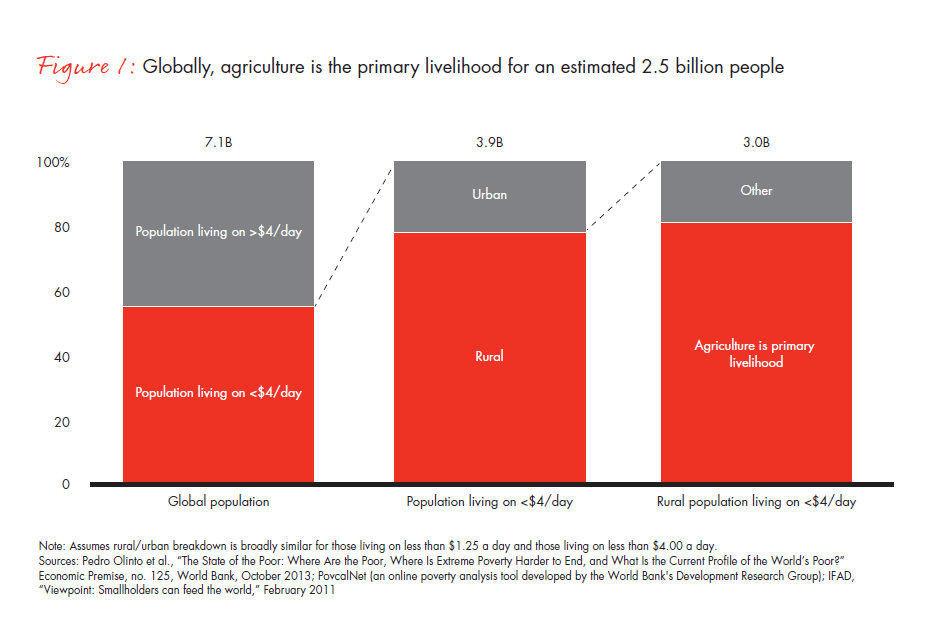
What does it take to get the developing world’s smallholder farmers to try one of these products? Importantly, what would it take to get them to buy these products again and again? For many of the 2.5 billion people living at the “base of the pyramid” and relying on agriculture for their livelihood,1 adopting these innovations could improve their lives and the lives of future generations (see Figure 1).
These questions lie at the core of this paper. In recent years, innovations for smallholder farmers have frequently been introduced by pioneer firms—entrepreneurial companies that develop and offer market-based innovations to serve the poor in places where governments and traditional aid have fallen short. These firms provide smallholder farmers with access to products, services and markets, which can significantly improve their productivity, incomes and lives. Although pioneer firms have a social purpose, they are typically set up as for-profit companies, aiming to quickly and sustainably scale their operations and broaden their impact. While these firms offer huge promise, they face challenges that make their very existence, let alone their growth, extremely challenging. Not only are these firms looking to serve hard-to-reach customers with limited disposable incomes, they are doing so in the context of broader systems that are often broken. In reviewing the performance of agriculture-focused pioneer firms around the world, we found that very few had scaled2 and even fewer had achieved both scale and profitability. What will it take to cross the Pioneer Gap3 and have many more of these new, promising firms scale?
While there is extensive literature on agriculture in the developing world, it focuses primarily on the actions of nongovernmental organizations (NGOs), aid agencies and governments, as well as on farmers’ decision making.4 In addition, much of that literature has been narrowly focused on one crop or one technology in a certain region and lacks specific business implications to inform management decisions. Relatively little has been written about the actions of the pioneer firms themselves—how they develop and execute their strategy and operating model as they grow and, in the process, encourage broad adoption of their innovation.
This paper aims to fill that gap by focusing on the interaction between farmers and pioneer firms and what needs to happen to spur sustained adoption, allowing these firms to serve hundreds of thousands, or even millions, of smallholder farmers. Also, although scale continues to be a core focus (some may say an obsession) for the development sector, clearer analysis is needed on how a firm should achieve scale to encourage mass adoption of its innovation. Last, we examine the relationship between firm and farmer in the wider market system context, considering how corporations, foundations and development agencies, impact investors, NGOs and the government can influence adoption and support the successful scaling of pioneer firms.
Our primary audience for this paper is the practitioners themselves: the management teams of agriculture-focused pioneer firms. To address the questions above, we have built on the existing literature on pioneer firms, particularly From Blueprint to Scale: The Case for Philanthropy in Impact Investing, published by Acumen and Monitor Inclusive Markets, which advocates for the crucial role that philanthropy plays in supporting these companies.

Key findings
Three key findings from our research point to what pioneer firms and other actors must do to spur greater adoption of agricultural innovations by smallholder farmers.
First, pioneer firms must systematically ensure that the “Four A’s” (awareness, advantage, affordability and access) are continuously in place for their farmer customers (see below, “Defining the Four A’s of adoption”).5 Adoption starts with an unrelenting focus on the farmer: how to raise his or her awareness of new products and services, how to communicate and reliably deliver on the advantage the farmer will gain by adopting innovations, how to ensure the affordability of these innovations and how to provide easy and timely access to them. While these Four A’s are not revolutionary,6 we learned from our research that few firms are able to systematically address each of these elements in a sustained way as they grow. This is not surprising given the structural challenges of serving the base of the economic pyramid and the inherent complexity firms encounter as they try to adapt to rural developing markets with often low levels of infrastructure and value chain development.
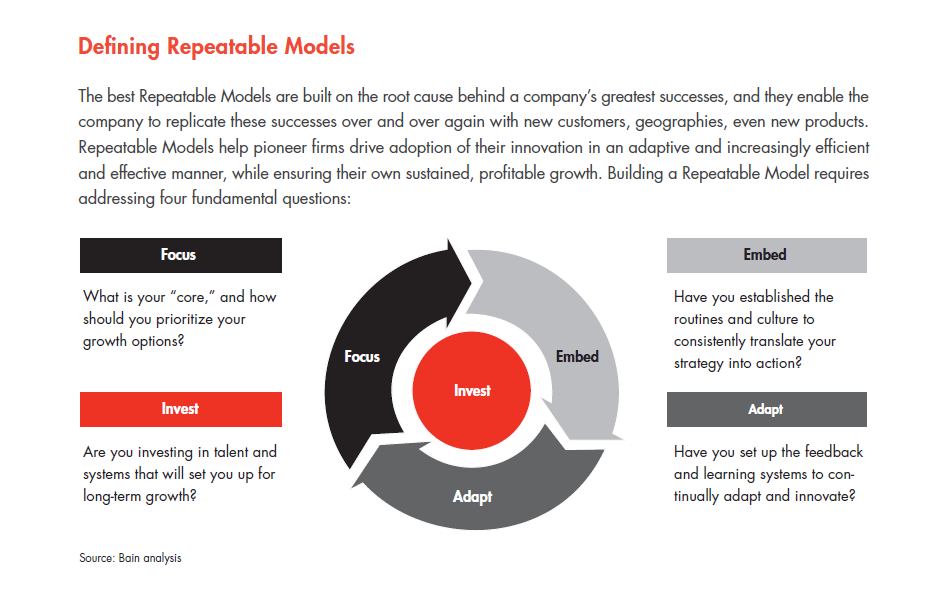
Second, pioneer firms must develop Repeatable Models® to achieve adoption at scale across villages, regions and countries (see below, “Defining Repeatable Models”). This means having the right strategies, processes, teams and supporting systems to drive adoption of their innovation in an adaptive and increasingly efficient and effective manner, while ensuring their own sustained, profitable growth. In short, Repeatable Models help pioneer firms promote “good scale” that endures while avoiding “bad scale” that is unprofitable and unsustainable. In our research, firms pursuing bad scale had introduced costly complexity by prematurely expanding to adjacencies (new customers, products, geographies or capabilities), while those on the path to good scale were implementing aspects of Repeatable Models. Building Repeatable Models entails, among other things, defining the company’s core market and distinctive competencies; establishing clear values, operating processes and market entry routines; appropriately hiring, training and managing the performance of employees; and developing and institutionalizing the customer feedback and learning systems that inform management as to whether and how the Four A’s are in place and that guide ongoing efforts for improvement and innovation.
Third, other actors across the agricultural system should tailor their actions to enhance the Four A’s and help pioneer firms develop and scale their Repeatable Models to bring their products and services to more farmers. Though an understanding of the key factors of adoption and scale are paramount, firms and farmers do not exist in isolation—they operate within a wider market system. This system can either promote the Four A’s and enable the firm to develop its Repeatable Model or hinder the firm’s success and slow down adoption. There are clearly examples of pioneer firms that, by virtue of their innovation and first-mover nature, disrupt and change part of a failing system; nonetheless, no single firm can rewire an entire system. Further, as the firm begins to reach scale of any significance, its interactions with this system (rules and regulations, infrastructure, access to finance and supporting inputs) and other key players (including competitors) will become more central to its success. Therefore, corporations, foundations and development agencies, impact investors, NGOs and the government should design investments, interventions and policies that promote the lasting success of pioneer firms and the smallholder farmer customers they serve.
The agriculture sector requires considerable investment by all sector actors to build a robust and supportive ecosystem, and it needs more capital from investors who take the long view and value social returns. We are encouraged by the ingenuity and perseverance of the many pioneer firms we have studied for this paper, but more must be done to support their work. As many management teams at pioneer firms have told us, the work is consistently challenging and takes a very long time to “get right,” and the rewards, in terms of impact and financial returns, are often uncertain at this early juncture.
The work of these pioneer firms is simply too important to remain sub-scale, and there is potential for a real breakthrough in the next 5 to 10 years. With this study, we hope to shift the odds more in favor of pioneer firms and the smallholder farmers they serve. We hope that current and aspiring entrepreneurs, as well as other system actors, will find in this study a clear roadmap for motivating those farmers to adopt innovative, value-creating products and services. If successful, this study will help accelerate results for all involved and, in so doing, contribute to our collective efforts to create growing prosperity.
NEXT · CHAPTER 1 · A starting point: On the path to prosperity
Defining the Four A’s of adoption
Awareness: Awareness is the knowledge that a farmer possesses about a product or service. This includes knowledge of a product or service “category” (e.g., a microfinance loan or microdrip irrigation), the knowledge of a specific company’s offerings as well as the knowledge of how the product or service should be used.
Advantage: Farmers will be motivated to adopt an innovation if they are convinced that the product or service will provide better outcomes than current practices—if an innovation promises to increase their wealth with higher crop yields or better prices for their outputs, for example, or if it can reduce expenses with lower labor and input (e.g., water, fertilizer) costs. Benefits may also take the form of reduction of income risk associated with output price volatility or crop failures stemming from weather or disease. Advantage can also come in the form of improved social standing within the community.
Affordability: Affordability is the extent to which farmers are financially able to purchase a product or service. The innovation must be affordable not just in terms of the absolute price; it must also be available for purchase at that price when farmers have money in their pockets based on their cash-flow cycles. Given cash-flow variability over the year, it may also be necessary for the farmer to have access to financing to make the product truly affordable.
Access: Access is defined by the ease, distance and timing of the procurement and sale of an agricultural innovation. Farmers have good access if the product or service is available, when they need it, at a location that they can easily get to.
1 IFAD, “Viewpoint: Smallholders can feed the world,” February 2011.
2 In reviewing the performance of 100 pioneer firms focused on selling to or buying from smallholder farmers in South Asia and sub-Saharan Africa, we found less than 5% with more than 250,000 customers or 25,000 suppliers in a single year.
3 The term “Pioneer Gap” was first coined in Harvey Koh, Ashish Karamchandani and Robert Katz, From Blueprint to Scale: The Case for Philanthropy in Impact Investing, Mumbai: Monitor Inclusive Markets/Acumen, 2012, and is defined as the gap between the time a pioneer firm starts and the time it becomes a viable and investible enterprise.
4 See Abhijit Banerjee and Esther Duflo, Poor Economics: A Radical Rethinking of the Way to Fight Global Poverty, New York: Public Affairs, 2011.
5 This framework is similar to a core observation made by C. K. Prahalad, “This population [the base of the pyramid] does not typically have access to world-class products or services or to regional and global markets for their effort and production. Awareness, access, affordability, and availability continue to be the problems” (Ted London and Stuart L. Hart, Next Generation Business Strategies for the Base of the Pyramid, Upper Saddle River, NJ: FT Press, 2010). Prahalad also used the term “4 A’s,” referring to awareness, access, affordability and availability in “Bottom of the Pyramid as a Source of Breakthrough Innovations,” Journal of Product Innovation Management 29, no. 1 (2011): 6–12.
6 C. K. Prahalad’s articles for The Journal of Product Innovation Management lay out his own Four A’s (awareness, access, affordability and availability) to stress how innovating to serve the bottom of the period can prompt significant returns for corporations.
First published in novembre 2014