
Skip to Content
  • Bureaux

    Bureaux

    Amérique du Nord et Amérique du Sud
    • Atlanta
    • Austin
    • Bogota
    • Boston
    • Buenos Aires
    • Chicago
    • Dallas
    • Denver
    • Houston
    • Los Angeles
    • Mexico City
    • Minneapolis
    • Monterrey
    • Montreal
    • New York
    • Rio de Janeiro
    • San Francisco
    • Santiago
    • São Paulo
    • Seattle
    • Silicon Valley
    • Toronto
    • Washington, DC
    Europe, Moyen-Orient et Afrique
    • Amsterdam
    • Athens
    • Berlin
    • Brussels
    • Copenhagen
    • Doha
    • Dubai
    • Dusseldorf
    • Frankfurt
    • Helsinki
    • Istanbul
    • Johannesburg
    • Kyiv
    • Lisbon
    • London
    • Madrid
    • Milan
    • Munich
    • Oslo
    • Paris
    • Riyadh
    • Rome
    • Stockholm
    • Vienna
    • Warsaw
    • Zurich
    Asie et Australie
    • Bangkok
    • Beijing
    • Bengaluru
    • Brisbane
    • Ho Chi Minh City
    • Hong Kong
    • Jakarta
    • Kuala Lumpur
    • Manila
    • Melbourne
    • Mumbai
    • New Delhi
    • Perth
    • Shanghai
    • Singapore
    • Sydney
    • Tokyo
    Voir tous les bureaux
  • Alumni
  • Presse
  • S’abonner
  • Contacter
  • Canada | Français

    Sélectionnez votre région et votre langue

    Global
    • Global (English)
    Amérique du Nord et Amérique du Sud
    • Brazil (Português)
    • Argentina (Español)
    • Canada (Français)
    • Chile (Español)
    • Colombia (Español)
    Europe, Moyen-Orient et Afrique
    • France (Français)
    • DACH Region (Deutsch)
    • Italy (Italiano)
    • Spain (Español)
    • Greece (Elliniká)
    Asie et Australie
    • China (中文版)
    • Korea (한국어)
    • Japan (日本語)
  • Saved items (0)
    Saved items (0)

    You have no saved items.

    Bookmark content that interests you and it will be saved here for you to read or share later.

    Explore Bain Insights
  • Expertises Sectorielles
    Menu principal

    Expertises Sectorielles

    • Aerospace et Défense
    • Agroalimentaire
    • Chimie
    • Infrastructures, BTP et Matériaux de Construction
    • Grande Consommation
    • Services Financiers
    • Santé
    • Engins & Equipements Industriels
    • Media et Divertissement
    • Metals
    • Mining
    • Pétrole & Gaz
    • Papier et Emballage
    • Private Equity
    • Secteur Public
    • Distribution
    • Technologie
    • Télécommunications
    • Transportation
    • Travel & Leisure
    • Utilities & Energies Renouvelables
  • Expertises Fonctionnelles
    Menu principal

    Expertises Fonctionnelles

    • Expérience Client
    • ESG
    • Innovation
    • Fusions et Acquisitions
    • Opérations
    • People & Organization
    • Private Equity
    • Sales & Marketing
    • Stratégie
    • IA, Perspectives et Solutions
    • Technology
    • Transformation
  • Digital
  • Points de Vue
  • About
    Menu principal

    About

    • Notre Activité
    • Nos Valeurs
    • Nos Collaborateurs et Notre Équipe Dirigeante
    • Notre Impact
    • Prix & Récompenses
    • Partenariats Internationaux
    Further: Our global responsibility
    • Sustainability
    • Impact Social
    • World Economic Forum
    Learn more about Further
  • Carrières
    Menu principal

    Carrières

    • Rejoignez-nous
      Carrières
      Rejoignez-nous
      • Find Your Place
      • Nos domaines d’expertise
      • Equipes multidisciplinaires
      • Étudiants
      • Stages et programmes
      • Événements de recrutement
    • La vie chez Bain
      Carrières
      La vie chez Bain
      • Blog: Inside Bain
      • Récits de carrière
      • Nos collaborateurs
      • Nos bureaux
      • Soutenir votre évolution professionnelle
      • Groupes d’affinités
      • Avantages chez Bain
    • Histoires d’impact
    • Notre processus de recrutement
      Carrières
      Notre processus de recrutement
      • Ce que vous pouvez attendre
      • Entretiens
    Trouver un poste
  • Bureaux
    Menu principal

    Bureaux

    • Amérique du Nord et Amérique du Sud
      Bureaux
      Amérique du Nord et Amérique du Sud
      • Atlanta
      • Austin
      • Bogota
      • Boston
      • Buenos Aires
      • Chicago
      • Dallas
      • Denver
      • Houston
      • Los Angeles
      • Mexico City
      • Minneapolis
      • Monterrey
      • Montreal
      • New York
      • Rio de Janeiro
      • San Francisco
      • Santiago
      • São Paulo
      • Seattle
      • Silicon Valley
      • Toronto
      • Washington, DC
    • Europe, Moyen-Orient et Afrique
      Bureaux
      Europe, Moyen-Orient et Afrique
      • Amsterdam
      • Athens
      • Berlin
      • Brussels
      • Copenhagen
      • Doha
      • Dubai
      • Dusseldorf
      • Frankfurt
      • Helsinki
      • Istanbul
      • Johannesburg
      • Kyiv
      • Lisbon
      • London
      • Madrid
      • Milan
      • Munich
      • Oslo
      • Paris
      • Riyadh
      • Rome
      • Stockholm
      • Vienna
      • Warsaw
      • Zurich
    • Asie et Australie
      Bureaux
      Asie et Australie
      • Bangkok
      • Beijing
      • Bengaluru
      • Brisbane
      • Ho Chi Minh City
      • Hong Kong
      • Jakarta
      • Kuala Lumpur
      • Manila
      • Melbourne
      • Mumbai
      • New Delhi
      • Perth
      • Shanghai
      • Singapore
      • Sydney
      • Tokyo
    Voir tous les bureaux
  • Alumni
  • Presse
  • S’abonner
  • Contacter
  • Canada | Français
    Menu principal

    Sélectionnez votre région et votre langue

    • Global
      Sélectionnez votre région et votre langue
      Global
      • Global (English)
    • Amérique du Nord et Amérique du Sud
      Sélectionnez votre région et votre langue
      Amérique du Nord et Amérique du Sud
      • Brazil (Português)
      • Argentina (Español)
      • Canada (Français)
      • Chile (Español)
      • Colombia (Español)
    • Europe, Moyen-Orient et Afrique
      Sélectionnez votre région et votre langue
      Europe, Moyen-Orient et Afrique
      • France (Français)
      • DACH Region (Deutsch)
      • Italy (Italiano)
      • Spain (Español)
      • Greece (Elliniká)
    • Asie et Australie
      Sélectionnez votre région et votre langue
      Asie et Australie
      • China (中文版)
      • Korea (한국어)
      • Japan (日本語)
  • Saved items  (0)
    Menu principal
    Saved items (0)

    You have no saved items.

    Bookmark content that interests you and it will be saved here for you to read or share later.

    Explore Bain Insights
  • Expertises Sectorielles
    • Expertises Sectorielles

      • Aerospace et Défense
      • Agroalimentaire
      • Chimie
      • Infrastructures, BTP et Matériaux de Construction
      • Grande Consommation
      • Services Financiers
      • Santé
      • Engins & Equipements Industriels
      • Media et Divertissement
      • Metals
      • Mining
      • Pétrole & Gaz
      • Papier et Emballage
      • Private Equity
      • Secteur Public
      • Distribution
      • Technologie
      • Télécommunications
      • Transportation
      • Travel & Leisure
      • Utilities & Energies Renouvelables
  • Expertises Fonctionnelles
    • Expertises Fonctionnelles

      • Expérience Client
      • ESG
      • Innovation
      • Fusions et Acquisitions
      • Opérations
      • People & Organization
      • Private Equity
      • Sales & Marketing
      • Stratégie
      • IA, Perspectives et Solutions
      • Technology
      • Transformation
  • Digital
  • Points de Vue
  • Carrières
    Recherches les plus fréquentes
    • Agile
    • Digital
    • Stratégie
    Vos recherches précédentes
      Pages récemment visitées

      Content added to saved items

      Saved items (0)

      Removed from saved items

      Saved items (0)

      Etude

      Growth Strategy: Identifying Your Parenting Advantages

      Growth Strategy: Identifying Your Parenting Advantages

      The traits that nurtured your main growth engine can bring new success beyond the core.

      Par Josef Ming, Adrien Bron, Matthew Crupi, Sri Rajan, Dunigan O'Keeffe, et Bhavya Nand Kishore

      • min
      }

      Etude

      Growth Strategy: Identifying Your Parenting Advantages
      en
      En Bref
      • Having a strong core business is still the best growth strategy. Yet executive teams are increasingly hunting for new growth engines because their main one has weakened or is under threat.
      • Companies in this position can successfully extend beyond their existing core by exploiting their parenting advantages: traits that allow them to create more value out of a business than competitors.
      • Leading diversified businesses exhibit eight forms of parenting advantages, derived from their operational outperformance, their approach to portfolio management, the defensibility of their profit pools, and the way they redraw industry boundaries.

      The hunt for new growth is becoming an existential challenge. Bain & Company research suggests that about one in five big companies is likely to be suffering a stall-out in its main growth engine, meaning that over five years it has suffered declines of more than 25% in revenue and more than 50% in profit, shedding at least $10 billion of its own market capitalization. Such declines tend to result in corporate collapse or acquisition.

      The outlook is hardly rosy at many of the companies that aren’t in this dire predicament. Measured over 10 years, only 1 in 13 businesses is a sustained value creator.

      Amid this heightened uncertainty, some are managing to build new core businesses at scale with apparent ease. Take Disney’s foray into streaming, or Amazon’s relentless push into new markets such as cloud computing. Yet the reality is that it’s extremely hard to reach beyond your core to evolve. While some diversified companies reward their shareholders with consistent double-digit returns (see Figure 1), broad-based value creators are the exception. In fact, most companies fail to generate an overall return superior to their cost of capital over the long term.

      Figure 1
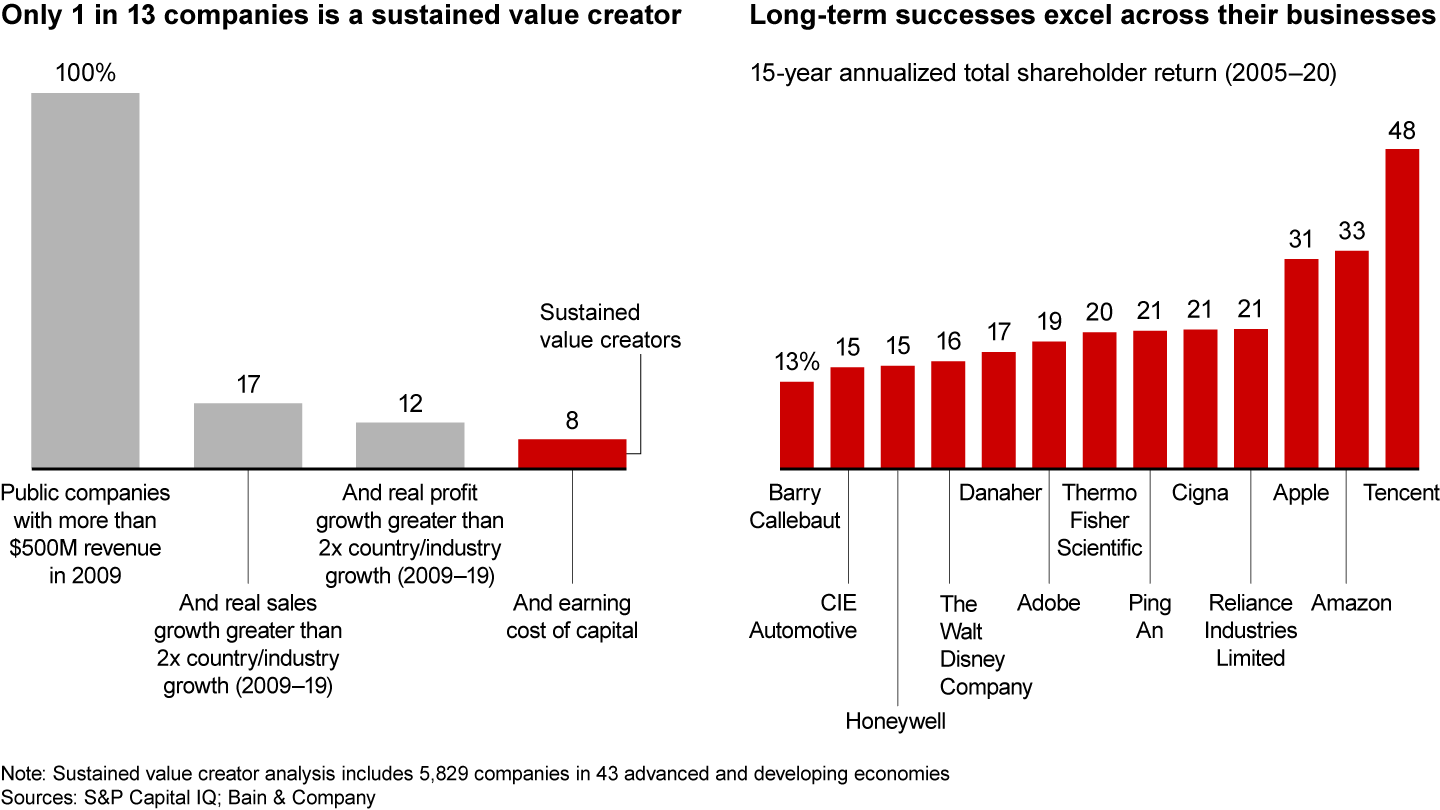
      It’s rare to create value day in, day out, but it is possible in a broad range of sectors
      It’s rare to create value day in, day out, but it is possible in a broad range of sectors
      It’s rare to create value day in, day out, but it is possible in a broad range of sectors

      When responding to threats to their current growth engine, one of the key mistakes companies make is to pursue a strategy of unrelated diversification. Investors are quick to discount companies that seem to sprawl, even in regions accustomed to rewarding breadth. In emerging Asian economies, where conglomerates have set the pace for years, pure-play rivals are now posting higher total shareholder returns as competition matures.

      In our experience, expansion beyond the core can be more coherent and less risky if executive teams take a systematic approach focused on what really differentiates their business from others. On one level, that requires paying close attention to business definition—through a deep understanding of customers, capabilities, and other factors that delineate the boundaries of each business, plus a keen sense of underlying connections between businesses.

      Yet we’ve also found that companies able to nurture multiple growth engines tend to be unusually certain of their parenting advantages: the traits that allow them to create more value out of a business than their competitors. They don’t all parent the same way; just as in families, there’s no one way to raise a corporate “child.” What successful parent companies do have in common is an admirable consistency of purpose, during periods of benign growth and intense upheaval alike.

      Gaining parenting advantages through customer focus

      The growth of Hilti, the Liechtenstein-headquartered construction supplier famous for its electropneumatic hammer drills delivered in red cases, has shown the effectiveness of consistently applying a single parenting mode over many business cycles. Since its founding in 1941, the group has evolved from a small family company to a global player with 2020 sales of CHF 5.3 billion. It developed from a supplier of direct-fastening tools toward offering a full portfolio of electric tools and fastening and protection solutions.

      Hilti’s parenting advantages have long come from its direct sales model. Unlike many rivals, it has largely refrained from engaging distributors, relying on a direct salesforce of about 17,000 people instead. This has given it a superior understanding of multilevel customer needs and innovation potential. As the common thread in the business, Hilti’s customer leadership has not just enabled the group to keep improving and inventing products and services; it has also empowered it to confront strategic challenges early.

      Hilti was ready and prepared when its drills became so fast that further acceleration offered only marginal gains to the user. Its preemptive expansion into laser systems shifted the focus from “how can I drill faster?” to “how can I more quickly find the right place to drill?”—a process still riven with inefficiencies that could be chiseled away at on behalf of customers. Hilti has also been at the forefront of expansion from hardware to software and services, developing end-to-end solutions to support and augment the value of its products. With ON!Track, Hilti made a first step into a software solution independent from its hardware products, allowing customers to digitalize their equipment and material management processes.

      Hilti’s management is now looking into a new challenge: how to leverage its parenting advantages into opportunities presented by the digitalization of the construction industry, be that through software, sensors integrated into the Internet of Things, or cloud-based data analysis. In short, its parenting advantages are poised to bring a distant adjacency into range.

      Hilti is a customer leader, one of two parenting modes that hinge on operational outperformance. The other mode is the efficiency leader: a company that gains an edge through relentless process optimization and economies of scale. Danaher, the US industrial and medical conglomerate, is a prime example of an efficiency leader. It has a repeatable formula for adding value across its subsidiaries through its Danaher Business System, a set of tools and processes to keep improving business performance, and its well-honed merger integration capabilities.

      Parenting advantages in portfolio management and beyond

      Working with executive teams globally, we see six other forms of parenting advantages within high-performing diversified businesses. All six varieties reflect a different blend of management strengths, operating capabilities, and proprietary assets. Two parenting modes relate to portfolio management—the art of entering and exiting profit pools at the right time.

      At one end of the portfolio management spectrum, there’s the persistent owner that excels at long-term value preservation, often supported by careful stakeholder management and a mission that explicitly goes beyond mere profit. Persistent owners include Henkel, the German industrial and consumer products group.

      At the other end of the spectrum lies the active buyer and seller. India’s Reliance Industries is a potent example of this form of parenting advantage. Initially in the yarn trade in the 1950s, it now has interests that span oil, gas, petrochemicals, telecommunications, retail, and media.

      The capabilities that underpin Reliance’s parenting advantages include its skill at identifying areas in which it can create and scale up a new business rapidly and profitably. That skill was on display in 2016 when it created Jio, its mobile telephone arm and digital ecosystem, as a new growth engine far from its hydrocarbon core. Reliance’s habit of outinvesting competitors when it enters a new market tends to pay dividends too.

      The interplay between the corporate center and business units—and how that activates a company’s differentiated capabilities—is crucial to building any parenting advantages. We call that a living strategy system (see Figure 2). One feature of Reliance’s living strategy system is that mature businesses get more autonomy than resource-hungry newer units. The front line is encouraged to use technology to test and learn new ways to gain scale and efficiency. And the whole conglomerate is infused with entrepreneurship.

      Figure 2
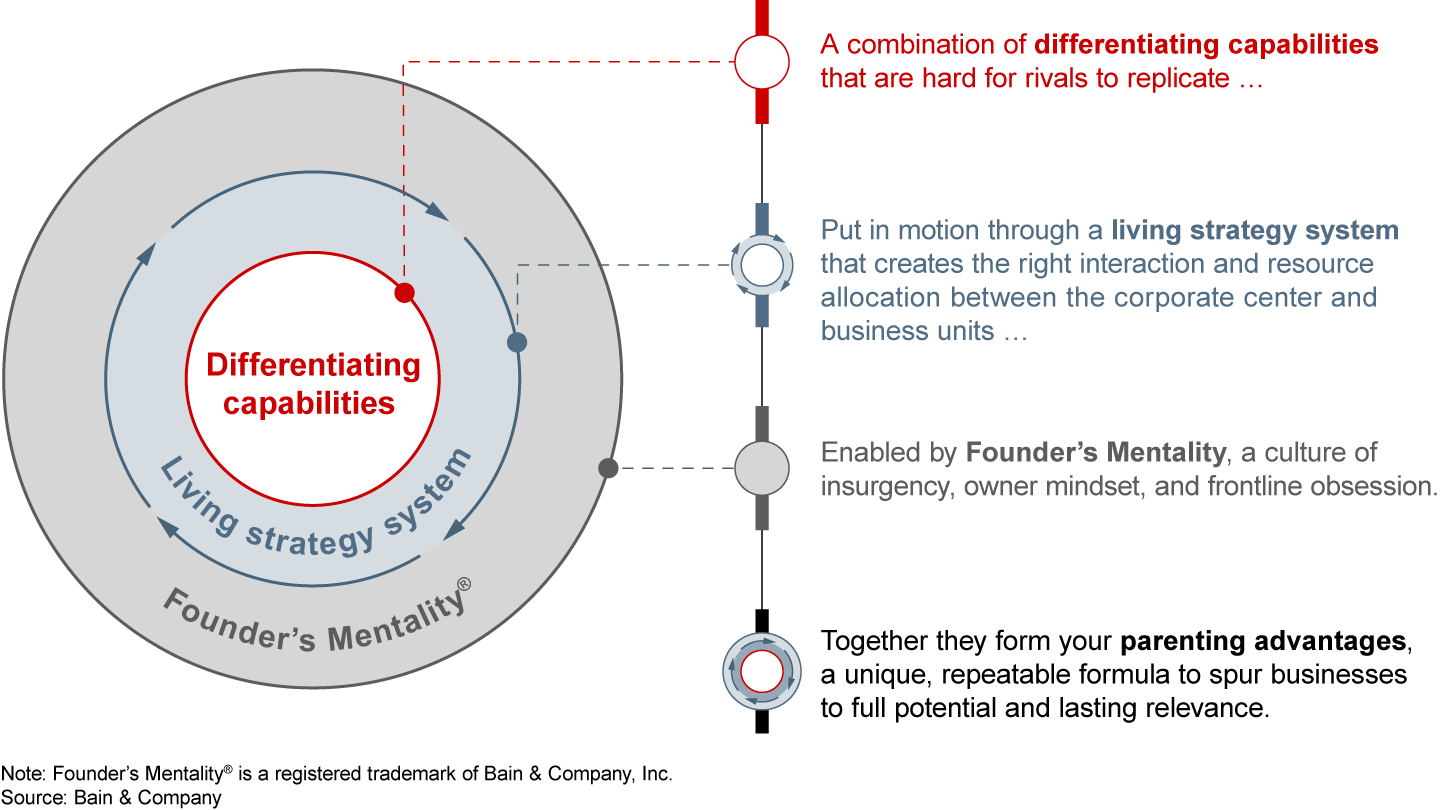
      Parenting advantages are based on three key elements that self-reinforce over time
      Parenting advantages are based on three key elements that self-reinforce over time
      Parenting advantages are based on three key elements that self-reinforce over time

      Two more sources of parenting advantages are exhibited by companies that are particularly skilled at protecting and expanding their profit pools. The global scale leader often uses scale and deep experience to outinvest competitors. In aerospace manufacturing, for example, global scale leaders continue to gain an edge by investing heavily in rarefied technical expertise and unusually strong customer relationships.

      Then there’s the multilocal champion that has specialist knowledge in a local market that’s nonetheless transferable across units. One example is Barry Callebaut, the Swiss cocoa processor and chocolate maker, which boasts superior commodity trading and sourcing capabilities, combined with deep expertise in West Africa and other markets.

      Barry Callebaut’s sourcing presence involves a form of backward integration: It’s not active in farming itself but is intimately involved in supporting farmer productivity through technological initiatives and its reliability as a buyer. It further leverages its parenting advantages in other related activities, ranging from making a significant margin on commodity trading to providing outsourced work and services to large food producers.

      The final two types of parenting advantages are displayed by diversified companies that manage to redraw the boundaries of industries in their favor. The first of these types is the serial disrupter: Think Tesla, Netflix, Adobe, and other companies that tap the power of data and technology to build new businesses before rivals. The other type is the platform builder, exemplified by the likes of Tencent and its ecosystem of digital services, Amazon Web Services (AWS), and Salesforce.

      Patterns in the past, a path for the future

      In order to look ahead, it’s sometimes necessary to look back. When companies begin the task of identifying and exploiting their parenting advantages, some of them find it useful to reconsider past chapters in their growth story as they gear up for future success.

      For executive teams, this reevaluation can yield powerful insights, highlighting not just the true nature and boundaries of the company’s various activities, but also pinpointing the areas in which it genuinely excels today, and where it can sustain an edge tomorrow.

      The questions you can ask as part of this strategic exercise include:

      • What are the differentiated capabilities and customer insights that fueled our past growth and continue to set us apart today?
      • Will these strengths survive the coming years, given the likely evolution of our customer base, our competitor set, advances in technology, and other trends?
      • Has our approach to developing and fine-tuning strategy given us a consistent edge as we grow? Can we change the business at speed at the same time as running it?
      • Have we built the sort of entrepreneurially minded company in which each unit feels like a scale insurgent rather than a bureaucracy?

      Answering these questions will help companies determine how their own parenting advantages have developed—and how they can be deployed to enable fresh chapters of growth.

      Auteurs
      • Headshot of Josef Ming
        Josef Ming
        Advisory Partner, Zurich
      • Headshot of Adrien Bron
        Adrien Bron
        Partner, Zurich
      • Headshot of Matthew Crupi
        Matthew Crupi
        Partner, Dallas
      • Headshot of Sri Rajan
        Sri Rajan
        Advisory Partner, San Francisco
      • Headshot of Dunigan O'Keeffe
        Dunigan O'Keeffe
        Partner, San Francisco
      • Headshot of Bhavya Nand Kishore
        Bhavya Nand Kishore
        Practice Executive Vice President, Zurich
      Contactez-nous
      Expertises fonctionnelles transverses
      • Corporate Strategy
      • Stratégie
      Agenda du CEO
      The Magic of Founder-led Companies

      Companies with their founder present performed twice as well as their peers in the S&P 500 over the past decade.

      Voir plus
      Agenda du CEO
      The 2026 Retail Executive Agenda

      Here are letters to the C-suite to help strengthen strategy, catalyze collaboration, and expand value creation in the AI age.

      Voir plus
      Agenda du CEO
      Shift to Vertical: David Haines, Group CEO, Flora Food Group

      What does it take to stay connected to your customers when scale and complexity threaten to pull you away? 

      Voir plus
      Stratégie
      Positioning Oil & Gas Companies for Today’s Capital Markets

      We interviewed senior investment professionals, and here’s what we heard.

      Voir plus
      Agenda du CEO
      What Business Leaders Need to Know About AI Sovereignty

      Aligning business strategy with national AI priorities is necessary to compete and scale.

      Voir plus
      First published in mai 2021
      Mots clés
      • Agenda du CEO
      • Corporate Strategy
      • Stratégie

      Comment nous avons aidé nos clients

      A Steel Company Seeks to Regain Market Leadership

      Lire l’étude de cas

      A Conglomerate Charts a New Global Strategy

      Lire l’étude de cas

      A financial services leader gains market confidence

      Lire l’étude de cas

      Vous souhaitez continuer cette conversation ?

      Nous aidons des dirigeants du monde entier à matérialiser des impacts et des résultats pérennes et créateurs de valeur dans leurs organisations.

      Les points de vue de Bain : notre perspective sur des problématiques auxquelles sont confrontées les entreprises à travers le monde, envoyés chaque mois dans votre boîte de réception. 

      *J’ai lu la politique de confidentialité et j’accepte les conditions.

      Merci de lire notre politique de confidentialité.
      Bain & Company
      Contactez-nous Sustainability Accessibility Conditions d’utilisation Politique de Confidentialité Cookie Policy Mentions Légales Sitemap Log In

      © 1996-2026 Bain & Company, Inc.

      Contacter Bain

      Comment pouvons-nous vous aider ?

      • Business inquiry
      • Career information
      • Press relations
      • Partnership request
      • Speaker request
      Voir tous les bureaux