
Skip to Content
  • Bureaux

    Bureaux

    Amérique du Nord et Amérique du Sud
    • Atlanta
    • Austin
    • Bogota
    • Boston
    • Buenos Aires
    • Chicago
    • Dallas
    • Denver
    • Houston
    • Los Angeles
    • Mexico City
    • Minneapolis
    • Monterrey
    • Montreal
    • New York
    • Rio de Janeiro
    • San Francisco
    • Santiago
    • São Paulo
    • Seattle
    • Silicon Valley
    • Toronto
    • Washington, DC
    Europe, Moyen-Orient et Afrique
    • Amsterdam
    • Athens
    • Berlin
    • Brussels
    • Copenhagen
    • Doha
    • Dubai
    • Dusseldorf
    • Frankfurt
    • Helsinki
    • Istanbul
    • Johannesburg
    • Kyiv
    • Lisbon
    • London
    • Madrid
    • Milan
    • Munich
    • Oslo
    • Paris
    • Riyadh
    • Rome
    • Stockholm
    • Vienna
    • Warsaw
    • Zurich
    Asie et Australie
    • Bangkok
    • Beijing
    • Bengaluru
    • Brisbane
    • Ho Chi Minh City
    • Hong Kong
    • Jakarta
    • Kuala Lumpur
    • Manila
    • Melbourne
    • Mumbai
    • New Delhi
    • Perth
    • Shanghai
    • Singapore
    • Sydney
    • Tokyo
    Voir tous les bureaux
  • Alumni
  • Presse
  • S’abonner
  • Contacter
  • Canada | Français

    Sélectionnez votre région et votre langue

    Global
    • Global (English)
    Amérique du Nord et Amérique du Sud
    • Brazil (Português)
    • Argentina (Español)
    • Canada (Français)
    • Chile (Español)
    • Colombia (Español)
    Europe, Moyen-Orient et Afrique
    • France (Français)
    • DACH Region (Deutsch)
    • Italy (Italiano)
    • Spain (Español)
    • Greece (Elliniká)
    Asie et Australie
    • China (中文版)
    • Korea (한국어)
    • Japan (日本語)
  • Saved items (0)
    Saved items (0)

    You have no saved items.

    Bookmark content that interests you and it will be saved here for you to read or share later.

    Explore Bain Insights
  • Expertises Sectorielles
    Menu principal

    Expertises Sectorielles

    • Aerospace et Défense
    • Agroalimentaire
    • Chimie
    • Infrastructures, BTP et Matériaux de Construction
    • Grande Consommation
    • Services Financiers
    • Santé
    • Engins & Equipements Industriels
    • Media et Divertissement
    • Metals
    • Mining
    • Pétrole & Gaz
    • Papier et Emballage
    • Private Equity
    • Secteur Public
    • Distribution
    • Technologie
    • Télécommunications
    • Transportation
    • Travel & Leisure
    • Utilities & Energies Renouvelables
  • Expertises Fonctionnelles
    Menu principal

    Expertises Fonctionnelles

    • Expérience Client
    • ESG
    • Innovation
    • Fusions et Acquisitions
    • Opérations
    • People & Organization
    • Private Equity
    • Sales & Marketing
    • Stratégie
    • IA, Perspectives et Solutions
    • Technology
    • Transformation
  • Digital
  • Points de Vue
  • About
    Menu principal

    About

    • Notre Activité
    • Nos Valeurs
    • Nos Collaborateurs et Notre Équipe Dirigeante
    • Notre Impact
    • Prix & Récompenses
    • Partenariats Internationaux
    Further: Our global responsibility
    • Sustainability
    • Impact Social
    • World Economic Forum
    Learn more about Further
  • Carrières
    Menu principal

    Carrières

    • Rejoignez-nous
      Carrières
      Rejoignez-nous
      • Find Your Place
      • Nos domaines d’expertise
      • Equipes multidisciplinaires
      • Étudiants
      • Stages et programmes
      • Événements de recrutement
    • La vie chez Bain
      Carrières
      La vie chez Bain
      • Blog: Inside Bain
      • Récits de carrière
      • Nos collaborateurs
      • Nos bureaux
      • Soutenir votre évolution professionnelle
      • Groupes d’affinités
      • Avantages chez Bain
    • Histoires d’impact
    • Notre processus de recrutement
      Carrières
      Notre processus de recrutement
      • Ce que vous pouvez attendre
      • Entretiens
    Trouver un poste
  • Bureaux
    Menu principal

    Bureaux

    • Amérique du Nord et Amérique du Sud
      Bureaux
      Amérique du Nord et Amérique du Sud
      • Atlanta
      • Austin
      • Bogota
      • Boston
      • Buenos Aires
      • Chicago
      • Dallas
      • Denver
      • Houston
      • Los Angeles
      • Mexico City
      • Minneapolis
      • Monterrey
      • Montreal
      • New York
      • Rio de Janeiro
      • San Francisco
      • Santiago
      • São Paulo
      • Seattle
      • Silicon Valley
      • Toronto
      • Washington, DC
    • Europe, Moyen-Orient et Afrique
      Bureaux
      Europe, Moyen-Orient et Afrique
      • Amsterdam
      • Athens
      • Berlin
      • Brussels
      • Copenhagen
      • Doha
      • Dubai
      • Dusseldorf
      • Frankfurt
      • Helsinki
      • Istanbul
      • Johannesburg
      • Kyiv
      • Lisbon
      • London
      • Madrid
      • Milan
      • Munich
      • Oslo
      • Paris
      • Riyadh
      • Rome
      • Stockholm
      • Vienna
      • Warsaw
      • Zurich
    • Asie et Australie
      Bureaux
      Asie et Australie
      • Bangkok
      • Beijing
      • Bengaluru
      • Brisbane
      • Ho Chi Minh City
      • Hong Kong
      • Jakarta
      • Kuala Lumpur
      • Manila
      • Melbourne
      • Mumbai
      • New Delhi
      • Perth
      • Shanghai
      • Singapore
      • Sydney
      • Tokyo
    Voir tous les bureaux
  • Alumni
  • Presse
  • S’abonner
  • Contacter
  • Canada | Français
    Menu principal

    Sélectionnez votre région et votre langue

    • Global
      Sélectionnez votre région et votre langue
      Global
      • Global (English)
    • Amérique du Nord et Amérique du Sud
      Sélectionnez votre région et votre langue
      Amérique du Nord et Amérique du Sud
      • Brazil (Português)
      • Argentina (Español)
      • Canada (Français)
      • Chile (Español)
      • Colombia (Español)
    • Europe, Moyen-Orient et Afrique
      Sélectionnez votre région et votre langue
      Europe, Moyen-Orient et Afrique
      • France (Français)
      • DACH Region (Deutsch)
      • Italy (Italiano)
      • Spain (Español)
      • Greece (Elliniká)
    • Asie et Australie
      Sélectionnez votre région et votre langue
      Asie et Australie
      • China (中文版)
      • Korea (한국어)
      • Japan (日本語)
  • Saved items  (0)
    Menu principal
    Saved items (0)

    You have no saved items.

    Bookmark content that interests you and it will be saved here for you to read or share later.

    Explore Bain Insights
  • Expertises Sectorielles
    • Expertises Sectorielles

      • Aerospace et Défense
      • Agroalimentaire
      • Chimie
      • Infrastructures, BTP et Matériaux de Construction
      • Grande Consommation
      • Services Financiers
      • Santé
      • Engins & Equipements Industriels
      • Media et Divertissement
      • Metals
      • Mining
      • Pétrole & Gaz
      • Papier et Emballage
      • Private Equity
      • Secteur Public
      • Distribution
      • Technologie
      • Télécommunications
      • Transportation
      • Travel & Leisure
      • Utilities & Energies Renouvelables
  • Expertises Fonctionnelles
    • Expertises Fonctionnelles

      • Expérience Client
      • ESG
      • Innovation
      • Fusions et Acquisitions
      • Opérations
      • People & Organization
      • Private Equity
      • Sales & Marketing
      • Stratégie
      • IA, Perspectives et Solutions
      • Technology
      • Transformation
  • Digital
  • Points de Vue
  • Carrières
    Recherches les plus fréquentes
    • Agile
    • Digital
    • Stratégie
    Vos recherches précédentes
      Pages récemment visitées

      Content added to saved items

      Saved items (0)

      Removed from saved items

      Saved items (0)

      Technology Report

      How Can We Meet AI’s Insatiable Demand for Compute Power?

      How Can We Meet AI’s Insatiable Demand for Compute Power?

      Technological innovation, new revenue, and public support may be needed to fund and supply enough electricity.

      Par David Crawford, Michael Schallehn, Paul Renno, Peter Hanbury, et Alessandro Cannarsi

      • First published on septembre 23, 2025
      • min
      }

      Rapport

      How Can We Meet AI’s Insatiable Demand for Compute Power?
      en
      En Bref
      • AI’s computational needs are growing more than twice as fast as Moore’s law, pushing toward 100 gigawatts of new demand in the US by 2030.
      • Meeting this demand could require $500 billion in annual spending on new data centers.
      • But even an aggressive reinvestment of IT and AI savings leaves a big gap.
      • Technological and algorithmic breakthroughs could help, but supply chain shortages or insufficient power supply could also thwart progress.

      This article is part of Bain’s Technology Report 2025

      Explore the report

      Of all the breathtaking observations about AI, few exceed this one: The growth rate for AI’s compute demand is more than twice the rate of Moore’s law (see Figure 1).

      For decades, Moore’s law—that is, the number of transistors on an integrated circuit doubles about every two years—has been the unrivaled measure of technological progress. If you apply its rate of progress to other fields of endeavor, the results are equally mind-blowing and amusing. For example, an automobile with Moore’s law applied would travel at 300,000 miles per hour, achieve 2 million miles per gallon of gas, and cost four cents.

      Now, AI’s compute demand—that is, the number of computations that must be performed to support evolving models—has grown at twice that rate over the past decade. With continued growth of these models and more adoption of AI by enterprises, Bain’s analysis suggests that the total global compute requirements could reach 200 gigawatts by 2030. In the US alone, total demand could reach 100 gigawatts by that time, which would increase new electricity demand on a grid that has seen relatively flat load growth for the past 20 years.

      Figure 1
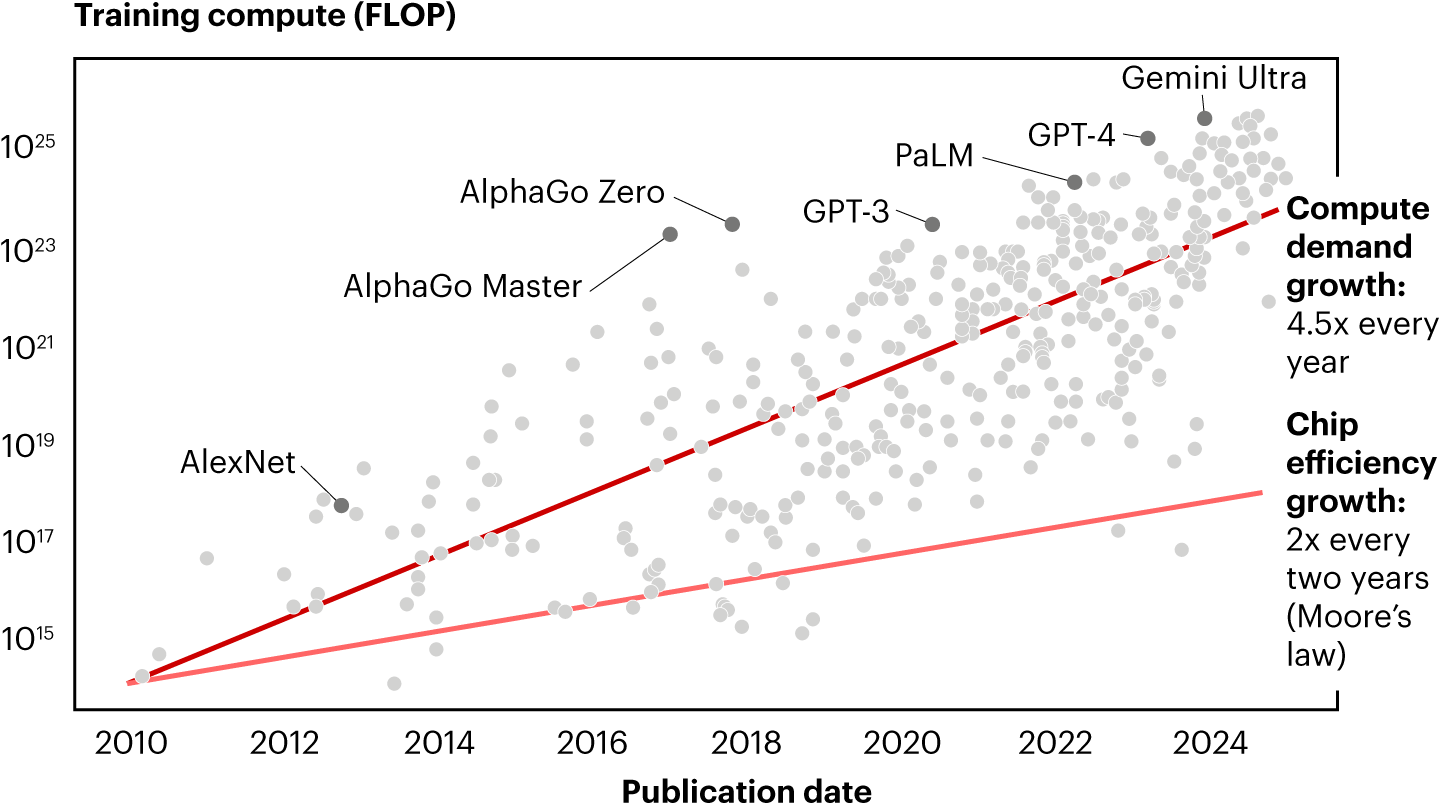
      Compute demand grows twice as fast as chip efficiency

      Notes: Chip efficiency growth not shown to exact scale, with the rate of growth intended to be illustrative; FLOP=floating point operations, which are the number of calculations a system performs

      Source: Epoch AI

      What are the implications of this for technology executives charged with allocating capital and managing investments? If you bet on continued growth and add lots of power generation or compute capacity while the trend slows down, you could be stuck with catastrophic unutilized power and compute capacity. If you bet that the trend will slow while it turns out to be durable, you may find yourself with insufficient capacity to capture a wave of growth and market share.

      What could change the trajectory?

      As companies form their strategic plans and determine investments, they should be considering four critical factors that could either impede or accelerate this growth: unaffordable economics, better graphics, technological breakthroughs, and supply chain shortages.

      The economics become unaffordable. Bain’s research suggests that building the data centers with the computing power needed to meet that anticipated demand would require about $500 billion of capital investment each year, a staggering sum that far exceeds any anticipated or imagined government subsidies. This suggests that the private sector would need to generate enough new revenue to fund the power upgrade. How much is that? Bain’s analysis of sustainable ratios of capex to revenue for cloud service providers suggests that $500 billion of annual capex corresponds to $2 trillion in annual revenue.

      What could fund this $2 trillion every year? If companies shifted all of their on-premise IT budgets to cloud and also reinvested the savings anticipated from applying AI in sales, marketing, customer support, and R&D (estimated at about 20% of those budgets) into capital spending on new data centers, the amount would still fall $800 billion short of the revenue needed to fund the full investment (see Figure 2).

      Figure 2
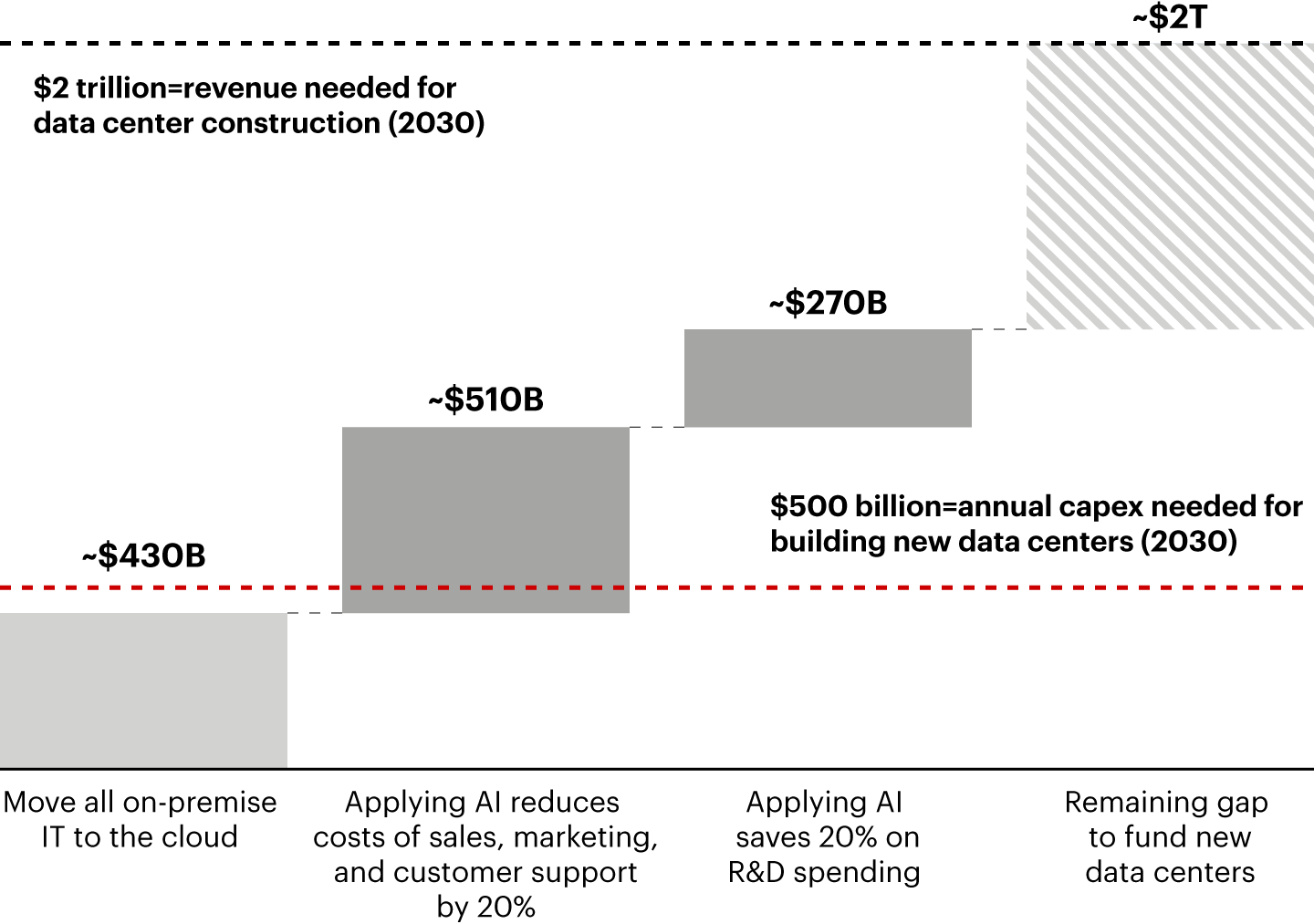
      Even with AI-related savings, $800 billion in additional revenue would need to be generated to fund the necessary data centers
      Sources: OECD; S&P Global; Bain Cloud CIO Survey; IDC; Fortune; Gartner

      The algorithms get better. When mathematical problems grow too complex or costly, step-change progress often comes not from incremental tuning but rather from entirely new algorithmic approaches. Innovations such as MapReduce (which popularized distributed data processing) and the Transformer architecture (which unlocked a more efficient way to process sequential data) exemplify this kind of breakthrough. Even at smaller scales, algorithmic innovation can unlock meaningful gains. In foundation models, techniques such as mixed-precision matrix computation improve training and inference efficiency. Logical methods, such as chain-of-thought prompting or large model distillation, boost performance while lowering computational load. DeepSeek is a recent example, pushing the compute efficiency frontier through smarter algorithmic design. Still, even with these innovations, the path forward requires a significant increase in infrastructure to reach the 100 gigawatts of additional compute power that will be needed.

      Technological breakthroughs change the landscape. History is replete with unexpected leaps of progress in computational power. Sixty years of Moore’s law progress in semiconductors has given us handheld devices that far outperform the most powerful computers of the 1970s. Many speculate that quantum computing, for example, could displace the favored semiconductors trajectory of today, reducing the compute and power demands of tomorrow’s systems. Bain’s research suggests we are at least 10 to 15 years away from quantum computers stable enough to replace generative AI training and inference workloads. Other technological breakthroughs could include specially designed training and inference application-specific integrated circuits (ASICs), which could be more efficient than general purpose graphics processing units (GPUs), or new forms of memory or advanced packaging to improve power efficiency.

      Shortages hit the supply chain. It will be difficult to build data centers fast enough to meet rising demand given constraints in four areas: power supply, construction services, compute enablers (such as GPUs), and the limited supply of data center equipment (including electrical switchgear and advanced cooling). Of these, increasing the supply of electricity may be the most challenging as bringing new power generation, transmission, and distribution online in a highly regulated industry can take four years or longer.

      While no single issue will solve this deep challenge, innovation, government support, and efficient markets are all factors that could help close the gap. AI has the potential not only to improve productivity but also to spur the development of new businesses and revolutionary technological advancements in areas as diverse as drug discovery, autonomous vehicles, and logistics. Such large shifts frequently unlock new value in the economy, and they could help produce the revenue needed for the necessary capex. However, without such innovations or breakthroughs, general progress could slow, and the field could be left to only those players in markets with adequate public funding.

      Read the Next Section

      Humanoid Robots: From Demos to Deployment

      More from the report

      • Tech's Most Valuable

      • Globally Fragmented Tech

      • Tech Investing's New Rules

      • AI Disrupts SaaS

      • AI's Appetite for Compute Power

      • Humanoid Robots

      • Quantum's Potential

      • Agentic AI Transformation

      • AI in Sales

      • Gen AI in Software Development

      • Agentic AI Architecture

      Read our Technology Report 2025

      EXPLORE THE FULL REPORT DOWNLOAD THE PDF
      Auteurs
      • Headshot of David Crawford
        David Crawford
        Partner, Silicon Valley
      • Headshot of Michael Schallehn
        Michael Schallehn
        Partner, Silicon Valley
      • Headshot of Paul Renno
        Paul Renno
        Partner, San Francisco
      • Headshot of Peter Hanbury
        Peter Hanbury
        Partner, San Francisco
      • Headshot of Alessandro Cannarsi
        Alessandro Cannarsi
        Partner, Milan
      Contactez-nous
      Synergies sectorielles
      • Technologie
      • Utilities & Energies Renouvelables
      Expertises fonctionnelles transverses
      • Capital Projects Acceleration
      • Digital
      • IA, Perspectives et Solutions
      • Opérations
      Comment pouvons-nous vous aider ?
      • Artificial Intelligence
      Artificial Intelligence Insights
      Can the US Energy Grid Keep Up with AI Data Centers?

      Our latest forecast projects data centers will consume 9% of US electricity by 2030, straining the grid without new solutions.

      Voir plus
      Technology Report
      Will Agentic AI Disrupt SaaS?

      Disruption is mandatory. Obsolescence is optional.

      Voir plus
      Artificial Intelligence
      How Agentic AI Is Reshaping Customer Behavior in Italy and Europe

      As global AI use increases, the challenge lies in ensuring users are appropriately empowered by the technology.

      Voir plus
      Artificial Intelligence Insights
      Solving for AI’s Data Center Construction Crunch

      AI’s computing needs could reach 200 gigawatts of new global demand by 2030, requiring companies to build faster and smarter.

      Voir plus
      Technology Report
      State of the Art of Agentic AI Transformation

      Tech-forward enterprises have cracked the code on ROI for AI. Falling behind is riskier than ever as the next wave of agentic AI raises the stakes.

      Voir plus
      Mots clés
      • Artificial Intelligence
      • Artificial Intelligence Insights
      • Capital Projects Acceleration
      • CIO Insights
      • Digital
      • IA, Perspectives et Solutions
      • Opérations
      • Technologie
      • Technology Report
      • Utilities & Energies Renouvelables

      Comment nous avons aidé nos clients

      Can Microchips Turbocharge Sustainability Improvement?

      Lire l’étude de cas

      An Environmental Services Company Captures Massive Savings from a Merger

      Lire l’étude de cas

      Increased sales productivity frees selling time and saves millions

      Lire l’étude de cas

      Vous souhaitez continuer cette conversation ?

      Nous aidons des dirigeants du monde entier à matérialiser des impacts et des résultats pérennes et créateurs de valeur dans leurs organisations.

      Les points de vue de Bain : notre perspective sur des problématiques auxquelles sont confrontées les entreprises à travers le monde, envoyés chaque mois dans votre boîte de réception. 

      *J’ai lu la politique de confidentialité et j’accepte les conditions.

      Merci de lire notre politique de confidentialité.
      Bain & Company
      Contactez-nous Sustainability Accessibility Conditions d’utilisation Politique de Confidentialité Cookie Policy Mentions Légales Sitemap Log In

      © 1996-2026 Bain & Company, Inc.

      Contacter Bain

      Comment pouvons-nous vous aider ?

      • Business inquiry
      • Career information
      • Press relations
      • Partnership request
      • Speaker request
      Voir tous les bureaux