
Skip to Content
  • Bureaux

    Bureaux

    Amérique du Nord et Amérique du Sud
    • Atlanta
    • Austin
    • Bogota
    • Boston
    • Buenos Aires
    • Chicago
    • Dallas
    • Denver
    • Houston
    • Los Angeles
    • Mexico City
    • Minneapolis
    • Monterrey
    • Montreal
    • New York
    • Rio de Janeiro
    • San Francisco
    • Santiago
    • São Paulo
    • Seattle
    • Silicon Valley
    • Toronto
    • Washington, DC
    Europe, Moyen-Orient et Afrique
    • Amsterdam
    • Athens
    • Berlin
    • Brussels
    • Copenhagen
    • Doha
    • Dubai
    • Dusseldorf
    • Frankfurt
    • Helsinki
    • Istanbul
    • Johannesburg
    • Kyiv
    • Lisbon
    • London
    • Madrid
    • Milan
    • Munich
    • Oslo
    • Paris
    • Riyadh
    • Rome
    • Stockholm
    • Vienna
    • Warsaw
    • Zurich
    Asie et Australie
    • Bangkok
    • Beijing
    • Bengaluru
    • Brisbane
    • Ho Chi Minh City
    • Hong Kong
    • Jakarta
    • Kuala Lumpur
    • Manila
    • Melbourne
    • Mumbai
    • New Delhi
    • Perth
    • Shanghai
    • Singapore
    • Sydney
    • Tokyo
    Voir tous les bureaux
  • Alumni
  • Presse
  • S’abonner
  • Contacter
  • Canada | Français

    Sélectionnez votre région et votre langue

    Global
    • Global (English)
    Amérique du Nord et Amérique du Sud
    • Brazil (Português)
    • Argentina (Español)
    • Canada (Français)
    • Chile (Español)
    • Colombia (Español)
    Europe, Moyen-Orient et Afrique
    • France (Français)
    • DACH Region (Deutsch)
    • Italy (Italiano)
    • Spain (Español)
    • Greece (Elliniká)
    Asie et Australie
    • China (中文版)
    • Korea (한국어)
    • Japan (日本語)
  • Saved items (0)
    Saved items (0)

    You have no saved items.

    Bookmark content that interests you and it will be saved here for you to read or share later.

    Explore Bain Insights
  • Expertises Sectorielles
    Menu principal

    Expertises Sectorielles

    • Aerospace et Défense
    • Agroalimentaire
    • Chimie
    • Infrastructures, BTP et Matériaux de Construction
    • Grande Consommation
    • Services Financiers
    • Santé
    • Engins & Equipements Industriels
    • Media et Divertissement
    • Metals
    • Mining
    • Pétrole & Gaz
    • Papier et Emballage
    • Private Equity
    • Secteur Public
    • Distribution
    • Technologie
    • Télécommunications
    • Transportation
    • Travel & Leisure
    • Utilities & Energies Renouvelables
  • Expertises Fonctionnelles
    Menu principal

    Expertises Fonctionnelles

    • Expérience Client
    • ESG
    • Innovation
    • Fusions et Acquisitions
    • Opérations
    • People & Organization
    • Private Equity
    • Sales & Marketing
    • Stratégie
    • IA, Perspectives et Solutions
    • Technology
    • Transformation
  • Digital
  • Points de Vue
  • About
    Menu principal

    About

    • Notre Activité
    • Nos Valeurs
    • Nos Collaborateurs et Notre Équipe Dirigeante
    • Notre Impact
    • Prix & Récompenses
    • Partenariats Internationaux
    Further: Our global responsibility
    • Sustainability
    • Impact Social
    • World Economic Forum
    Learn more about Further
  • Carrières
    Menu principal

    Carrières

    • Rejoignez-nous
      Carrières
      Rejoignez-nous
      • Find Your Place
      • Nos domaines d’expertise
      • Equipes multidisciplinaires
      • Étudiants
      • Stages et programmes
      • Événements de recrutement
    • La vie chez Bain
      Carrières
      La vie chez Bain
      • Blog: Inside Bain
      • Récits de carrière
      • Nos collaborateurs
      • Nos bureaux
      • Soutenir votre évolution professionnelle
      • Groupes d’affinités
      • Avantages chez Bain
    • Histoires d’impact
    • Notre processus de recrutement
      Carrières
      Notre processus de recrutement
      • Ce que vous pouvez attendre
      • Entretiens
    Trouver un poste
  • Bureaux
    Menu principal

    Bureaux

    • Amérique du Nord et Amérique du Sud
      Bureaux
      Amérique du Nord et Amérique du Sud
      • Atlanta
      • Austin
      • Bogota
      • Boston
      • Buenos Aires
      • Chicago
      • Dallas
      • Denver
      • Houston
      • Los Angeles
      • Mexico City
      • Minneapolis
      • Monterrey
      • Montreal
      • New York
      • Rio de Janeiro
      • San Francisco
      • Santiago
      • São Paulo
      • Seattle
      • Silicon Valley
      • Toronto
      • Washington, DC
    • Europe, Moyen-Orient et Afrique
      Bureaux
      Europe, Moyen-Orient et Afrique
      • Amsterdam
      • Athens
      • Berlin
      • Brussels
      • Copenhagen
      • Doha
      • Dubai
      • Dusseldorf
      • Frankfurt
      • Helsinki
      • Istanbul
      • Johannesburg
      • Kyiv
      • Lisbon
      • London
      • Madrid
      • Milan
      • Munich
      • Oslo
      • Paris
      • Riyadh
      • Rome
      • Stockholm
      • Vienna
      • Warsaw
      • Zurich
    • Asie et Australie
      Bureaux
      Asie et Australie
      • Bangkok
      • Beijing
      • Bengaluru
      • Brisbane
      • Ho Chi Minh City
      • Hong Kong
      • Jakarta
      • Kuala Lumpur
      • Manila
      • Melbourne
      • Mumbai
      • New Delhi
      • Perth
      • Shanghai
      • Singapore
      • Sydney
      • Tokyo
    Voir tous les bureaux
  • Alumni
  • Presse
  • S’abonner
  • Contacter
  • Canada | Français
    Menu principal

    Sélectionnez votre région et votre langue

    • Global
      Sélectionnez votre région et votre langue
      Global
      • Global (English)
    • Amérique du Nord et Amérique du Sud
      Sélectionnez votre région et votre langue
      Amérique du Nord et Amérique du Sud
      • Brazil (Português)
      • Argentina (Español)
      • Canada (Français)
      • Chile (Español)
      • Colombia (Español)
    • Europe, Moyen-Orient et Afrique
      Sélectionnez votre région et votre langue
      Europe, Moyen-Orient et Afrique
      • France (Français)
      • DACH Region (Deutsch)
      • Italy (Italiano)
      • Spain (Español)
      • Greece (Elliniká)
    • Asie et Australie
      Sélectionnez votre région et votre langue
      Asie et Australie
      • China (中文版)
      • Korea (한국어)
      • Japan (日本語)
  • Saved items  (0)
    Menu principal
    Saved items (0)

    You have no saved items.

    Bookmark content that interests you and it will be saved here for you to read or share later.

    Explore Bain Insights
  • Expertises Sectorielles
    • Expertises Sectorielles

      • Aerospace et Défense
      • Agroalimentaire
      • Chimie
      • Infrastructures, BTP et Matériaux de Construction
      • Grande Consommation
      • Services Financiers
      • Santé
      • Engins & Equipements Industriels
      • Media et Divertissement
      • Metals
      • Mining
      • Pétrole & Gaz
      • Papier et Emballage
      • Private Equity
      • Secteur Public
      • Distribution
      • Technologie
      • Télécommunications
      • Transportation
      • Travel & Leisure
      • Utilities & Energies Renouvelables
  • Expertises Fonctionnelles
    • Expertises Fonctionnelles

      • Expérience Client
      • ESG
      • Innovation
      • Fusions et Acquisitions
      • Opérations
      • People & Organization
      • Private Equity
      • Sales & Marketing
      • Stratégie
      • IA, Perspectives et Solutions
      • Technology
      • Transformation
  • Digital
  • Points de Vue
  • Carrières
    Recherches les plus fréquentes
    • Agile
    • Digital
    • Stratégie
    Vos recherches précédentes
      Pages récemment visitées

      Content added to saved items

      Saved items (0)

      Removed from saved items

      Saved items (0)

      Article

      Inclusion Helps Your Company’s Black Employees Move Up, Not Out

      Inclusion Helps Your Company’s Black Employees Move Up, Not Out

      Companies can’t simply hire their way to diversity; they also must retain and advance employees. That starts with making sure they feel included.

      Par Alex Noether et Dria James

      • min
      }

      Article

      Inclusion Helps Your Company’s Black Employees Move Up, Not Out
      en

      As we celebrate this year’s Black History Month as two Black leaders at Bain, we are immensely thankful for the progress that those who came before us and that so many of our peers have fought to realize, from legislative progress on civil rights and employment to the tireless efforts of those who have strived for years to create more diverse and equitable workplaces.

      Yet for all the advances made, the data is clear: Too many Black workers remain stuck at the bottom of their organizations. Thirty-six percent of Black workers are in frontline roles, the highest percentage of any racial group and starkly higher than white workers (21%). Even more alarming, 21% of Black workers are in lower-income frontline roles that pay less than $30,000 per year (see Figure 1). Black people also are much less likely to hold middle-management and senior positions.

      Figure 1
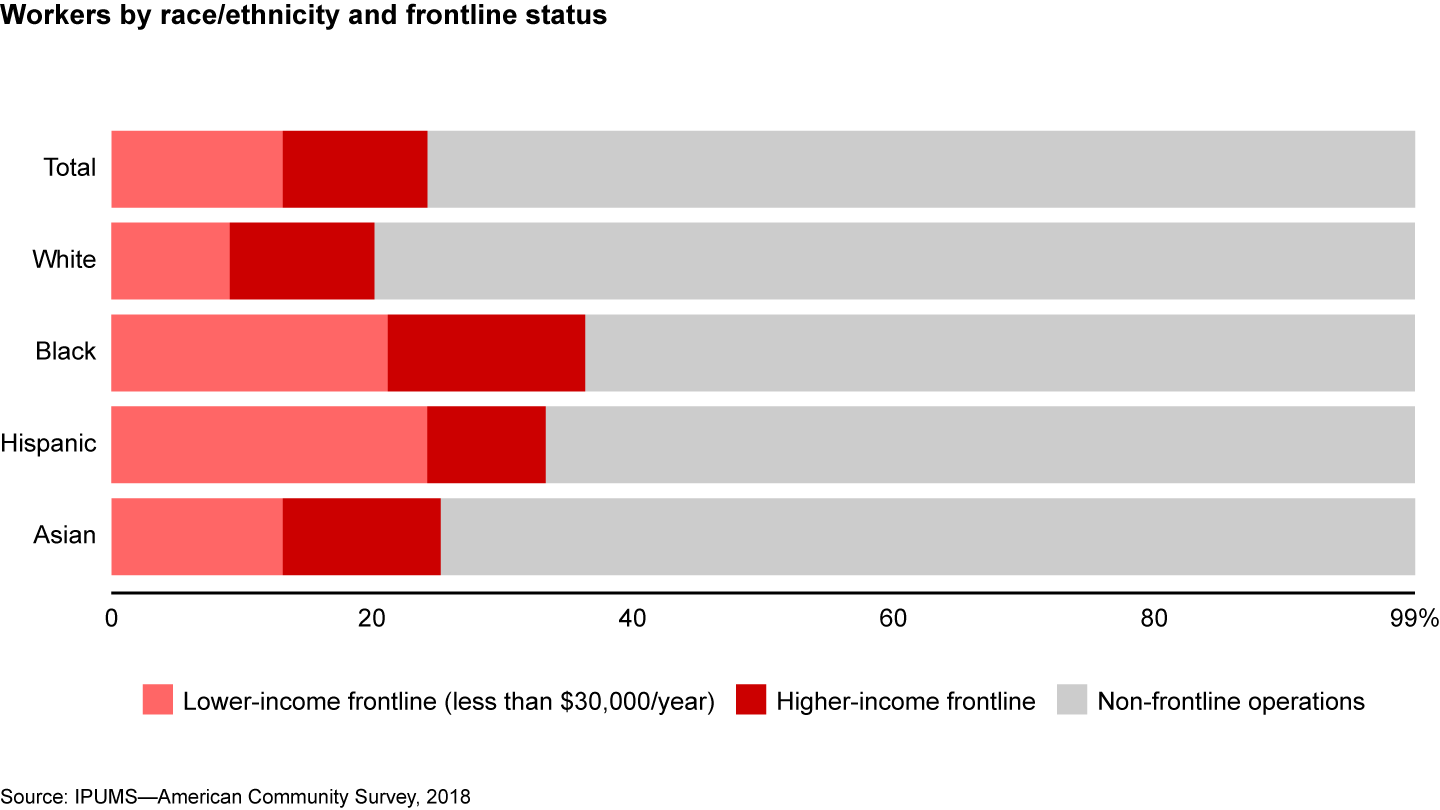
      Black employees are overrepresented in frontline roles
      Black employees are overrepresented in frontline roles
      Black employees are overrepresented in frontline roles

      One barrier to Black advancement is attrition. Companies closely guard such data, but there’s plenty of evidence that retention rates for Black employees are low. A 2019 report from Coqual found that Black employees were 30% more likely to intend to leave than their white colleagues. Any attrition is disturbing amid the Great Resignation, but faster rates for Black employees are all the more alarming as companies focusing on improving diversity, equity, and inclusion (DEI) see the diversity of their population shrink, which, in turn, reduces opportunities for advancing equity.

      Yet new Bain & Company research finds that inclusion, the third pillar of DEI, may be the key both to understanding this attrition and to knocking down the barriers it poses to advancement. To learn what makes employees feel included, we surveyed 10,000 people across industries, geographies, and demographic backgrounds at all levels of seniority and organizational size.

      One of our key findings was that employees who do not feel included are significantly more likely to quit. And we found that Black employees who feel excluded at work are two to four times more likely to leave their jobs than Black (or white) employees who feel fully included at work (see Figure 2).

      Figure 2
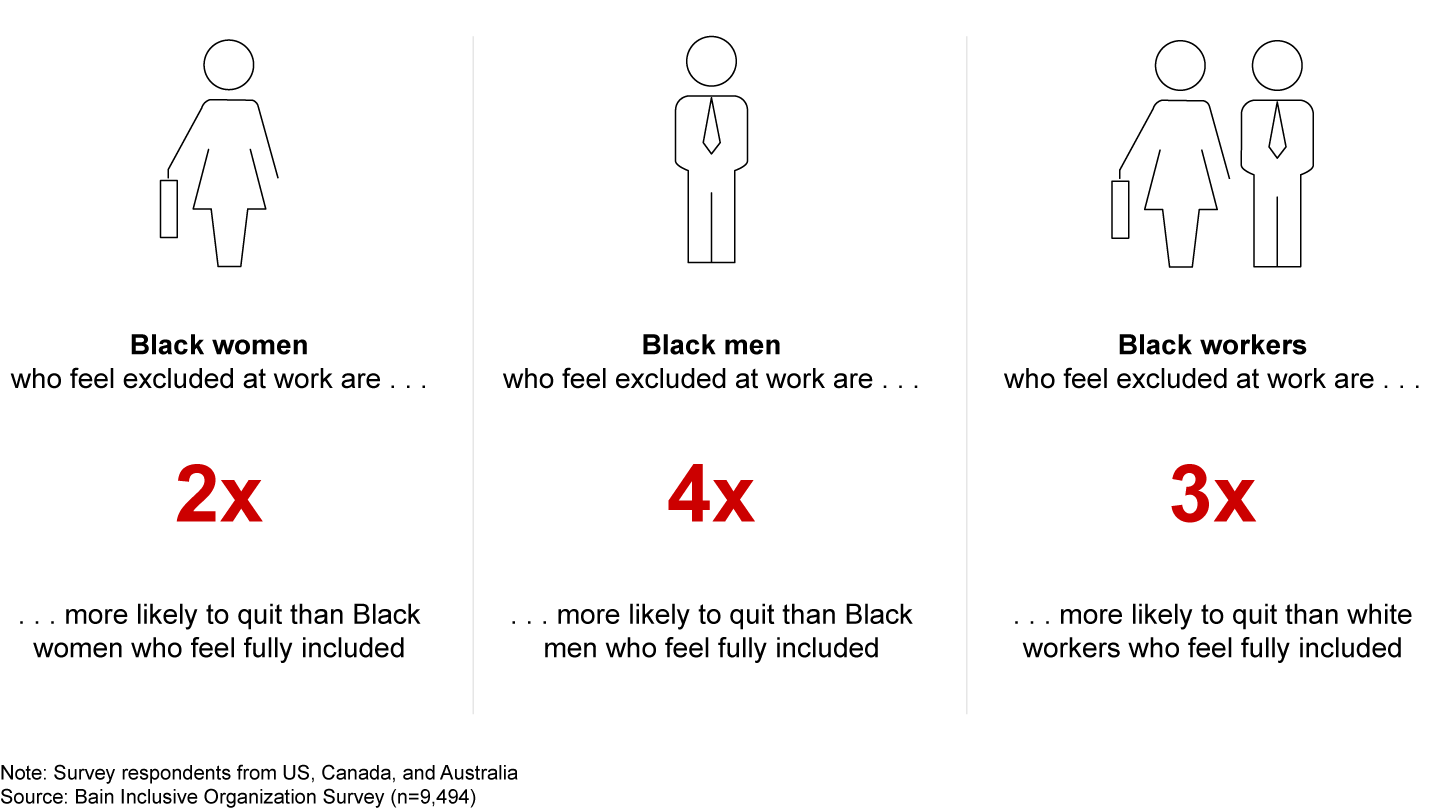
      Black employees who feel excluded at work are much more likely to leave
      Black employees who feel excluded at work are much more likely to leave
      Black employees who feel excluded at work are much more likely to leave

      Improving the retention and advancement of Black workers is a multifaceted challenge requiring multiple complex solutions. But clearly there is one “must do” for employers, and that is to make their workplaces more inclusive for Black employees.

      Clearly there is one ‘must do’ for employers: Make their workplaces more inclusive for Black employees.

      Beyond the obvious fact that fostering inclusion is the right thing to do and supports retention, inclusion also helps workers perform at their best. From neuroscience, we know that feeling excluded sets off biological alarms in the brain similar to those caused by physical pain, which is hardly conducive to employee performance. With only 20% to 25% of Black employees feeling fully included at work today, improving inclusion is a clear opportunity to support their success and advancement.

      Fostering inclusion is deceptively difficult, however, as we outlined in The Fabric of Belonging: How to Weave an Inclusive Culture. One of the key challenges is that organizations often struggle to identify what enablers will most increase feelings and experiences of inclusion for specific populations, each with different experiences and unique needs.

      Our survey statistically unpacked the most effective enablers of inclusion for 18 different populations, with a focus on how intersectionality—that is, combining lenses such as race, gender, and sexual orientation—reveals enablers with even greater impact for those populations than for broader groups.

      Here is some of what we learned about enabling inclusion for Black men and women in the workplace in the US, Canada, and Australia.

      Black women. Our study found that one of the biggest differences between Black women who feel included and those who do not is the establishment of rituals and norms around coaching and professional development conversations.

      The presence of rituals and norms regarding coaching is particularly important to Black women because they often do not have access to leaders who resemble them. It is well known that unconscious biases tend to encourage people to mentor and sponsor people who are similar to themselves. And since there are often not enough senior Black women present to organically form relationships to mentor junior ones, Black women benefit more from formal mechanisms or cultural expectations that encourage their leaders to give them the same amount of coaching that others receive.

      Black men. Our study found that Black men who feel the most included work in groups in which decision-making rights are clearly articulated and leadership teams demonstrate high levels of humility—that is, leaders recognize that they “don’t know everything and can learn/improve from others.”

      It is hardly surprising that these enablers matter significantly to Black men, who often are unfairly stereotyped as “aggressive” or “angry.” In a workplace where white men may feel free to share dissenting opinions, Black men may worry that the same outspokenness could cast them in a negative light. But in a workplace where it is clear which decisions each person does and does not own and where leaders demonstrate receptivity to differing points of view, these personal risks to Black men are mitigated, allowing them to participate more freely.

      These are just two examples of how specific enablers can meaningfully improve how included Black employees feel. But to be most effective at fostering greater inclusion, organizations need to take stock of their own unique situations (for example, what they do and do not do well, what matters to their Black employees, etc.). The first steps are for organizations to recognize the importance of increasing those feelings and experiences of inclusion for their Black employees, and to commit to understanding (with a data-driven approach such as the one we describe above) which enablers will be most effective for fostering inclusion for their Black workers.

      We are committed to pushing our organization and other organizations to ask and answer the tough questions required to keep breaking down barriers and to promote full inclusion for Black people in the workplace. If we have learned anything from history, it is that it takes commitment and action from all of us to effect such change. In other words, in the spirit of inclusion, we need to come together to tackle these challenges. That is how we will make our workplaces truly inviting and inclusive for Black employees and for everyone.

      Auteurs
      • Headshot of Alex Noether
        Alex Noether
        Alumni, Toronto
      • Dria James
        Former Senior Director, Global Diversity, Equity and Inclusion, Washington, DC
      Contactez-nous
      Expertises fonctionnelles transverses
      • Diversity, Equity & Inclusion
      • Leadership & Talent
      Diversity, Equity & Inclusion
      The Fabric of Belonging: How to Weave an Inclusive Culture

      Inclusive organizations have higher-performing, happier teams. But what’s the secret to creating such organizations?

      Voir plus
      Diversity, Equity & Inclusion
      Beyond Policies: Leadership Behaviors That Propel Women to the Top

      After a decade of progress, the next chapter of growth will rely on inclusive behaviors from every leader, every day.

      Voir plus
      Diversity, Equity & Inclusion
      The Business of Belonging

      Why making everyone feel included is smart strategy.

      Voir plus
      Diversity, Equity & Inclusion
      Better with Age: The Rising Importance of Older Workers

      Some 150 million jobs will shift to older workers by the end of the decade. Here’s how to get ready.

      Voir plus
      Diversity, Equity & Inclusion
      Advancing Gender Equity in the Middle East Workforce

      Women of the GCC are transforming the region’s workforce. Focused inclusion efforts can capitalize on this momentum.

      Voir plus
      First published in février 2022
      Mots clés
      • Diversity, Equity & Inclusion
      • Leadership & Talent

      Comment nous avons aidé nos clients

      A Conglomerate Charts a New Global Strategy

      Lire l’étude de cas

      Can Microchips Turbocharge Sustainability Improvement?

      Lire l’étude de cas

      A holding company lets go to grow

      Lire l’étude de cas

      Vous souhaitez continuer cette conversation ?

      Nous aidons des dirigeants du monde entier à matérialiser des impacts et des résultats pérennes et créateurs de valeur dans leurs organisations.

      Les points de vue de Bain : notre perspective sur des problématiques auxquelles sont confrontées les entreprises à travers le monde, envoyés chaque mois dans votre boîte de réception. 

      *J’ai lu la politique de confidentialité et j’accepte les conditions.

      Merci de lire notre politique de confidentialité.
      Bain & Company
      Contactez-nous Sustainability Accessibility Conditions d’utilisation Politique de Confidentialité Cookie Policy Mentions Légales Sitemap Log In

      © 1996-2026 Bain & Company, Inc.

      Contacter Bain

      Comment pouvons-nous vous aider ?

      • Business inquiry
      • Career information
      • Press relations
      • Partnership request
      • Speaker request
      Voir tous les bureaux