

Etude
In 2004, the financial services firm Charles Schwab was struggling. Costs were spinning out of control, and the stock price had plummeted from $40 to just $6. Yet just four years later, Schwab had regained its position as an industry leader and its stock price had tripled. A key part of the turnaround: Schwab’s Net Promoter System®, which helped the company provide world-class service while living up to the customer-focused beliefs that are at the heart of its strategy. “The beauty of Net Promoter®,” says CEO Walt Bettinger, “is that it helps to simplify complex issues and helps people to make the right decisions. [It] makes people ask themselves: Is this the right thing to do for our customer, and is it economically appropriate for the firm?”
Rackspace is an entrepreneurial company in the fiercely competitive cloud computing and managed hosting business. It has grown rapidly since its founding in 1998 and by 2011, its revenue run rate had exceeded $1 billion. What distinguishes Rackspace from competitors, says former CEO Lanham Napier, is the “Fanatical Support” it offers customers, and the process the company uses to measure and manage Fanatical Support is the Net Promoter System. “The goal of Fanatical Support is to create customers who are promoters,” says Napier. “Promoters recommend Rackspace to their friends, becoming an extension of our salesforce. Customers who are promoters are also more profitable, staying with us longer and buying more of our services…. The creation of loyal promoters not only reduces customer acquisition costs, it improves retention rates and inspires Rackers [employees]. We have witnessed these results firsthand.”
Several years ago, American Express CEO Ken Chenault came to believe that his company’s service quality was not what it should be. Service had become “a back-office cost center, focused on reducing expenses and executing transactions,” remembers Jim Bush, the executive Chenault appointed to lead the company’s service organization. “We were effective and efficient… but we were missing an opportunity to establish bonds with [our customers] and build more meaningful relationships.” Bush initiated a series of measures to improve service quality and improve the environment for its service employees. One of the key elements of his approach: launching a Net Promoter System, known internally as Recommend to a Friend. In just three years, American Express saw a significant increase in customer satisfaction scores, greater efficiency and service margins, and 50% lower employee attrition in its US service centers.
By now, most executives are familiar with Net Promoter Scores, a method of measuring customers’ loyalty by sorting them into promoters, passives and detractors (see below, “Calculating Your Net Promoter Score®”). But what is the Net Promoter System that has helped these three companies and many others reach—or remain in—the top ranks of their industries?
A Net Promoter System is a management philosophy, a way of running a business. Net Promoter companies commit to specific processes and systems that help everyone focus on earning the passionate loyalty of both customers and employees. The business payoffs are substantial, as Schwab and the others found. Loyal, passionate customers stay longer, spend more, contribute suggestions and sing your company’s praises to friends and colleagues. Loyal, passionate employees love working for you, come up with new ideas and go the extra mile to delight customers. That’s why loyalty correlates so strongly with sustainable, profitable organic growth. On average, an industry’s loyalty leader grows more than twice as fast as its competitors.
Financial benefits aren’t the only reason for implementing a Net Promoter System. Unlike conventional accounting, which often tempts companies to chase short-term profits at the expense of loyalty and even ethics, the Net Promoter approach requires—and inspires—a company to do the right thing by its customers and employees. It is the business equivalent of the Golden Rule: Treat others as you would have them treat you. Judging by the idealistic statements in many companies’ annual reports, most CEOs are like Bettinger, Napier or Chenault: They want their companies to grow by enriching the lives of customers and employees. What they have lacked, until now, is a system that builds that goal into their companies’ everyday operations.
The Net Promoter System is a management philosophy that companies around the world use to earn the passionate loyalty of customers and employees. Rob Markey, global practice leader of Bain's Customer Strategy and Marketing practice, explains the system's origins.
The basics
Boiled down to its essentials, a Net Promoter System has just four requirements. Net Promoter companies:
Regularly sort their customers into three simple groups: promoters, passives and detractors. Ideally, companies ask just a few questions in their surveys:
- How likely is it that you would recommend [product, service or company/brand] to a friend or colleague? (This question is scored on a 0-10 scale.)
- Why?
- What could we do better?
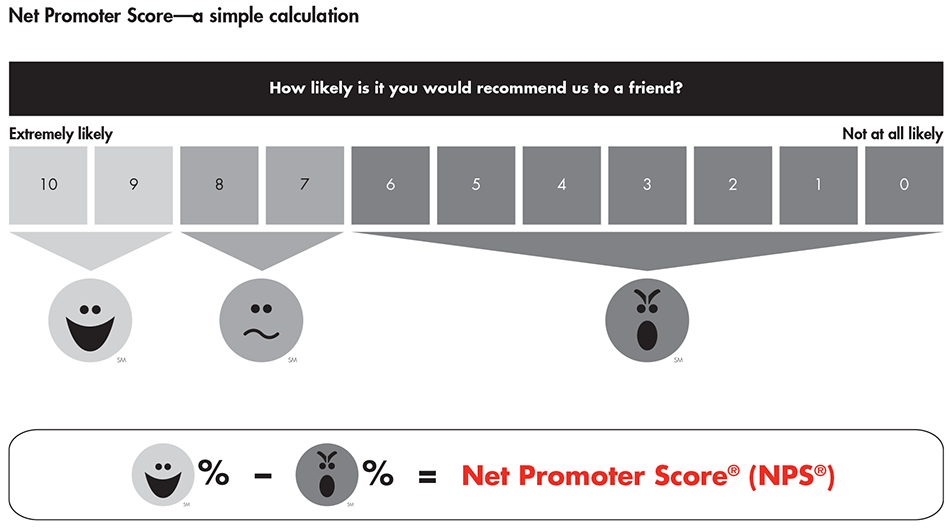
Customers’ responses to the first question allow you to classify them as promoters (9–10), passives (7–8) or detractors (0–6). The responses also enable you to create a Net Promoter Score (NPS®), which is simply the percentage of promoters minus the percentage of detractors. You can analyze this score by business, geographical region, channel or any other segment, and you can track it from week to week to see how your loyalty-building efforts are working. It’s both your customer balance sheet and your ethical compass. “NPS is the first screen I look at on my computer when I arrive at the office each morning,” says Bettinger, Schwab’s CEO. “It provides a litmus test of how well we are living up to our core values.”
Develop processes for short-cycle, closed-loop feedback, learning, recovery and action. The other questions are even more important than the score itself. They help companies understand what they are doing right and what they are doing wrong. They enable companies to begin the process of discovering the root cause of the customer’s experience—the deeper causes beneath the customer’s description—and then take action to improve that experience.
“Closing the loop” involves sharing feedback from a customer—as soon as possible after it is received—with the employees most responsible for creating that customer’s experience. The relevant employees may be an account team, specific sales or service representatives and supervisors, or the product designers, engineers, pricing executives and others who help shape a customer’s experience with the company. Closing the loop also involves contacting customers whose feedback merits follow-up, so that you can probe deeper into their experience, remedy individual problems where possible and begin to address systemic issues. Of course, closing the loop is also an excellent way to find out what sorts of experiences are wowing customers and turning them into promoters, so you can deliver those more often.
Make it a top priority to earn the enthusiastic loyalty of customers and employees. That is, create more promoters and fewer detractors. This is the job of the company’s leadership. The most effective leaders regularly demonstrate their own commitment to earning customer and employee loyalty, and they expect a comparable level of commitment from others. This doesn’t typically happen unless the leaders have concluded that earning customer and employee loyalty is a top strategic priority—that getting customers to buy more, stay longer and tell their friends is one of the primary ways the company will deliver great financial and strategic results.
Leadership commitment is essential partly because the system is always a balancing act. Employees naturally want to delight customers, but they must do so in economically rational ways. So the CEO and CFO need to understand the vastly different economics of promoters, passives and detractors and ensure that people in the organization have the tools for making appropriate trade-offs. Moreover, a Net Promoter System typically requires making thoughtful investments, assigning the most talented leaders to important initiatives and adjusting incentives and organizational structures to facilitate cooperation among departments and functions. Finally, a Net Promoter System is likely to require significant investments in IT systems, training and the like. Only an organization’s leaders can commit the necessary resources.
Focus on employees as the key to winning with customers. Building a truly customer-centric culture and organization is never primarily a top-down affair, to be implemented solely with the levers of conventional management. It is always a bottom-up process, with people throughout the organization actively developing and supporting the company’s culture. Energized, motivated people are more likely to put in the extra discretionary effort that can raise productivity and create superior experiences for customers, which in turn leads to better financial performance. Employees need to see the fundamental connection between the work they do every day and its impact on customers. They must experience firsthand the deep satisfaction of earning their customers’ heartfelt gratitude and loyalty. If they don’t, then their jobs are just jobs—they may do as they’re told, but they won’t bring much energy, enthusiasm or creativity to the workplace. And true customer centricity requires energy, enthusiasm and creativity.
The simplicity of the Net Promoter Score sometimes creates the misperception that it is all about one question and the resulting score. But the leaders of great companies, such as Schwab and American Express, understand that the score is just the beginning—the catalyst. It is the full system that creates the conditions for real change and improvement.
Elements of the system
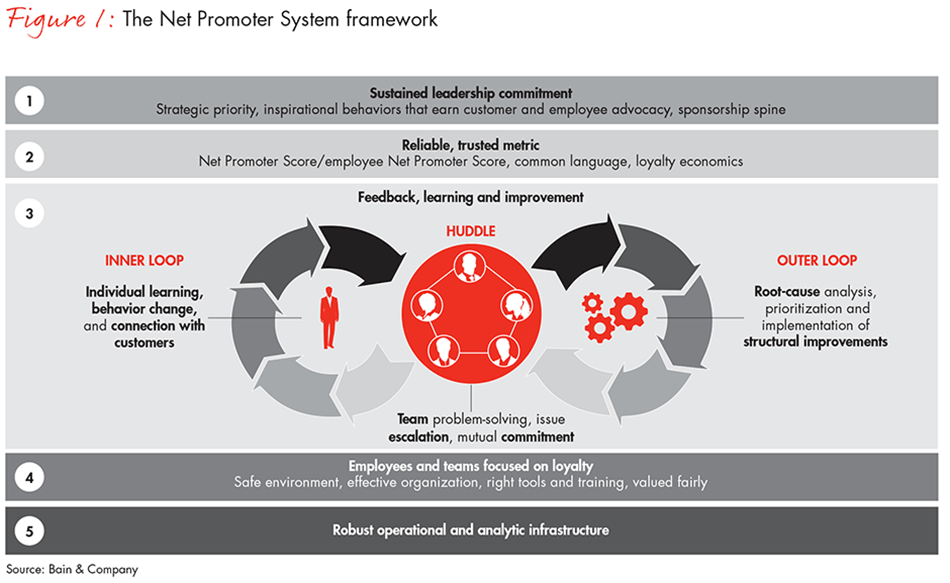
Implementing a Net Promoter System involves at least five essential elements (see Figure 1). Other articles in the Loyalty Insights series examine these elements in depth, showing how companies have dealt with the challenges and how they have built robust processes and practices in each area. The following briefly summarizes these elements:
- Sustained leadership commitment. The senior leadership team—and especially the CEO—must embrace the goal of creating more promoters and fewer detractors as a mission-critical priority. They must embed customer centricity in the company’s strategy, lead by example, and offer teaching and coaching.
- A reliable, trusted metric. Over time, companies find that they must develop, test and fine-tune their sampling and survey techniques so that everyone in the organization feels complete confidence in both the individual customer classifications and the organization’s customer and employee Net Promoter Scores. When coupled with a carefully quantified understanding of the differing lifetime value of promoters, passives and detractors, this metric allows companies to gauge the value of investments in improving the customer and employee experience.
- Feedback, learning and improvement. At the heart of the Net Promoter System are learning mechanisms for both individuals and the organization as a whole. The inner loop provides frontline employees and teams with real-time customer feedback, allowing them to act quickly to improve the customer experience. The regular feedback allows them to become self-correcting and self-directing. Huddles are short, interactive team working sessions that take place regularly. They constantly reinforce the commitment to serve customers better and create more promoters. They can identify practical solutions and serve as a crucial link between the Net Promoter System’s inner loop and its outer loop. The outer loop’s explicit purpose is to prioritize and support customer-friendly changes (often suggested in huddles) that employees or frontline teams can’t make on their own. A team uses feedback from huddles, along with operational data and marketplace insights, to do deep, root-cause analysis of customer issues and recommend a prioritized set of initiatives to improve customer experience.
- Employee/team environment focused on loyalty. Employees need to see the fundamental connection between the work they do and its impact on customers, and find it so inspiring that they bring their own energy, enthusiasm and creativity to the task of delivering a great customer experience. This requires thoughtful hiring and providing the right tools and environment, formal training, positive coaching and a well-developed system of rewards and recognition.
- Robust operational and analytic infrastructure. At the heart of the Net Promoter System is fast-cycle closed-loop feedback. This requires support from a robust operational infrastructure that can trigger feedback requests, capture the responses, send them to the right employees (in real time), track follow-up, and support data mining and insight generation. It also requires an internal advocacy organization (the same team, usually, that runs the outer loop) and strong analytics capabilities.
Implementing a Net Promoter System isn’t easy, and it isn’t for everybody. The Net Promoter approach defines the cultural values and core economics that affect every aspect of a company’s business system and competitive strategy. The most successful companies work hard on all five elements, and they try hard to live up to the Golden Rule values that are the system’s foundation.
But when you do it right—as Charles Schwab, Rackspace and American Express have discovered—you leave the competition in the dust.
Calculating Your Net Promoter Score
The Net Promoter System begins with scores from customer surveys: On a scale of 0 to 10, how likely would you be to recommend this company (or this product) to friends and colleagues? Ratings of 9 or 10 indicate promoters; 7 and 8, passives; and 0 through 6, detractors. The Net Promoter Score is simply the percentage of promoters minus the percentage of detractors (see chart below).
Fred Reichheld and Rob Markey are authors of the bestseller The Ultimate Question 2.0: How Net Promoter Companies Thrive in a Customer-Driven World. Markey is a partner and director in Bain & Company’s New York office and leads the firm’s Global Customer Strategy & Marketing practice. Reichheld is a Fellow at Bain & Company. He is the bestselling author of three other books on loyalty published by Harvard Business Review Press, including The Loyalty Effect, Loyalty Rules! and The Ultimate Question, as well as numerous articles published in Harvard Business Review.
Net Promoter®, Net Promoter System®, Net Promoter Score® and NPS® are registered trademarks of Bain & Company, Inc., Fred Reichheld and Satmetrix Systems, Inc.
First published in décembre 2011