
Skip to Content
  • Bureaux

    Bureaux

    Amérique du Nord et Amérique du Sud
    • Atlanta
    • Austin
    • Bogota
    • Boston
    • Buenos Aires
    • Chicago
    • Dallas
    • Denver
    • Houston
    • Los Angeles
    • Mexico City
    • Minneapolis
    • Monterrey
    • Montreal
    • New York
    • Rio de Janeiro
    • San Francisco
    • Santiago
    • São Paulo
    • Seattle
    • Silicon Valley
    • Toronto
    • Washington, DC
    Europe, Moyen-Orient et Afrique
    • Amsterdam
    • Athens
    • Berlin
    • Brussels
    • Copenhagen
    • Doha
    • Dubai
    • Dusseldorf
    • Frankfurt
    • Helsinki
    • Istanbul
    • Johannesburg
    • Kyiv
    • Lisbon
    • London
    • Madrid
    • Milan
    • Munich
    • Oslo
    • Paris
    • Riyadh
    • Rome
    • Stockholm
    • Vienna
    • Warsaw
    • Zurich
    Asie et Australie
    • Bangkok
    • Beijing
    • Bengaluru
    • Brisbane
    • Ho Chi Minh City
    • Hong Kong
    • Jakarta
    • Kuala Lumpur
    • Manila
    • Melbourne
    • Mumbai
    • New Delhi
    • Perth
    • Shanghai
    • Singapore
    • Sydney
    • Tokyo
    Voir tous les bureaux
  • Alumni
  • Presse
  • S’abonner
  • Contacter
  • Canada | Français

    Sélectionnez votre région et votre langue

    Global
    • Global (English)
    Amérique du Nord et Amérique du Sud
    • Brazil (Português)
    • Argentina (Español)
    • Canada (Français)
    • Chile (Español)
    • Colombia (Español)
    Europe, Moyen-Orient et Afrique
    • France (Français)
    • DACH Region (Deutsch)
    • Italy (Italiano)
    • Spain (Español)
    • Greece (Elliniká)
    Asie et Australie
    • China (中文版)
    • Korea (한국어)
    • Japan (日本語)
  • Saved items (0)
    Saved items (0)

    You have no saved items.

    Bookmark content that interests you and it will be saved here for you to read or share later.

    Explore Bain Insights
  • Expertises Sectorielles
    Menu principal

    Expertises Sectorielles

    • Aerospace et Défense
    • Agroalimentaire
    • Chimie
    • Infrastructures, BTP et Matériaux de Construction
    • Grande Consommation
    • Services Financiers
    • Santé
    • Engins & Equipements Industriels
    • Media et Divertissement
    • Metals
    • Mining
    • Pétrole & Gaz
    • Papier et Emballage
    • Private Equity
    • Secteur Public
    • Distribution
    • Technologie
    • Télécommunications
    • Transportation
    • Travel & Leisure
    • Utilities & Energies Renouvelables
  • Expertises Fonctionnelles
    Menu principal

    Expertises Fonctionnelles

    • Expérience Client
    • ESG
    • Innovation
    • Fusions et Acquisitions
    • Opérations
    • People & Organization
    • Private Equity
    • Sales & Marketing
    • Stratégie
    • IA, Perspectives et Solutions
    • Technology
    • Transformation
  • Digital
  • Points de Vue
  • About
    Menu principal

    About

    • Notre Activité
    • Nos Valeurs
    • Nos Collaborateurs et Notre Équipe Dirigeante
    • Notre Impact
    • Prix & Récompenses
    • Partenariats Internationaux
    Further: Our global responsibility
    • Sustainability
    • Impact Social
    • World Economic Forum
    Learn more about Further
  • Carrières
    Menu principal

    Carrières

    • Rejoignez-nous
      Carrières
      Rejoignez-nous
      • Find Your Place
      • Nos domaines d’expertise
      • Equipes multidisciplinaires
      • Étudiants
      • Stages et programmes
      • Événements de recrutement
    • La vie chez Bain
      Carrières
      La vie chez Bain
      • Blog: Inside Bain
      • Récits de carrière
      • Nos collaborateurs
      • Nos bureaux
      • Soutenir votre évolution professionnelle
      • Groupes d’affinités
      • Avantages chez Bain
    • Histoires d’impact
    • Notre processus de recrutement
      Carrières
      Notre processus de recrutement
      • Ce que vous pouvez attendre
      • Entretiens
    Trouver un poste
  • Bureaux
    Menu principal

    Bureaux

    • Amérique du Nord et Amérique du Sud
      Bureaux
      Amérique du Nord et Amérique du Sud
      • Atlanta
      • Austin
      • Bogota
      • Boston
      • Buenos Aires
      • Chicago
      • Dallas
      • Denver
      • Houston
      • Los Angeles
      • Mexico City
      • Minneapolis
      • Monterrey
      • Montreal
      • New York
      • Rio de Janeiro
      • San Francisco
      • Santiago
      • São Paulo
      • Seattle
      • Silicon Valley
      • Toronto
      • Washington, DC
    • Europe, Moyen-Orient et Afrique
      Bureaux
      Europe, Moyen-Orient et Afrique
      • Amsterdam
      • Athens
      • Berlin
      • Brussels
      • Copenhagen
      • Doha
      • Dubai
      • Dusseldorf
      • Frankfurt
      • Helsinki
      • Istanbul
      • Johannesburg
      • Kyiv
      • Lisbon
      • London
      • Madrid
      • Milan
      • Munich
      • Oslo
      • Paris
      • Riyadh
      • Rome
      • Stockholm
      • Vienna
      • Warsaw
      • Zurich
    • Asie et Australie
      Bureaux
      Asie et Australie
      • Bangkok
      • Beijing
      • Bengaluru
      • Brisbane
      • Ho Chi Minh City
      • Hong Kong
      • Jakarta
      • Kuala Lumpur
      • Manila
      • Melbourne
      • Mumbai
      • New Delhi
      • Perth
      • Shanghai
      • Singapore
      • Sydney
      • Tokyo
    Voir tous les bureaux
  • Alumni
  • Presse
  • S’abonner
  • Contacter
  • Canada | Français
    Menu principal

    Sélectionnez votre région et votre langue

    • Global
      Sélectionnez votre région et votre langue
      Global
      • Global (English)
    • Amérique du Nord et Amérique du Sud
      Sélectionnez votre région et votre langue
      Amérique du Nord et Amérique du Sud
      • Brazil (Português)
      • Argentina (Español)
      • Canada (Français)
      • Chile (Español)
      • Colombia (Español)
    • Europe, Moyen-Orient et Afrique
      Sélectionnez votre région et votre langue
      Europe, Moyen-Orient et Afrique
      • France (Français)
      • DACH Region (Deutsch)
      • Italy (Italiano)
      • Spain (Español)
      • Greece (Elliniká)
    • Asie et Australie
      Sélectionnez votre région et votre langue
      Asie et Australie
      • China (中文版)
      • Korea (한국어)
      • Japan (日本語)
  • Saved items  (0)
    Menu principal
    Saved items (0)

    You have no saved items.

    Bookmark content that interests you and it will be saved here for you to read or share later.

    Explore Bain Insights
  • Expertises Sectorielles
    • Expertises Sectorielles

      • Aerospace et Défense
      • Agroalimentaire
      • Chimie
      • Infrastructures, BTP et Matériaux de Construction
      • Grande Consommation
      • Services Financiers
      • Santé
      • Engins & Equipements Industriels
      • Media et Divertissement
      • Metals
      • Mining
      • Pétrole & Gaz
      • Papier et Emballage
      • Private Equity
      • Secteur Public
      • Distribution
      • Technologie
      • Télécommunications
      • Transportation
      • Travel & Leisure
      • Utilities & Energies Renouvelables
  • Expertises Fonctionnelles
    • Expertises Fonctionnelles

      • Expérience Client
      • ESG
      • Innovation
      • Fusions et Acquisitions
      • Opérations
      • People & Organization
      • Private Equity
      • Sales & Marketing
      • Stratégie
      • IA, Perspectives et Solutions
      • Technology
      • Transformation
  • Digital
  • Points de Vue
  • Carrières
    Recherches les plus fréquentes
    • Agile
    • Digital
    • Stratégie
    Vos recherches précédentes
      Pages récemment visitées

      Content added to saved items

      Saved items (0)

      Removed from saved items

      Saved items (0)

      Etude

      Is the Bank Branch Dead?

      Is the Bank Branch Dead?

      Customers deserting bank branches in favor of mobile and online channels for many interactions signal that the size and nature of the branch network has to change faster and more substantially than most banks acknowledge.

      Par Richard Fleming, Mark Schofield and Damian Stephenson

      • min
      }

      Etude

      Is the Bank Branch Dead?
      en

      No, the branch has not died. But with customers deserting branches in favor of mobile and online channels for many interactions, the size and nature of the branch network has to change faster and more substantially than most banks acknowledge. Banks will be pressed to redesign networks to make them smaller, less costly and oriented toward high-value sales and advice.

      Consider the evidence for radical transformation. For one thing, the network has oversaturated the population. In the US, Bain & Company estimates that 80% of customers live or work within 3 miles of a branch, up from about 75% fifteen years ago. US branches cluster together more densely than their European counterparts, yet US banks do not achieve meaningfully higher convenience scores. And customers use traditional-format branches less every year. As currently configured, the typical US branch requires at least 5,000 teller transactions per month to justify the cost of the operation, and we estimate that for a typical US regional bank, one-third of US branches fall below this level.

      Mark Schofield, a partner in Bain's Financial Services practice, discusses three critical ways that banks can harvest digital dividends and create smaller, radically different branch networks.

      Some smaller, alternative formats have already proven to be profitable by focusing on sales and advice while encouraging customers to use digital channels for their routine transactions. Nordea’s branch network in Europe’s Nordic countries, for instance, has evolved from being predominantly full-service to focusing on advisory or daily cash and service. Along the way, Nordea’s retail cost-to-income ratio has improved from above 60% to 56%. ABN AMRO, based in the Netherlands, reduced its branch footprint by 46% between 2009 and 2013, while also increasing the share of limited-service branches.

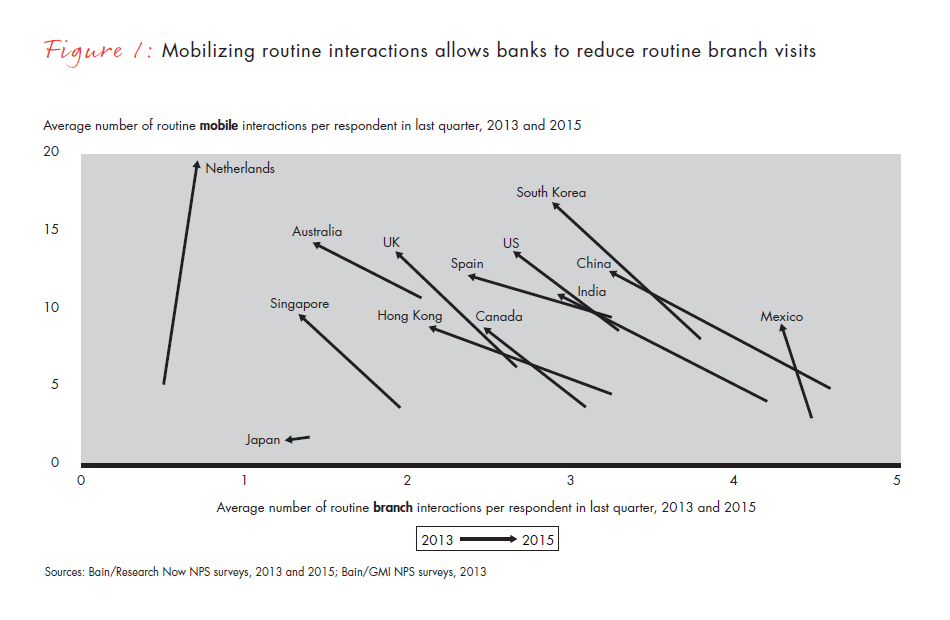
      Granted, closing and reformatting branches usually requires a one-time capital investment. But these activities deliver considerable productivity gains: Every 100 closures in North America, for instance, might free up $40 million to $60 million in annual operating expenses. Moreover, banks that reduce their footprint and transform remaining branches can increase their revenues. That’s because they’ve shifted many interactions from branch to digital channels (see Figure 1), which are less expensive to operate and, when built right, delight customers.

      is-the-bank-branch-dead-fig-01_embed

      The experiences to date of retail banks that have excelled in branch transformation suggest a few principles essential to a successful transition.

      Take on three activities in parallel. Banks must reduce bad interactions (due to errors or rework) in the branch and shift avoidable interactions to digital channels. For most banks, 60% to 70% of teller transactions are either bad or avoidable and can be migrated to digital channels with changes to customer behavior or with a few changes to policy and process.

      In parallel, they can test, redefine and implement their new branch model by progressively closing or remodeling locations and by realigning staff to match new skills with the newly emphasized sales and advice roles.

      They also should progressively digitalize customer experiences to emphasize convenience and speed.

      Build the business case with eyes open. The base case should not resemble the current situation, but rather should factor in the customer defection and reduced cross-selling that will occur as competitors expand digital offerings. Also, banks should calculate the upside using overall profit lift through revenue growth, an improved customer experience and reduced operating cost, rather than calculating in cost terms only.

      It’s critical to emphasize self-funding: Savings generated through reductions in volume and physical footprint can be reinvested to expand digital transactions. This will require the early commitment of the entire leadership team, as the nature of the work cuts across most functions of the business.

      Execute a customer-centric plan at the micro-market level. For each micro-market, consisting of 10 to 20 branches, the plan should address the specific priorities and engagement methods for the local customer base, and customer feedback should inform service improvements. The plan should model the expected shift in channel interactions and the attendant reduction in physical volumes, which in turn can inform the number and type of assets, such as staff and ATMs, required in the future.

      Banks carry a major liability in the forms of the fixed cost of existing branches that will have to close, plus the investment cost required to reformat and retool the network. Delays in branch transformation will likely force that liability into banks’ stock prices. Faster-moving banks will stand a better chance of reaping the benefits of convenient digital channels combined with smarter branch networks.

      By Richard Fleming, Mark Schofield and Damian Stephenson.


      is-the-bank-branch-dead-fig-01_full
      Auteurs
      • Headshot of Richard Fleming
        Richard Fleming
        Partner, Sydney
      • Mark Schofield
        Former Partner, Toronto
      • Headshot of Damian Stephenson
        Damian Stephenson
        Partner, Sydney
      Contactez-nous
      Synergies sectorielles
      • Services Financiers
      Services Financiers
      Wolf in Sheep's Clothing: Disruption Ahead for Transaction Banking

      The field is getting crowded and technology-intensive. How can banks stand out?

      Voir plus
      La Banque du Futur
      Perform Today, Prove Tomorrow, Propel the Stock Valuation

      Leading banks build credibility with investors by aligning their strategy, execution, and equity story.

      Voir plus
      Services Financiers
      Rethinking Transformation: Lawrence Lam on Leading Change at Prudential

      Frankie Leung speaks with Lawrence Lam, CEO of Prudential Hong Kong, about organizational transformation and sustaining change through a people-led approach.

      Voir plus
      La Banque du Futur
      Voting with Their Feet: Banking Consumers Want a Seamless Digital Experience

      Half of consumers’ digital purchases go to a competitor of their primary bank, and half of those who buy anywhere encounter friction in the process.

      Voir plus
      Services Financiers
      Banking M&A

      As conditions shift, leading banks are fusing scale with scope to create future-ready organizations.

      Voir plus
      First published in novembre 2015
      Mots clés
      • La Banque du Futur
      • Services Financiers

      Comment nous avons aidé nos clients

      A European Banking Giant Rises to the Fintech Challenge

      Lire l’étude de cas

      A financial services leader gains market confidence

      Lire l’étude de cas

      The change process unlocks potential and profits

      Lire l’étude de cas

      Vous souhaitez continuer cette conversation ?

      Nous aidons des dirigeants du monde entier à matérialiser des impacts et des résultats pérennes et créateurs de valeur dans leurs organisations.

      Les points de vue de Bain : notre perspective sur des problématiques auxquelles sont confrontées les entreprises à travers le monde, envoyés chaque mois dans votre boîte de réception. 

      *J’ai lu la politique de confidentialité et j’accepte les conditions.

      Merci de lire notre politique de confidentialité.
      Bain & Company
      Contactez-nous Sustainability Accessibility Conditions d’utilisation Politique de Confidentialité Cookie Policy Mentions Légales Sitemap Log In

      © 1996-2026 Bain & Company, Inc.

      Contacter Bain

      Comment pouvons-nous vous aider ?

      • Business inquiry
      • Career information
      • Press relations
      • Partnership request
      • Speaker request
      Voir tous les bureaux