
Skip to Content
  • Bureaux

    Bureaux

    Amérique du Nord et Amérique du Sud
    • Atlanta
    • Austin
    • Bogota
    • Boston
    • Buenos Aires
    • Chicago
    • Dallas
    • Denver
    • Houston
    • Los Angeles
    • Mexico City
    • Minneapolis
    • Monterrey
    • Montreal
    • New York
    • Rio de Janeiro
    • San Francisco
    • Santiago
    • São Paulo
    • Seattle
    • Silicon Valley
    • Toronto
    • Washington, DC
    Europe, Moyen-Orient et Afrique
    • Amsterdam
    • Athens
    • Berlin
    • Brussels
    • Copenhagen
    • Doha
    • Dubai
    • Dusseldorf
    • Frankfurt
    • Helsinki
    • Istanbul
    • Johannesburg
    • Kyiv
    • Lisbon
    • London
    • Madrid
    • Milan
    • Munich
    • Oslo
    • Paris
    • Riyadh
    • Rome
    • Stockholm
    • Vienna
    • Warsaw
    • Zurich
    Asie et Australie
    • Bangkok
    • Beijing
    • Bengaluru
    • Brisbane
    • Ho Chi Minh City
    • Hong Kong
    • Jakarta
    • Kuala Lumpur
    • Manila
    • Melbourne
    • Mumbai
    • New Delhi
    • Perth
    • Shanghai
    • Singapore
    • Sydney
    • Tokyo
    Voir tous les bureaux
  • Alumni
  • Presse
  • S’abonner
  • Contacter
  • Canada | Français

    Sélectionnez votre région et votre langue

    Global
    • Global (English)
    Amérique du Nord et Amérique du Sud
    • Brazil (Português)
    • Argentina (Español)
    • Canada (Français)
    • Chile (Español)
    • Colombia (Español)
    Europe, Moyen-Orient et Afrique
    • France (Français)
    • DACH Region (Deutsch)
    • Italy (Italiano)
    • Spain (Español)
    • Greece (Elliniká)
    Asie et Australie
    • China (中文版)
    • Korea (한국어)
    • Japan (日本語)
  • Saved items (0)
    Saved items (0)

    You have no saved items.

    Bookmark content that interests you and it will be saved here for you to read or share later.

    Explore Bain Insights
  • Expertises Sectorielles
    Menu principal

    Expertises Sectorielles

    • Aerospace et Défense
    • Agroalimentaire
    • Chimie
    • Infrastructures, BTP et Matériaux de Construction
    • Grande Consommation
    • Services Financiers
    • Santé
    • Engins & Equipements Industriels
    • Media et Divertissement
    • Metals
    • Mining
    • Pétrole & Gaz
    • Papier et Emballage
    • Private Equity
    • Secteur Public
    • Distribution
    • Technologie
    • Télécommunications
    • Transportation
    • Travel & Leisure
    • Utilities & Energies Renouvelables
  • Expertises Fonctionnelles
    Menu principal

    Expertises Fonctionnelles

    • Expérience Client
    • ESG
    • Innovation
    • Fusions et Acquisitions
    • Opérations
    • People & Organization
    • Private Equity
    • Sales & Marketing
    • Stratégie
    • IA, Perspectives et Solutions
    • Technology
    • Transformation
  • Digital
  • Points de Vue
  • About
    Menu principal

    About

    • Notre Activité
    • Nos Valeurs
    • Nos Collaborateurs et Notre Équipe Dirigeante
    • Notre Impact
    • Prix & Récompenses
    • Partenariats Internationaux
    Further: Our global responsibility
    • Sustainability
    • Impact Social
    • World Economic Forum
    Learn more about Further
  • Carrières
    Menu principal

    Carrières

    • Rejoignez-nous
      Carrières
      Rejoignez-nous
      • Find Your Place
      • Nos domaines d’expertise
      • Equipes multidisciplinaires
      • Étudiants
      • Stages et programmes
      • Événements de recrutement
    • La vie chez Bain
      Carrières
      La vie chez Bain
      • Blog: Inside Bain
      • Récits de carrière
      • Nos collaborateurs
      • Nos bureaux
      • Soutenir votre évolution professionnelle
      • Groupes d’affinités
      • Avantages chez Bain
    • Histoires d’impact
    • Notre processus de recrutement
      Carrières
      Notre processus de recrutement
      • Ce que vous pouvez attendre
      • Entretiens
    Trouver un poste
  • Bureaux
    Menu principal

    Bureaux

    • Amérique du Nord et Amérique du Sud
      Bureaux
      Amérique du Nord et Amérique du Sud
      • Atlanta
      • Austin
      • Bogota
      • Boston
      • Buenos Aires
      • Chicago
      • Dallas
      • Denver
      • Houston
      • Los Angeles
      • Mexico City
      • Minneapolis
      • Monterrey
      • Montreal
      • New York
      • Rio de Janeiro
      • San Francisco
      • Santiago
      • São Paulo
      • Seattle
      • Silicon Valley
      • Toronto
      • Washington, DC
    • Europe, Moyen-Orient et Afrique
      Bureaux
      Europe, Moyen-Orient et Afrique
      • Amsterdam
      • Athens
      • Berlin
      • Brussels
      • Copenhagen
      • Doha
      • Dubai
      • Dusseldorf
      • Frankfurt
      • Helsinki
      • Istanbul
      • Johannesburg
      • Kyiv
      • Lisbon
      • London
      • Madrid
      • Milan
      • Munich
      • Oslo
      • Paris
      • Riyadh
      • Rome
      • Stockholm
      • Vienna
      • Warsaw
      • Zurich
    • Asie et Australie
      Bureaux
      Asie et Australie
      • Bangkok
      • Beijing
      • Bengaluru
      • Brisbane
      • Ho Chi Minh City
      • Hong Kong
      • Jakarta
      • Kuala Lumpur
      • Manila
      • Melbourne
      • Mumbai
      • New Delhi
      • Perth
      • Shanghai
      • Singapore
      • Sydney
      • Tokyo
    Voir tous les bureaux
  • Alumni
  • Presse
  • S’abonner
  • Contacter
  • Canada | Français
    Menu principal

    Sélectionnez votre région et votre langue

    • Global
      Sélectionnez votre région et votre langue
      Global
      • Global (English)
    • Amérique du Nord et Amérique du Sud
      Sélectionnez votre région et votre langue
      Amérique du Nord et Amérique du Sud
      • Brazil (Português)
      • Argentina (Español)
      • Canada (Français)
      • Chile (Español)
      • Colombia (Español)
    • Europe, Moyen-Orient et Afrique
      Sélectionnez votre région et votre langue
      Europe, Moyen-Orient et Afrique
      • France (Français)
      • DACH Region (Deutsch)
      • Italy (Italiano)
      • Spain (Español)
      • Greece (Elliniká)
    • Asie et Australie
      Sélectionnez votre région et votre langue
      Asie et Australie
      • China (中文版)
      • Korea (한국어)
      • Japan (日本語)
  • Saved items  (0)
    Menu principal
    Saved items (0)

    You have no saved items.

    Bookmark content that interests you and it will be saved here for you to read or share later.

    Explore Bain Insights
  • Expertises Sectorielles
    • Expertises Sectorielles

      • Aerospace et Défense
      • Agroalimentaire
      • Chimie
      • Infrastructures, BTP et Matériaux de Construction
      • Grande Consommation
      • Services Financiers
      • Santé
      • Engins & Equipements Industriels
      • Media et Divertissement
      • Metals
      • Mining
      • Pétrole & Gaz
      • Papier et Emballage
      • Private Equity
      • Secteur Public
      • Distribution
      • Technologie
      • Télécommunications
      • Transportation
      • Travel & Leisure
      • Utilities & Energies Renouvelables
  • Expertises Fonctionnelles
    • Expertises Fonctionnelles

      • Expérience Client
      • ESG
      • Innovation
      • Fusions et Acquisitions
      • Opérations
      • People & Organization
      • Private Equity
      • Sales & Marketing
      • Stratégie
      • IA, Perspectives et Solutions
      • Technology
      • Transformation
  • Digital
  • Points de Vue
  • Carrières
    Recherches les plus fréquentes
    • Agile
    • Digital
    • Stratégie
    Vos recherches précédentes
      Pages récemment visitées

      Content added to saved items

      Saved items (0)

      Removed from saved items

      Saved items (0)

      Etude

      Marketing’s New Middleman: AI Agents

      Marketing’s New Middleman: AI Agents

      From discovery to decision, large language models are starting to gatekeep the marketing funnel, so brand stewards must learn to speak their language.

      Par Natasha Sommerfeld, Rishi Dave, et Daniel Webster-Clark

      • min
      }

      Etude

      Marketing’s New Middleman: AI Agents
      en
      En Bref
      • The marketing funnel is being upended as buyers increasingly turn to AI tools for product recommendations, comparisons, and research.
      • AI-powered “zero-click” journeys compress the discovery-to-decision process, reducing opportunities for brands to influence consumers, differentiate themselves, or even appear during the buying journey.
      • Traffic and conversion dynamics are shifting as website visits from traditional search engines decline and AI referral traffic begins to grow, with limited visibility for marketers and fewer chances to capture lead data.
      • To stay relevant, marketers must adapt by optimizing content for large language models, investing in new performance metrics, and rethinking their digital strategy around a future where the AI agent—not the buyer—is in control.

      Buyers increasingly rely on search powered by generative artificial intelligence to guide their purchase journeys. They’re perusing AI summaries on traditional search engines such as Google and Bing or going directly to large language models (LLMs) such as ChatGPT to conduct research, ask for product recommendations, or get buying advice.

      Recent data suggests the magnitude of the shift:

      • A survey of more than 1,100 US consumers by Bain & Company found that 80% of them rely on these “zero-click” results for at least 40% of their searches.  
      • HubSpot has found that traffic to many company sites has decreased by up to 30%.
      • Scrunch AI’s audit of anonymized search journeys across its clients’ websites finds that AI referral traffic is growing by about 40% monthly.
      • Adobe Analytics reports that traffic to retailer websites from generative AI sources increased by 1,200% in February 2025 vs. July 2024.

      This shift to generative AI–referred traffic upends the traditional customer discovery funnel. What does the new, zero-click funnel look like—and what does it mean for businesses?

      Robots in the driver’s seat

      The traditional digital buying journey is linear and labor-intensive. Customers actively work their way through searching, clicking, comparing options across sites, downloading white papers, or reading reviews. Each stage requires effort, which inevitably causes drop-off. The more work a customer must do, the more likely they are to abandon the journey altogether, especially for lower-stakes or impulse purchases.

      AI-powered search allows buyers to outsource many of these friction-filled middle steps. As the AI agent gets to know an individual’s preferences, there is an added benefit of answer quality improving over time. Exponential improvement in the underlying technology due to scaling, architecture, and infrastructure innovation will only increase model performance.

      Today, Adobe finds that conversion rates through AI-powered search are closing the gap with other product discovery paths that customers use, and Scrunch AI reports conversion rates can be twice that of standard Google search for certain journeys. As the AI-powered path gains share, brands will have fewer chances to get in front of the customer, differentiate their offering, and build trust over time. AI agents work on the customer’s behalf when they summarize reviews, recommend products, rank options, and, increasingly, anticipate preferences based on past behavior. In some cases, they can carry the customer from vague interest to specific recommendation in a single step. The funnel thus fragments into pieces that move quickly and out of sight, and it is increasingly controlled by the AI tool rather than the customer (see Figure 1).

      Figure 1
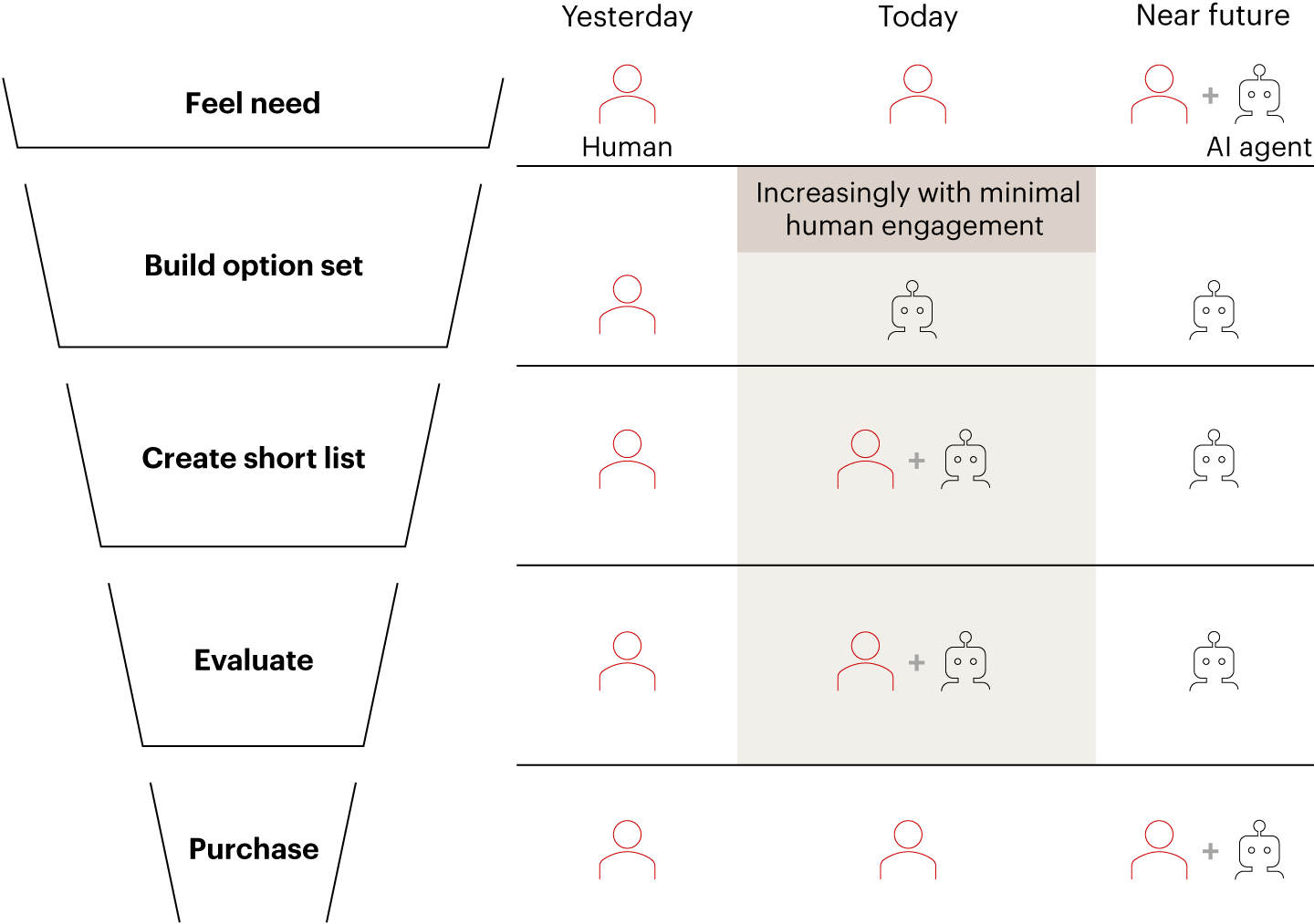
      Traditional digital buying journeys are being disrupted
      Source: Bain & Company

      The speed at which customers are moving from the old world to the new varies. Our survey identified areas that are most likely to move faster, notably learning, shopping, and styling advice (see Figure 2).

      Figure 2
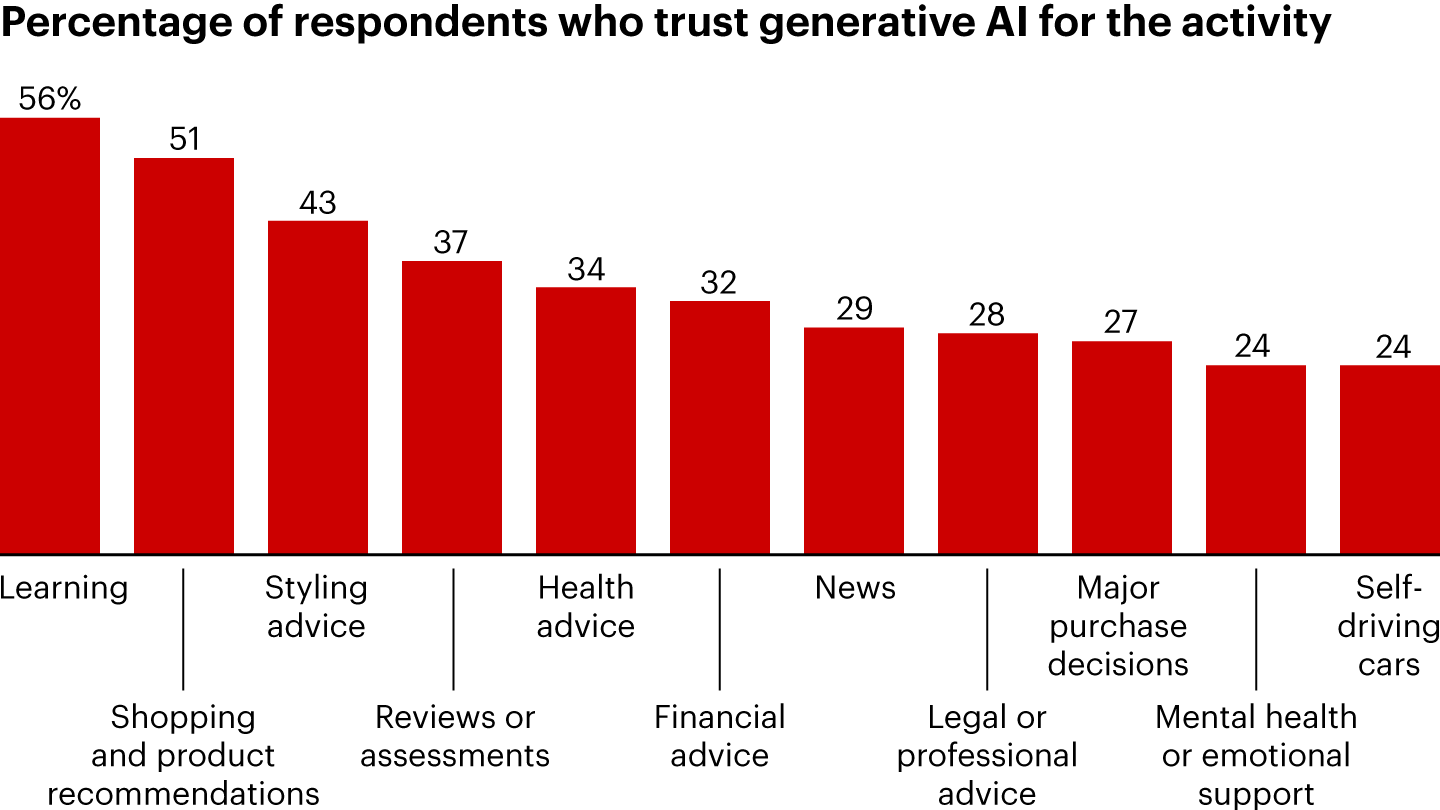
      US consumers are more likely to trust generative AI for lower-stakes activities
      Source: Bain–Dynata Generative AI Consumer Survey, December 2024 (n=1,117)

      These areas stem from a few factors:

      • people’s comfort sharing the data needed to adapt general responses to specific recommendations;
      • a lower level of importance and price; and
      • lower risk from making a wrong choice.

      Contending with the new funnel

      The rise of AI referral has major implications for marketing and sales teams. Companies that don’t optimize their approach for AI agents’ new role in many steps of the funnel have already started to lose potential customers. The kicker: They might not even be aware of the loss, as they never hosted the initial website visit or content download to explore the product. Without that initial exploratory touchpoint, marketers likely cannot reengage those prospective customers, since they do not exist in company databases.

      In the old order, when a prospect didn’t convert, the company at least had the breadcrumbs of page views, ad impressions, form fills, or email sign-ups, enabling marketers to follow up. But the AI-powered funnel shuts out sellers well before the journey reaches them. Discovery, evaluation, and short-listing all happen inside the AI tool. Unless a company’s brand surfaces at that moment or is already top of the buyer’s mind, it might never make the list. The exception is for repeat and loyalty-based purchases, for which customers might still go straight to their preferred vendors, bypassing the new research tools entirely.

      As a result, we anticipate that customers will engage along three paths. One is direct to the brand website. A second is intermediated through AI, a path that ranges from casual shopping assistance to full completion of the purchase by the AI agent. Third, for people who don’t adopt generative AI, traditional channels will retain the lion’s share of traffic, but even there, the growing presence of AI summaries will change the nature of brands’ positions.

      What do LLMs value?

      In the near future, it won’t be an either/or world. Companies will need to optimize their content strategy and website for each path. For the direct and traditional routes, the usual rules of removing friction and creating personalized journeys and value propositions still apply.

      However, succeeding with AI-intermediated traffic requires a broader set of marketing levers, valued differently than traditional search. Within LLMs, expert opinions, earned media, and customer or forum commentary carry greater weight in search results, because the LLMs seek to validate the claims of branded company sites. Scrunch AI analysis finds that more than 90% of content in response to nonbranded search queries in LLM engines comes from third-party sources exclusively. Even when an LLM mentions a brand, more than 60% of content still comes from nonbranded sources, and as the engines evolve, they may rely more heavily on such content.

      Today, LLM engines value the following content characteristics:

      • Language. They prefer rich, conversational text, such as blogs and explainers, over webinars or embedded images.
      • Agent-friendly structure. Ordered lists, definitions, and guides make it easy for LLMs to process and summarize information.
      • Clean, scrapable sites. Accurate, fully indexed sites work better than keyword stuffing or years-old pages designed to build site authority. Agents seem to get confused by decade-old value propositions hiding in deep indexes.
      • Off-site earned authority. Publications cited prominently in external media and expert commentary confirm and triangulate value propositions.
      • Off-site deep customer conversations. A large presence in external reviews and forums generates mentions, backlinks, and credibility.

      Three steps for adapting

      Some leading companies have delved into understanding how the AI referral transition affects their businesses. A few are already starting to invest in capabilities to improve results from LLM marketing. Companies committed to accelerating the shift can improve performance through a practical, three-step approach.

      1. Identify the new metrics that matter. Without the right set of metrics to understand both value at stake and how traffic is changing, companies will fail to see—much less pursue—the largest sources of marketing leads.

      2. Build intelligence to identify potential levers of improvement. Marketers should continuously evaluate how LLMs affect the customer funnel today and how that could change in the near future. Most valuable will be tools that provide a clear, readily updatable view of the customer buying journey, the AI-powered funnel, and how brands appear in AI-powered search engines. Each aspect of this view should translate to a practical scorecard. While LLMs and AI-powered search build upon similar inputs, they often produce radically different results and outcomes. A scorecard helps companies focus on the areas of greatest need and identify possible levers to attain the desired outcomes. 

      3. Devise testable hypotheses and experiment quickly. Once a company identifies potential areas of focus to improve AI search performance, it can prioritize the long list of actions and start experimenting. Many organizations will need to develop new capabilities and agile processes to run, monitor, and scale “influence experiments” and allocate marketing resources based on the test results.

      With LLMs cutting brands out of the funnel before they even know a buyer is looking, most current search engine optimization strategies fall short. Adapting the strategy to incorporate LLMs will create a reinforcement cycle: Strong internal, earned, and social content leads to more AI references, greater trust and engagement, and further prioritization in LLM outputs.

      To succeed in the era of LLMs, marketers must optimize for AI agents—not just humans.

      About Scrunch AI

      Scrunch AI, founded by Chris Andrew and Robert MacCloy, shows companies how they are represented by major AI search models. The platform reveals how brands appear in AI search, offers insights on how to improve, and provides an infrastructure layer to manage AI crawlers and agents.

      Auteurs
      • Headshot of Natasha Sommerfeld
        Natasha Sommerfeld
        Partner, Boston
      • Headshot of Rishi Dave
        Rishi Dave
        Partner, New York
      • Headshot of Daniel Webster-Clark
        Daniel Webster-Clark
        Partner, Chicago
      Contactez-nous
      Expertises fonctionnelles transverses
      • Customer Experience
      • Digital
      • IA, Perspectives et Solutions
      • Stratégie Client et Marketing
      Comment pouvons-nous vous aider ?
      • Artificial Intelligence
      CMO Insights
      Agentic AI Commerce Hinges on Consumer Trust

      Security, privacy, and institutional trust are the battlegrounds for AI-led payments.

      Voir plus
      CMO Insights
      The 2026 Retail Executive Agenda

      Here are letters to the C-suite to help strengthen strategy, catalyze collaboration, and expand value creation in the AI age.

      Voir plus
      Artificial Intelligence Insights
      What Business Leaders Need to Know About AI Sovereignty

      Aligning business strategy with national AI priorities is necessary to compete and scale.

      Voir plus
      CMO Insights
      The New Growth Equation for Tech Services

      As AI and geopolitical change upend the status quo, service providers face a stark choice—transform or fall behind.

      Voir plus
      Artificial Intelligence Insights
      Five of the Most Insightful Podcast Episodes On AI

      AI experts share what leaders need to know about agentic systems, data, and team dynamics in order to succeed in 2026.

      Voir plus
      First published in avril 2025
      Mots clés
      • Artificial Intelligence
      • Artificial Intelligence Insights
      • CIO Insights
      • CMO Insights
      • Customer Experience
      • Digital
      • IA, Perspectives et Solutions
      • Stratégie Client et Marketing

      Comment nous avons aidé nos clients

      A Beauty Company Enables Always-On Brand Acceleration

      Lire l’étude de cas

      Reimagining Insurance for the AI Era

      Lire l’étude de cas

      A Digital-First Bank Finds a Customer-Driven Path to Profitability

      Lire l’étude de cas

      Vous souhaitez continuer cette conversation ?

      Nous aidons des dirigeants du monde entier à matérialiser des impacts et des résultats pérennes et créateurs de valeur dans leurs organisations.

      Les points de vue de Bain : notre perspective sur des problématiques auxquelles sont confrontées les entreprises à travers le monde, envoyés chaque mois dans votre boîte de réception. 

      *J’ai lu la politique de confidentialité et j’accepte les conditions.

      Merci de lire notre politique de confidentialité.
      Bain & Company
      Contactez-nous Sustainability Accessibility Conditions d’utilisation Politique de Confidentialité Cookie Policy Mentions Légales Sitemap Log In

      © 1996-2026 Bain & Company, Inc.

      Contacter Bain

      Comment pouvons-nous vous aider ?

      • Business inquiry
      • Career information
      • Press relations
      • Partnership request
      • Speaker request
      Voir tous les bureaux