
Skip to Content
  • Bureaux

    Bureaux

    Amérique du Nord et Amérique du Sud
    • Atlanta
    • Austin
    • Bogota
    • Boston
    • Buenos Aires
    • Chicago
    • Dallas
    • Denver
    • Houston
    • Los Angeles
    • Mexico City
    • Minneapolis
    • Monterrey
    • Montreal
    • New York
    • Rio de Janeiro
    • San Francisco
    • Santiago
    • São Paulo
    • Seattle
    • Silicon Valley
    • Toronto
    • Washington, DC
    Europe, Moyen-Orient et Afrique
    • Amsterdam
    • Athens
    • Berlin
    • Brussels
    • Copenhagen
    • Doha
    • Dubai
    • Dusseldorf
    • Frankfurt
    • Helsinki
    • Istanbul
    • Johannesburg
    • Kyiv
    • Lisbon
    • London
    • Madrid
    • Milan
    • Munich
    • Oslo
    • Paris
    • Riyadh
    • Rome
    • Stockholm
    • Vienna
    • Warsaw
    • Zurich
    Asie et Australie
    • Bangkok
    • Beijing
    • Bengaluru
    • Brisbane
    • Ho Chi Minh City
    • Hong Kong
    • Jakarta
    • Kuala Lumpur
    • Manila
    • Melbourne
    • Mumbai
    • New Delhi
    • Perth
    • Shanghai
    • Singapore
    • Sydney
    • Tokyo
    Voir tous les bureaux
  • Alumni
  • Presse
  • S’abonner
  • Contacter
  • Canada | Français

    Sélectionnez votre région et votre langue

    Global
    • Global (English)
    Amérique du Nord et Amérique du Sud
    • Brazil (Português)
    • Argentina (Español)
    • Canada (Français)
    • Chile (Español)
    • Colombia (Español)
    Europe, Moyen-Orient et Afrique
    • France (Français)
    • DACH Region (Deutsch)
    • Italy (Italiano)
    • Spain (Español)
    • Greece (Elliniká)
    Asie et Australie
    • China (中文版)
    • Korea (한국어)
    • Japan (日本語)
  • Saved items (0)
    Saved items (0)

    You have no saved items.

    Bookmark content that interests you and it will be saved here for you to read or share later.

    Explore Bain Insights
  • Expertises Sectorielles
    Menu principal

    Expertises Sectorielles

    • Aerospace et Défense
    • Agroalimentaire
    • Chimie
    • Infrastructures, BTP et Matériaux de Construction
    • Grande Consommation
    • Services Financiers
    • Santé
    • Engins & Equipements Industriels
    • Media et Divertissement
    • Metals
    • Mining
    • Pétrole & Gaz
    • Papier et Emballage
    • Private Equity
    • Secteur Public
    • Distribution
    • Technologie
    • Télécommunications
    • Transportation
    • Travel & Leisure
    • Utilities & Energies Renouvelables
  • Expertises Fonctionnelles
    Menu principal

    Expertises Fonctionnelles

    • Expérience Client
    • ESG
    • Innovation
    • Fusions et Acquisitions
    • Opérations
    • People & Organization
    • Private Equity
    • Sales & Marketing
    • Stratégie
    • IA, Perspectives et Solutions
    • Technology
    • Transformation
  • Digital
  • Points de Vue
  • About
    Menu principal

    About

    • Notre Activité
    • Nos Valeurs
    • Nos Collaborateurs et Notre Équipe Dirigeante
    • Notre Impact
    • Prix & Récompenses
    • Partenariats Internationaux
    Further: Our global responsibility
    • Sustainability
    • Impact Social
    • World Economic Forum
    Learn more about Further
  • Carrières
    Menu principal

    Carrières

    • Rejoignez-nous
      Carrières
      Rejoignez-nous
      • Find Your Place
      • Nos domaines d’expertise
      • Equipes multidisciplinaires
      • Étudiants
      • Stages et programmes
      • Événements de recrutement
    • La vie chez Bain
      Carrières
      La vie chez Bain
      • Blog: Inside Bain
      • Récits de carrière
      • Nos collaborateurs
      • Nos bureaux
      • Soutenir votre évolution professionnelle
      • Groupes d’affinités
      • Avantages chez Bain
    • Histoires d’impact
    • Notre processus de recrutement
      Carrières
      Notre processus de recrutement
      • Ce que vous pouvez attendre
      • Entretiens
    Trouver un poste
  • Bureaux
    Menu principal

    Bureaux

    • Amérique du Nord et Amérique du Sud
      Bureaux
      Amérique du Nord et Amérique du Sud
      • Atlanta
      • Austin
      • Bogota
      • Boston
      • Buenos Aires
      • Chicago
      • Dallas
      • Denver
      • Houston
      • Los Angeles
      • Mexico City
      • Minneapolis
      • Monterrey
      • Montreal
      • New York
      • Rio de Janeiro
      • San Francisco
      • Santiago
      • São Paulo
      • Seattle
      • Silicon Valley
      • Toronto
      • Washington, DC
    • Europe, Moyen-Orient et Afrique
      Bureaux
      Europe, Moyen-Orient et Afrique
      • Amsterdam
      • Athens
      • Berlin
      • Brussels
      • Copenhagen
      • Doha
      • Dubai
      • Dusseldorf
      • Frankfurt
      • Helsinki
      • Istanbul
      • Johannesburg
      • Kyiv
      • Lisbon
      • London
      • Madrid
      • Milan
      • Munich
      • Oslo
      • Paris
      • Riyadh
      • Rome
      • Stockholm
      • Vienna
      • Warsaw
      • Zurich
    • Asie et Australie
      Bureaux
      Asie et Australie
      • Bangkok
      • Beijing
      • Bengaluru
      • Brisbane
      • Ho Chi Minh City
      • Hong Kong
      • Jakarta
      • Kuala Lumpur
      • Manila
      • Melbourne
      • Mumbai
      • New Delhi
      • Perth
      • Shanghai
      • Singapore
      • Sydney
      • Tokyo
    Voir tous les bureaux
  • Alumni
  • Presse
  • S’abonner
  • Contacter
  • Canada | Français
    Menu principal

    Sélectionnez votre région et votre langue

    • Global
      Sélectionnez votre région et votre langue
      Global
      • Global (English)
    • Amérique du Nord et Amérique du Sud
      Sélectionnez votre région et votre langue
      Amérique du Nord et Amérique du Sud
      • Brazil (Português)
      • Argentina (Español)
      • Canada (Français)
      • Chile (Español)
      • Colombia (Español)
    • Europe, Moyen-Orient et Afrique
      Sélectionnez votre région et votre langue
      Europe, Moyen-Orient et Afrique
      • France (Français)
      • DACH Region (Deutsch)
      • Italy (Italiano)
      • Spain (Español)
      • Greece (Elliniká)
    • Asie et Australie
      Sélectionnez votre région et votre langue
      Asie et Australie
      • China (中文版)
      • Korea (한국어)
      • Japan (日本語)
  • Saved items  (0)
    Menu principal
    Saved items (0)

    You have no saved items.

    Bookmark content that interests you and it will be saved here for you to read or share later.

    Explore Bain Insights
  • Expertises Sectorielles
    • Expertises Sectorielles

      • Aerospace et Défense
      • Agroalimentaire
      • Chimie
      • Infrastructures, BTP et Matériaux de Construction
      • Grande Consommation
      • Services Financiers
      • Santé
      • Engins & Equipements Industriels
      • Media et Divertissement
      • Metals
      • Mining
      • Pétrole & Gaz
      • Papier et Emballage
      • Private Equity
      • Secteur Public
      • Distribution
      • Technologie
      • Télécommunications
      • Transportation
      • Travel & Leisure
      • Utilities & Energies Renouvelables
  • Expertises Fonctionnelles
    • Expertises Fonctionnelles

      • Expérience Client
      • ESG
      • Innovation
      • Fusions et Acquisitions
      • Opérations
      • People & Organization
      • Private Equity
      • Sales & Marketing
      • Stratégie
      • IA, Perspectives et Solutions
      • Technology
      • Transformation
  • Digital
  • Points de Vue
  • Carrières
    Recherches les plus fréquentes
    • Agile
    • Digital
    • Stratégie
    Vos recherches précédentes
      Pages récemment visitées

      Content added to saved items

      Saved items (0)

      Removed from saved items

      Saved items (0)

      Etude

      Reinventing the Role of Medical Affairs

      Reinventing the Role of Medical Affairs

      A strategic overhaul of medical affairs can help pharma companies win in an era of Big Data medicine.

      Par Loic Plantevin, Christoph Schlegel and Maria Gordian

      • min
      }

      Etude

      Reinventing the Role of Medical Affairs
      en

      The most competitive pharma companies in the coming decade will be masters of data and digital technologies. They will generate and analyze vast volumes of real-world data and excel at communicating scientific evidence. Above all, they will help physicians navigate in a far more complex healthcare universe.

      That profound shift is already under way. Pharma companies are developing data and scientific insights. But information channels are changing, and many companies have difficulty communicating science effectively with the growing array of stakeholders that influence purchasing decisions. That shortfall is one reason many new drug launches underperform: 50% of all launches now fail to meet company expectations, Bain research shows.

      Leading companies are upgrading medical affairs to overcome that deficit. Equipped with deep product knowledge and disease understanding, medical affairs teams can become a strategic ace in an era of Big Data. They are well positioned to generate and present high-quality scientific knowledge to the market and educate stakeholders about next-generation products.

      Loïc Plantevin, a partner with Bain's Healthcare practice, describes how medical affairs can become a strategic ace by presenting high-quality data to the people who influence purchasing decisions.

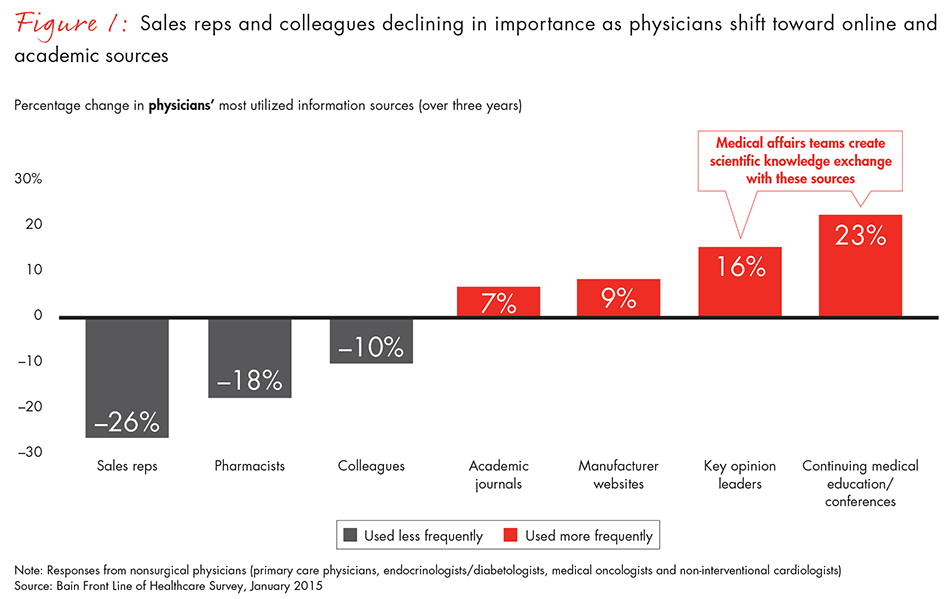
      As the demand for real-world evidence grows, those two roles will become increasingly critical to pharma companies’ performance. Physicians already are reducing their reliance on sales representatives and turning to more scientific sources of information, Bain research shows (see Figure 1). That shift is even more pronounced among younger physicians. In parallel, the total number of sales representatives has fallen. In North America, pharma salesforce levels have dropped by about 7% between 2005 and 2011 and have leveled off since then. In Europe, they have fallen by 10% between 2006 and 2010.

      An experienced medical affairs team can link scientific and clinical results to patient outcomes, adding value at every stage of a drug’s development. When discussing a potential new compound with physicians, payers and opinion leaders, for example, medical affairs teams gather vital feedback on its market potential and patient needs at the earliest stages of the drug development process. The insights they glean over time can improve return on investment and create a strong competitive advantage by helping companies design more effective clinical programs and launches.

      reinventing-role-of-medical-affairs-fig-01_embed

      Transforming medical affairs to medical value


      Why have so few pharma companies started down this path? Most remain focused on products instead of outcomes, and they regard medical affairs staff as technical product advisers. That traditional approach could become a handicap as rivals retrain medical affairs teams to develop scientific evidence and demonstrate to physicians, payers, patient groups and key opinion leaders how new products improve patient outcomes.

      The winners in an era of Big Data will transform medical affairs teams into medical value teams with three strategic roles: communicating scientific evidence, providing market-based strategic input to drug development and portfolio management, and overseeing the effort to produce Big Data and real-world evidence.

      Engaging stakeholders and communicating science


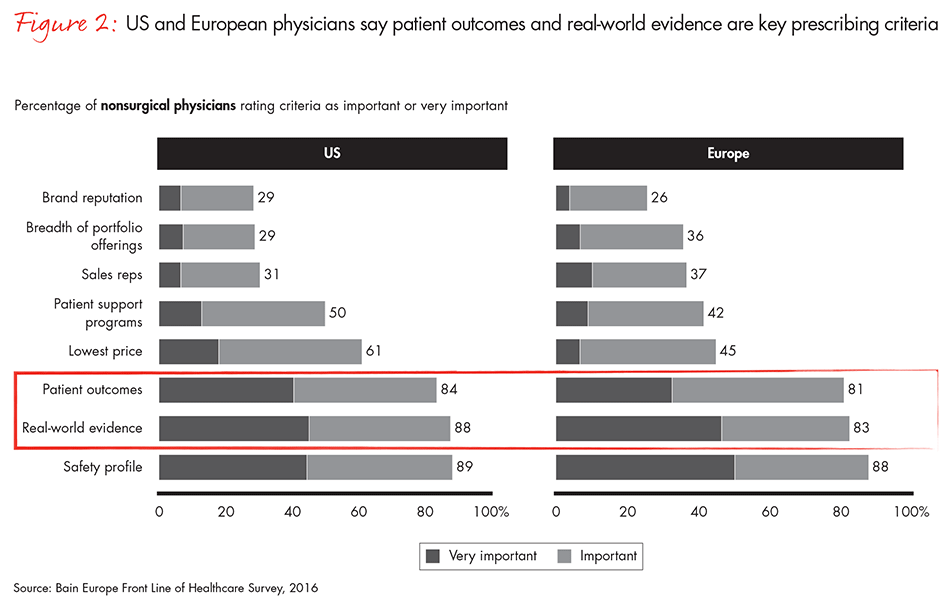
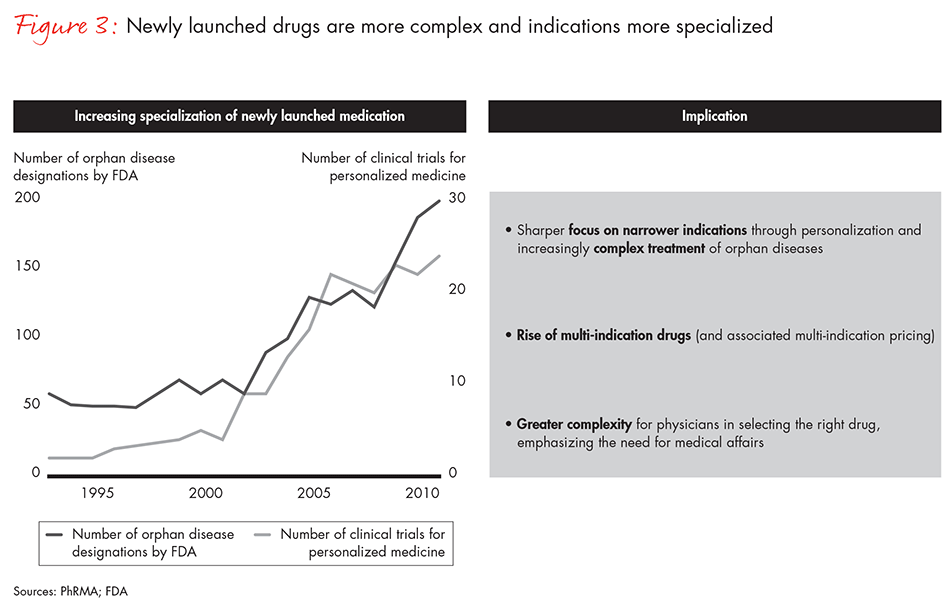
      Bain research shows that 88% of US physicians and 83% of EU physicians consider real-world evidence a top criterion in prescribing drugs (see Figure 2). But sorting through the vast increase in evidence has become an overwhelming task—physicians, payers and healthcare providers are struggling with data overload. At the same time, diagnostic tools are becoming more sophisticated and drugs increasingly complex (see Figure 3). Those developments have increased the need for more transparent data on drug performance.
      reinventing-role-of-medical-affairs-fig-02_embed

      reinventing-role-of-medical-affairs-fig-03_embed

      Leading companies have understood that medical value teams can step into the breach and help physicians, payers, providers and key opinion leaders make sense of a deluge of data and identify the best use for new products. That approach creates a virtuous circle for pharma companies.

      As medical value teams build long-term relationships with a variety of stakeholders, they benefit from continual market feedback and a better, more nuanced understanding of the market and patient needs. At the same time, increased engagement with stakeholders helps pharma companies focus on outcomes.

      When a new entrant launched a product challenging a big specialty pharma company, the strong relationship and trust the pharma company had built with prescribers over many years allowed it to engage in a frank dialogue with them about the competition. By using scientific data, the pharma company’s medical affairs team was able to cut through the marketing noise and profile its product fairly vs. the new entrant.

      Providing market-based strategic input to drug development and portfolio management


      By leveraging deep relationships with prescribers and opinion leaders and continually collecting feedback and signals from the market, medical value teams can provide critical input to drug development and life cycle management from early identification of promising compounds through post-launch market strategies.

      When leading companies initiate a new drug program, their medical value teams provide market-based input on unmet medical needs and clinical requirements, informing the development strategy and evaluation of the clinical and economic potential of a program. During clinical development, they contribute early stakeholder feedback providing firsthand input on product positioning and the scientific platform.

      As companies prepare to launch a new drug, medical value teams develop a strategy for market education. Finally, once it is on the market, they design and implement data generation strategies, integrating classical phase IV studies with real-world evidence and Big Data analytics.

      To do all those things effectively, medical value teams need to be an integral part of cross-functional product development and product management teams. By working with all pharma functions along the value chain, they help to increase a company’s understanding of unmet medical needs, attractiveness of treatment pathways, value of clinical trial protocol options, speed of regulatory approvals and launch success rates.

      Developing Big Data and real-world evidence


      A third important role for medical value teams is creating scientific evidence to support drug development, including real-world evidence, in-house data and scientific analysis. A medical value team can help companies cope not only with the sharp increase in demand for independent data but also the steady rise in drug protocols and guidelines and greater transparency requirements. Leading companies deploy medical value teams to integrate new types of evidence and steer collaborations with data providers and big analytics companies.

      Digital technologies in particular offer pharma companies innovative new ways to engage with customers and collect real-world data at lower cost. GlaxoSmithKline (GSK) partnered with Apple in June 2016, using Apple’s ResearchKit app framework to monitor patient progress in a large rheumatoid arthritis trial. GSK’s goal is to gather data for three months on the condition and symptoms of 300 people with rheumatoid arthritis as well as insights on how it might build the iPhone-based ResearchKit app into future clinical trials. The ResearchKit app gathers data on joint pain and fatigue using a mix of surveys and sensor-enabled tests. That reduces costs and travel for patients, simplifies data gathering and increases patient engagement. The app is an early milestone in the medical data revolution, but it underscores the capabilities that medical value teams will need in the future.

      Shire is also leveraging digital medicine and data to improve patient outcomes. Its myPKFiT software uses data analytics to reduce the number of blood samples needed in calculating prophylactic medication dosages for hemophilia patients. The software uses existing clinical data to predict patients’ pharmacokinetics (PK) curve based on 2 blood samples instead of 11. A personalized approach based on PK enables more precise dosing, fewer side effects and better patient engagement.

      Biotech companies such as Celgene have led the way by infusing science and medical knowledge in their go-to-market models and creating a pivotal role for medical value teams. By performing multiple trials and giving physicians early access to drugs still under development, biotech companies spread knowledge about new compounds while gaining valuable expert input.

      Pharma companies can build on that experience by developing scientific evidence and reaching out to the entire spectrum of stakeholders to demonstrate the value of new compounds. That, in turn, will help shift their focus from products to outcomes.

      Monday morning 8:00 AM agenda


      Medical affairs departments designed for the 20th century will be eclipsed by the coming era of Big Data medicine. Leadership teams eager to rethink the role of medical affairs can begin by adding the following key questions to their next strategy meeting agenda:

      • Does medical affairs have a clear engagement strategy for each important stakeholder group, and are we continually monitoring and improving them?
      • Are we leveraging the full potential of our medical affairs team across all stages of drug development and life cycle management?
      • Do we have Big Data and real-world evidence strategies for our key products, and are they fully integrated with the overall brand strategy?
      • Does our medical affairs team have the right capabilities for a new era of Big Data medicine? If not, do we have a plan to develop them?

      As digital technologies transform drug development and marketing, companies that reinvent medical affairs can build competitive advantage in a rapidly changing pharma landscape.

      Loic Plantevin is a partner with Bain & Company in the Paris office. Christoph Schlegel is a Bain partner in the Frankfurt office. Maria Gordian is a partner in Bain’s New York office.


      reinventing-role-of-medical-affairs-fig-01_full

      reinventing-role-of-medical-affairs-fig-02_full

      reinventing-role-of-medical-affairs-fig-03_full
      Auteurs
      • Headshot of Loïc Plantevin
        Loïc Plantevin
        Partner, Paris
      • Headshot of Christoph Schlegel
        Christoph Schlegel
        Alumni, Frankfurt
      • Headshot of Maria Gordian
        Maria Gordian
        Partner, New York
      Contactez-nous
      Synergies sectorielles
      • Santé
      Santé
      Getting the Dose Right: A Digital Prescription for the Pharma Industry

      To get started, set a few clear priorities, and partner outside the industry.

      Voir plus
      Santé
      Rapport Santé 2016 : Les professionnels de santé en première ligne
      Voir plus
      Santé
      Accelerating Growth and Innovation in European Mid-Sized Pharma

      Insights from the last decade of growth and portfolio innovation can help crack the growth code for EU mid-size pharma.

      Voir plus
      Santé
      How Life Sciences Leaders Are Widening the AI Capability Gap

      Most pharma and medtech companies agree that a strong data foundation is table stakes. Few invest equally in the behaviors needed to move from pilots to adoption.

      Voir plus
      Santé
      From Silos to Pods: Scaling AI in Life Sciences

      Cross-functional collaboration is the real differentiator between those that see meaningful returns and those that don’t.

      Voir plus
      First published in mars 2017
      Mots clés
      • Santé

      Comment nous avons aidé nos clients

      Speed at Scale: The Thermo Fisher story

      Lire l’étude de cas

      Taking Shared Services to a New Level at a Healthcare Company

      Lire l’étude de cas

      A new commercial strategy for a dental implant provider

      Lire l’étude de cas

      Vous souhaitez continuer cette conversation ?

      Nous aidons des dirigeants du monde entier à matérialiser des impacts et des résultats pérennes et créateurs de valeur dans leurs organisations.

      Les points de vue de Bain : notre perspective sur des problématiques auxquelles sont confrontées les entreprises à travers le monde, envoyés chaque mois dans votre boîte de réception. 

      *J’ai lu la politique de confidentialité et j’accepte les conditions.

      Merci de lire notre politique de confidentialité.
      Bain & Company
      Contactez-nous Sustainability Accessibility Conditions d’utilisation Politique de Confidentialité Cookie Policy Mentions Légales Sitemap Log In

      © 1996-2026 Bain & Company, Inc.

      Contacter Bain

      Comment pouvons-nous vous aider ?

      • Business inquiry
      • Career information
      • Press relations
      • Partnership request
      • Speaker request
      Voir tous les bureaux