
Skip to Content
  • Bureaux

    Bureaux

    Amérique du Nord et Amérique du Sud
    • Atlanta
    • Austin
    • Bogota
    • Boston
    • Buenos Aires
    • Chicago
    • Dallas
    • Denver
    • Houston
    • Los Angeles
    • Mexico City
    • Minneapolis
    • Monterrey
    • Montreal
    • New York
    • Rio de Janeiro
    • San Francisco
    • Santiago
    • São Paulo
    • Seattle
    • Silicon Valley
    • Toronto
    • Washington, DC
    Europe, Moyen-Orient et Afrique
    • Amsterdam
    • Athens
    • Berlin
    • Brussels
    • Copenhagen
    • Doha
    • Dubai
    • Dusseldorf
    • Frankfurt
    • Helsinki
    • Istanbul
    • Johannesburg
    • Kyiv
    • Lisbon
    • London
    • Madrid
    • Milan
    • Munich
    • Oslo
    • Paris
    • Riyadh
    • Rome
    • Stockholm
    • Vienna
    • Warsaw
    • Zurich
    Asie et Australie
    • Bangkok
    • Beijing
    • Bengaluru
    • Brisbane
    • Ho Chi Minh City
    • Hong Kong
    • Jakarta
    • Kuala Lumpur
    • Manila
    • Melbourne
    • Mumbai
    • New Delhi
    • Perth
    • Shanghai
    • Singapore
    • Sydney
    • Tokyo
    Voir tous les bureaux
  • Alumni
  • Presse
  • S’abonner
  • Contacter
  • Canada | Français

    Sélectionnez votre région et votre langue

    Global
    • Global (English)
    Amérique du Nord et Amérique du Sud
    • Brazil (Português)
    • Argentina (Español)
    • Canada (Français)
    • Chile (Español)
    • Colombia (Español)
    Europe, Moyen-Orient et Afrique
    • France (Français)
    • DACH Region (Deutsch)
    • Italy (Italiano)
    • Spain (Español)
    • Greece (Elliniká)
    Asie et Australie
    • China (中文版)
    • Korea (한국어)
    • Japan (日本語)
  • Saved items (0)
    Saved items (0)

    You have no saved items.

    Bookmark content that interests you and it will be saved here for you to read or share later.

    Explore Bain Insights
  • Expertises Sectorielles
    Menu principal

    Expertises Sectorielles

    • Aerospace et Défense
    • Agroalimentaire
    • Chimie
    • Infrastructures, BTP et Matériaux de Construction
    • Grande Consommation
    • Services Financiers
    • Santé
    • Engins & Equipements Industriels
    • Media et Divertissement
    • Metals
    • Mining
    • Pétrole & Gaz
    • Papier et Emballage
    • Private Equity
    • Secteur Public
    • Distribution
    • Technologie
    • Télécommunications
    • Transportation
    • Travel & Leisure
    • Utilities & Energies Renouvelables
  • Expertises Fonctionnelles
    Menu principal

    Expertises Fonctionnelles

    • Expérience Client
    • ESG
    • Innovation
    • Fusions et Acquisitions
    • Opérations
    • People & Organization
    • Private Equity
    • Sales & Marketing
    • Stratégie
    • IA, Perspectives et Solutions
    • Technology
    • Transformation
  • Digital
  • Points de Vue
  • About
    Menu principal

    About

    • Notre Activité
    • Nos Valeurs
    • Nos Collaborateurs et Notre Équipe Dirigeante
    • Notre Impact
    • Prix & Récompenses
    • Partenariats Internationaux
    Further: Our global responsibility
    • Sustainability
    • Impact Social
    • World Economic Forum
    Learn more about Further
  • Carrières
    Menu principal

    Carrières

    • Rejoignez-nous
      Carrières
      Rejoignez-nous
      • Find Your Place
      • Nos domaines d’expertise
      • Equipes multidisciplinaires
      • Étudiants
      • Stages et programmes
      • Événements de recrutement
    • La vie chez Bain
      Carrières
      La vie chez Bain
      • Blog: Inside Bain
      • Récits de carrière
      • Nos collaborateurs
      • Nos bureaux
      • Soutenir votre évolution professionnelle
      • Groupes d’affinités
      • Avantages chez Bain
    • Histoires d’impact
    • Notre processus de recrutement
      Carrières
      Notre processus de recrutement
      • Ce que vous pouvez attendre
      • Entretiens
    Trouver un poste
  • Bureaux
    Menu principal

    Bureaux

    • Amérique du Nord et Amérique du Sud
      Bureaux
      Amérique du Nord et Amérique du Sud
      • Atlanta
      • Austin
      • Bogota
      • Boston
      • Buenos Aires
      • Chicago
      • Dallas
      • Denver
      • Houston
      • Los Angeles
      • Mexico City
      • Minneapolis
      • Monterrey
      • Montreal
      • New York
      • Rio de Janeiro
      • San Francisco
      • Santiago
      • São Paulo
      • Seattle
      • Silicon Valley
      • Toronto
      • Washington, DC
    • Europe, Moyen-Orient et Afrique
      Bureaux
      Europe, Moyen-Orient et Afrique
      • Amsterdam
      • Athens
      • Berlin
      • Brussels
      • Copenhagen
      • Doha
      • Dubai
      • Dusseldorf
      • Frankfurt
      • Helsinki
      • Istanbul
      • Johannesburg
      • Kyiv
      • Lisbon
      • London
      • Madrid
      • Milan
      • Munich
      • Oslo
      • Paris
      • Riyadh
      • Rome
      • Stockholm
      • Vienna
      • Warsaw
      • Zurich
    • Asie et Australie
      Bureaux
      Asie et Australie
      • Bangkok
      • Beijing
      • Bengaluru
      • Brisbane
      • Ho Chi Minh City
      • Hong Kong
      • Jakarta
      • Kuala Lumpur
      • Manila
      • Melbourne
      • Mumbai
      • New Delhi
      • Perth
      • Shanghai
      • Singapore
      • Sydney
      • Tokyo
    Voir tous les bureaux
  • Alumni
  • Presse
  • S’abonner
  • Contacter
  • Canada | Français
    Menu principal

    Sélectionnez votre région et votre langue

    • Global
      Sélectionnez votre région et votre langue
      Global
      • Global (English)
    • Amérique du Nord et Amérique du Sud
      Sélectionnez votre région et votre langue
      Amérique du Nord et Amérique du Sud
      • Brazil (Português)
      • Argentina (Español)
      • Canada (Français)
      • Chile (Español)
      • Colombia (Español)
    • Europe, Moyen-Orient et Afrique
      Sélectionnez votre région et votre langue
      Europe, Moyen-Orient et Afrique
      • France (Français)
      • DACH Region (Deutsch)
      • Italy (Italiano)
      • Spain (Español)
      • Greece (Elliniká)
    • Asie et Australie
      Sélectionnez votre région et votre langue
      Asie et Australie
      • China (中文版)
      • Korea (한국어)
      • Japan (日本語)
  • Saved items  (0)
    Menu principal
    Saved items (0)

    You have no saved items.

    Bookmark content that interests you and it will be saved here for you to read or share later.

    Explore Bain Insights
  • Expertises Sectorielles
    • Expertises Sectorielles

      • Aerospace et Défense
      • Agroalimentaire
      • Chimie
      • Infrastructures, BTP et Matériaux de Construction
      • Grande Consommation
      • Services Financiers
      • Santé
      • Engins & Equipements Industriels
      • Media et Divertissement
      • Metals
      • Mining
      • Pétrole & Gaz
      • Papier et Emballage
      • Private Equity
      • Secteur Public
      • Distribution
      • Technologie
      • Télécommunications
      • Transportation
      • Travel & Leisure
      • Utilities & Energies Renouvelables
  • Expertises Fonctionnelles
    • Expertises Fonctionnelles

      • Expérience Client
      • ESG
      • Innovation
      • Fusions et Acquisitions
      • Opérations
      • People & Organization
      • Private Equity
      • Sales & Marketing
      • Stratégie
      • IA, Perspectives et Solutions
      • Technology
      • Transformation
  • Digital
  • Points de Vue
  • Carrières
    Recherches les plus fréquentes
    • Agile
    • Digital
    • Stratégie
    Vos recherches précédentes
      Pages récemment visitées

      Content added to saved items

      Saved items (0)

      Removed from saved items

      Saved items (0)

      Etude

      Rethinking M&A Valuation Assumptions

      Rethinking M&A Valuation Assumptions

      Why the assumptions behind many M&A models may be too onerous.

      Par Michael Robbins and Hubert Shen

      • min
      }

      Etude

      Rethinking M&A Valuation Assumptions
      en

      Global mergers and acquisitions are on pace to reach a record high this year. Yet we continue to hear from many chief financial officers (CFOs), treasurers and other executives assessing M&A opportunities that they just can’t make deals pencil out.

      For every buyer, it seems, another dozen potential buyers have been walking away because their M&A models show that they will not earn adequate returns. They might have strong balance sheets, abundant dry powder and prospective targets that could add strategic value and growth, but many still choose to sit on the sidelines, in the interest of being prudent with their shareholders’ capital. And recent volatility in financial markets could make potential buyers even more hesitant.

      These reasons have led companies into a no-growth trap: Cautious companies wind up holding on to their cash, returning it to shareholders through dividends and share buybacks, or trying to boost profit margins through cost reductions. What should CFOs who are discarding potential deals and investments in their own business do with the mounting cash on their balance sheets? Should they simply wait for better valuations and, in the meantime, continue returning capital to shareholders?

      We suggest an alternative: Reassess internal hurdle rates to make sure they accurately capture current capital markets conditions. This reassessment could help expand and clarify the universe of attractive investment opportunities, whether they be M&A or organic.

      Two factors generally account for higher-than-necessary hurdle rates: the reluctance of companies to lower internal hurdle rates to the same extent as declines in their weighted average cost of capital (WACC), and the acquisition premiums placed on potential deals.

      Michael Robbins, a partner in the Corporate Finance practice, discusses what companies can do to avoid falling into a no-growth trap when M&A deals fall through.

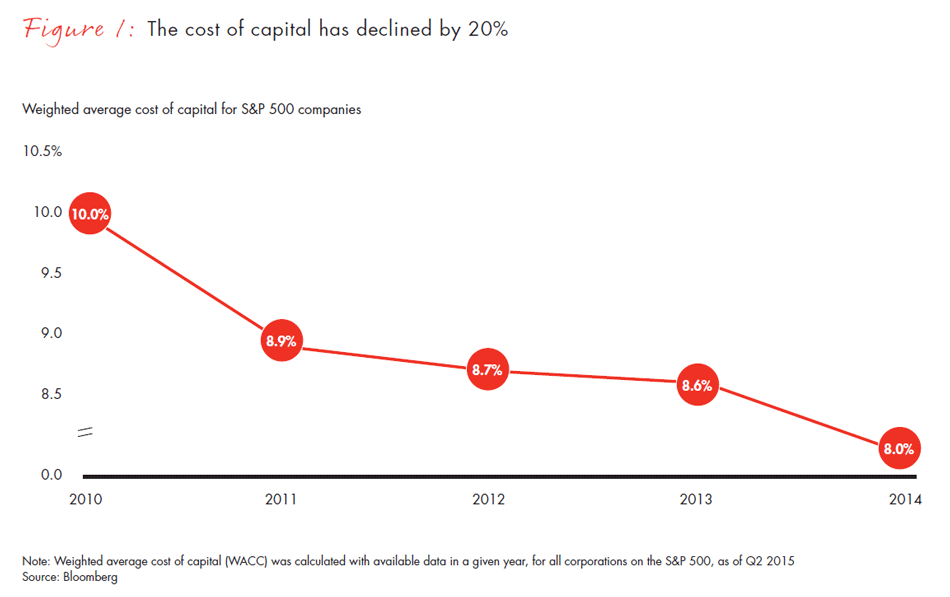
      Our analysis suggests that the WACC of the S&P 500 companies has steadily decreased and is, on average, 20% less than just a few years ago (see Figure 1). Many CFOs, however, have not lowered their internal investment hurdle rates as quickly or as far. Believing that interest rates must rise again soon, they have adopted a more conservative approach, lowering hurdle rates less than what the declining WACC would suggest.

      In addition, the risk premium they give to acquisitions (typically 200 to 300 basis points) and their general conservatism regarding WACC (typically 50 to 100 basis points) has not changed, further building in conservatism on a lower base.

      rethinking-ma-valuation-fig01_embed

      Why interest rates likely will remain low

      What corporate stewards of capital do from here depends in large part on the source of their concerns. If deals are not penciling out because potential buyers cannot get comfortable with the growth projections sellers have embedded into the price, then that may be a reasonable constraint. On the other hand, if the conservatism stems from worry that long-term interest rates will soon rise, that’s another matter.

      There is enough evidence to believe that long-term interest rates will remain low for a while, even after the US Federal Reserve begins the process of normalizing monetary policy. For one thing, the capital superabundance we first wrote about in 2012 continues to prevail, with $600 trillion in global financial assets available for investment. The law of supply and demand means that the cost of capital will likely remain low. (For more about capital superabundance, see Bain’s report, A World Awash in Money: Capital Trends through 2020.)

      Weakness in major economies, such as the eurozone, Japan and China, and in smaller markets, like Canada and Australia, has caused aggressive monetary easing in these countries, based on the pattern set by the Fed. It will be difficult for US interest rates to move sharply higher when overseas rates are being suppressed.

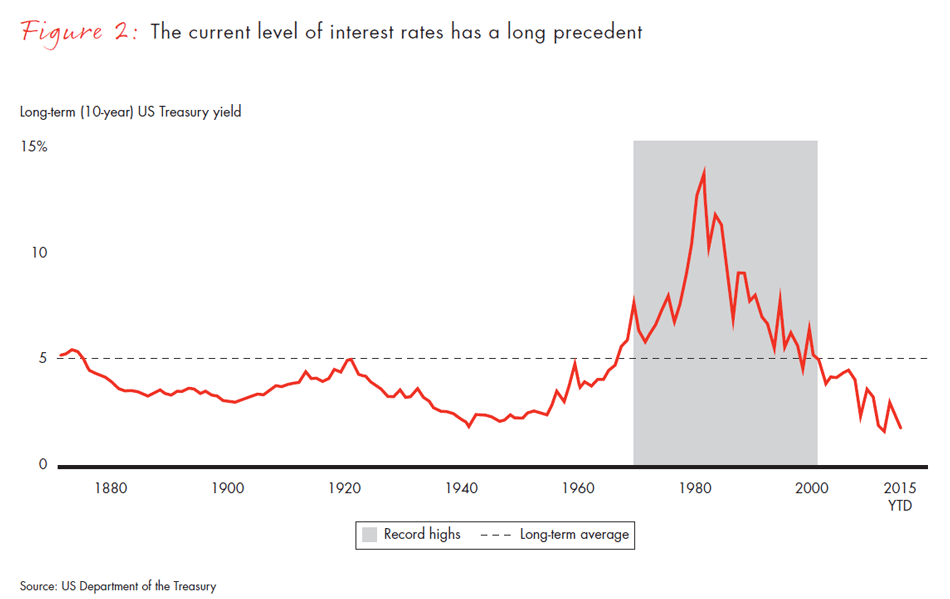
      Moreover, the strengthening of the US dollar serves as both signal and carrier of rising capital flows to the US. As international investors buy longer-term government and corporate bonds, interest rates generally will be suppressed. It’s also worth noting that the current level of rates is close to the long-term average over the past two centuries (see Figure 2).

      rethinking-ma-valuation-fig02_embed

      A prolonged period of capital surplus likely will be characterized by persistent low interest rates and thin real rates of return. The implication for CFOs, treasurers and others hunting for acceptable deals: Reevaluate and adjust internal investment hurdle rates and portfolio investment return targets accordingly. Without these adjustments, executives may end up parking capital on the sidelines indefinitely while waiting for higher-return opportunities that will not materialize.

      To be sure, by recent historical measures, valuation multiples in today’s environment still seem rich. Yet investors cannot invest in opportunities of the past, and very few can accurately time the valuation cycles of assets in the market. They must make capital allocation decisions and trade-offs against the only options presently available. And at present, interest rates have reached generational lows, partly because investors have found no better risk-reward trade-offs.

      Rethinking the assumptions that underlie a deal model is a big step. CFOs and other executives should examine several questions to determine whether to take that step and how much to reset the model (see the sidebar, “Fundamental questions for CFOs”).

      Fundamental questions for CFOs

      1. Do you separate the predictability of cash flows from the actual cost-of-capital requirements? This may require you to double down on due diligence efforts and invest more in scenario planning than in probability weighting and setting conservative hurdle rates, which serve to penalize the investment valuation twice.
      2. Have you updated cost-of-capital benchmarks to reflect most of the recent requirements for returns across different asset classes? Shareholders’ requirements for returns change over time and are influenced by the universe of alternatives available to them. In today’s capital markets, expectations for returns across asset classes have been tempered.
      3. Do you give yourself credit for having experience in making similar investments in the past? Do you evaluate the assigned risk premiums, given the lower cost of capital today? Our research suggests that serial acquirers are better at underwriting realistic assumptions and executing on deals. Your embedded acquisition premium may not need to be what it once was.
      4. Have you reevaluated the right target capital structure? Given current interest rates, it’s possible that your capital structure could be more productive at a different level, potentially lowering your WACC.

      Given current interest rates, it’s possible that your capital structure could be more productive at a different level, potentially lowering your WACC.

      Executives who still worry about timing this market at high valuations could consider a series of smaller investments or acquisitions over time, rather than one big acquisition that may be more susceptible to timing risk. Bain’s analysis shows that frequency and materiality both matter: Building M&A capabilities with a series of smaller acquisitions often leads to better returns over time. In addition, a company is more likely to perform better when more of its market capitalization comes from its acquisitions.

      More broadly, the most successful acquirers think long term about their portfolio of assets. They understand that strategic investments that complement their company’s core business can unlock more value than deals that simply pencil out in the near term. For CFOs finding deals that are attractive but too expensive, a reevaluation just might lead to a different conclusion.

      Michael Robbins, a Washington, DC-based partner with Bain & Company, is a leader of the firm’s Corporate Finance practice in the Americas. Hubert Shen is a principal with the practice and is based in Los Angeles.


      rethinking-ma-valuation-fig01_full

      rethinking-ma-valuation-fig02_full
      Auteurs
      • Headshot of Michael Robbins
        Michael Robbins
        Partner, Washington, DC
      • Headshot of Hubert Shen
        Hubert Shen
        Partner, Los Angeles
      Contactez-nous
      Expertises fonctionnelles transverses
      • Fusions et Acquisitions
      Comment pouvons-nous vous aider ?
      • Corporate Finance
      Fusions et Acquisitions
      Agitators and Reformers: How to Respond to Activist Investors

      Someday soon, an activist investor is likely to show up on your corporate doorstep.

      Voir plus
      Santé
      Mega-Mergers in Health Insurance: 10 Steps to Successful Integration

      Tailor integration to identify value, keep the right people and focus on critical decisions.

      Voir plus
      Corporate Finance
      Finding Hidden Value in a Company’s Investors

      A new investor relationship management program prepared one company for the future.

      Voir plus
      Corporate Finance
      CNBC’s 2025 CFO Council Summit: Rebuilding Finance in the Age of AI

      Leaders are using AI to transform finance into an insight engine.

      Voir plus
      Fusions et Acquisitions
      What Agency Consolidation Means for CMOs

      As agency holding companies get bigger and deeper, CMOs must rethink ownership, integration, and how to stay in control.

      Voir plus
      First published in octobre 2015
      Mots clés
      • Corporate Finance
      • Fusions et Acquisitions

      Comment nous avons aidé nos clients

      Helping a Healthcare Company Unlock Maximum Value

      Lire l’étude de cas

      Finance transformation: For one company, second time’s the charm

      Lire l’étude de cas

      Salesforce integration generates M&A success in healthcare

      Lire l’étude de cas

      Vous souhaitez continuer cette conversation ?

      Nous aidons des dirigeants du monde entier à matérialiser des impacts et des résultats pérennes et créateurs de valeur dans leurs organisations.

      Les points de vue de Bain : notre perspective sur des problématiques auxquelles sont confrontées les entreprises à travers le monde, envoyés chaque mois dans votre boîte de réception. 

      *J’ai lu la politique de confidentialité et j’accepte les conditions.

      Merci de lire notre politique de confidentialité.
      Bain & Company
      Contactez-nous Sustainability Accessibility Conditions d’utilisation Politique de Confidentialité Cookie Policy Mentions Légales Sitemap Log In

      © 1996-2026 Bain & Company, Inc.

      Contacter Bain

      Comment pouvons-nous vous aider ?

      • Business inquiry
      • Career information
      • Press relations
      • Partnership request
      • Speaker request
      Voir tous les bureaux