
Skip to Content
  • Bureaux

    Bureaux

    Amérique du Nord et Amérique du Sud
    • Atlanta
    • Austin
    • Bogota
    • Boston
    • Buenos Aires
    • Chicago
    • Dallas
    • Denver
    • Houston
    • Los Angeles
    • Mexico City
    • Minneapolis
    • Monterrey
    • Montreal
    • New York
    • Rio de Janeiro
    • San Francisco
    • Santiago
    • São Paulo
    • Seattle
    • Silicon Valley
    • Toronto
    • Washington, DC
    Europe, Moyen-Orient et Afrique
    • Amsterdam
    • Athens
    • Berlin
    • Brussels
    • Copenhagen
    • Doha
    • Dubai
    • Dusseldorf
    • Frankfurt
    • Helsinki
    • Istanbul
    • Johannesburg
    • Kyiv
    • Lisbon
    • London
    • Madrid
    • Milan
    • Munich
    • Oslo
    • Paris
    • Riyadh
    • Rome
    • Stockholm
    • Vienna
    • Warsaw
    • Zurich
    Asie et Australie
    • Bangkok
    • Beijing
    • Bengaluru
    • Brisbane
    • Ho Chi Minh City
    • Hong Kong
    • Jakarta
    • Kuala Lumpur
    • Manila
    • Melbourne
    • Mumbai
    • New Delhi
    • Perth
    • Shanghai
    • Singapore
    • Sydney
    • Tokyo
    Voir tous les bureaux
  • Alumni
  • Presse
  • S’abonner
  • Contacter
  • Canada | Français

    Sélectionnez votre région et votre langue

    Global
    • Global (English)
    Amérique du Nord et Amérique du Sud
    • Brazil (Português)
    • Argentina (Español)
    • Canada (Français)
    • Chile (Español)
    • Colombia (Español)
    Europe, Moyen-Orient et Afrique
    • France (Français)
    • DACH Region (Deutsch)
    • Italy (Italiano)
    • Spain (Español)
    • Greece (Elliniká)
    Asie et Australie
    • China (中文版)
    • Korea (한국어)
    • Japan (日本語)
  • Saved items (0)
    Saved items (0)

    You have no saved items.

    Bookmark content that interests you and it will be saved here for you to read or share later.

    Explore Bain Insights
  • Expertises Sectorielles
    Menu principal

    Expertises Sectorielles

    • Aerospace et Défense
    • Agroalimentaire
    • Chimie
    • Infrastructures, BTP et Matériaux de Construction
    • Grande Consommation
    • Services Financiers
    • Santé
    • Engins & Equipements Industriels
    • Media et Divertissement
    • Metals
    • Mining
    • Pétrole & Gaz
    • Papier et Emballage
    • Private Equity
    • Secteur Public
    • Distribution
    • Technologie
    • Télécommunications
    • Transportation
    • Travel & Leisure
    • Utilities & Energies Renouvelables
  • Expertises Fonctionnelles
    Menu principal

    Expertises Fonctionnelles

    • Expérience Client
    • ESG
    • Innovation
    • Fusions et Acquisitions
    • Opérations
    • People & Organization
    • Private Equity
    • Sales & Marketing
    • Stratégie
    • IA, Perspectives et Solutions
    • Technology
    • Transformation
  • Digital
  • Points de Vue
  • About
    Menu principal

    About

    • Notre Activité
    • Nos Valeurs
    • Nos Collaborateurs et Notre Équipe Dirigeante
    • Notre Impact
    • Prix & Récompenses
    • Partenariats Internationaux
    Further: Our global responsibility
    • Sustainability
    • Impact Social
    • World Economic Forum
    Learn more about Further
  • Carrières
    Menu principal

    Carrières

    • Rejoignez-nous
      Carrières
      Rejoignez-nous
      • Find Your Place
      • Nos domaines d’expertise
      • Equipes multidisciplinaires
      • Étudiants
      • Stages et programmes
      • Événements de recrutement
    • La vie chez Bain
      Carrières
      La vie chez Bain
      • Blog: Inside Bain
      • Récits de carrière
      • Nos collaborateurs
      • Nos bureaux
      • Soutenir votre évolution professionnelle
      • Groupes d’affinités
      • Avantages chez Bain
    • Histoires d’impact
    • Notre processus de recrutement
      Carrières
      Notre processus de recrutement
      • Ce que vous pouvez attendre
      • Entretiens
    Trouver un poste
  • Bureaux
    Menu principal

    Bureaux

    • Amérique du Nord et Amérique du Sud
      Bureaux
      Amérique du Nord et Amérique du Sud
      • Atlanta
      • Austin
      • Bogota
      • Boston
      • Buenos Aires
      • Chicago
      • Dallas
      • Denver
      • Houston
      • Los Angeles
      • Mexico City
      • Minneapolis
      • Monterrey
      • Montreal
      • New York
      • Rio de Janeiro
      • San Francisco
      • Santiago
      • São Paulo
      • Seattle
      • Silicon Valley
      • Toronto
      • Washington, DC
    • Europe, Moyen-Orient et Afrique
      Bureaux
      Europe, Moyen-Orient et Afrique
      • Amsterdam
      • Athens
      • Berlin
      • Brussels
      • Copenhagen
      • Doha
      • Dubai
      • Dusseldorf
      • Frankfurt
      • Helsinki
      • Istanbul
      • Johannesburg
      • Kyiv
      • Lisbon
      • London
      • Madrid
      • Milan
      • Munich
      • Oslo
      • Paris
      • Riyadh
      • Rome
      • Stockholm
      • Vienna
      • Warsaw
      • Zurich
    • Asie et Australie
      Bureaux
      Asie et Australie
      • Bangkok
      • Beijing
      • Bengaluru
      • Brisbane
      • Ho Chi Minh City
      • Hong Kong
      • Jakarta
      • Kuala Lumpur
      • Manila
      • Melbourne
      • Mumbai
      • New Delhi
      • Perth
      • Shanghai
      • Singapore
      • Sydney
      • Tokyo
    Voir tous les bureaux
  • Alumni
  • Presse
  • S’abonner
  • Contacter
  • Canada | Français
    Menu principal

    Sélectionnez votre région et votre langue

    • Global
      Sélectionnez votre région et votre langue
      Global
      • Global (English)
    • Amérique du Nord et Amérique du Sud
      Sélectionnez votre région et votre langue
      Amérique du Nord et Amérique du Sud
      • Brazil (Português)
      • Argentina (Español)
      • Canada (Français)
      • Chile (Español)
      • Colombia (Español)
    • Europe, Moyen-Orient et Afrique
      Sélectionnez votre région et votre langue
      Europe, Moyen-Orient et Afrique
      • France (Français)
      • DACH Region (Deutsch)
      • Italy (Italiano)
      • Spain (Español)
      • Greece (Elliniká)
    • Asie et Australie
      Sélectionnez votre région et votre langue
      Asie et Australie
      • China (中文版)
      • Korea (한국어)
      • Japan (日本語)
  • Saved items  (0)
    Menu principal
    Saved items (0)

    You have no saved items.

    Bookmark content that interests you and it will be saved here for you to read or share later.

    Explore Bain Insights
  • Expertises Sectorielles
    • Expertises Sectorielles

      • Aerospace et Défense
      • Agroalimentaire
      • Chimie
      • Infrastructures, BTP et Matériaux de Construction
      • Grande Consommation
      • Services Financiers
      • Santé
      • Engins & Equipements Industriels
      • Media et Divertissement
      • Metals
      • Mining
      • Pétrole & Gaz
      • Papier et Emballage
      • Private Equity
      • Secteur Public
      • Distribution
      • Technologie
      • Télécommunications
      • Transportation
      • Travel & Leisure
      • Utilities & Energies Renouvelables
  • Expertises Fonctionnelles
    • Expertises Fonctionnelles

      • Expérience Client
      • ESG
      • Innovation
      • Fusions et Acquisitions
      • Opérations
      • People & Organization
      • Private Equity
      • Sales & Marketing
      • Stratégie
      • IA, Perspectives et Solutions
      • Technology
      • Transformation
  • Digital
  • Points de Vue
  • Carrières
    Recherches les plus fréquentes
    • Agile
    • Digital
    • Stratégie
    Vos recherches précédentes
      Pages récemment visitées

      Content added to saved items

      Saved items (0)

      Removed from saved items

      Saved items (0)

      Etude

      Solving for the Dark Side of Metcalfe's Law

      Solving for the Dark Side of Metcalfe's Law

      Digital technology can help close the wide productivity gaps that plague so many modern organizations.

      Par Chris Brahm, Greg Caimi and Michael Mankins

      • min
      }

      Etude

      Solving for the Dark Side of Metcalfe's Law
      en

      Telecommunications networks in general—and the Internet in particular—have changed our lives forever. Metcalfe's Law explains why they've become so powerful: A network's value increases exponentially with its size, meaning that the more people are using it, the more their participation enhances the network. This is generally a very good thing, but not always. Metcalfe's Law, it turns out, has a dark side when it comes to workplace productivity.

      As the cost of initiating one-to-one and one-to-many interactions drops to zero, the number of interactions increases—exponentially. By our estimates, a senior executive who in the 1970s might have received fewer than 1,000 outside phone calls, telexes or telegrams a year now faces a tidal wave of 30,000 emails and other electronic communications. Moreover, connected enterprises and automated scheduling have driven meeting time through the roof. At one company we analyzed as part of an organization-wide time-management study, employees throughout the organization spent a staggering 300,000 hours a year supporting a single weekly executive committee meeting.

      In reporting on this finding, the Guardian put it best: “Meetings: Even more of a soul-sucking waste of time than you thought.”

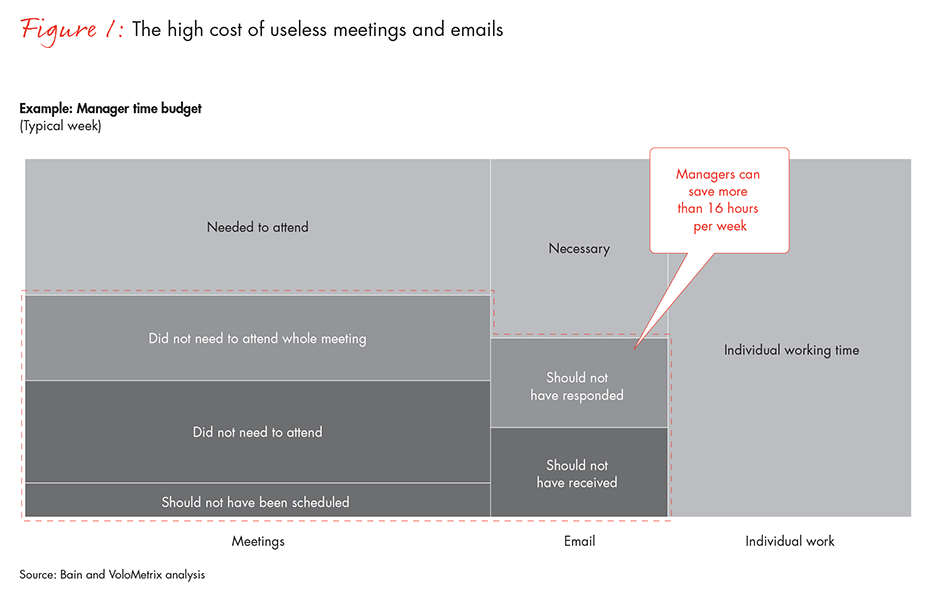
      In our research, a typical manager burned 16 hours a week managing emails and attending meetings that were unnecessary (see Figure 1). Useless meetings alone cost businesses more than $30 billion a year in the US, according to Atlassian. Given how much this kind of wasted energy saps employee morale, it's no wonder a global Gallup survey found that only 13% of employees are engaged at work—with “engaged” defined as being psychologically committed to their jobs and likely to be making positive contributions to their organizations.

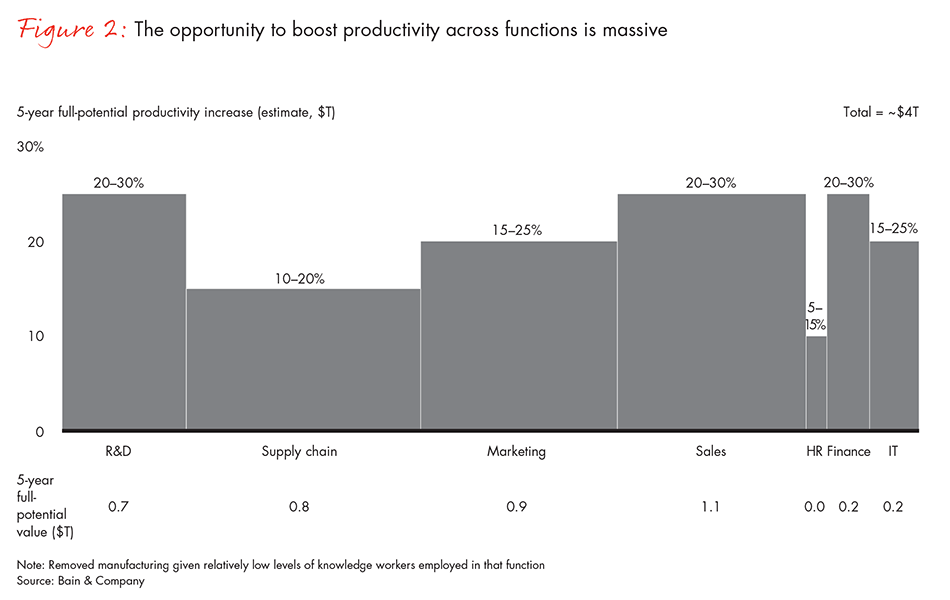
      For any organization, this degree of lost productivity is corrosive. But it also represents a significant opportunity: Our experience indicates that the overall productivity increase possible in the modern enterprise can range as high as 30%, depending on the organization and function (see Figure 2). The real question is: How can leaders capture that upside by closing the wide productivity gap that plagues so many modern organizations?
      solving-for-the-dark-side-of-metcalfes-law-fig01_embed

      solving-for-the-dark-side-of-metcalfes-law-fig02_embed

      The answer is part “analog” and part “digital.” The analog tools are old school: strategy and culture. The first foundational element for productivity is a strategy clearly stated, effectively communicated and linked to frontline priorities. People need to embrace the mission and buy in, understanding how it translates into specific behaviors and actions required of them. The second foundational element is a culture that values disciplined and engaged interaction. It is oriented toward action and results. It rejects swirl, indecision and collaboration for collaboration's sake.

      These analog management methods are essential. But in the modern and connected enterprise they are no longer sufficient. Improved productivity increasingly requires using technology to support strategy and culture. One aspect of this is using communication and collaboration platforms to increase engagement when people collaborate. Simple changes like replacing more audio conferencing with video, for instance, can shame the more than 70% of attendees who admit to parallel processing during meetings into actually engaging. Community-based collaboration platforms vs. blast email can also serve to increase focus and engagement. There is a whole raft of new communication and collaboration technology coming out in this area.

      But it is also essential to understand where organizational obstacles exist that prevent workers from focusing on their most important priorities. Increasingly, that means using analytics to see where breakdowns and waste occur so they can be addressed proactively, both through frontline and management feedback loops.

      At a recent Bain Executive Digital Immersion session in Palo Alto, we discussed the growing number of digital solutions that can help companies enable, analyze and empower their workforce to make it more productive. Some examples include:

      • Analyzing a company's email, calendar and CRM data to see how people are spending their time. This creates feedback loops within the enterprise that help individuals and the organization as a whole manage the unintended consequences of Metcalfe's Law.
      • Providing executives with insight into the “organizational load” they create—the meetings they schedule, the emails they send and the other ways they impose on people's time.
      • Melding collaboration platforms into a specific workflow—product design, for example, or an important ad-hoc corporate initiative like a merger. That helps focus collaboration and content within a specific context.
      • Creating feedback loops around meeting-specific performance to help shift culture.
      • Applying heuristics that link individual behaviors within a function to individual success. That data can then be fed back to frontline individuals and their managers to help sharpen development and performance.
      • Creating team- and org-based employee engagement surveys and follow-up loops. This creates visibility and focuses attention on what is detracting from engagement.

      Sunshine is the best disinfectant, as they say. And creating visibility around these issues is incredibly valuable in diagnosing where dysfunction is lurking within the enterprise. It is critical, of course, to protect employee privacy while creating a unique view of what is really happening within the organization. But existing tools—those that render the data anonymous, for instance—can solve that problem without compromising the value of the insights.

      The point is that digital technology has dramatically enhanced a company's ability to defeat the dark side of Metcalfe's Law. Realizing the full potential of the modern, connected enterprise requires both good “analog management” and better digital tools to remain focused on the priorities and culture that make an organization successful.


      solving-for-the-dark-side-of-metcalfes-law-fig01_full

      solving-for-the-dark-side-of-metcalfes-law-fig02_full
      Auteurs
      • Headshot of Chris Brahm
        Chris Brahm
        Alumni, San Francisco
      • Greg Caimi
        Former Partner, San Francisco
      • Headshot of Michael Mankins
        Michael Mankins
        Partner, Austin
      Contactez-nous
      Synergies sectorielles
      • Telecommunications
      Expertises fonctionnelles transverses
      • Agile Enterprise
      Telecommunications
      VARs: The Untapped Growth Engine for Telcos

      As enterprise customers migrate to IP connectivity, telcos must consider offering IT services to shore up their margins, and for some, acquiring a value-added reseller may be the best option.

      Voir plus
      Telecommunications
      L'enjeu de « repremiumisation » des opérateurs télécom en Europe
      Voir plus
      Grande Consommation
      Assuring the Price is Right Online

      In a world where competitors are pricing below cost, should a traditional company match prices online or build a sustainable business model and wait out its competitors?

      Voir plus
      Agile
      Bart Delmulle: Enablers for a Simple and Digital Transformation in Telecom

      A simple and digital approach can bring better customer experiences, significant growth and more profitability for telcos.

      Voir plus
      Agile
      Purposeful Business the Agile Way

      Turn squishy debates into concrete action.

      Voir plus
      First published in mars 2016
      Mots clés
      • Agile
      • Agile Enterprise
      • Telecommunications

      Comment nous avons aidé nos clients

      Jump-starting innovation for a telecom solutions provider

      Lire l’étude de cas

      Post-merger cultural issues jeopardize a deal

      Lire l’étude de cas

      Customer segmentation aligns TelecomCo's growth strategy with consumers' needs

      Lire l’étude de cas

      Vous souhaitez continuer cette conversation ?

      Nous aidons des dirigeants du monde entier à matérialiser des impacts et des résultats pérennes et créateurs de valeur dans leurs organisations.

      Les points de vue de Bain : notre perspective sur des problématiques auxquelles sont confrontées les entreprises à travers le monde, envoyés chaque mois dans votre boîte de réception. 

      *J’ai lu la politique de confidentialité et j’accepte les conditions.

      Merci de lire notre politique de confidentialité.
      Bain & Company
      Contactez-nous Sustainability Accessibility Conditions d’utilisation Politique de Confidentialité Cookie Policy Mentions Légales Sitemap Log In

      © 1996-2026 Bain & Company, Inc.

      Contacter Bain

      Comment pouvons-nous vous aider ?

      • Business inquiry
      • Career information
      • Press relations
      • Partnership request
      • Speaker request
      Voir tous les bureaux