
Skip to Content
  • Bureaux

    Bureaux

    Amérique du Nord et Amérique du Sud
    • Atlanta
    • Austin
    • Bogota
    • Boston
    • Buenos Aires
    • Chicago
    • Dallas
    • Denver
    • Houston
    • Los Angeles
    • Mexico City
    • Minneapolis
    • Monterrey
    • Montreal
    • New York
    • Rio de Janeiro
    • San Francisco
    • Santiago
    • São Paulo
    • Seattle
    • Silicon Valley
    • Toronto
    • Washington, DC
    Europe, Moyen-Orient et Afrique
    • Amsterdam
    • Athens
    • Berlin
    • Brussels
    • Copenhagen
    • Doha
    • Dubai
    • Dusseldorf
    • Frankfurt
    • Helsinki
    • Istanbul
    • Johannesburg
    • Kyiv
    • Lisbon
    • London
    • Madrid
    • Milan
    • Munich
    • Oslo
    • Paris
    • Riyadh
    • Rome
    • Stockholm
    • Vienna
    • Warsaw
    • Zurich
    Asie et Australie
    • Bangkok
    • Beijing
    • Bengaluru
    • Brisbane
    • Ho Chi Minh City
    • Hong Kong
    • Jakarta
    • Kuala Lumpur
    • Manila
    • Melbourne
    • Mumbai
    • New Delhi
    • Perth
    • Shanghai
    • Singapore
    • Sydney
    • Tokyo
    Voir tous les bureaux
  • Alumni
  • Presse
  • S’abonner
  • Contacter
  • Canada | Français

    Sélectionnez votre région et votre langue

    Global
    • Global (English)
    Amérique du Nord et Amérique du Sud
    • Brazil (Português)
    • Argentina (Español)
    • Canada (Français)
    • Chile (Español)
    • Colombia (Español)
    Europe, Moyen-Orient et Afrique
    • France (Français)
    • DACH Region (Deutsch)
    • Italy (Italiano)
    • Spain (Español)
    • Greece (Elliniká)
    Asie et Australie
    • China (中文版)
    • Korea (한국어)
    • Japan (日本語)
  • Saved items (0)
    Saved items (0)

    You have no saved items.

    Bookmark content that interests you and it will be saved here for you to read or share later.

    Explore Bain Insights
Page d’accueil Bain.fr
Founder's Mentality®
  • Overview
  • About
    Page d’accueil Bain.fr
    Founder's Mentality®

    About

    • About Founder's Mentality
    • About Micro-battles
  • Podcast
  • Book
  • Blog
  • Bureaux
    Menu principal

    Bureaux

    • Amérique du Nord et Amérique du Sud
      Bureaux
      Amérique du Nord et Amérique du Sud
      • Atlanta
      • Austin
      • Bogota
      • Boston
      • Buenos Aires
      • Chicago
      • Dallas
      • Denver
      • Houston
      • Los Angeles
      • Mexico City
      • Minneapolis
      • Monterrey
      • Montreal
      • New York
      • Rio de Janeiro
      • San Francisco
      • Santiago
      • São Paulo
      • Seattle
      • Silicon Valley
      • Toronto
      • Washington, DC
    • Europe, Moyen-Orient et Afrique
      Bureaux
      Europe, Moyen-Orient et Afrique
      • Amsterdam
      • Athens
      • Berlin
      • Brussels
      • Copenhagen
      • Doha
      • Dubai
      • Dusseldorf
      • Frankfurt
      • Helsinki
      • Istanbul
      • Johannesburg
      • Kyiv
      • Lisbon
      • London
      • Madrid
      • Milan
      • Munich
      • Oslo
      • Paris
      • Riyadh
      • Rome
      • Stockholm
      • Vienna
      • Warsaw
      • Zurich
    • Asie et Australie
      Bureaux
      Asie et Australie
      • Bangkok
      • Beijing
      • Bengaluru
      • Brisbane
      • Ho Chi Minh City
      • Hong Kong
      • Jakarta
      • Kuala Lumpur
      • Manila
      • Melbourne
      • Mumbai
      • New Delhi
      • Perth
      • Shanghai
      • Singapore
      • Sydney
      • Tokyo
    Voir tous les bureaux
  • Alumni
  • Presse
  • S’abonner
  • Contacter
  • Canada | Français
    Menu principal

    Sélectionnez votre région et votre langue

    • Global
      Sélectionnez votre région et votre langue
      Global
      • Global (English)
    • Amérique du Nord et Amérique du Sud
      Sélectionnez votre région et votre langue
      Amérique du Nord et Amérique du Sud
      • Brazil (Português)
      • Argentina (Español)
      • Canada (Français)
      • Chile (Español)
      • Colombia (Español)
    • Europe, Moyen-Orient et Afrique
      Sélectionnez votre région et votre langue
      Europe, Moyen-Orient et Afrique
      • France (Français)
      • DACH Region (Deutsch)
      • Italy (Italiano)
      • Spain (Español)
      • Greece (Elliniká)
    • Asie et Australie
      Sélectionnez votre région et votre langue
      Asie et Australie
      • China (中文版)
      • Korea (한국어)
      • Japan (日本語)
  • Saved items  (0)
    Menu principal
    Saved items (0)

    You have no saved items.

    Bookmark content that interests you and it will be saved here for you to read or share later.

    Explore Bain Insights
Founder's Mentality®
  • Expertises Sectorielles
    • Expertises Sectorielles

      • Aerospace et Défense
      • Agroalimentaire
      • Chimie
      • Infrastructures, BTP et Matériaux de Construction
      • Grande Consommation
      • Services Financiers
      • Santé
      • Engins & Equipements Industriels
      • Media et Divertissement
      • Metals
      • Mining
      • Pétrole & Gaz
      • Papier et Emballage
      • Private Equity
      • Secteur Public
      • Distribution
      • Technologie
      • Télécommunications
      • Transportation
      • Travel & Leisure
      • Utilities & Energies Renouvelables
  • Expertises Fonctionnelles
    • Expertises Fonctionnelles

      • Expérience Client
      • ESG
      • Innovation
      • Fusions et Acquisitions
      • Opérations
      • People & Organization
      • Private Equity
      • Sales & Marketing
      • Stratégie
      • IA, Perspectives et Solutions
      • Technology
      • Transformation
  • Digital
  • Points de Vue
  • Carrières
    Recherches les plus fréquentes
    • Agile
    • Digital
    • Stratégie
    Vos recherches précédentes
      Pages récemment visitées

      Content added to saved items

      Saved items (0)

      Removed from saved items

      Saved items (0)

      Founder's Mentality Blog

      The Best Practices of Great Scalers

      The Best Practices of Great Scalers

      People who understand how to scale innovation are built, not born. Here are 10 ways that leaders can develop this essential skill.

      Par James Allen

      • min
      }

      Article

      The Best Practices of Great Scalers
      en

      In our studies of large incumbent companies and their struggles to achieve long-term profitable growth, we’ve recognized a startling pattern. Most incumbents have lost the critical art of business building. To sustain growth by building new businesses, companies need to excel at scaling, the act of institutionalizing innovation across the enterprise. It sounds simple enough, but few companies properly recognize and value the people who know how to scale good ideas. We call these people the Scaling CommunitySM. They serve as the bridge between a company’s innovators and executors by turning disruptive ideas into daily routines and behaviors.

      What makes a great member of the Scaling Community? How do CEOs find and nurture scalers in their organizations? We’ve been working with The Chemistry Group, a London-based research company that studies the traits and behaviors of high-performing individuals, to answer these questions. Our research involved extensive interviews with some of the best scalers identified by our colleagues. In building a profile based on these exemplary individuals, we uncovered a powerful insight: Scalers are built, not born. While some of their personality traits develop during childhood, they learn many of their defining behaviors through experiences in the workplace. In fact, all of the individuals we interviewed considered themselves students of scaling.

      As our group of scalers shared their journeys, they divulged some of the lessons they learned along the way. We collected their best practices to help guide other potential scalers as they find their place within their organization (see Figure 1). Below are the top 10 practices.

      Figure 1
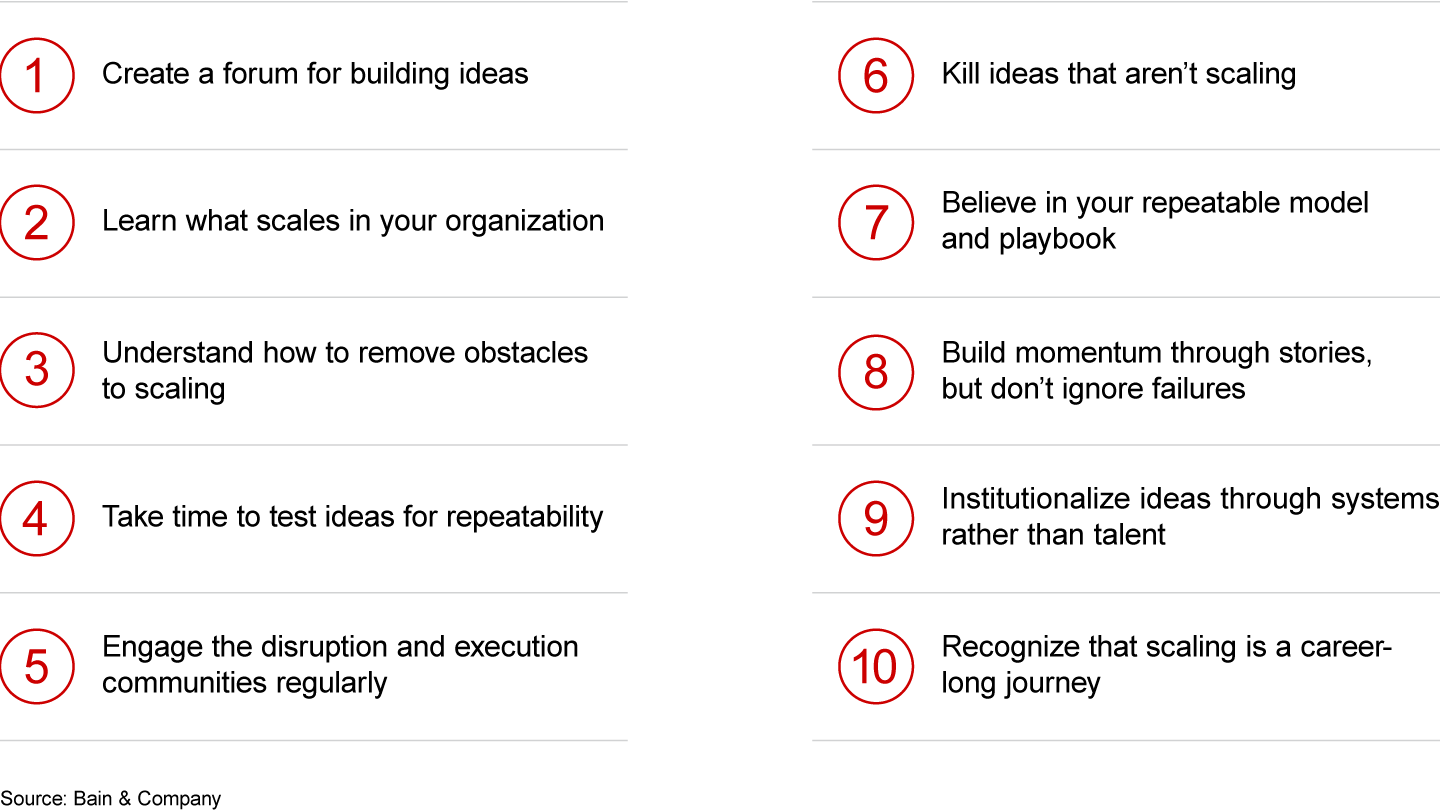
      Scalers can use 10 best practices to develop their role in an organization
      Scalers can use 10 best practices to develop their role in an organization
      Scalers can use 10 best practices to develop their role in an organization

      No. 1: Create a forum for building ideas. Scalers don’t view themselves as idea generators, but rather as idea builders. Their job is to give idea generators a forum to discuss their innovations and brainstorm how to make them bigger. Scalers should encourage more ideas than necessary. Once they have an extensive list of innovations, they ruthlessly narrow it down to one or two ideas with the potential for huge impact. Overall, scalers feel that their job is to develop good relationships with innovators and a reputation for turning ideas into results.

      No. 2: Learn what scales in your organization. Scalers argue that ideas are plentiful but ideas that scale are very rare. They must figure out how to work within their organization’s culture. The best scalers consider four key areas. 

      • The customer: Listen to customers, and build their feedback into your processes. If there isn’t customer pull for an idea, you’ll never scale it.
      • The front line: Ideas that empower your front line and fit into their daily routines have a bigger impact. One of the scalers that we profiled has an acid test for a good repeatable model. He asks himself, “Does this innovation give the front line more rewards or make their lives easier?” In his interview, he explained, “If you can create pull for change, you can transform the company faster. When I find myself pushing an idea, I realize that the front line knows something I don’t and is resisting. Most times, I rethink what I’m doing.”
      • Repeatability: Look for the repeatable model within the idea. Simplify complex initiatives so that they can be repeated in diverse situations.
      • The experience curve or network effect: Look for competitive advantage in all ideas, particularly in two areas. First, favor ideas in which you can continuously learn and improve—this has the potential to keep you ahead of the competition. In addition, you should consider if there is some network effect. With some ideas, the more times you execute, the more data you collect, and the more you can improve the value of what you do for customers. These are the ideas that you want to scale.

      No. 3: Understand how to remove obstacles to scaling. Scalers recognize patterns of what will scale well and what will scale poorly in their organization. Using this insight, they go after the obstacles to scaling. Great scalers consider four common roadblocks.

      • Lack of empowerment: Are we giving our executors enough power? How can we give the execution community more decision-making authority?
      • Lack of tools or processes: Do our people have the right tools or routines to succeed?
      • Lack of learning: Are our executors able to learn from each other? Are we helping them communicate?
      • Lack of feasibility: Are we making it too easy for others to say no to our ideas? Are our initial investment requests too big? Are we controlling risks?

      No. 4: Take time to test ideas for repeatability. Scalers won’t roll out an idea until they’ve rigorously tested it for repeatability in the real world. The worst thing that scalers can do is overwhelm executors with half-baked ideas. The best scalers work with executors to translate ideas into specific routines and behaviors for their day-to-day work.

      No. 5: Engage the disruption and execution communities regularly. Scalers believe that innovation is iterative. When they need to solve issues during the initial implementation, they return to the idea generators. Innovators help the scalers to pivot or rethink an approach that isn’t working. When they need to solve issues during scaling, scalers reach out to the execution community. Executors can help scalers think about how to bring the idea into daily routines and behaviors. The best scalers talk to both communities regularly to refine the idea.

      No. 6: Kill ideas that aren’t scaling. Scalers don’t become emotionally attached to the idea or the person advocating it. They let the results speak for themselves. If an idea doesn’t scale and the scalers can’t pivot to a new solution, they advocate to drop the idea. They operate under the principle that there is always too much to do.

      No. 7: Believe in your repeatable model and playbook. When you figure out the right playbook, you need to ensure that others execute it flawlessly. To guarantee buy-in, scalers should invest time to test, learn and refine. The best scalers graduate the repeatable model from test and learn to 100% compliance. Early in scaling, they allow constant adjustments. They want to experiment with multiple ideas. But once they have found a winning model, scalers will move in the opposite direction. They demand adherence to the final playbook with zero deviation.

      No. 8: Build momentum through hero stories, but don’t ignore failures. Scalers look for leaders in the execution community and ask them to champion implementation. When there is a success, scalers encourage the leaders to tell the story. They build momentum by showing results and bringing others on board. But they also allow the heroes to tell stories of failure. By sharing both types of stories, scalers gain credibility. This balance is key to successful engagement across the organization.

      No. 9: Institutionalize ideas through systems rather than talent. Scalers want to build organizational capabilities. They like systems. They like processes. They want these initiatives to outlast them. They also want these initiatives to outlast the early heroes who built momentum. They don’t let results depend on a few individuals. Scalers are unique because they create institutional capabilities. They are more interested in creating results for the organization than building talent.

      No. 10: Recognize that scaling is a career-long journey. Scalers learn from mistakes and successes. They study what works and what doesn’t. They seek feedback. They recognize that they improve with each failure. They don’t wing it. Scalers understand that they are made, not born.

      As you develop your role in scaling, we encourage you to create your own list of best practices and share it with your community. Scalers are great students, but you need great course material to get started.

      James Allen is a senior partner with Bain’s Global Strategy practice, and he is based in London. He coauthored The Founder’s Mentality.

      Scaling Community℠ is a service mark of Bain & Company, Inc.

      Related

      Scaling Businesses as a Team

      Every organization implicitly comprises three communities; leading CEOs ensure that they develop the right relationships.

      Auteurs
      • Headshot of James Allen
        James Allen
        Advisory Partner, London
      Contactez-nous
      Expertises fonctionnelles transverses
      • Business Strategy
      Comment pouvons-nous vous aider ?
      • Bain Micro-battles System®
      Business Strategy
      How to Identify Great Scalers

      People who excel at scaling businesses are defined by a unique set of traits and behaviors.

      Voir plus
      Conduite du Changement
      Micro-battles and the Journey to Scale Insurgency

      Discrete, fast-moving initiatives bring focus to strategic choices and help companies rediscover the art of getting stuff done.

      Voir plus
      Business Strategy
      Scaling Businesses as a Team

      Every organization implicitly comprises three communities; leading CEOs ensure that they develop the right relationships.

      Voir plus
      Founder's Mentality
      Covid-19: Is Your Board Hitting the Brakes on CEO Succession?

      Crises slow the most critical leadership decisions.

      Voir plus
      Founder's Mentality
      The Magic of Founder-led Companies

      Companies with their founder present performed twice as well as their peers in the S&P 500 over the past decade.

      Voir plus
      First published in avril 2019
      Mots clés
      • Bain Micro-battles System®
      • Business Strategy
      • Founder's Mentality

      Comment nous avons aidé nos clients

      Springtime for April as a Digital Transformation Takes Root

      Lire l’étude de cas

      Better Forecasts, Less Waste Boost Grupo Bimbo’s Profitability

      Lire l’étude de cas

      How Micro-battles Powered a Brand and Sales Lift at BeautyCo

      Lire l’étude de cas

      Vous souhaitez continuer cette conversation ?

      Nous aidons des dirigeants du monde entier à matérialiser des impacts et des résultats pérennes et créateurs de valeur dans leurs organisations.

      Bain Micro-battles System® is a registered trademark of Bain & Company, Inc.

      Les points de vue de Bain : notre perspective sur des problématiques auxquelles sont confrontées les entreprises à travers le monde, envoyés chaque mois dans votre boîte de réception. 

      *J’ai lu la politique de confidentialité et j’accepte les conditions.

      Merci de lire notre politique de confidentialité.
      Bain & Company
      Contactez-nous Sustainability Accessibility Conditions d’utilisation Politique de Confidentialité Cookie Policy Mentions Légales Sitemap Log In

      © 1996-2026 Bain & Company, Inc.

      Contacter Bain

      Comment pouvons-nous vous aider ?

      • Business inquiry
      • Career information
      • Press relations
      • Partnership request
      • Speaker request
      Voir tous les bureaux