
Skip to Content
  • Bureaux

    Bureaux

    Amérique du Nord et Amérique du Sud
    • Atlanta
    • Austin
    • Bogota
    • Boston
    • Buenos Aires
    • Chicago
    • Dallas
    • Denver
    • Houston
    • Los Angeles
    • Mexico City
    • Minneapolis
    • Monterrey
    • Montreal
    • New York
    • Rio de Janeiro
    • San Francisco
    • Santiago
    • São Paulo
    • Seattle
    • Silicon Valley
    • Toronto
    • Washington, DC
    Europe, Moyen-Orient et Afrique
    • Amsterdam
    • Athens
    • Berlin
    • Brussels
    • Copenhagen
    • Doha
    • Dubai
    • Dusseldorf
    • Frankfurt
    • Helsinki
    • Istanbul
    • Johannesburg
    • Kyiv
    • Lisbon
    • London
    • Madrid
    • Milan
    • Munich
    • Oslo
    • Paris
    • Riyadh
    • Rome
    • Stockholm
    • Vienna
    • Warsaw
    • Zurich
    Asie et Australie
    • Bangkok
    • Beijing
    • Bengaluru
    • Brisbane
    • Ho Chi Minh City
    • Hong Kong
    • Jakarta
    • Kuala Lumpur
    • Manila
    • Melbourne
    • Mumbai
    • New Delhi
    • Perth
    • Shanghai
    • Singapore
    • Sydney
    • Tokyo
    Voir tous les bureaux
  • Alumni
  • Presse
  • S’abonner
  • Contacter
  • Canada | Français

    Sélectionnez votre région et votre langue

    Global
    • Global (English)
    Amérique du Nord et Amérique du Sud
    • Brazil (Português)
    • Argentina (Español)
    • Canada (Français)
    • Chile (Español)
    • Colombia (Español)
    Europe, Moyen-Orient et Afrique
    • France (Français)
    • DACH Region (Deutsch)
    • Italy (Italiano)
    • Spain (Español)
    • Greece (Elliniká)
    Asie et Australie
    • China (中文版)
    • Korea (한국어)
    • Japan (日本語)
  • Saved items (0)
    Saved items (0)

    You have no saved items.

    Bookmark content that interests you and it will be saved here for you to read or share later.

    Explore Bain Insights
  • Expertises Sectorielles
    Menu principal

    Expertises Sectorielles

    • Aerospace et Défense
    • Agroalimentaire
    • Chimie
    • Infrastructures, BTP et Matériaux de Construction
    • Grande Consommation
    • Services Financiers
    • Santé
    • Engins & Equipements Industriels
    • Media et Divertissement
    • Metals
    • Mining
    • Pétrole & Gaz
    • Papier et Emballage
    • Private Equity
    • Secteur Public
    • Distribution
    • Technologie
    • Télécommunications
    • Transportation
    • Travel & Leisure
    • Utilities & Energies Renouvelables
  • Expertises Fonctionnelles
    Menu principal

    Expertises Fonctionnelles

    • Expérience Client
    • ESG
    • Innovation
    • Fusions et Acquisitions
    • Opérations
    • People & Organization
    • Private Equity
    • Sales & Marketing
    • Stratégie
    • IA, Perspectives et Solutions
    • Technology
    • Transformation
  • Digital
  • Points de Vue
  • About
    Menu principal

    About

    • Notre Activité
    • Nos Valeurs
    • Nos Collaborateurs et Notre Équipe Dirigeante
    • Notre Impact
    • Prix & Récompenses
    • Partenariats Internationaux
    Further: Our global responsibility
    • Sustainability
    • Impact Social
    • World Economic Forum
    Learn more about Further
  • Carrières
    Menu principal

    Carrières

    • Rejoignez-nous
      Carrières
      Rejoignez-nous
      • Find Your Place
      • Nos domaines d’expertise
      • Equipes multidisciplinaires
      • Étudiants
      • Stages et programmes
      • Événements de recrutement
    • La vie chez Bain
      Carrières
      La vie chez Bain
      • Blog: Inside Bain
      • Récits de carrière
      • Nos collaborateurs
      • Nos bureaux
      • Soutenir votre évolution professionnelle
      • Groupes d’affinités
      • Avantages chez Bain
    • Histoires d’impact
    • Notre processus de recrutement
      Carrières
      Notre processus de recrutement
      • Ce que vous pouvez attendre
      • Entretiens
    Trouver un poste
  • Bureaux
    Menu principal

    Bureaux

    • Amérique du Nord et Amérique du Sud
      Bureaux
      Amérique du Nord et Amérique du Sud
      • Atlanta
      • Austin
      • Bogota
      • Boston
      • Buenos Aires
      • Chicago
      • Dallas
      • Denver
      • Houston
      • Los Angeles
      • Mexico City
      • Minneapolis
      • Monterrey
      • Montreal
      • New York
      • Rio de Janeiro
      • San Francisco
      • Santiago
      • São Paulo
      • Seattle
      • Silicon Valley
      • Toronto
      • Washington, DC
    • Europe, Moyen-Orient et Afrique
      Bureaux
      Europe, Moyen-Orient et Afrique
      • Amsterdam
      • Athens
      • Berlin
      • Brussels
      • Copenhagen
      • Doha
      • Dubai
      • Dusseldorf
      • Frankfurt
      • Helsinki
      • Istanbul
      • Johannesburg
      • Kyiv
      • Lisbon
      • London
      • Madrid
      • Milan
      • Munich
      • Oslo
      • Paris
      • Riyadh
      • Rome
      • Stockholm
      • Vienna
      • Warsaw
      • Zurich
    • Asie et Australie
      Bureaux
      Asie et Australie
      • Bangkok
      • Beijing
      • Bengaluru
      • Brisbane
      • Ho Chi Minh City
      • Hong Kong
      • Jakarta
      • Kuala Lumpur
      • Manila
      • Melbourne
      • Mumbai
      • New Delhi
      • Perth
      • Shanghai
      • Singapore
      • Sydney
      • Tokyo
    Voir tous les bureaux
  • Alumni
  • Presse
  • S’abonner
  • Contacter
  • Canada | Français
    Menu principal

    Sélectionnez votre région et votre langue

    • Global
      Sélectionnez votre région et votre langue
      Global
      • Global (English)
    • Amérique du Nord et Amérique du Sud
      Sélectionnez votre région et votre langue
      Amérique du Nord et Amérique du Sud
      • Brazil (Português)
      • Argentina (Español)
      • Canada (Français)
      • Chile (Español)
      • Colombia (Español)
    • Europe, Moyen-Orient et Afrique
      Sélectionnez votre région et votre langue
      Europe, Moyen-Orient et Afrique
      • France (Français)
      • DACH Region (Deutsch)
      • Italy (Italiano)
      • Spain (Español)
      • Greece (Elliniká)
    • Asie et Australie
      Sélectionnez votre région et votre langue
      Asie et Australie
      • China (中文版)
      • Korea (한국어)
      • Japan (日本語)
  • Saved items  (0)
    Menu principal
    Saved items (0)

    You have no saved items.

    Bookmark content that interests you and it will be saved here for you to read or share later.

    Explore Bain Insights
  • Expertises Sectorielles
    • Expertises Sectorielles

      • Aerospace et Défense
      • Agroalimentaire
      • Chimie
      • Infrastructures, BTP et Matériaux de Construction
      • Grande Consommation
      • Services Financiers
      • Santé
      • Engins & Equipements Industriels
      • Media et Divertissement
      • Metals
      • Mining
      • Pétrole & Gaz
      • Papier et Emballage
      • Private Equity
      • Secteur Public
      • Distribution
      • Technologie
      • Télécommunications
      • Transportation
      • Travel & Leisure
      • Utilities & Energies Renouvelables
  • Expertises Fonctionnelles
    • Expertises Fonctionnelles

      • Expérience Client
      • ESG
      • Innovation
      • Fusions et Acquisitions
      • Opérations
      • People & Organization
      • Private Equity
      • Sales & Marketing
      • Stratégie
      • IA, Perspectives et Solutions
      • Technology
      • Transformation
  • Digital
  • Points de Vue
  • Carrières
    Recherches les plus fréquentes
    • Agile
    • Digital
    • Stratégie
    Vos recherches précédentes
      Pages récemment visitées

      Content added to saved items

      Saved items (0)

      Removed from saved items

      Saved items (0)

      Article

      The Secret to More Cloud Adoption in Europe? More Supply

      The Secret to More Cloud Adoption in Europe? More Supply

      Industry mix, regulations, customer attitudes and different levels of investment are the main reasons for lower cloud penetration in Europe compared with the US.

      Par Mark Brinda et Kate Woolley

      • min
      }

      Article

      The Secret to More Cloud Adoption in Europe? More Supply
      en

      This is the fourth in a series of posts on the enterprise cloud market—its economics, customer segments and the opportunities for technology providers.

      Spending on public cloud hardware, software and services in Europe lags behind spending in the US by several years. But the conventional wisdom on why that is misses a couple of critical points.

      Figure 1
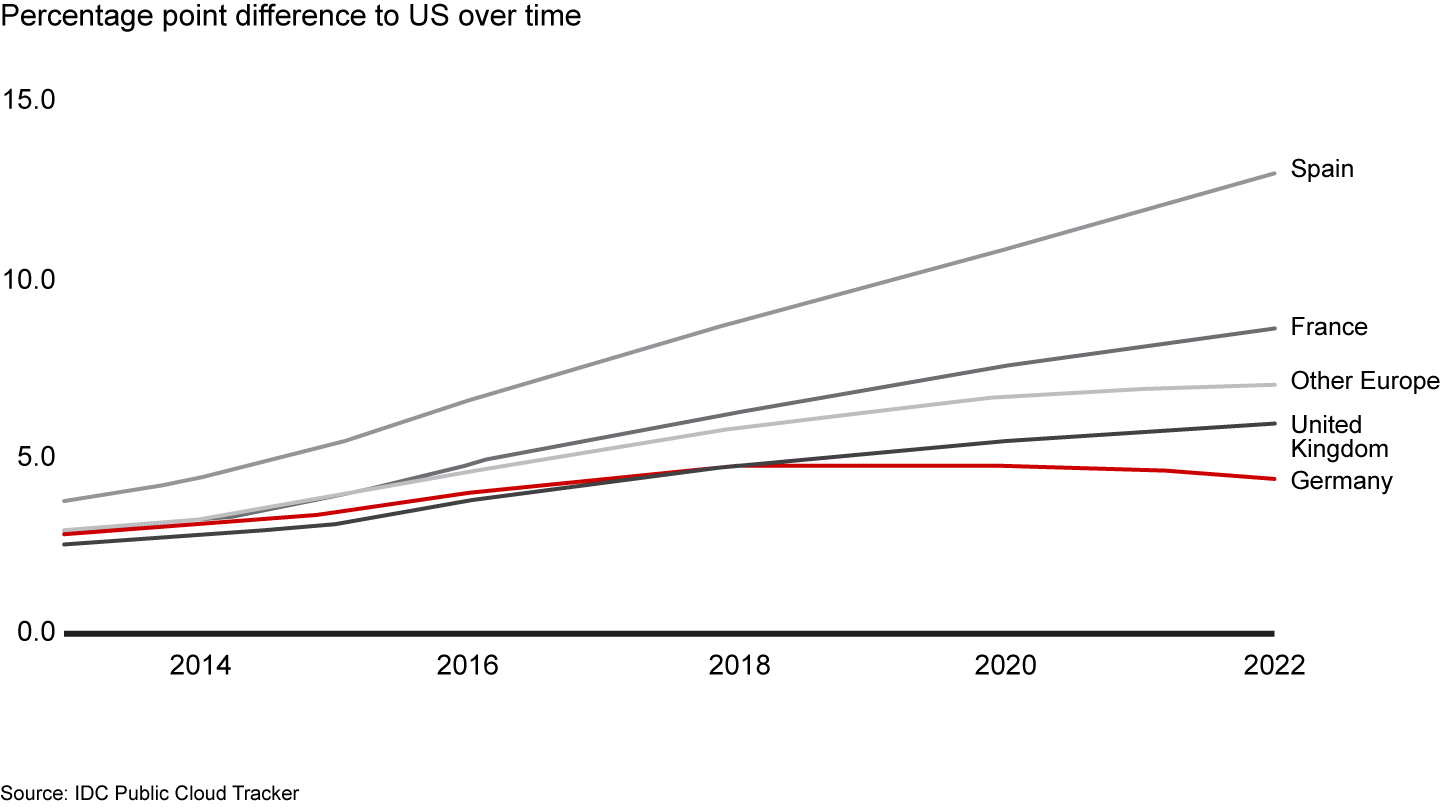
      European markets trail the US in cloud adoption, but Germany appears poised to begin closing the gap over the next few years
      European markets trail the US in cloud adoption, but Germany appears poised to begin closing the gap over the next few years
      European markets trail the US in cloud adoption, but Germany appears poised to begin closing the gap over the next few years

      First, European countries vary in how far behind the US they are in deploying workloads to the cloud. Companies in Germany and the UK are not far behind, only a couple of years behind in their percentage of total IT spending going to public cloud vendors. France and other countries lag further behind, and Spain isn’t expected to reach the 5% mark until about six years after the US did (see Figure 1).

      Second, much of the commentary about why Europe’s companies are spending proportionally less on the cloud focuses only on the demand side. Conventional wisdom holds that Europeans are more concerned about privacy and security (or the dominance of US providers) and that this slows the region’s deployment to the cloud. But supply is also a big factor in cloud growth. Growth for cloud vendors tends to rise after they build big data centers within countries, suggesting that company sentiment about deploying to the cloud may not be so different from that in the US after all.

      Significant opportunities remain for major cloud service providers and other technology vendors. Western Europe’s public cloud market could reach $43 billion in 2019, and it is expected to grow at about 21% a year, driven by continued increases in IT spending and a trend toward outsourcing (see Figure 2).

      Figure 2
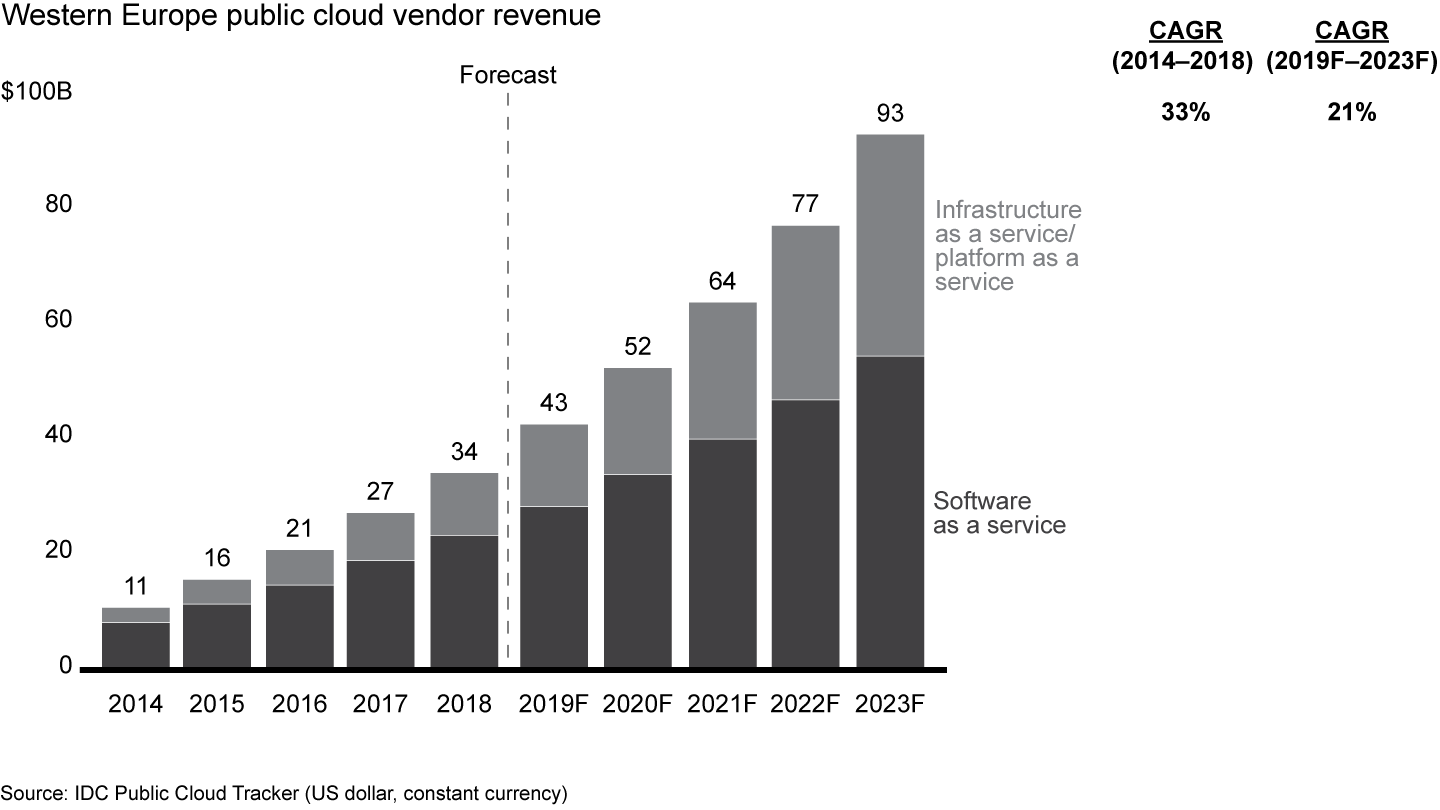
      Public cloud revenue in Europe could reach $43 billion in 2019, and it is expected to grow at 21% annually
      Public cloud revenue in Europe could reach $43 billion in 2019, and it is expected to grow at 21% annually
      Public cloud revenue in Europe could reach $43 billion in 2019, and it is expected to grow at 21% annually

      In addition to the supply constraint, three demand-related issues also appear to be slowing adoption rates in Europe.

      • Industry mix: One is that Europe’s economy is more heavily concentrated in industries that have lower rates of cloud adoption. For example, Germany’s economy is heavily weighted toward industrial and manufacturing businesses, and Spain's market comprises many small and medium-sized businesses that are less likely to demand public cloud technologies. By contrast, the US is heavily weighted toward technology and professional services—industries that have been quicker to embrace cloud.
      • Security and privacy concerns: Regional differences regarding data security and privacy still play a role. Strict regulations, such as the General Data Protection Regulation (GDPR) in Europe and sector-specific regulations in the US, inspire confidence in the cloud. But many European firms are still reluctant to adopt cloud technology because of concerns about data security, particularly when data centers might be located beyond national borders. As confidence in cloud security grows, however, these attitudes may shift, particularly in Germany.
      • Homegrown: Companies in the US may be more comfortable with the cloud because the biggest cloud service providers—namely, Amazon Web Services (AWS), Microsoft Azure and Google Cloud—and most of their data centers are based there. Recently, Germany, France and the UK have all seen increased investments in data centers after the arrival of hyperscale players, though the uncertainty around Brexit could dampen cloud growth for UK companies.
      Figure 3
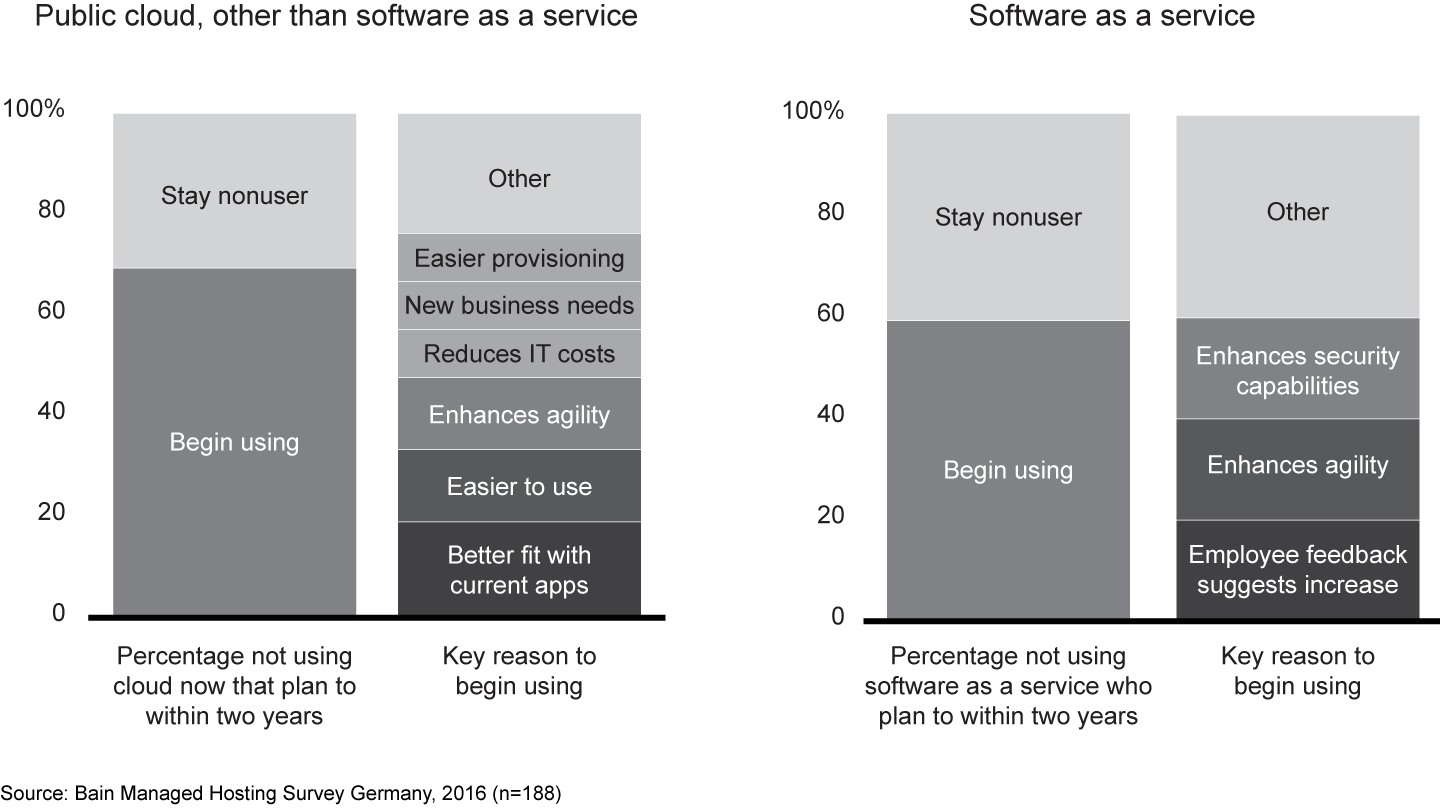
      In Germany, most of the companies we surveyed that were not already using public cloud or software as a service said they intended to begin doing so within two years
      In Germany, most of the companies we surveyed that were not already using public cloud or software as a service said they intended to begin doing so within two years
      In Germany, most of the companies we surveyed that were not already using public cloud or software as a service said they intended to begin doing so within two years

      As noted above, adoption rates differ from one country to the next, with some leaders eagerly adopting cloud economics while others make more tentative moves.

      • Germany is the second-largest data center hub in Europe, and it was the first European country to see the biggest cloud service providers set up shop. AWS opened a data center in Frankfurt in 2014, followed by IBM in 2015, Microsoft Azure in 2016 and Google in 2017. In addition to the EU's GDPR data privacy measures, Germany has instituted its own national measures to bolster data security certification and testing, including the adoption of Cloud Computing Compliance Controls Catalog (C5) certification, which sets a minimum baseline of data transparency and security for the public sector adopting public cloud. Our research found that among German companies not already using software as a service or public cloud applications, most planned to begin deploying the tech within two years (see Figure 3).
      • The UK is the largest data center hub in Europe, and public sentiment toward cloud remains positive, with more than 90% of British companies using cloud technology in some capacity. Small and public sector organizations have bolstered adoption rates. AWS and Microsoft Azure opened their first UK data centers in 2016, followed by IBM in 2017. The UK will almost certainly adopt measures similar to GDPR upon its departure from the EU, but even so, the possibilities of future deviation and lack of cohesiveness with other European systems raise questions about future adoption rates.
      • France trails the UK in terms of percentage of GDP spent on digital and cloud technologies, but it is in line with the percentage that Germany spends. France is Europe's third-largest data center hub. IBM opened its first SoftLayer site in Paris in 2015, AWS followed in 2017, and Microsoft Azure opened four data centers in France in 2018. France’s public sector faces greater hurdles than its European peers, with an IT infrastructure that is less centralized and a limited budget for cloud migration initiatives. Recently, the French government reduced taxes on data centers to encourage cloud investment, and a 2018 Paris convention on cloud delivered a detailed plan to move the IT systems of all French administration to the cloud.
      • Spain lags behind Germany, France and the UK in terms of percentage of GDP spent on digital and cloud technologies. The large cloud service providers have been slow to set up shop: IBM opened a data center in Barcelona in 2015, but AWS, Microsoft Azure and Google have yet to establish data centers in Spain. Spain's attitude toward cloud adoption is more reserved because its enterprise market is much smaller than the enterprise markets of other leading European players. Spain's smaller enterprises are less likely to adopt cloud technology because of migration complexities, greater specialized support demands and less need of the benefits of scale. Spanish cloud providers may decide to expand by consolidating a relatively fragmented industry and providing a specialized service in which the hyperscale players fall short.

      Europe is a top priority for large technology vendors, but it’s important not to treat it as a single market. Important national differences remain, and vendors will need to understand the differences among these competitive environments in order to make smart strategic decisions.

      Mark Brinda and Kate Woolley are partners with Bain & Company’s Global Technology practice. Both are based in New York. 

      Read More in This Series

      Mastering the Cloud Economy

      Technology providers selling cloud software, services and hardware can strengthen their value proposition by developing a better understanding of cloud economics, customer preferences, and the impact of the cloud’s ascendance in legacy and disruptive technologies.

      Auteurs
      • Headshot of Mark Brinda
        Mark Brinda
        Partner, New York
      • Kate Woolley
        Alumni, New York
      Contactez-nous
      Synergies sectorielles
      • Cloud Computing
      • Technologie
      Mastering the Cloud Economy
      CIOs Expect to Rely More on Containers and Serverless Architectures

      Virtual machine vendors will set their strategy to take advantage of the rise of these technologies.

      Voir plus
      Technologie
      Will AI Disrupt Tech’s Most Valuable Companies?

      Hyperscalers and other market leaders have adapted well to technology shifts, but generative AI poses new challenges.

      Voir plus
      Mastering the Cloud Economy
      Hyperconverged Infrastructure and Hybrid Cloud Are Devouring Market Share

      As spending shifts rapidly away from legacy, on-premise computing, new alternatives create opportunities for technology incumbents and the distribution channel.

      Voir plus
      Technologie
      What DeepSeek Means for Data Center Investment Risk

      Lighter models won’t slow data center growth, but they do add uncertainty. Investors must assess demand shifts and readiness for AI’s power and cooling needs.

      Voir plus
      Mastering the Cloud Economy
      Is the Container Market Rolling Up to the Big Cloud Service Providers?

      Purchasing decisions about containers as a service tend to correlate with other infrastructure decisions despite most tech chiefs’ preference for a multivendor environment.

      Voir plus
      First published in juillet 2019
      Mots clés
      • Cloud Computing
      • Mastering the Cloud Economy
      • Technologie

      Comment nous avons aidé nos clients

      Can Microchips Turbocharge Sustainability Improvement?

      Lire l’étude de cas

      Helping a Midsize ERP Player Compete against the Giants

      Lire l’étude de cas

      Increased sales productivity frees selling time and saves millions

      Lire l’étude de cas

      Vous souhaitez continuer cette conversation ?

      Nous aidons des dirigeants du monde entier à matérialiser des impacts et des résultats pérennes et créateurs de valeur dans leurs organisations.

      Les points de vue de Bain : notre perspective sur des problématiques auxquelles sont confrontées les entreprises à travers le monde, envoyés chaque mois dans votre boîte de réception. 

      *J’ai lu la politique de confidentialité et j’accepte les conditions.

      Merci de lire notre politique de confidentialité.
      Bain & Company
      Contactez-nous Sustainability Accessibility Conditions d’utilisation Politique de Confidentialité Cookie Policy Mentions Légales Sitemap Log In

      © 1996-2026 Bain & Company, Inc.

      Contacter Bain

      Comment pouvons-nous vous aider ?

      • Business inquiry
      • Career information
      • Press relations
      • Partnership request
      • Speaker request
      Voir tous les bureaux