

Etude

En Bref
- As inflation rages, companies that weather the storm best will improve productivity through cost-cutting, even as they adjust prices and find new sources of growth.
- Companies that cut costs to improve productivity the most during previous inflationary periods achieved higher total shareholder returns compared with firms that took less action, based on our analysis of 5,700 global companies.
- With mounting inflation disruption, the best performers will follow six important steps that use cost-cutting efforts to advance their strategic agenda.
A critical gauge of the pressure facing companies is the producer price index (PPI), which measures the prices of goods immediately postproduction. In each of the months in 2021, the PPI in the G7 countries rose at an average rate of 9.3%. Then, in January of this year it reached 13.5%, and 14.1% in February (see Figure 1). This is a stark contrast to the average of –1.5% throughout 2020, and it shows just how perilously inflation was gaining speed before the rising commodity prices caused by the war in Ukraine and with the pandemic tailwinds—all this while the global economy is already grappling with supply chain disruptions, labor shortages, and high wages.
Figure 1
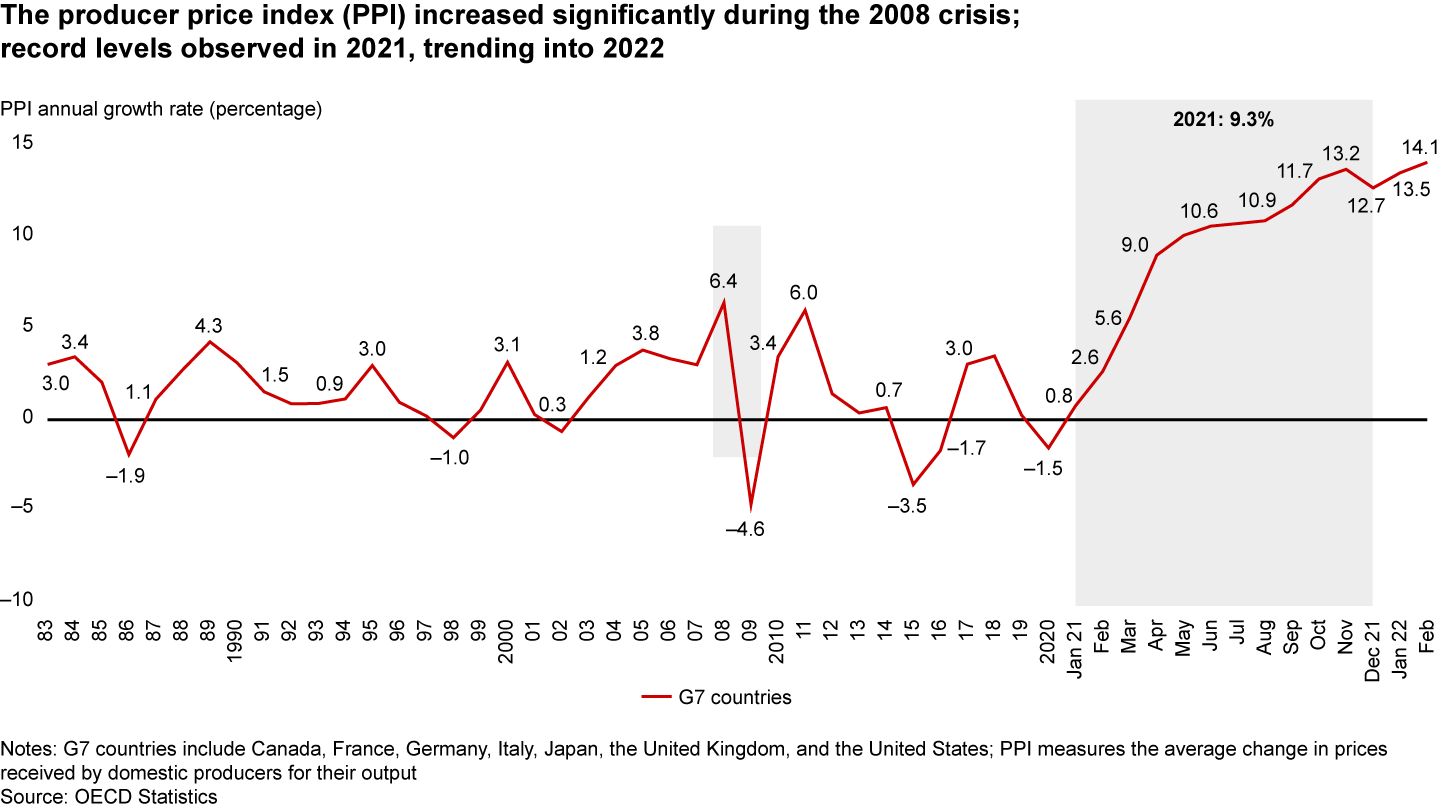

The last time the world saw a significant bump in PPI was in the first half of 2008, the early months of the Great Recession. Companies that weathered that storm the best took decisive steps to counter rising inflation by pushing through price increases consistent with PPI—but that alone was not enough. The best performers also took significant steps to boost productivity, primarily by cutting costs. Our analysis of the performance of 5,700 global companies found that those that cut costs to improve productivity the most during previous inflationary periods achieved higher total shareholder returns (TSR)—27% was the median—than companies that took less action. (We determined productivity by measuring EBITDA and revenue growth.) The evidence is clear: Even as many companies deal with inflation by devoting more energy to adjusting prices or finding new sources of growth, cutting costs remains an important part of managing this economic environment.
But what are the steps that typically make a difference?
BorgWarner, a US-based automotive supplier, faced major challenges in the 2008–11 inflationary period and deployed a number of tactics to outperform the market. The company reduced work and the labor required to perform it, including shifting production capacity in line with customer demand. It centralized information systems to support more efficient back-office processes, created a global procurement organization to spend and buy better, and focused capital spending on the most important strategic issues. These actions helped the company attain 43% compounded annual TSR growth.
We found that companies achieving such gains from cost programs during inflation focused on similar tactics. However, this current inflationary period is unique: Labor markets are historically competitive, consumer demand has not dipped the way it did in 2008, and supply chains are more constrained. As they prepare for higher inflation in this new environment, companies will need to make moves that not only cut costs but also build more scalable growth platforms, positioning them to strategically reinvest in programs that deliver greater resilience and stronger purchasing and pricing capabilities. They need cost programs that allow them to grow top-line revenue and reduce their dependence on difficult labor markets while improving employee retention. Successful companies deploy six tactics to achieve these goals. We’ll look at them one by one.
Get spending visibility
High-resolution spending visibility is the foundation of any expense management capability. It enables managers to fully understand where money is spent and who spends it. In an inflationary period, it is critical to establish repeatable, end-to-end, actionable visibility of spending by cost category, business process, function, and business unit. This is the foundation for all other productivity efforts. It enables the right level of accountability throughout the organization to ensure that all decisions are made knowing the full impact on P&L.
Differentiate between strategic and nonstrategic spending
In any disruptive environment, odds are higher that executives will make choices that jeopardize the company’s long-term strategy. It’s not uncommon to make broad-based cuts that are not aligned with the company’s strategy—and as a result, will not yield optimal return on investment nor maximize shareholder value in the long run. Instead, clearly distinguish between strategic and nonstrategic cost-cutting, the protecting of signature customer and employee experiences, and fiduciary requirements, for example. Use consistent, accessible financials to prioritize higher return on investment (ROI) decisions. A sustainable cost management system should fuel a company’s strategy and enable the business to out-invest competitors, at scale, on strategic costs in both good and bad times.
Managers must identify where investments should be pulled back and cost savings realized; where you can more selectively trim costs to improve the return on operating expenses; and where you can boost growth through greater investment in the strategic capabilities needed to achieve differential results. This investment posture sets the stage for reshaping the P&L, cost structure, operating model, and capabilities that will enable the chosen strategy. It helps leaders agree on such basic decisions as which capabilities need to be best in class—built to enable and sustain competitive advantage—vs. best in cost. It positions a company to make better decisions about deploying increasingly scarce resources to reinvigorate its strategy and maximize shareholder value in times of economic disruption. That includes investments in people, for example. For companies like Walmart and Target, for instance, the decision to invest to allow employees to pursue debt-free education is a strategic investment to differentiate the retailer in the competition for labor.
Unpack the drivers of spending
With improved visibility and a clear sense of how costs align with strategy, the next step is to develop a more robust understanding of the real enablers of cost in an inflationary environment. Dissect the rate (prices paid) and consumption (quantity or volume), including the underlying drivers, for critical cost categories. This step allows companies to create granular, trackable initiatives linked to a unique driver of a broader cost category. It sets the stage for a host of possible moves. Among the biggest: establishing a preferred vendor program to increase buying power, reevaluating the right make vs. buy mix for core functions like software development, and deploying AI-powered sourcing tools to generate automated insights from spending data, flagging savings and compliance opportunities in real time.
These steps can deliver real, near-term savings. One energy company conducted a full review of its applications and identified more than 80 that could be eliminated in the short term and save the company an annual $10 million. Getting this sophisticated view of what’s really behind spending is particularly critical in rising inflation because it enables companies to advance to the next three tactics.
Reduce consumption
With increased spending visibility and the ability to isolate drivers, companies can tailor their approach to match the inflationary environment. For example, even if companies aren’t able to buy better because of supply chain and producer pricing pressures, they can make sure that they spend better. One way to do this is to set up a “spending czar” or “spending control tower.” When a global healthcare company realized that too many acquisitions left the company with cost inefficiency, it empowered a spending czar to break down silos and make decisions across the organization. It was the first big step in finding more than $300 million in annual cost savings.
A focus on spending better can also lead to cross-functional change. One large technology company determined that many of the cost issues it faced while constructing new facilities were created from groups outside of the decision makers on new-build projects. Increasing cross-functional collaboration ultimately allowed the company to cut construction time by six months, saving more than $400 million in the process. Setting up cross-function spending controls helps companies zero in on the costs that can no longer be justified or can be avoided by doing the work differently, allowing the company to continually prioritize spending and make sure that any savings identified don’t creep back in as time goes on.
Eliminate work
With labor shortages and ballooning labor costs, eliminating the work itself has the greatest impact. Companies that do this well use a clean-sheet mindset, or zero-based redesign, which can help reset the way work is done. This approach forces companies to scrutinize both what activities are performed and how those activities are performed, with specific tactics to eliminate unnecessary work and automate.
As inflation lingers, companies across industries are reexamining their work and determining what adds the most value and is absolutely necessary, providing both cost savings and the opportunity to deploy dollars and scarce labor resources to what will help them grow. Eliminating work can take many forms. Snack maker Mondelez International is well on its way to streamlining manufacturing by eliminating one in every four products in its portfolio, a goal it set in the first months of the Covid-19 pandemic. Hotels everywhere are limiting housekeeping by making it an opt-in vs. opt-out service.
Automate
After eliminating work, the final tactic is to automate. Technologies like robotic process automation (RPA), workflow, and intelligent document processing can free up workers and make each person much more effective at creating value. At retailers, for example, important associates often spend too many hours, days, and weeks manually inputting item and product data (e.g., case size, pack size, dimensions, website images) when they could be working on more strategic activities, such as analyzing data and generating insights.
In addition to labor cost savings, automation can promote stability in an organization. Our research found that companies that had invested more in automation before the pandemic have weathered the crisis better than others. Meanwhile, in our experience they’ve generated higher revenues and see fewer disruptions to the supply chain, workforce productivity, and demand. Companies can use the productivity gains and cost savings they accrue from deploying the previous five tools to invest in automation.
Despite the importance of automation, digital transformations often don’t deliver the desired results. A Bain survey found that 76% of digital transformations settled for dilution of value and mediocre performance. Orchestration is the most important transformation element in digital leadership—without the right approach a digital transformation can’t move at the speed or scale needed to deliver the results companies need to see. Companies that are successful don’t just invest in identifying the opportunities and potential solutions; they make sure they have the right plan in place to roll out automation. This will be a critical factor for everyone looking to leverage automation to combat inflationary pressures.
Companies as diverse as Cigna and David’s Bridal have been publicly reporting the benefits of automating at scale. The value Cigna realized from automating processes leaped from $2 million to more than $100 million within a year, and the company expects that ultimately to reach $1 billion. When David’s Bridal debuted its Zoey messaging concierge service in early 2020, it reduced contact center operating costs by over 30% and shifted 30% of appointment-booking phone traffic out of stores, allowing employees to focus on providing more value-added in-person services.
These and other companies are preemptively building cost management systems that allow them to strategically invest while gaining the resiliency to overcome high inflation. They have acknowledged that disruption is here to stay and will have long-lasting effects. By relying on these six strategies during this window of opportunity, such companies are taking the bold and rapid actions necessary to transform their businesses and deliver a future-proof value creation model. By playing both offense and defense in a disruptive environment, they position themselves to outpace less-proactive competitors long after the volatility ends.
This brief is based on an article that originally appeared in Harvard Business Review.
First published in avril 2022